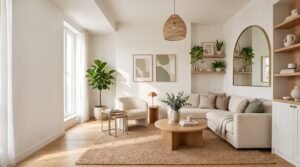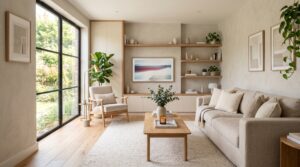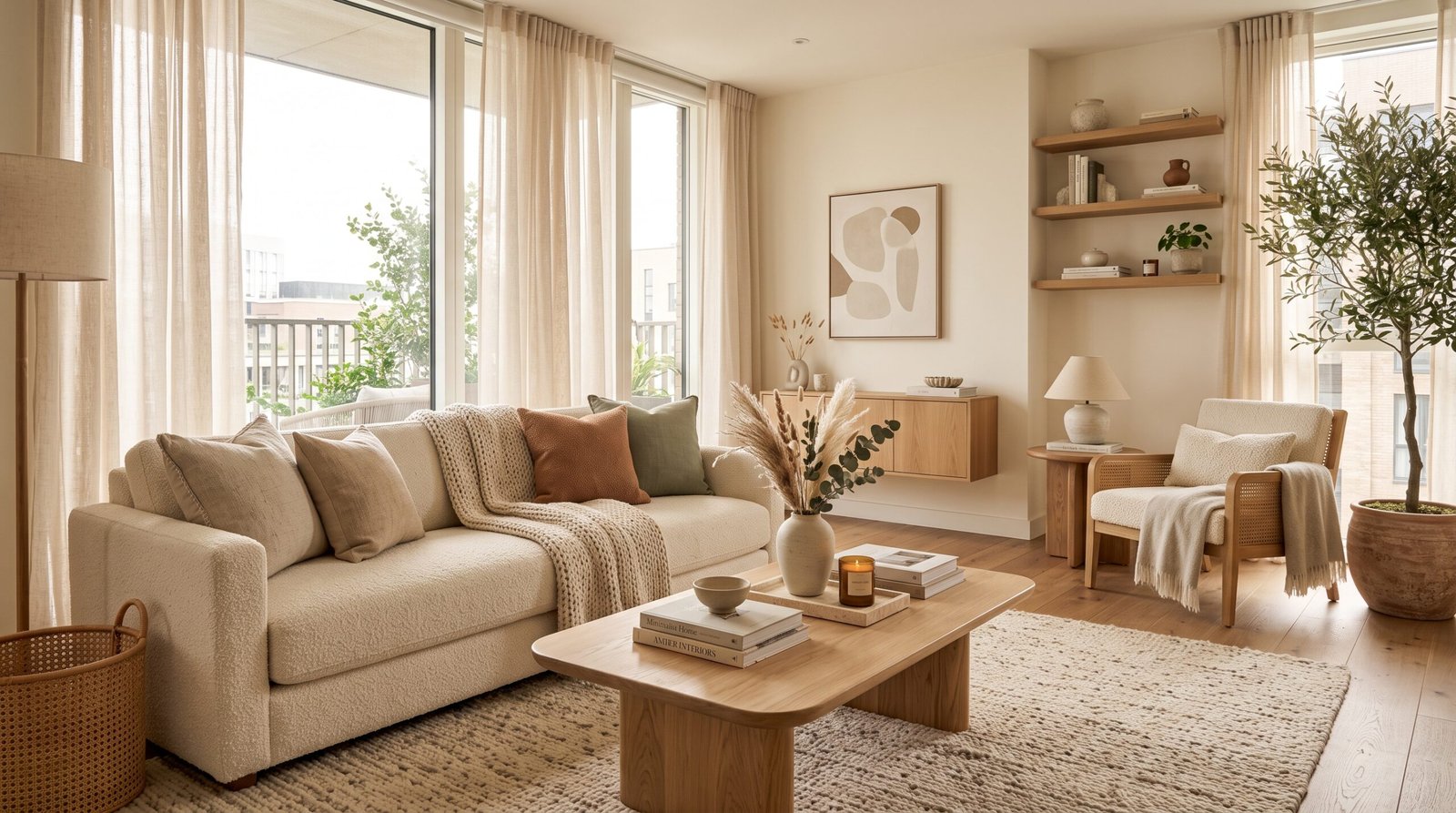
Good apartment living room decor is not about buying more furniture. It is about making the room you already have work harder: a clear layout, a sofa that fits the wall, light at more than one height, and a few textures that make the room feel finished. This guide gives you seven ideas for a rented or owned apartment, with the measurements, materials and steps each one needs, and the mistakes that make small rooms feel smaller.
Start by measuring the room before you buy anything: the length of the longest wall, the width of the seating wall, and the walkways you need to keep clear. In a living room, a walkway of about 75 to 90 cm lets two people pass without turning sideways, and a rug that is too small makes the whole room look smaller than it is. Write the numbers down and carry them with you when you shop, so you choose pieces that fit the room rather than pieces you hope will fit.
In this guide
- Why apartment living room decor feels unfinished
- 1. Give the awkward corner a job
- 2. Choose the sofa first, then everything else
- 3. Layer textures in threes
- 4. Hang a gallery wall that fits the wall
- 5. Layer the light at three heights
- 6. Choose furniture that does two jobs
- 7. Make it renter-friendly
- Mistakes to avoid
- Frequently asked questions
Why apartment living room decor feels unfinished
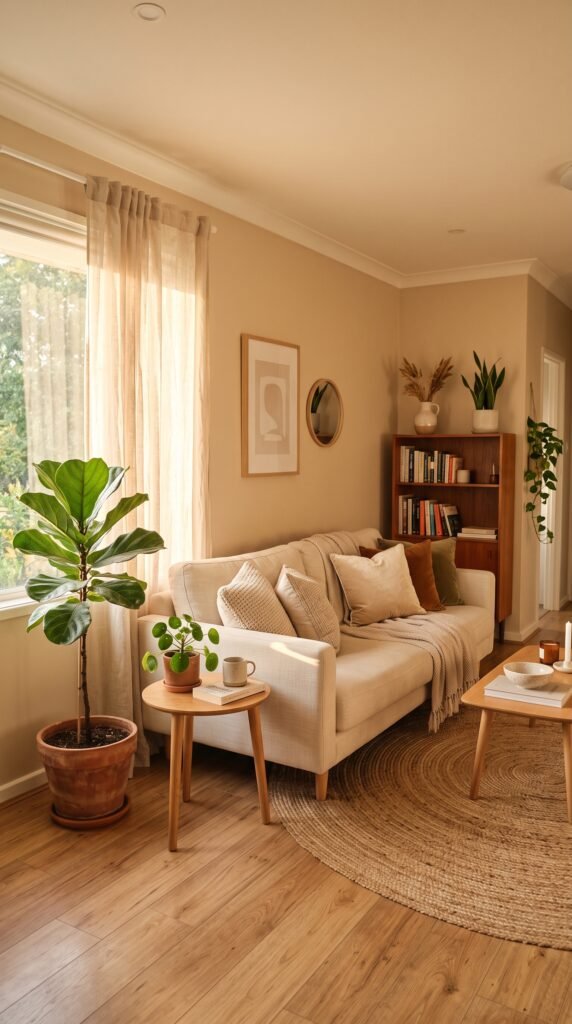
Apartment living room decor usually feels unfinished for three reasons: too little natural light reaching the seating area, furniture that does not relate to anything else in the room, and walls left bare because the flat is rented. None of those needs a renovation. They need a plan: one clear focal point, one consistent palette, and one change in height. If the room still looks flat after those three things, the problem is often proportion rather than the pieces themselves, as explained in this guide to why your room feels off.
The most common mistake is trying to add more: more furniture, more decor, more colour. A thoughtfully edited room almost always looks better than a crowded one. When every piece earns its place, the room breathes, and the pieces you keep look intentional rather than accidental. Before you buy, decide on a base palette of two neutrals and one accent colour, and use that palette for every new purchase for a month. Small living rooms reward that discipline: small living room ideas from Architectural Digest show the same pattern again and again, with scale, light and layering doing most of the work.
1. Give the awkward corner a job
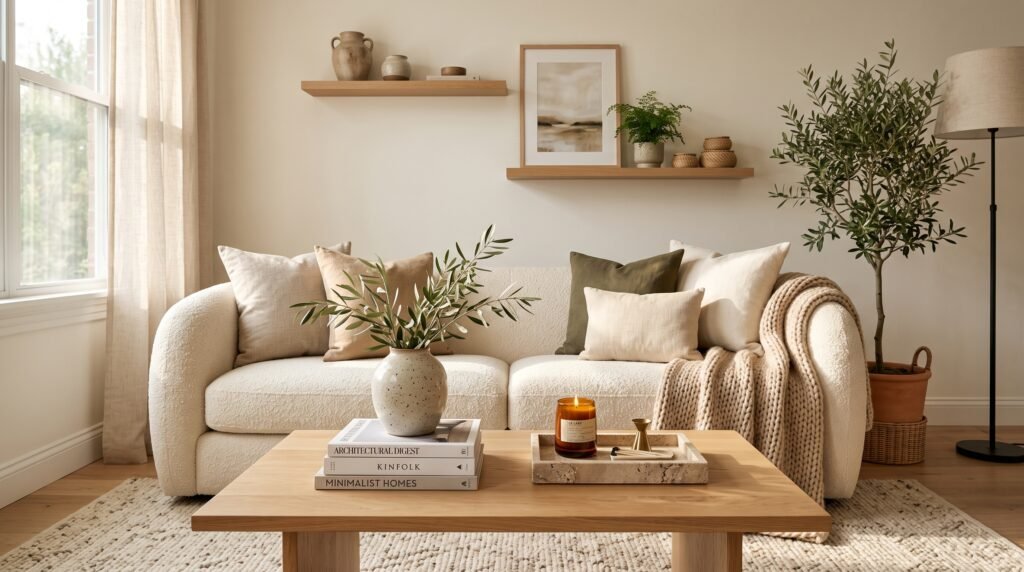
Almost every apartment living room has a corner that collects nothing: too small for the sofa, too dark for a plant, too awkward for a shelf. Apartment living room decor works best when that corner gets one clear job, rather than being left empty or filled with whatever has no other home. Three jobs suit most corners: a reading chair, a small desk, or a plant display.
For a reading corner, choose an armchair 70 to 80 cm wide, a small side table 40 to 45 cm across, and a floor lamp that rises above the chair back. Leave at least 60 cm between the chair and the sofa so the corner reads as its own zone. For a plant corner, group three plants at three heights, a tall plant on the floor, a medium plant on a stand, and a small plant on a stool, and keep them in pots of the same material so the group looks deliberate. For a small desk corner, a wall-mounted desk or a narrow console 90 to 110 cm wide fits most apartments and gives you a work surface without a full desk.
Whichever job you choose, add a rug or a mat under it, even a small one, to mark the zone. A corner without a floor covering looks like leftover space; the same corner with a defined edge looks like a room within the room. Keep the corner to three or four items at most, and resist the urge to store things there: the moment a corner holds a box you have not unpacked, it stops being a corner and becomes a cupboard.
2. Choose the sofa first, then everything else
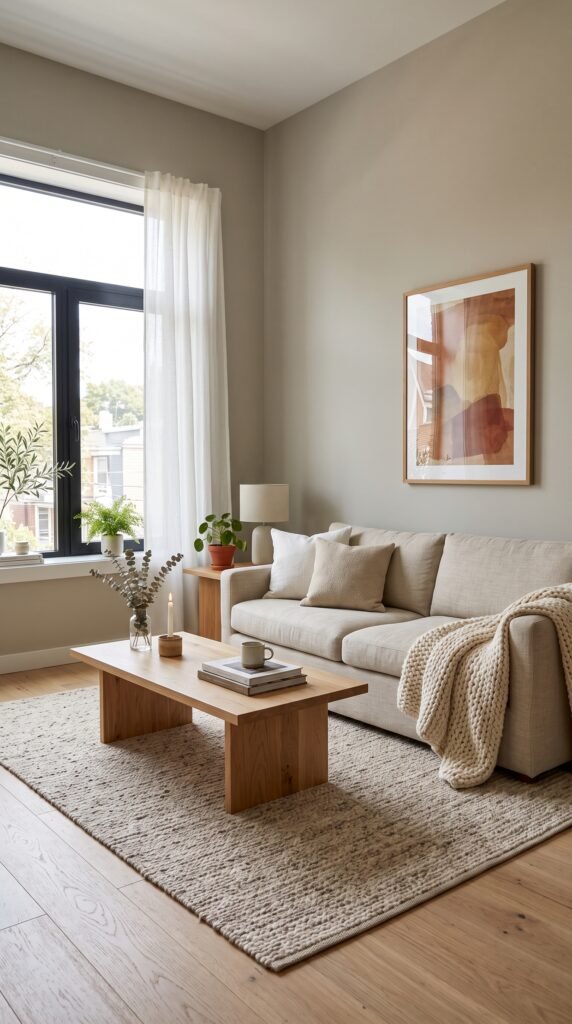
The sofa is the largest piece in the room, so it should be chosen first and everything else should fit around it. Apartment living room decor goes wrong most often when the sofa is too big for the wall: it blocks a walkway, it crowds the coffee table, or it leaves no wall for anything else. Measure the seating wall, subtract 30 cm on each side for breathing room, and that is the maximum sofa length for your room. In many apartments that means a two-seater of 160 to 180 cm, rather than a three-seater.
Choose a sofa with a seat height of about 45 to 48 cm, which suits most adults for sitting and standing, and with visible legs if the room is small: legs you can see under create a sense of floor space, while a sofa that sits flat on the floor looks heavier and makes the room feel smaller. A solid neutral fabric, such as a warm grey, oatmeal or soft sage, is easier to style over time than a bold pattern, because you can change the cushions and throw with the seasons without replacing the sofa.
Then choose the rug to fit the sofa, not the other way round. The rug should be at least as wide as the sofa and long enough for the front legs of the sofa and the chairs to sit on it. For a two-seater, a rug of about 160 by 230 cm is a good starting point; for a three-seater, look at 200 by 290 cm. If you are unsure, lay painter’s tape on the floor in the rug’s size and live with the outline for a day. For the details, read this guide on how to choose the perfect living room rug before you buy.
3. Layer textures in threes

Texture is what makes a room feel warm instead of flat, and it is the cheapest way to make a small living room feel finished. Apartment living room decor works with three textures at a time: something soft, something woven and something smooth. A velvet cushion, a woven throw and a smooth ceramic vase, for example, give the eye three different surfaces to notice, while three cushions in the same fabric give it only one.
Apply the rule of three to the sofa. Choose two cushions and one throw, or three cushions in two textures and one colour. Mix a soft velvet or bouclé cushion with a linen cushion and a knitted throw, and keep all three inside your base palette so the mix looks calm rather than busy. The same rule works on the floor: a flat-weave rug, a woven basket and a soft ottoman give the room texture at every height.
Plants add a fourth texture, the living one, and they suit rooms that otherwise feel too hard: glass, metal and painted walls. Choose plants you can keep alive in the light you actually have — a snake plant or a pothos near a window, a dried arrangement where there is almost no light — and put them in pots that match the room, not in a mix of free plant pots. If a cushion or throw starts to look thin or faded, replace that one item rather than buying a whole new set: texture is a layer you refresh, not a set you buy once.
4. Hang a gallery wall that fits the wall
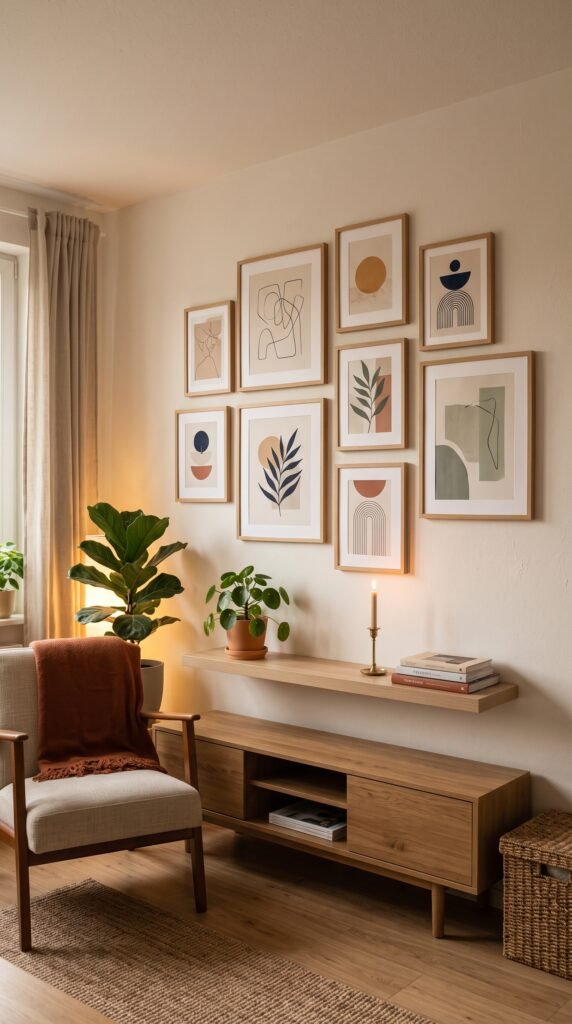
A gallery wall only works when it is sized to the wall behind the sofa. Apartment living room decor often fails here because the frames are too small for the space: six small frames spread across a two-metre sofa look like a postage stamp on a wall. As a starting point, the gallery should be about two-thirds the width of the sofa below it, and the centre of the arrangement should sit about 145 to 150 cm from the floor, which is roughly eye level for most people standing in the room.
Plan it on the floor before you hang anything. Lay the frames on the floor in the arrangement you want, with gaps of 5 to 8 cm between them, and take a photo. Hang the largest frame first, then build out from it, keeping the same gap everywhere. Use frames in one finish, all black, all oak or all white, so the pictures, not the frames, do the talking. Mix art prints with one or two personal photos if you like, but keep the palette inside your base colours: a gallery with five different bright colours will fight with the sofa instead of sitting above it.
In a rented flat, use removable adhesive hanging strips rated for the weight of each frame, and follow the maker’s instructions for the wall surface. Check the weight rating on the packet before you hang a heavy frame, and remove the strips the way the maker says to, by pulling the tab down slowly, so you do not damage the paint when you move out. If you would rather not hang anything, lean two large frames on a sideboard or on the floor against the wall: a leaned gallery gives the same effect without a single hole.
5. Layer the light at three heights
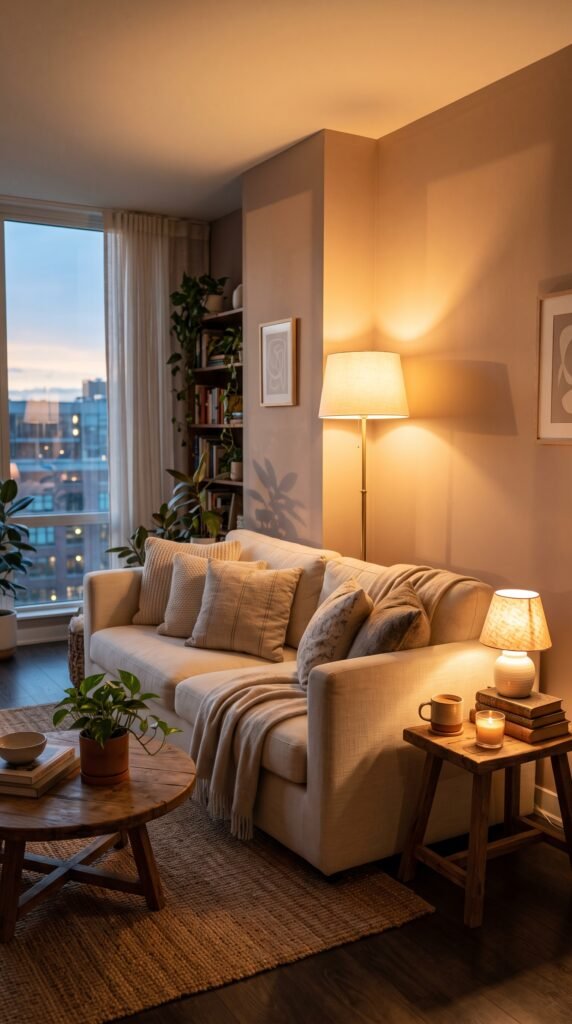
A single ceiling light makes a room look flat, because it lights everything from above and nothing from the side. Apartment living room decor needs light at three heights: a low light near the sofa, a medium light at eye level, and a high light from the ceiling. Together they let you change the mood of the room without changing the furniture.
Start with the low light: a floor lamp behind or beside the sofa, or a small table lamp on a side table, with a warm-white bulb of around 2700K. Add the medium light next: a lamp on a shelf or a sideboard, or a picture light above the gallery wall. Keep the ceiling light as the third layer, and use it only when you need full brightness, for cleaning or for reading fine print. If the ceiling light is too harsh, a dimmer switch is a small job for an electrician in a flat you own; in a rental, a lampshade that diffuses the light, or simply using the lamps instead, does most of the same job.
Place a mirror opposite or beside a window if the room is dark: it bounces daylight further into the room and makes the room feel wider. Choose a mirror that is large enough to matter, at least 60 cm across on a small wall, and hang it where it reflects something pleasant, a plant or the window, rather than a blank wall or the television. If the room has little natural light, keep the mirror and the lamps in the same warm tone, so the light in the room feels consistent rather than mixed.
6. Choose furniture that does two jobs
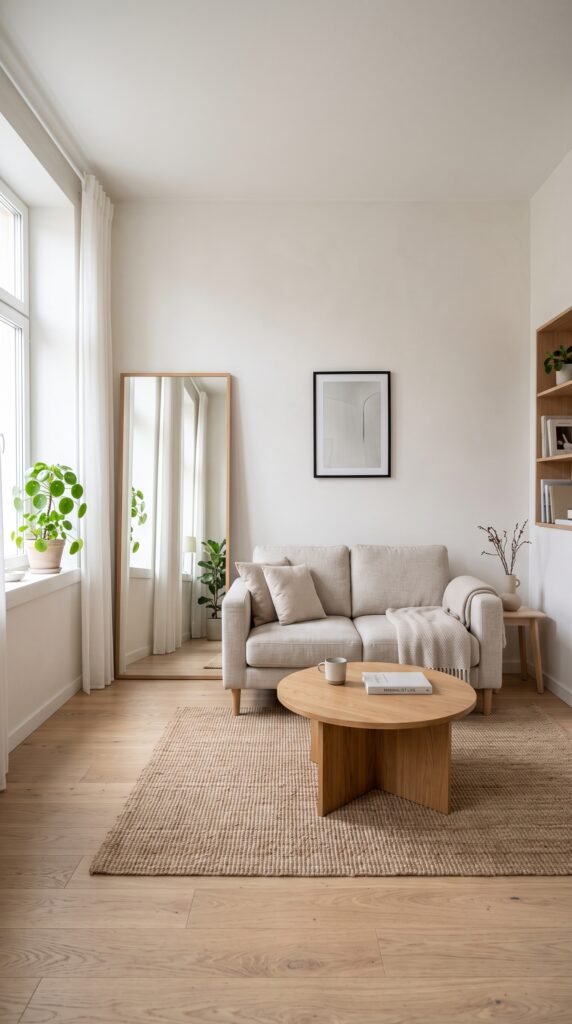
In a small apartment, every large piece should earn its floor space twice. Apartment living room decor in a small room works when the furniture multitasks: a storage ottoman that holds throws and doubles as a footrest, a coffee table with a lower shelf for books, or a side table that folds away when you need the floor. Before you buy a single-purpose piece, ask what else it could do.
Start with the coffee table. A table 90 to 110 cm long and 45 to 55 cm wide suits most two-seater sofas, with about 40 to 45 cm between the table and the sofa so you can sit down without shuffling sideways. A lift-top table turns the same surface into a laptop desk, and a table with a shelf underneath keeps the top clear. Next, look at seating: a storage ottoman in the room’s palette stores blankets out of sight, and a pair of small stools can be pulled out when guests visit and tucked away afterwards, instead of a second armchair that is used twice a year.
Keep the room’s footprint in mind: one large piece that does two jobs is better than two small pieces that each do one. A room with a sofa, a lift-top coffee table and a storage ottoman has three surfaces and storage, with floor space left over; the same room with a sofa, a coffee table, a side table, a desk and a storage box has five pieces fighting for the same floor. Measure the total footprint of everything you plan to put in the room, and if it covers more than about half the floor, remove something.
7. Make it renter-friendly
Most apartment living room decor has to survive a landlord’s inspection, so the best ideas in this guide are the ones that leave no trace. Apartment living room decor for renters starts with the surfaces you cannot change: the walls, the floor and the light fittings. Work with them, not against them, and put the personality in things you can take with you when you move.
Use removable adhesive hooks and strips for frames, mirrors and light items, and check the weight rating before you hang anything heavy. Use a large rug to cover a floor you do not like, and a floor lamp where you cannot change the ceiling light. Swap the cushions, the throw and the art prints when the seasons change, rather than repainting: a room with neutral furniture and seasonal textiles can look completely different twice a year, and everything fits in one box when you move. If you want more ideas in the same spirit, these small apartment aesthetic ideas are designed for tiny spaces that have to feel big.
Before you sign a lease or renew one, photograph the walls and the floor so you have a record of their condition, and keep the original fittings you remove, such as curtain rails or light shades, in a labelled box. When you leave, the room should look as it did when you arrived, with your decor in boxes, not on the walls.
Mistakes to avoid
Most apartment living room decor fails for the same few reasons, and all of them are easy to avoid once you know them. Check your room against this list before you buy anything new.
- Buying the sofa before measuring the wall. A sofa that is too long for the wall dominates the room and leaves no space for anything else.
- Choosing a rug that is too small. A rug should sit under the front legs of the seating, not float in the middle of the floor like a mat.
- Using only the ceiling light. One light from above flattens the room; add a floor lamp and a table lamp so the room has light at more than one height.
- Hanging art too high or too small. Centre the gallery about 145 to 150 cm from the floor, and size it to about two-thirds of the sofa width.
- Adding more instead of editing. If the room feels full, remove one item before you buy another one. A room that breathes looks larger than a room that is full.
Frequently asked questions about apartment living room decor
How do I decorate a small apartment living room?
Measure first, choose the sofa to fit the wall, and add one focal point, one rug and light at three heights. Apartment living room decor in a small room works best when every piece does two jobs, so a storage ottoman and a lift-top coffee table will help more than three extra decorative objects.
What size rug should I buy for an apartment living room?
For a two-seater sofa, a rug of about 160 by 230 cm is a good starting point; for a three-seater, look at 200 by 290 cm. The front legs of the sofa and the chairs should sit on the rug, and the rug should be at least as wide as the sofa.
How can I make a rented living room feel like home without painting?
Use a large rug, layered lighting, cushions and throws in your palette, and art hung with removable strips or leaned against the wall. Those four changes alter how the room feels without touching the walls, and they all move with you.
How high should I hang a gallery wall above a sofa?
Centre the arrangement about 145 to 150 cm from the floor, and leave about 15 to 20 cm between the bottom of the lowest frame and the top of the sofa. That keeps the gallery connected to the sofa instead of floating high on the wall.
What is the best lighting for a dark apartment living room?
Layer three lights: a floor lamp beside the sofa, a table lamp at eye level and the ceiling light for full brightness. Use warm-white bulbs of around 2700K throughout, and a mirror opposite or beside a window to bounce the daylight you do have further into the room.
You do not need to do all seven ideas at once. Start with the one that will change your room most, the sofa if it is the wrong size, the lighting if the room feels flat in the evening, or the corner if one part of the room is wasted, and build from there. Apartment living room decor is at its best when the room looks considered but still works for everyday life: somewhere to sit, somewhere to put a cup down, and light that suits the time of day.