
To fix height before decorating, start with the tallest thing in the room, not the prettiest one. Most flat-feeling rooms are not short of color, pattern, or furniture. They are short of height. Everything sits at roughly the same level – the sofa, the coffee table, the rug, the low bookcase – so the eye has nowhere to travel upward, and the room reads as finished even when it is not.
This guide gives you a simple order to follow: test the height first, fix the tallest gap, and only then buy the low pieces. You will get measurements to aim for, a 30-second test you can do with a tape measure, the cheapest tall fixes that actually work, and the cases where height is not the answer.
IN THIS GUIDE
- The Mistake: Buying Sideways Instead of Up
- Fix Height Before Decorating: The 30-Second Height Test
- The Fix That Actually Worked
- Why a Plant Solved It Better Than Furniture Would Have
- Doing the Actual Math
- Where to Put Height First
- Where This Rule Doesn’t Apply
- The Actual Rule, Restated
- Frequently Asked Questions

The Mistake: Buying Sideways Instead of Up
The easiest way to spend a decorating budget is on things that sit low: a new rug, a coffee table, a different arrangement of the seating. Each one can be a good buy on its own. Together, they rarely change how tall a room feels, because none of them changes the top third of the wall.
Stand at the doorway and look across the room. If every piece tops out below your shoulders, the room has a height gap, not a shopping gap. A rug cannot fill it. A gallery wall hung too low cannot fill it either. That is why a room can look fully furnished and still feel unfinished.
Small rooms show this problem first, because there is less wall to hide it on. If you are working with a small bedroom, read how to transform small bedroom decor without moving a single wall before you buy anything else – the same height-first thinking applies there, on a smaller scale.
Fix Height Before Decorating: The 30-Second Height Test
You do not need a design plan to test this. You need a tape measure and 30 seconds at the doorway.
- Measure the ceiling height. In most US homes this is 8 feet (96 inches) or 9 feet (108 inches). Write it down.
- Measure the tallest piece in the room. Include the plant pot, the top of the bookcase, or the top of the curtain rod – whichever is highest.
- Compare the two numbers. If the tallest piece is less than two-thirds of the ceiling height, the top third of the room is empty.
- Look at the corners. Find the corner that looks most empty when you walk in. That is where the tall fix belongs.
- Check the art. If the center of your largest picture hangs well below 57 inches from the floor, it is sitting in the low half of the wall, not the middle of it.
If the tallest piece in the room is less than two-thirds of the ceiling height, and the top third of the walls is empty, height is the first thing to fix. If you fix height before decorating the lower half of the room, every later purchase – the rug, the lamp, the art – has a frame to sit inside.
The Fix That Actually Worked
The fix is one tall element in the room’s emptiest corner. A tall plant is the easiest version: it needs no assembly, no wall anchors, and no matching set. Put it in the corner that feels most empty when you walk in, usually the corner farthest from the door or beside the largest window.
To fix height before decorating on a tight budget, choose a plant – real or faux – that is tall enough to matter. In an 8-foot room, that means 5 to 6 feet tall, including the pot. A 3-foot plant on the floor is still a low piece. A 6-foot plant reaches into the top third of the wall and gives the eye a place to land.
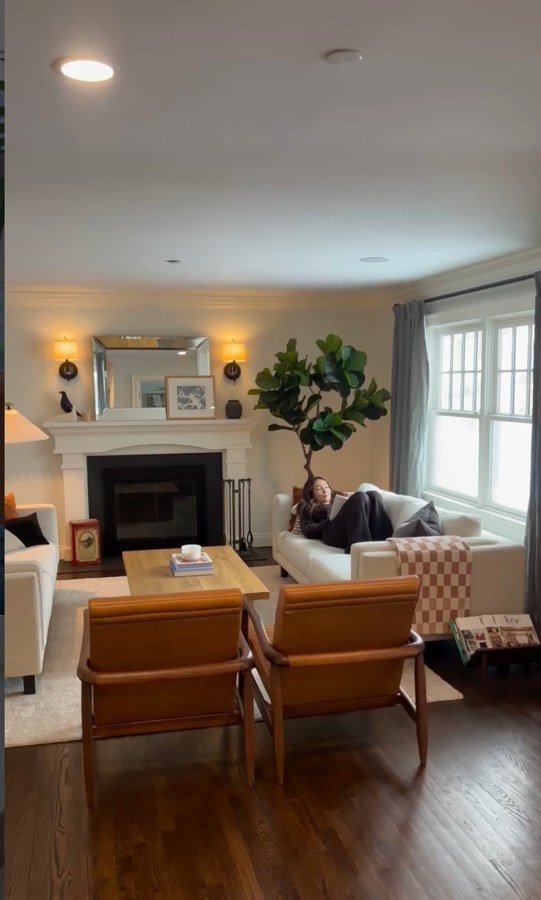
The same idea works in any corner – the eye needs a landing point at the far end of the room.
If a real plant will not survive your light or your schedule, a faux tree is a practical alternative. Check the trunk and the pot first: a straight, bare trunk and a light plastic pot are what make a faux plant look fake from across the room. A heavier pot, a few inches of soil or stones on top, and a plant placed near a window do more for realism than any brand name.
Why a Plant Solved It Better Than Furniture Would Have
A tall piece of furniture – a bookshelf, an armoire, a tall dresser – can do the same height job, but it usually costs more, weighs more, and needs more planning. It has to be delivered, assembled, and, for safety, anchored to the wall with the hardware it comes with, especially in a home with children. A tall plant does the height job without any of that.
Furniture also fills the floor. In a small room, a tall bookshelf takes up the same corner a plant would, but it also adds visual weight and needs to be filled. A plant adds height and leaves the floor feeling open. That is why, when the only problem is a flat, low room, a plant is usually the cheaper first step – not because furniture is bad, but because it solves a bigger problem than the one you have.
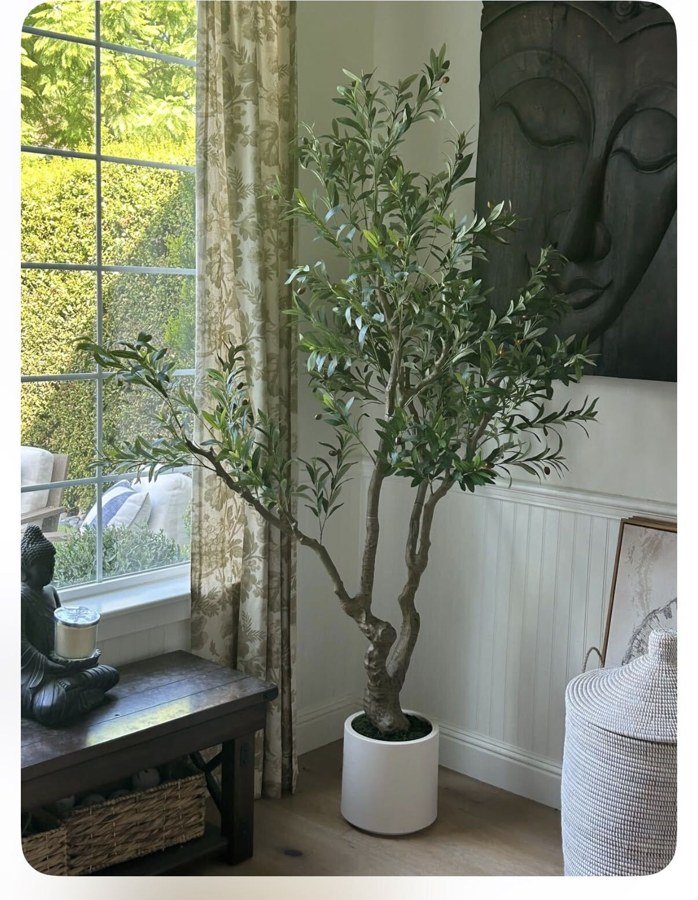
Look at the trunk and the pot before you buy a faux tree – those two details decide whether it looks real.
There is one clear exception. If you also need storage, buy the furniture. Height plus storage is a better use of money than height alone. If you only need height, start with the plant, live with it for a few weeks, and then decide whether you still want the furniture.
Doing the Actual Math
Since this whole site is about budgets, it is worth being clear about what the expensive mistake usually is. It is not buying one wrong rug. It is buying several low pieces in a row, each one a little better than the last, without ever fixing the height gap that made the room feel flat in the first place. The tall fix does not have to be expensive – it has to be tall enough.
When you fix height before decorating, use this table as your target. Aim for a tall piece that reaches about two-thirds to three-quarters of the way up the wall, and leave clear space above it so the room does not feel crowded.
| Ceiling height | Aim for a tall piece | Space left above it |
|---|---|---|
| 8 feet (96 inches) | 64 to 72 inches tall | 24 to 32 inches |
| 9 feet (108 inches) | 72 to 81 inches tall | 27 to 36 inches |
| 10 feet (120 inches) | 80 to 90 inches tall | 30 to 40 inches |
The same math applies to art. Apartment Therapy’s widely used 57-inch rule puts the center of a framed picture about 57 inches from the floor, which is close to average eye level. Art hung with its center at 57 inches sits in the middle of the wall, not floating near the ceiling or sinking toward the sofa. See Apartment Therapy’s guide to the 57-inch rule for hanging art for the full method. If you hang art above a sofa, leave 6 to 8 inches between the top of the sofa and the bottom of the frame, so the art reads as part of the seating area, not as a separate decoration.
Ceilings help explain why 8 feet can feel low even though it is normal. The International Residential Code sets a minimum ceiling height of 7 feet for habitable rooms, and most US homes are built with 8- or 9-foot ceilings. That means the top third of an 8-foot wall is only about 32 inches deep – one tall plant or one tall piece of art is enough to fill it. You do not need a 10-foot tree.
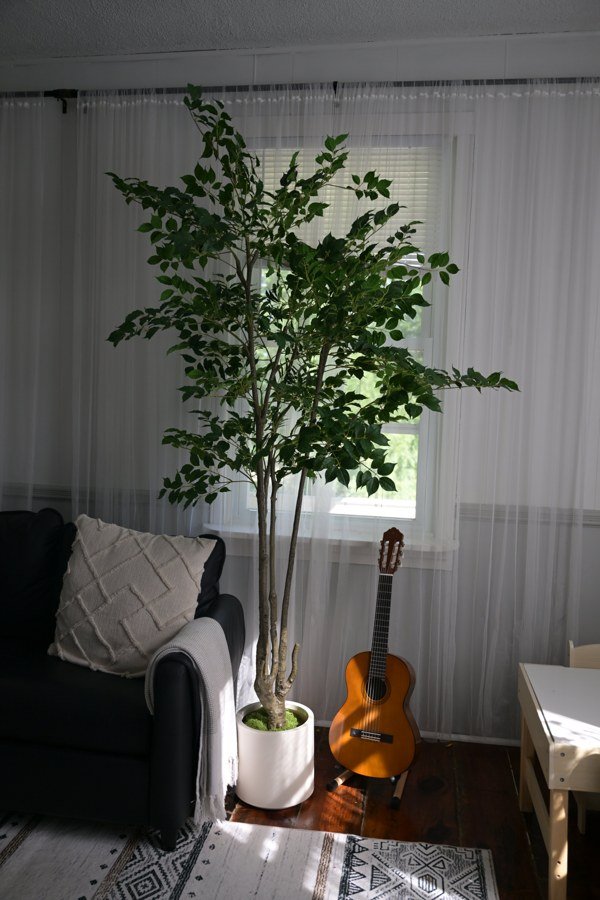
Real plants or faux? Either way, height is the point – choose the one you can keep alive or keep clean.
Once height is in place, light is the next layer to fix. See bedroom lighting ideas under $40 for low-cost ways to layer light without rewiring anything.
Where to Put Height First
Where you put the tall piece matters as much as how tall it is. Start with one of these three spots, and do not try to fill all three at once.
- The corner farthest from the door. This is the first tall thing your eye meets when you walk in, so it sets the height for the whole room.
- Beside the bed or at the end of the sofa. A tall plant or floor lamp here balances the long, low line of the bed or sofa and stops it from looking like a flat slab.
- Flanking a fireplace or a wide window. Two tall pieces on either side frame the feature, but one tall piece on one side is enough if the other side already has height.
Avoid putting the tall piece in the middle of the longest wall, where it blocks the natural walking path, or directly in front of a window, where it blocks the light. When you fix height before decorating a small room, the corner is almost always the safest first choice, because it uses space that was already empty.
Where This Rule Doesn’t Apply
To be fair to rugs and gallery walls, height isn’t the fix for every flat-feeling room. A few situations call for a different first step.
- If the room already has a tall bookshelf, armoire, or floor-to-ceiling curtains, height is probably not the missing piece. Look at lighting or color instead.
- If the ceilings are unusually low, an overly tall piece can make the room feel cramped. Choose a slimmer tall piece, raise the curtain rod closer to the ceiling, and keep the top of the piece at least 12 inches below the ceiling.
- If the room is already visually busy, adding height on top of a lot of pattern and clutter will make it feel taller and messier. Clear one surface and remove one low piece first.
For everything else – the ordinary living room, bedroom, or dining nook that just feels a little flat – height is the cheapest place to start.
The Actual Rule, Restated
Before you buy anything else, fix height. Measure the ceiling, find the emptiest corner, and put one tall element there. Then step back and look again before you buy the next thing.
- Measure first. Ceiling height, tallest piece, and the center height of your art.
- Choose one tall element that reaches two-thirds to three-quarters of the wall height.
- Place it in the emptiest corner and live with it for a week before you buy anything else.
- Then buy the low pieces – the rug, the lamp, the art – to finish a room that already has structure.
Everything else – the rug, the gallery wall, the better lamp – matters, but it matters more once the room has height. That is the whole rule: fix height before decorating, and let the low pieces finish a room that already has structure. For tiny rooms, pair this rule with dreamy bedroom decor ideas for tiny rooms, which show how height and light work together in a small space.
Frequently Asked Questions
Why should I fix height before decorating?
Because height is what makes a room look designed rather than just furnished. When everything sits low, the top third of the walls stays empty and the room feels flat, no matter how good the rug or sofa is. Fix height before decorating and the low pieces you already own start to look like they belong together.
How tall should a plant or tall piece be?
Aim for two-thirds to three-quarters of the ceiling height, including the pot. In an 8-foot room, that is 64 to 72 inches. In a 9-foot room, it is 72 to 81 inches. Leave at least 12 inches of clear space above the piece so it does not crowd the ceiling.
What if my ceilings are only 7 or 8 feet high?
Height still helps, but choose a slim tall piece rather than a wide one, and keep at least 12 inches clear above it. Raising the curtain rod to just below the ceiling and hanging curtains to the floor also adds height without taking up floor space.
Is a faux plant a good choice, or should I buy a real one?
Either can work. A real plant adds life and texture, but it needs the right light and regular care. A faux plant works in a dark corner or a home where a real plant would not survive, as long as the trunk and pot look solid. Choose the one you can keep looking good, and dust a faux plant every few weeks.
What should I buy first if I can only afford one thing?
Buy the one tall element that fits the emptiest corner – usually a tall plant or a tall floor lamp. Live with it for a week, then decide what the room still needs. In most flat-feeling rooms, that single tall piece changes the room more than a new rug or a new coffee table would.
If you remember one thing, fix height before decorating first, then shop for the low pieces. That order is what turns a flat room into a finished one.
Start today: measure the ceiling, pick the corner, and fix height before decorating before you buy anything else.