9 Small Apartment Aesthetic Ideas That Feel Cozy and Intentional
Small apartment aesthetic cozy ideas that actually work — 9 ways to make a compact space feel warm, intentional, and like it's truly yours.
5/16/202616 min read


Affiliate Disclosure: This post contains affiliate links. If you buy through them, I may earn a small commission at no extra cost to you. I only recommend products I'd genuinely consider for my own home, and my recommendations are based on the criteria I explain in this post — not on which brand pays the highest commission.
You rearranged the furniture twice, bought a new throw pillow, and the room still feels like a hotel room that somebody gave up on halfway through decorating. Nothing is technically wrong with it — the furniture fits, the walls aren't bare — but it also doesn't feel like anyone actually lives there. That specific feeling of "close but not quite" is one of the most frustrating places to be in a small apartment.
This post covers both sides of that equation. First, I'll walk you through the principles that actually create a cozy, intentional small apartment aesthetic — the stuff most decorating guides skip over. Then I'll bring in a few specific products that are worth considering once you understand what you're actually trying to do. Products are more useful when you know why you're buying them, so we're doing the education first.
Why Most Small Apartment Aesthetic Advice Misses the Point
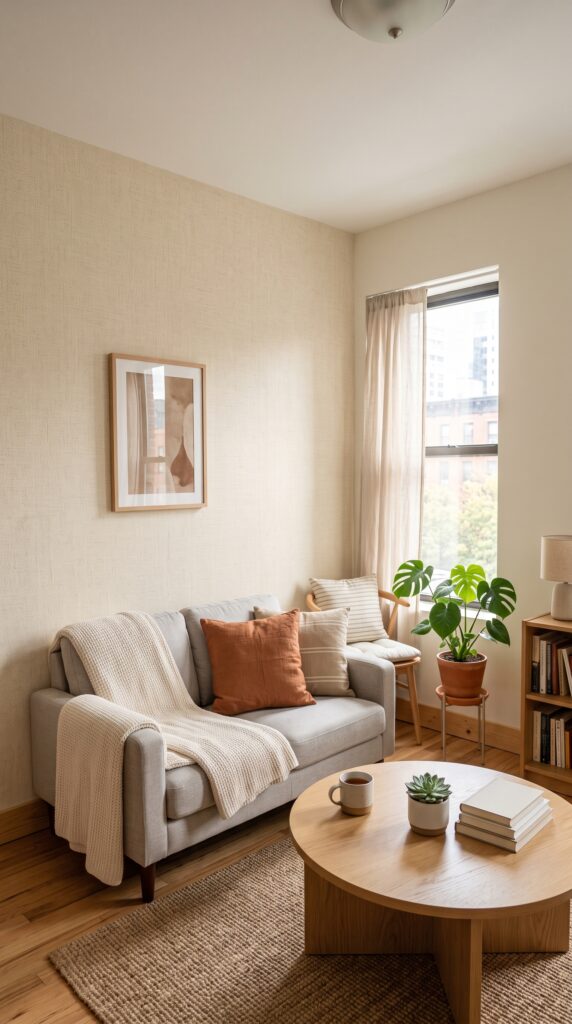
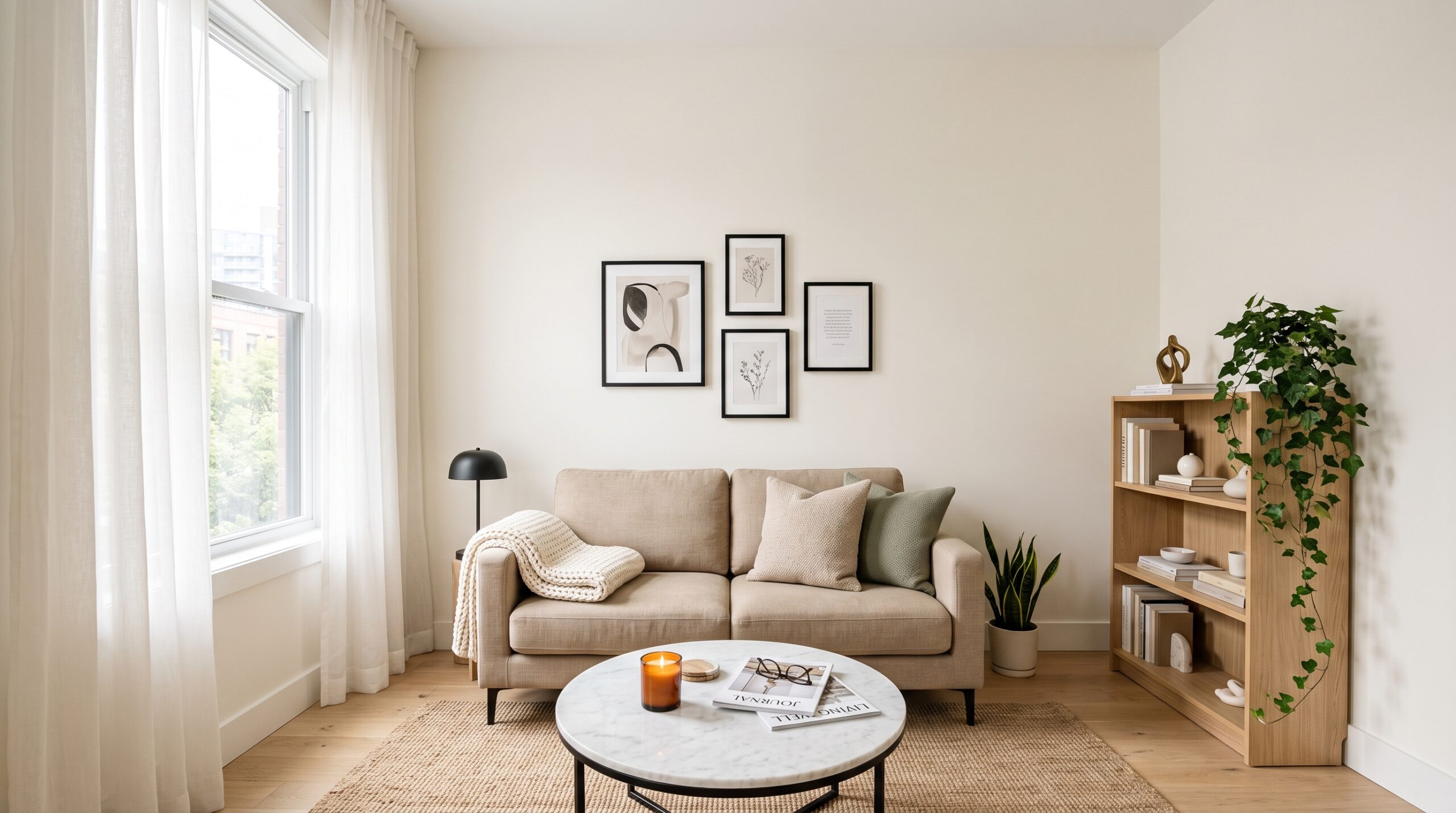
The advice you'll find most places boils down to "use mirrors to make it feel bigger" and "stick to a neutral palette." That's not wrong exactly, but it's so incomplete it might as well be wrong. A room full of pale beige furniture and a large mirror can still feel cold, sterile, and deeply uncomfortable to sit in — and I've been in plenty of those rooms. Telling someone to "keep it light and airy" ignores the fact that airy is not the same as cozy, and for a lot of people in small apartments, cozy is the actual goal. The real issue is that most guides are optimizing for the photograph, not for the feeling of being in the room. There's a big difference between a space that looks good in a wide-angle Instagram shot and a space that makes you exhale when you walk in after a long day. Cozy is a sensory experience — it's about texture, light quality, and the sense that things were placed with some intention behind them. You can get there in 400 square feet. You just have to know what you're actually going for.


The Small Apartment Cozy Aesthetic Principles That Actually Matter
If I'd understood three things from the start, I would have saved myself about two years of incremental furniture shuffling and impulse purchases that didn't pan out. These aren't design rules in the formal sense — they're more like the framework that makes every other decision easier. Think of them as the "why" behind the things that actually work in small, cozy spaces. No products in this section, because this is the part that matters most.
Principle 1 — Light Layers Before Everything Else
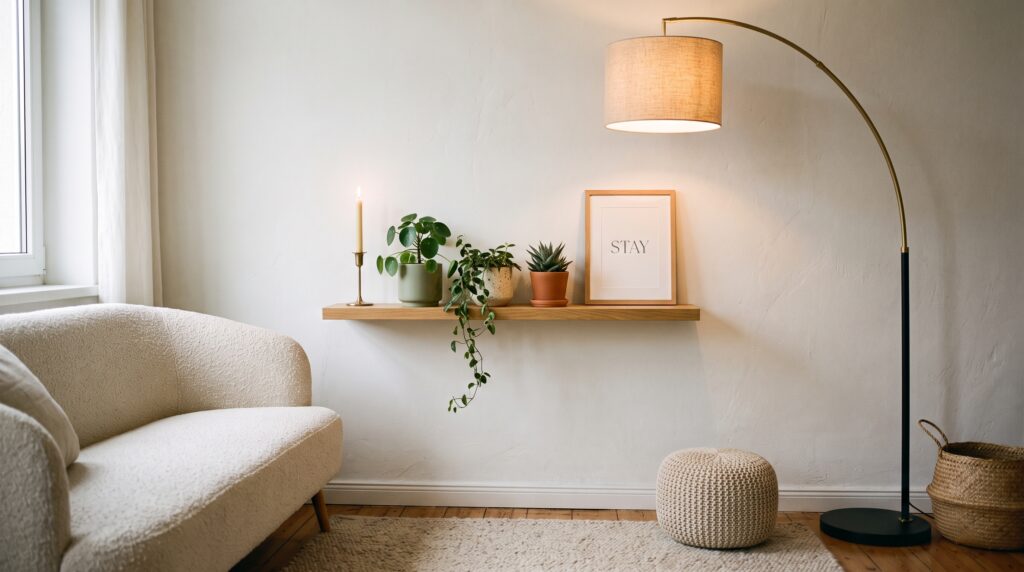
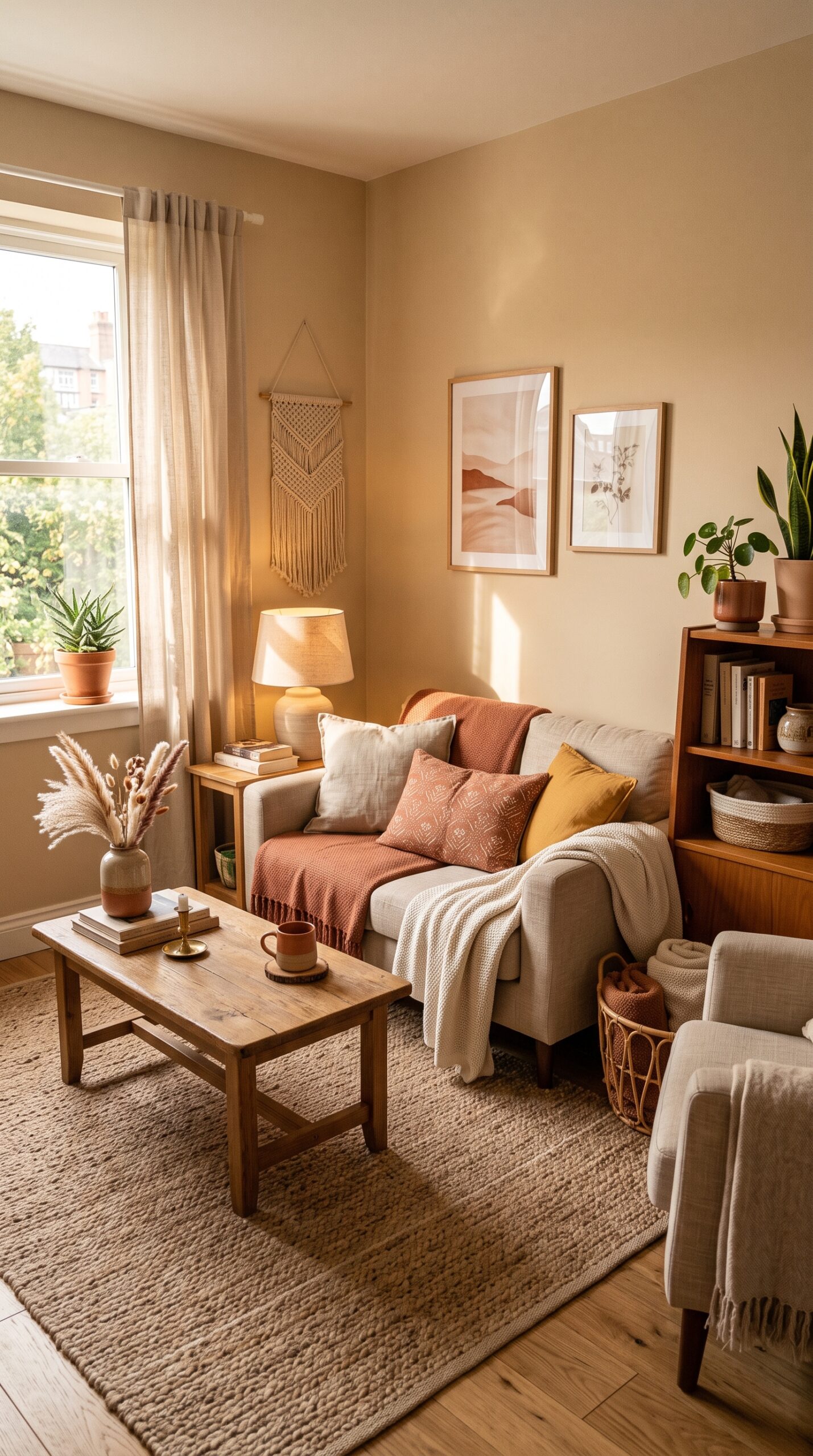
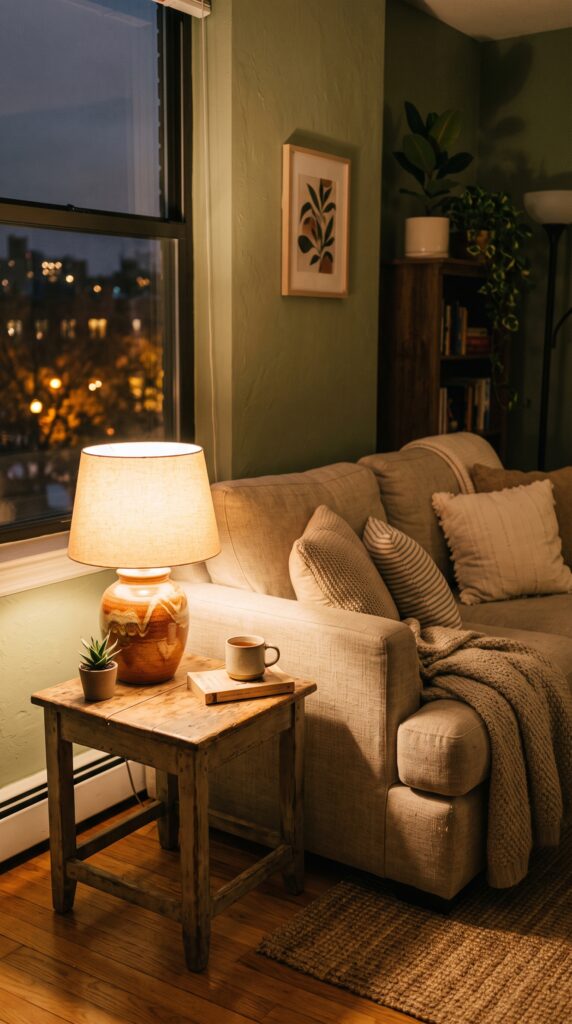
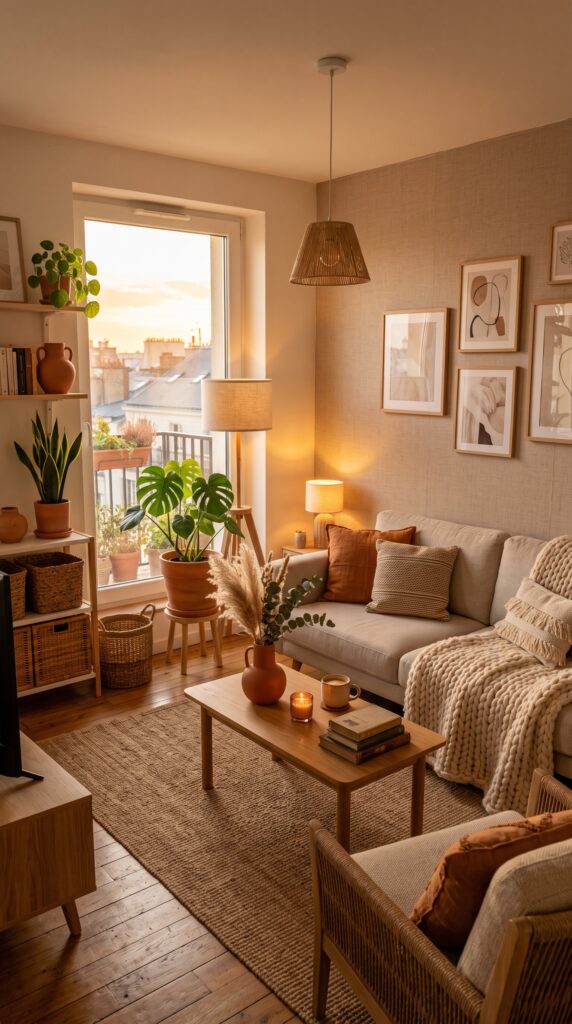
The single biggest reason small apartments feel cold or uninviting isn't the size — it's the lighting. Most apartments come with one overhead fixture per room, and overhead lighting alone creates what I'd describe as a "waiting room" effect. It lights the space evenly and flatly, which is practical but not remotely warm. The fix is layering: a floor lamp in one corner, a table lamp on a surface at seated eye level, and ideally something with a warm bulb (look for 2700K on the box, not 4000K or higher). When you have three light sources at different heights, the room immediately reads as more intentional and more cozy — even before you change a single piece of furniture. The mistake most people make is buying the lamp but keeping the overhead light on at full brightness, which cancels out the effect entirely.
Principle 2 — Texture Does the Work That Color Can't
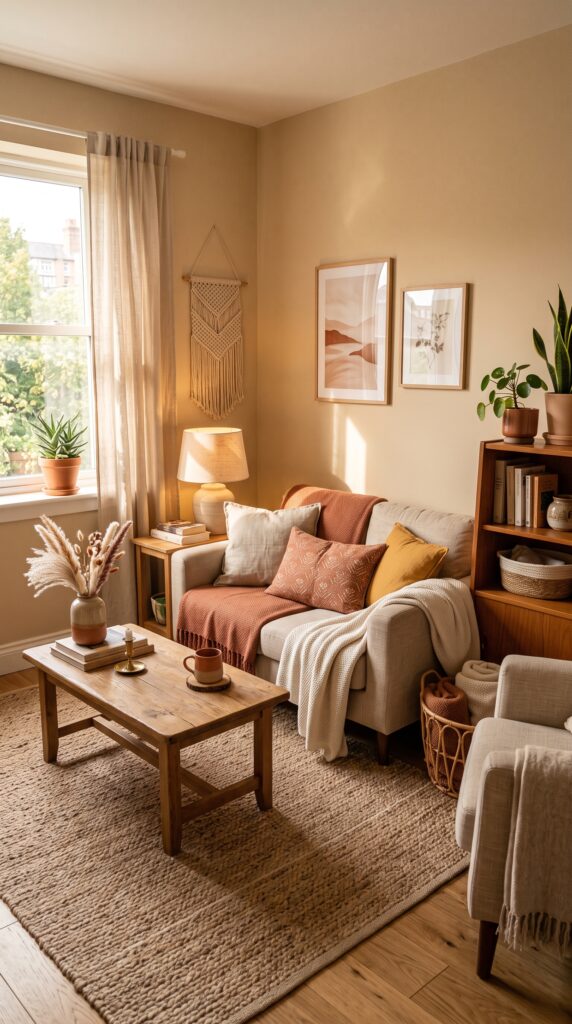
Color gets all the attention in decorating advice, but texture is what actually creates the sensation of coziness. You can have the warmest terracotta walls in the world and still have a room that feels cold if every surface is smooth and flat. What registers in your brain as "warm and inviting" is partly visual but also tactile and anticipatory — your brain looks at a chunky knit blanket draped over a chair and already starts relaxing before you've sat down. In a small apartment, you don't have room for a lot of furniture, so each piece of textile or object has to carry more weight. One good linen pillow does more for a cozy aesthetic than three cheap polyester ones. I learned this the hard way after buying a four-pack of pillow covers that looked fine in photos but felt like gift wrap in person.
Principle 3 — Deliberate Grouping Over Spreading Things Out
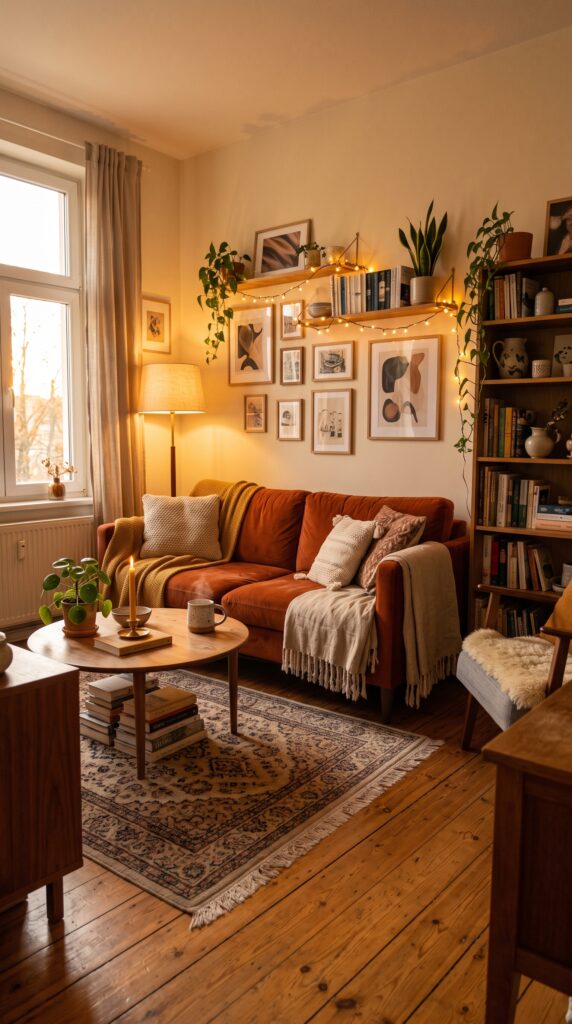
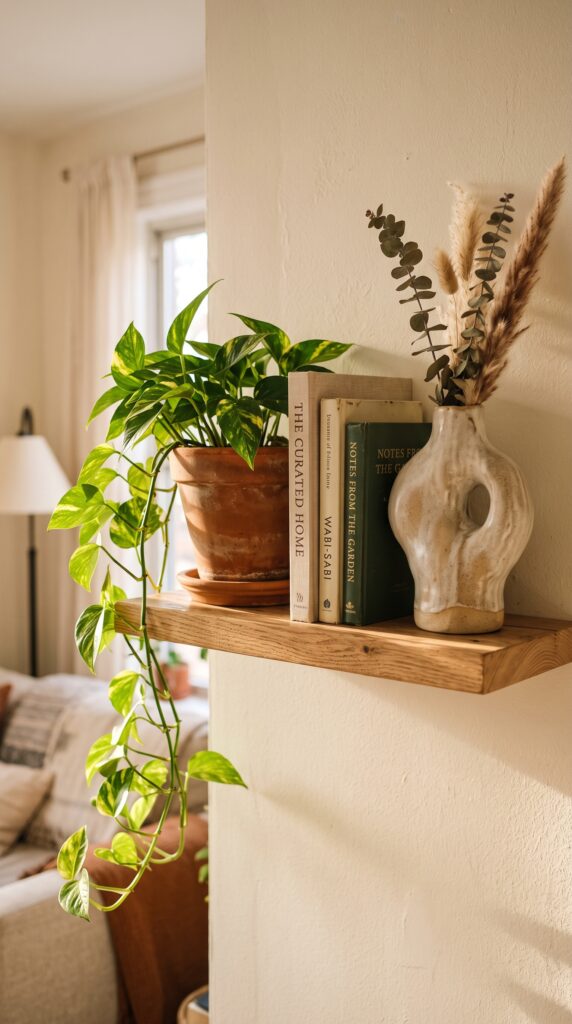
There's an instinct in small spaces to spread things out evenly — one plant here, one candle there, one book on each surface — because it feels like you're "using the space." In practice, this creates visual noise that reads as clutter, not coziness. What works better is deliberate grouping: three objects of varying heights clustered together on one surface, a corner of the room styled with a lamp, a plant, and a basket, a shelf with books stacked both upright and horizontally with one small object in front. Grouped arrangements feel intentional. Spread-out arrangements feel like you ran out of energy halfway through putting things away. The rule I use is simple — if a surface has one item on it, either add two more or take that one item off entirely.


Two Products Worth Considering First
Now that you have the framework — layered light, real texture, and deliberate grouping — it's easier to shop with purpose instead of hope. These two picks came to mind first because they each directly support more than one of the principles above, which means they pull more weight per dollar than a typical decorative buy. I'll be honest that this is the affiliate section of the post, but I've tried to place here the products I'd actually suggest to a friend starting from scratch in a small apartment, not the ones with the best commission rates. Each one has a real limitation I'll tell you about upfront.


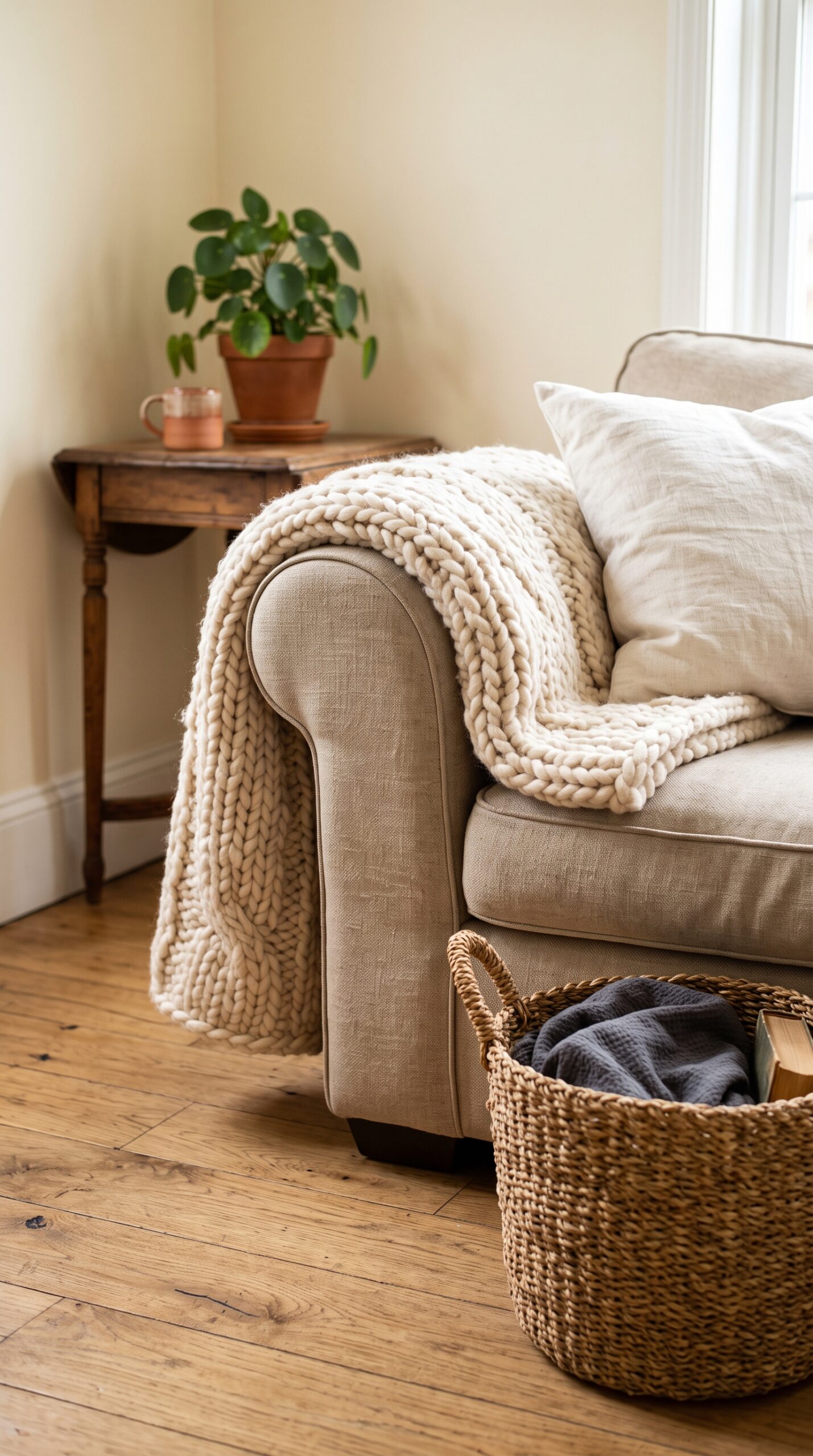
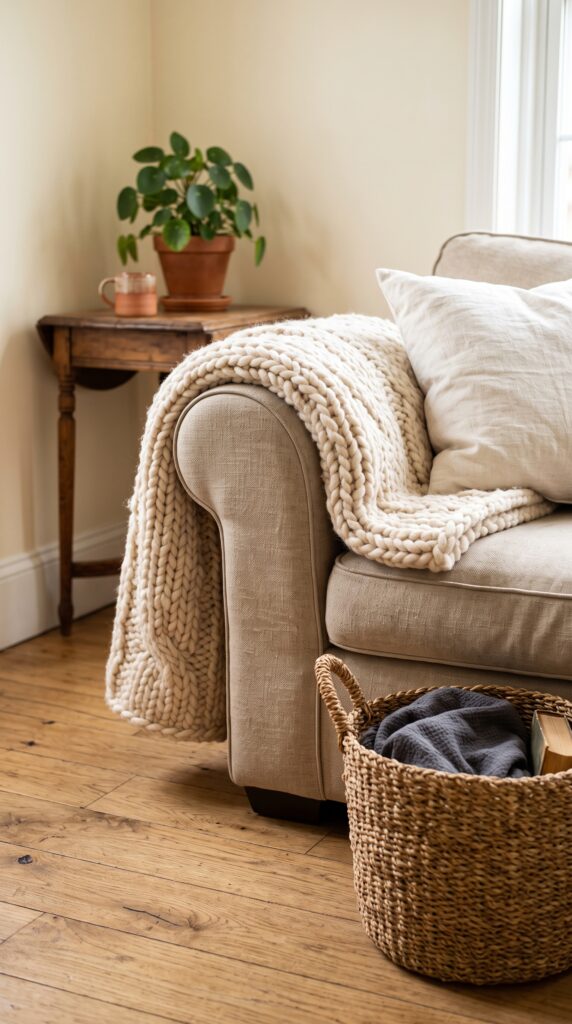
Chunky Hand-Knit Cotton Throw Blanket in Oatmeal or Sage — Oversized Sofa Drape
"A well-made chunky knit throw draped over the arm of a sofa is one of the fastest ways to add both visual warmth and actual texture to a small apartment — just make sure the weave is tight enough to last more than a season."
Best for: Anyone whose sofa or armchair currently looks bare and "finished but flat" — not a great pick if you have pets who shed heavily, since the open weave catches fur like velcro
There's a reason this type of throw appears in nearly every cozy apartment photo you've ever saved — it works because it reads as warm before you've even touched it, which is exactly what Principle 2 is about. The cotton version holds up better than acrylic alternatives over time and doesn't pill the same way, though it's slightly less insulating than a wool blend if you're looking for something to actually sleep under. Sized around 50 by 60 inches, it drapes naturally over a sofa arm or chair without looking forced or overly staged. The honest downside is that the open-weave construction means it snags relatively easily on rough surfaces, so be careful around textured walls or exposed wood with splinters.
—Chunky open-knit weave in 100% cotton that photographs beautifully and holds its shape after washing better than acrylic alternatives
—Neutral colorways like oatmeal and sage work across most small apartment color palettes without clashing or competing with existing furniture
—Open weave catches pet hair easily and can snag on rough surfaces — not the most practical pick for households with large shedding dogs or cats
Why it stands out: This directly supports Principle 2 — it adds genuine tactile texture to a flat surface in a way that your eye reads as warm and inviting before anyone even touches it.
What problem it solves: It addresses the "furnished but still feels cold" problem, where the furniture is all in place but nothing in the room signals comfort or personality.


Two Smart Add-Ons Once You've Got the Basics
If you've already sorted your lighting, your rug, and your foundational pieces from Part 1, these next two picks are worth your attention — but I want to be clear that they're genuinely optional. They're not the things you buy first. They're the layer you add once the room feels mostly right and you want to push it from "nice" to "finished." The first is for anyone who got their shelf or mantle styling mostly there but feels like something is still missing at eye level. The second is for anyone whose cozy corner looks great in daylight but falls flat at night.


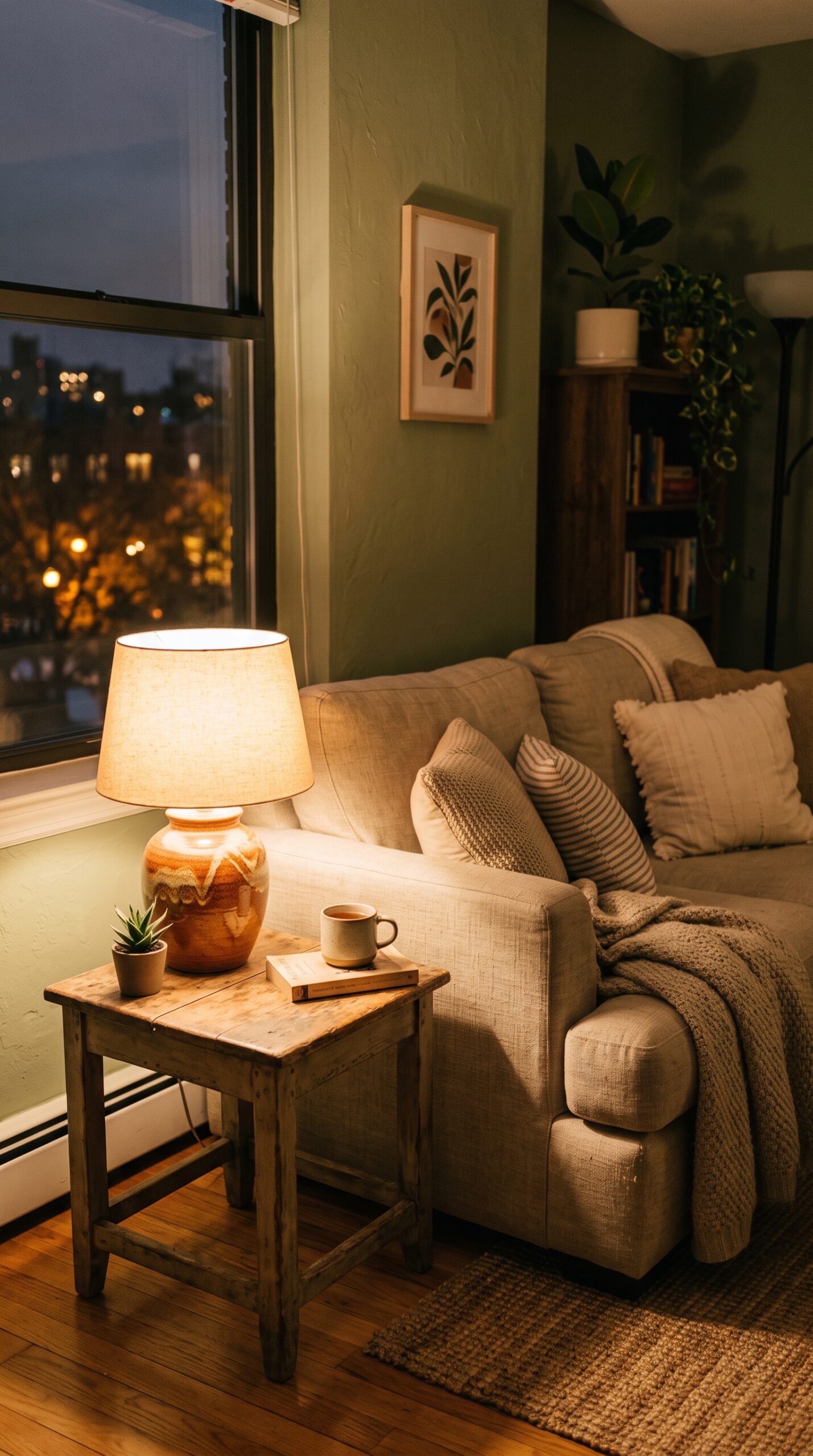
Rechargeable Amber Glass Table Lamp with Linen Shade (Cordless, dimmable)
"Cordless and dimmable is the combination that actually makes this useful, not just pretty."
Best for: Renters who can't hardwire sconces and want warm atmosphere lighting for a reading nook or nightstand — not ideal if you need a lamp for actual task lighting or reading fine print
I learned the hard way that a beautiful lamp means nothing if it's chained to the one outlet behind your bed that's also running your phone charger and fan. A rechargeable lamp solves the flexibility problem entirely — you place it where it looks right, not where the cord reaches. The amber glass base throws a warm amber glow even before the bulb is on, and the linen shade diffuses the light softly rather than directing it harshly downward. The trade-off is battery life: most rechargeable lamps in this range last 4-8 hours on a full charge at mid-brightness, so if you run it all evening every evening, you'll be charging it every couple of days.
—Fully cordless and rechargeable via USB-C, charges in roughly 3-4 hours
—Three-level dimmer with a warm 2700K color temperature that mimics candlelight
—Battery life drops noticeably on the brightest setting — best used at mid or low
Why it stands out: Directly addresses the overhead-lighting-only problem by giving you a flexible, moveable warm light source you can put exactly where the room needs it.
What problem it solves: The cold, flat apartment evening atmosphere that no amount of throw pillows will fix.


Two More Picks for Readers Who Want to Go Further
These last two are not for everyone, and I mean that. If you've worked through the basics and the add-ons above and your room already feels cozy and intentional, you can honestly stop here and be happy. What I'm about to recommend is for two specific situations: one is for readers who want a softer, more layered wall treatment than bare paint but aren't ready to commit to wallpaper, and the other is for anyone whose space has a dead corner that no floor lamp or plant seems to fully bring to life. These are finishing-touch picks — meaningful for the right room, unnecessary for most.
Common Small Apartment Aesthetic Mistakes That Ruin the Look
After helping a dozen friends style their first apartments and rethinking my own living room three times over, I've noticed the same handful of mistakes come up almost every single time. They're not obvious in the store or on a mood board — they only become obvious once you're standing in your room wondering why it doesn't feel the way you thought it would. I'll cover the four biggest ones here, because fixing even one of them can change how a room reads entirely. No products in this section — just the hard-won observations.
Mistake 1 — Buying Everything the Same Size
This one gets a lot of people because proportion feels like a design school concept, not a practical one. So they pick a medium vase, a medium candle, a medium plant, and arrange them on a shelf — and wonder why it looks flat and forgettable. The problem is that your eye needs contrast to move around a space: something tall, something low, something small. A good fix is the rule of odd numbers and varied heights. Aim for groupings of three with at least a 6-inch height difference between the tallest and shortest item.
Mistake 2 — Using Overhead Lighting as Your Only Light Source
This is probably the single biggest reason small apartments feel harsh or sad in the evening. The logic makes sense — the light is there, it works, why add more? But overhead light, especially in standard apartments with flat fixtures, throws light downward and creates shadows that flatten the room and make it feel cold. The fix is almost always to add at least two secondary light sources: a floor lamp in a corner, a table lamp on a side table, or even plug-in sconces on either side of the bed. Your room doesn't need to be brighter — it needs light coming from more directions and closer to eye level.
Mistake 3 — Treating Every Wall Like It Needs Filling
I made this mistake in my first apartment and it took me two years to figure out why the walls looked chaotic. I thought more art meant more personality. What it actually meant was competing focal points and a room that felt smaller, not larger. Empty wall space isn't a design failure — it's breathing room that makes the pieces you do hang look more intentional. The rule I follow now: one strong focal wall treated with care, and the other walls left mostly quiet. That usually means one gallery wall or one large statement piece, not four.
Mistake 4 — Choosing Rugs That Are Too Small
This is the most common mistake in living rooms specifically, and it's almost always driven by price. A rug that fits under only the coffee table and doesn't reach the sofa legs makes the furniture look like it's floating unrelated to each other — it visually chops the room into fragments. For a small apartment living room, you usually need at least a 5x8 rug, and ideally a 6x9 or 8x10 if the space allows. Yes, those cost more. But one right-sized rug does more for a room than three small ones ever will. If budget is tight, look at washable rug brands like Ruggable, where a 6x9 runs around $200-$250 on sale.
Removable Linen-Texture Peel-and-Stick Wallpaper Panel (Neutral oat colorway, sold by the roll)
"When it works, it works beautifully — but surface prep is everything with this product."
Best for: Renters creating a soft accent wall behind a bed or sofa without painting — skip this entirely if your walls are heavily textured, because peel-and-stick won't adhere properly and will peel at the edges within weeks
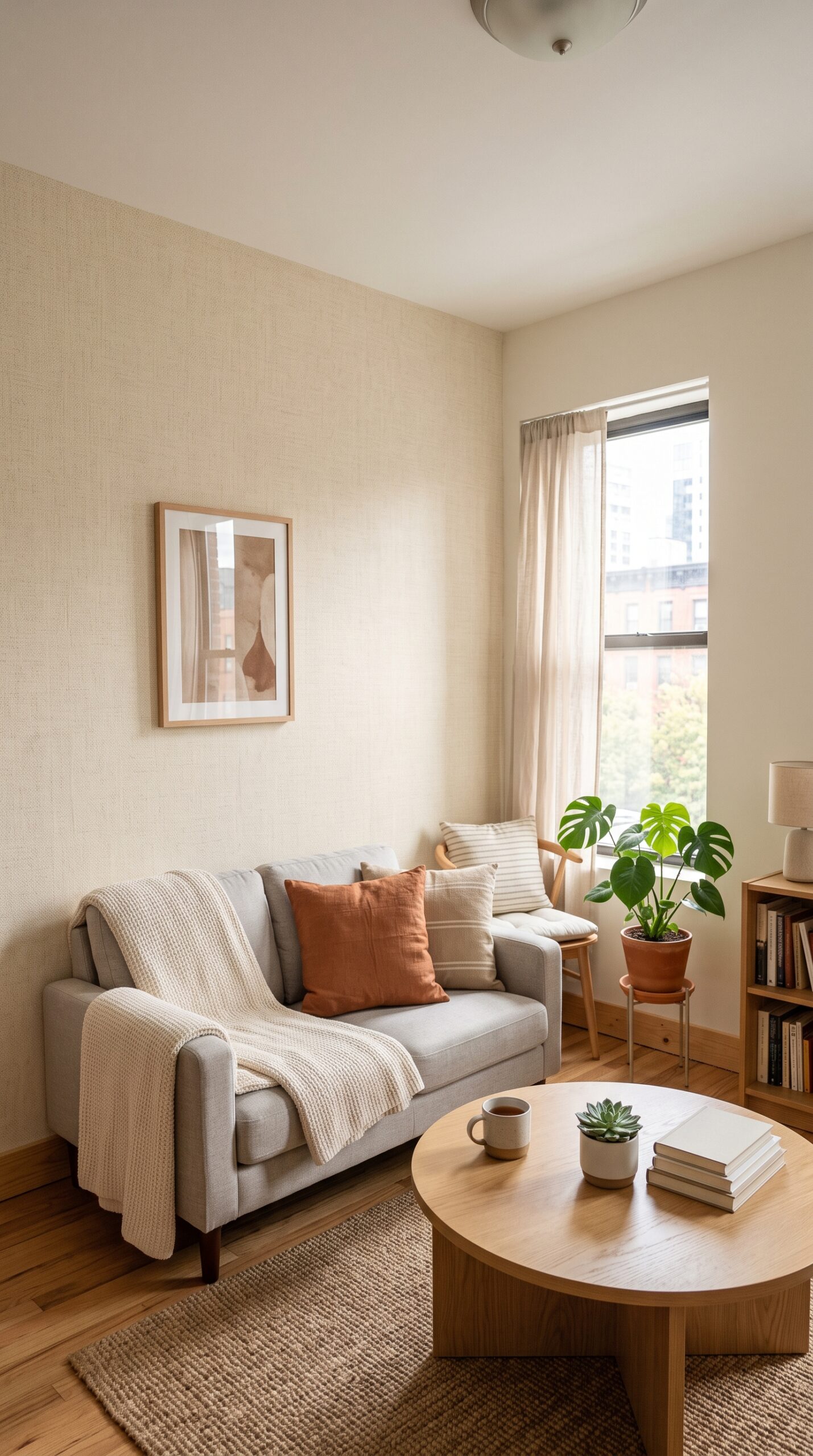
A linen-texture wallpaper panel in a warm oat or greige tone does something paint can't: it adds visual depth and a soft, almost tactile quality to a flat wall without pattern commitment. I've seen it used behind a bed as a headboard substitute in small apartments where a real headboard would eat too much floor space, and it reads as intentional rather than renter-makeshift. Most rolls cover about 20-22 square feet, so a standard bedroom accent wall behind a queen bed takes three to four rolls and runs around $80-$120 total. The honest downside is that removal isn't always clean — on fresh, flat paint it lifts off without damage, but on older or semi-gloss paint it can pull.
—Linen texture adds depth that flat paint can't replicate, even in the same color
—Repositionable within the first 60 seconds after application, which helps with alignment
—On semi-gloss or older paint, adhesion can fail at seams within a few months — test one panel first
Why it stands out: Addresses the "quiet wall that needs just something" problem without committing to a design you're stuck with.
What problem it solves: That flat, echo-y wall behind the bed or sofa that makes an otherwise nice room feel unfinished.


Ceramic Base Edison Table Lamp with Linen Drum Shade — Warm Amber Glow Edition
"A properly designed table lamp with a warm ceramic base and linen shade does more for a small apartment's cozy aesthetic than almost any other single purchase — but only if you use it with a 2700K bulb and turn the overhead off."
Best for: Someone furnishing a living room or bedroom corner from scratch who wants a lamp that actually changes how the room feels; not the right pick if you already have ample warm light sources and just need a ceiling fixture replacement
The combination of a matte ceramic base and a natural linen shade is one of those pairings that just works across almost every small-apartment color palette — warm whites, earthy greens, terracotta, even darker moody tones. The linen shade diffuses the light softly instead of projecting it harshly, which is what you want for that layered evening warmth. In a real home at around 18 to 22 inches tall, this size lamp sits nicely on a side table or console without overwhelming the scale of a small room. The honest limitation is that the shade can attract dust in a way that darker or synthetic shades don't, so if you're not someone who dusts surfaces regularly, factor that in.
—Matte ceramic base in earthy tones (cream, warm grey, or terracotta depending on colorway) that adds textural interest as an object in itself, not just a light source
—Natural linen shade creates a soft warm diffusion rather than a harsh directional glow — the difference in room feel is significant
—Shade requires occasional light dusting and can show fingerprints if handled frequently; it's a minor issue but worth knowing before you buy
Why it stands out: This directly applies Principle 1 — it adds a warm, low, layered light source that breaks the overhead-only trap most small apartments are stuck in.
What problem it solves: It fixes the "waiting room lighting" problem that makes even well-decorated small apartments feel cold and impersonal at night.
Terracotta and Mango Wood Sculptural Bud Vase Set (Set of 3, varied heights)
"These do the heavy lifting of making a simple shelf look like you thought about it."
Best for: Anyone building a shelf vignette or coffee table arrangement who needs height variation — skip this if you already have a lot of decorative objects and just need editing, not more pieces
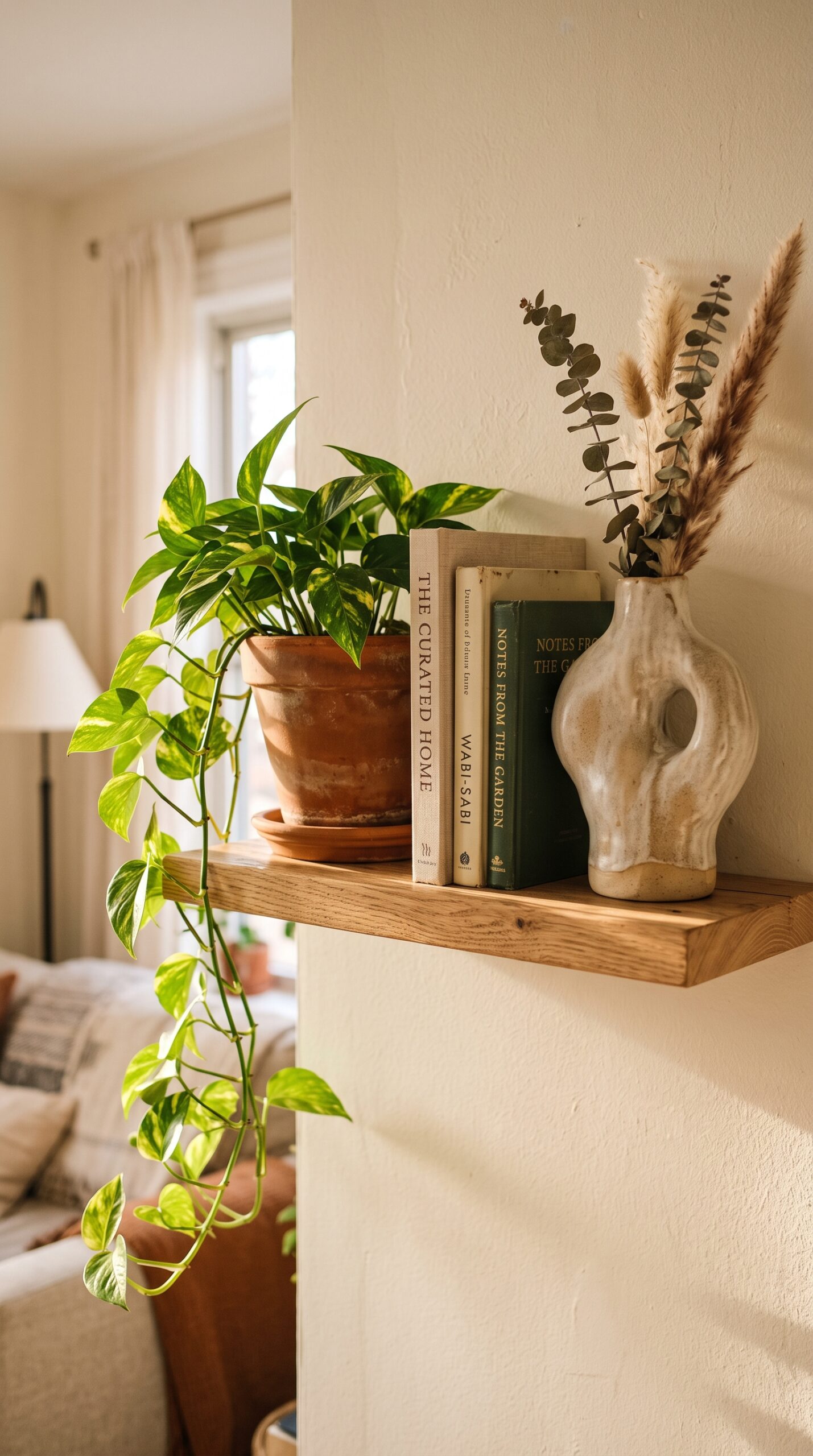
A set like this works because the height variation is already built in — you're not guessing about what scale goes where. The terracotta and mango wood combination reads warm without being too rustic, so it fits well in modern, boho, and Scandinavian-leaning apartments alike. I've used a similar set on a floating shelf next to a trailing pothos and it looked like something out of an interiors magazine, honestly. The limitation is that these are purely decorative — they don't hold large stems well, and the smallest vase in most sets is essentially just a sculpture.
—Three distinct heights (typically 4 inches, 7 inches, and 10 inches) for instant visual variation
—Matte terracotta and warm wood tones that photograph beautifully in natural light
—The bases can be slightly uneven on some sets — check reviews for any mention of wobbling before buying
Why it stands out: Fixes the "everything is the same size" mistake covered above without requiring you to hunt individually for three different objects that actually go together.
What problem it solves: That frustrating shelf-styling problem where the objects look fine but the arrangement still feels flat.
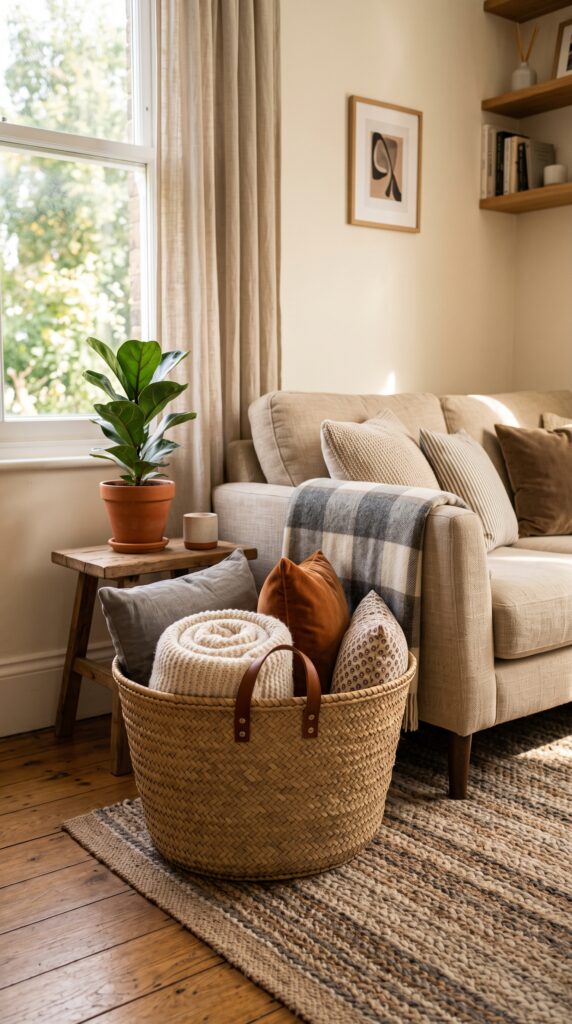
Woven Seagrass Floor Basket with Leather Handles (Large, 18-inch diameter)
"Solves a storage problem and a styling problem at the same time, which is exactly what small apartments need."
Best for: Anyone who has a dead corner that needs grounding and also has a blanket storage problem — not the right call if you hate the earthy, natural-material look or if your apartment already skews very cool and minimal
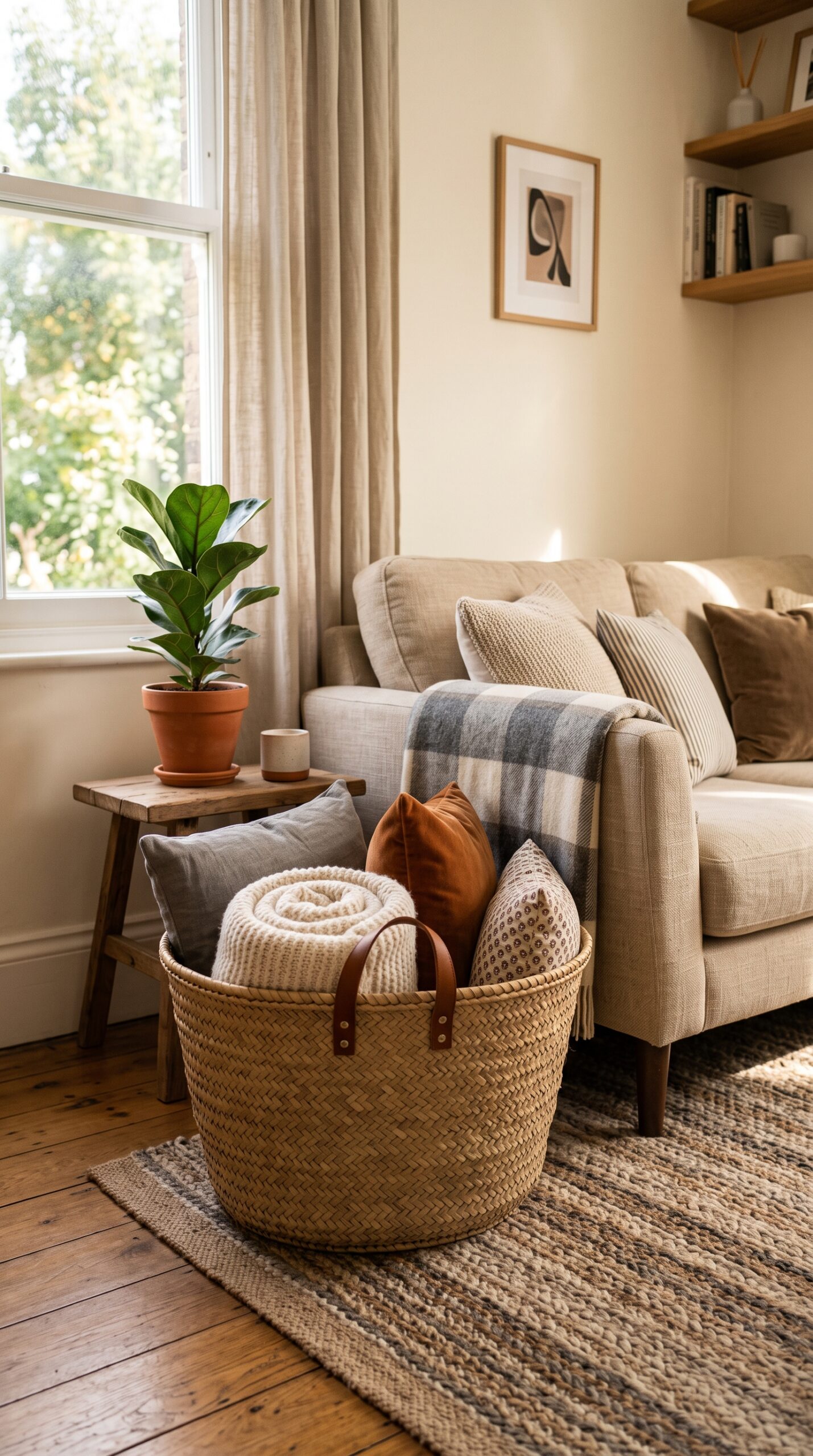
An 18-inch seagrass basket with leather handles is one of those objects that earns its floor space by doing two things: it holds three to four folded throws or extra pillows, and it visually anchors a corner that would otherwise just be wasted air. In my living room, one sits next to the sofa and it's the detail that people most often comment on — which still surprises me, because it costs around $35-$60 depending on where you buy it. The leather handles add enough warmth and finish that it doesn't read as purely functional. The trade-off is that seagrass sheds slightly, especially in the first few weeks — you'll want to vacuum near it regularly.
—Woven seagrass construction is sturdy enough to hold 15-20 lbs without losing its shape
—Leather handles add a finishing detail that plain baskets don't have
—Seagrass can shed fine fibers in the first month — not ideal if anyone in the household has allergies
Why it stands out: Ties directly to the idea that every object in a small apartment should earn its place by serving more than one purpose.
What problem it solves: The dead corner problem and the "blankets piled on the sofa arm" problem in one move.
How to Decide What's Right for Your Space
I can't see your apartment, so I can't tell you exactly which of these ideas and products apply to you — but I can give you a framework based on the patterns I've seen. If your main frustration is that the room feels cold or uninviting, start with lighting every single time. If it feels cluttered despite not having much, the problem is almost always proportion or too many small objects competing. And if you feel like the room is fine but just not special, that's usually a signal that you need one strong focal point — a textured wall, a great rug, a corner styled with real intention — rather than a general upgrade across the board.
If you're working with a small space
Scale down your furniture footprint before adding any decor — one sofa and a chair will always feel better than two sofas in a room under 300 square feet. Keep your color palette to two or three tones and let texture do the variation work instead of color. Wall-mounted storage and floating shelves are your best friends here because they keep the floor clear, which is what makes a small room feel larger.
If you have pets or kids
Washable is non-negotiable — Ruggable and similar washable rug brands exist specifically for this situation, and the $200-$250 investment for a washable 6x9 is far better than a $400 rug you'll replace in two years. For throw pillows and blankets, look for indoor-outdoor fabrics like Sunbrella or tightly woven cotton — they wipe clean and hold up much better than linen or velvet. Keep your floor baskets lower and sturdier, and avoid anything fragile at coffee table height.
If you're on a tight budget
Be honest about where cheap works and where it doesn't. A $15 throw blanket from IKEA can look great on the right sofa, but a $30 rug from a discount store will make your whole room look off — rug is the one place worth saving up for. Thrift stores and Facebook Marketplace are genuinely good sources for vases, baskets, books, and candle holders, where the brand doesn't matter and wear adds character. Spend on the one anchor piece per room (rug, sofa, light fixture) and thrift or budget-buy everything else.
Final Thoughts
The honest truth is that no specific product makes a room feel cozy — the principles do. Warm light at eye level, scale that makes sense, a few objects with height variation, and enough empty space for the eye to rest: those things matter more than whether you bought the exact vase I mentioned. I'd actually encourage you to start with just one idea from this post rather than trying to implement everything at once. Pick the mistake that resonated most with you — the rug that's too small, the overhead-only lighting, the cluttered shelf — and fix that one thing first. Taste develops through doing, and after you solve one problem in your own room, you'll understand the principles in a way that no amount of reading can give you. If you try something and it doesn't work the way you expected, come back — leave a comment, and I'm happy to think through it with you.


Contact
Questions? Reach out anytime, we're here.
Phone
usama@nuvoradecor.com
© 2025. All rights reserved.