If you have been searching for small living room decor ideas that actually work in a real home, start here. A small living room does not need a bigger footprint. It needs furniture that fits, storage that does not eat floor space, and a layout that leaves room to move. This guide gives you nine fixes you can use in that order, with the measurements and steps to get each one right.
In This Guide
- The Myths Holding Your Small Living Room Back
- Measure First: The Numbers That Make a Small Room Work
- 9 Small Living Room Decor Ideas That Actually Work
- How to Choose the Right Ideas for Your Room Shape
- Mistakes to Avoid in a Small Living Room
- What to Buy First on a Tight Budget
- Frequently Asked Questions
The Myths Holding Your Small Living Room Back
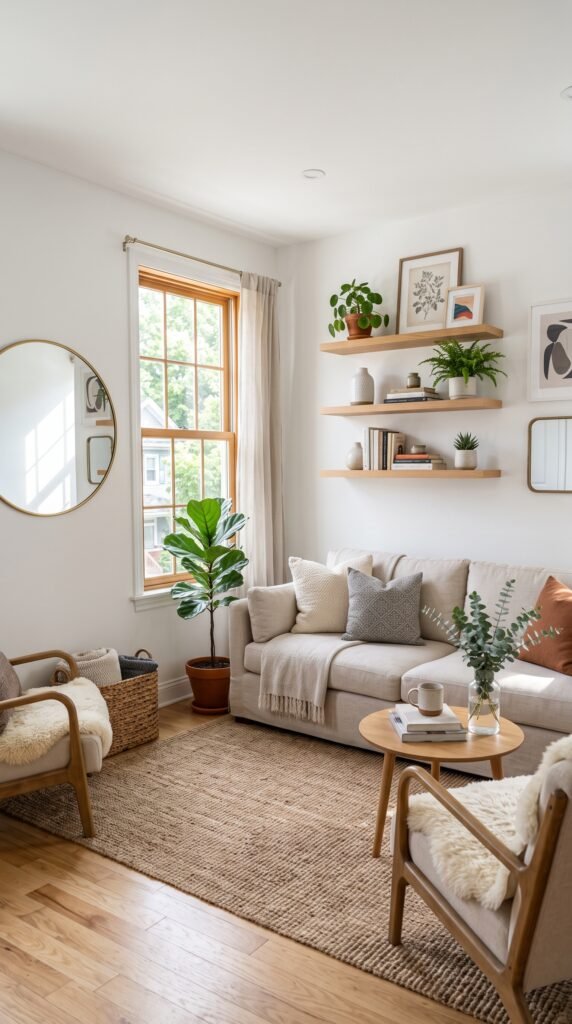
Bad advice spreads fast in home decor, and small rooms get the worst of it. Three myths cause most of the problems people blame on size. Many of the best small living room decor ideas start by ignoring those myths.
Myth 1: Small rooms need small furniture. A room full of tiny chairs, a tiny sofa, and a tiny table usually looks more cluttered, not less. One well-sized sofa that fits the wall, with two or three larger pieces around it, reads as calmer and more intentional. The test is fit, not size: a sofa should leave a clear walkway and should not block a door, a window, or a radiator.
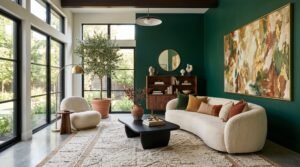
Myth 2: Dark colors will make the room feel like a cave. A dark accent wall can add depth, especially behind a sofa or a television, as long as the rest of the room stays light and the wall is not crowded with dark furniture. What makes a room feel closed in is low light and too many competing colors, not one dark wall on its own.
Myth 3: You need to keep everything off the floor. Leggy furniture helps, because you can see floor underneath it, but a room still needs storage. The answer is to choose storage that does two jobs, such as an ottoman that holds blankets or a bench with a lift-up lid, rather than removing storage altogether. The same approach works in other small rooms. See Bathroom Storage Ideas for Clutter-Free Living for the same principle applied to a bathroom.
Measure First: The Numbers That Make a Small Room Work
Before you buy anything, measure the room and sketch the layout on paper. Measure the length and width of the room, the width of each door and window, and the height of the ceiling. Then measure the furniture you already own. Most layout problems in a small living room are measurement problems, and they are much cheaper to fix on paper than after a delivery. Good small living room decor ideas always start with measurements, not shopping.
- Main walkways: leave 30 to 36 inches clear for the paths you use every day, such as the route from the door to the sofa and from the sofa to the kitchen.
- Sofa to coffee table: leave 14 to 18 inches. Closer than that, you cannot walk past it. Farther than that, you cannot reach a drink without leaning forward.
- Side table height: choose a side table within 2 inches of the height of your sofa arm, so a cup or a book sits at a natural height.
- Rug size: the front legs of the sofa and chairs should sit on the rug. If only the coffee table sits on it, the rug is too small for the seating area.
- Television distance: sit where you will watch from, then check that you can read the screen comfortably without turning your head. If you cannot, move the seating or choose a smaller screen, rather than pushing the sofa against the far wall.
Mark the footprint of any large piece on the floor with painter’s tape before you order it. Walk around the taped outline for a day. If you keep stepping over a corner or squeezing past it, the piece is too big for that spot, however good it looks in a showroom. For more visual examples of scale and proportion in small rooms, see Architectural Digest’s small living room ideas, which show larger sofas, mirrors, and layered lighting used in compact spaces.
9 Small Living Room Decor Ideas That Actually Work
These nine small living room decor ideas are listed in the order that matters most. Fix the furniture and the layout first, then the rug and the light, then the color and the finishing touches. Each one works on its own, and together they make a cramped room feel organized and calm.
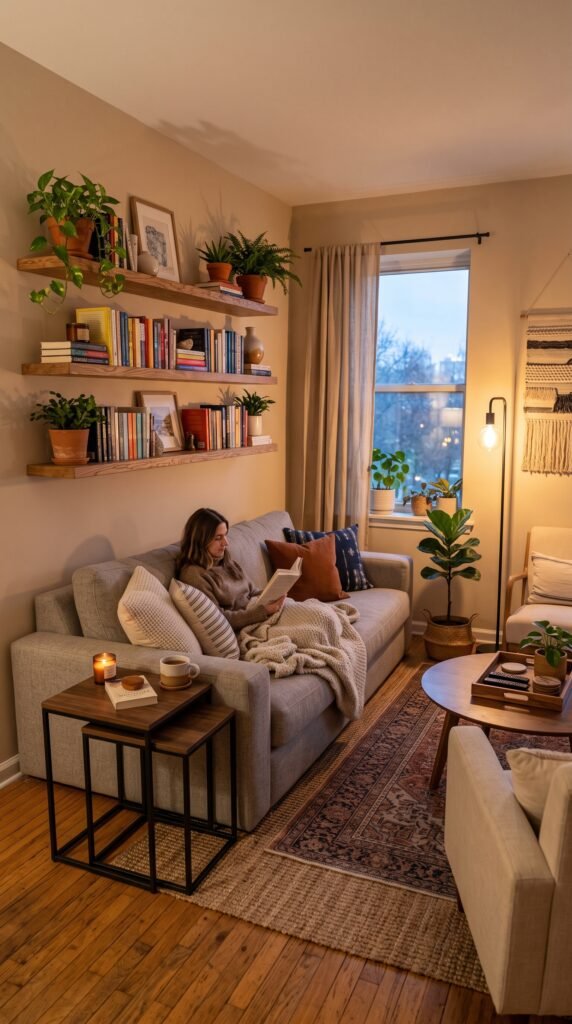
1. Choose Furniture That Earns Its Floor Space
Every piece in a small living room needs to justify the floor it takes up. Start with the sofa, because it is the largest piece and it sets the layout. Measure the wall it will sit against, then subtract at least 30 inches for a walkway at one end if that end is a route through the room. A two-seat sofa or a compact three-seat sofa is often a better fit than a large sectional, unless the sectional sits in a corner and leaves the rest of the room clear.
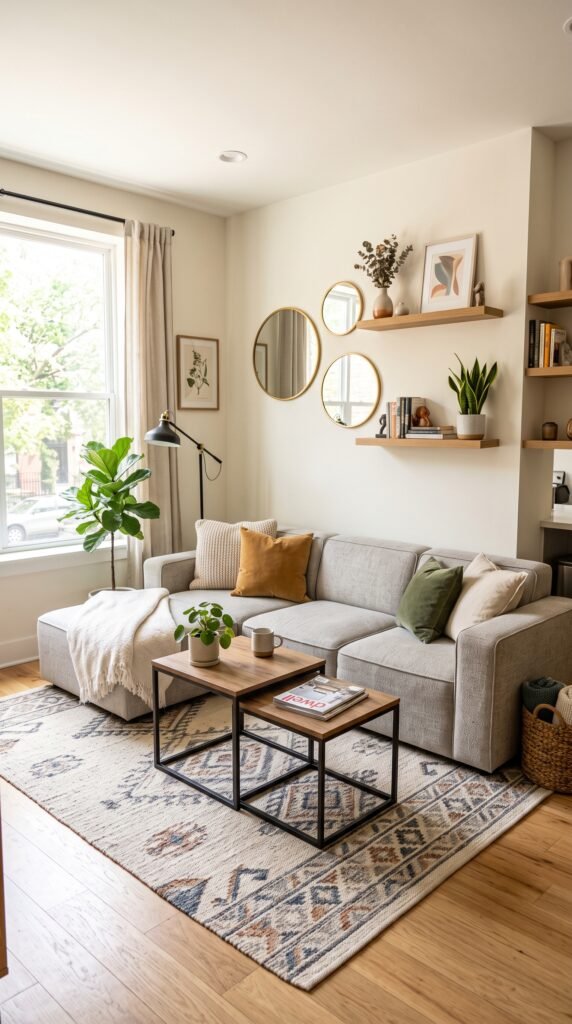
Look for pieces that do two jobs: a storage ottoman that holds throws and board games, a bench that works as extra seating and as a place for shoes, or a modular sofa you can rearrange when the room needs to change. Avoid a matching set of oversized chairs. One armchair, placed at an angle, gives you a second seat without filling the room with furniture that all matches and all competes for attention. That is one of the most practical small living room decor ideas for a room that has to work hard every day.
2. Go Vertical With Storage
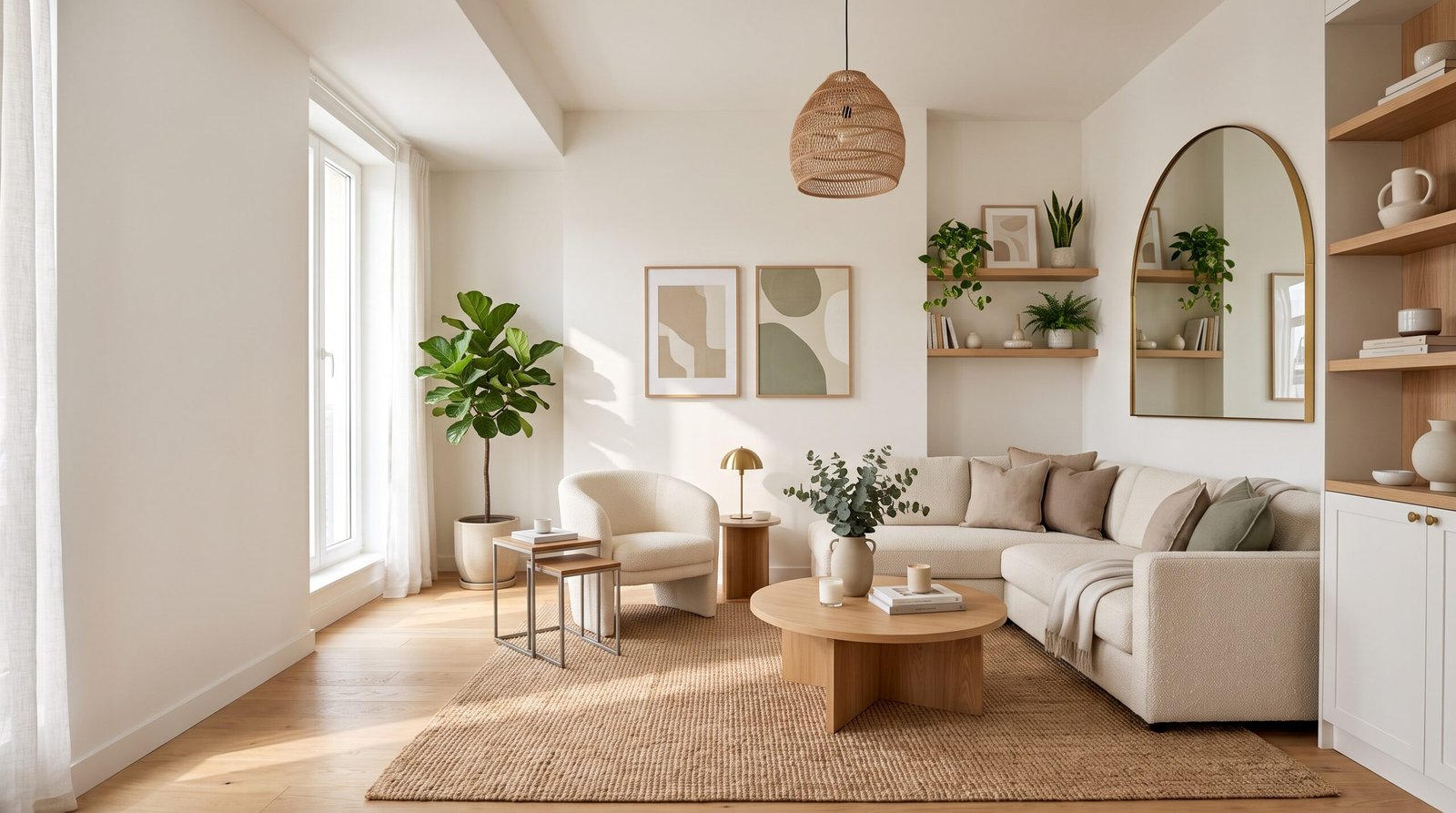
Floor space is limited, but wall space usually is not. Most living rooms have 8 feet or more of wall height, and the top half is often empty. Use it. Fit floating shelves above a sofa or beside a television for books, plants, and objects you use often. Keep the shelves you reach every day at shoulder height or below, and use the higher shelves for display only, so you are not climbing for a book you want every evening.
Fix shelves into wall studs or use fixings rated for the weight you plan to put on them, and check the shelf is level before you load it. A tall, narrow bookcase in a corner uses less floor than a wide, low unit and draws the eye upward, which makes the ceiling feel higher. Leave some empty space on each shelf. A shelf packed edge to edge reads as clutter, even if everything on it is tidy. Vertical storage is one of the simplest small living room decor ideas to try first, because it uses wall space you already have.
3. Use Nesting Tables Instead of a Single Coffee Table
A traditional coffee table takes up the same footprint all day, even when you only need a surface for one cup. A set of two or three nesting tables solves that. Keep the largest table in place for everyday use, tuck the smaller tables underneath, and pull one out when you have guests or when you want a surface beside a chair. When the room needs to be cleared, the tables nest back into the footprint of one.
Choose tables with a simple shape and a light frame, such as wood with slim metal legs, so they do not look heavy when they are grouped together. Check the height against your sofa seat: the table surface should sit at about the same height as the seat, or up to 2 inches lower, so you can set a cup down without reaching up or down. Nesting tables are among the most flexible small living room decor ideas for a room that changes between quiet evenings and guests.
4. Do Not Skip the Side Table
A side table next to the sofa is one of the smallest changes with the biggest daily effect. Without one, cups, books, glasses, and phones end up on the sofa cushions, on the floor, or balanced on the arm of the sofa. With one, each of those things has a place, and the room stays tidier without extra effort. It is a small detail, but it is one of those small living room decor ideas that makes daily life easier.
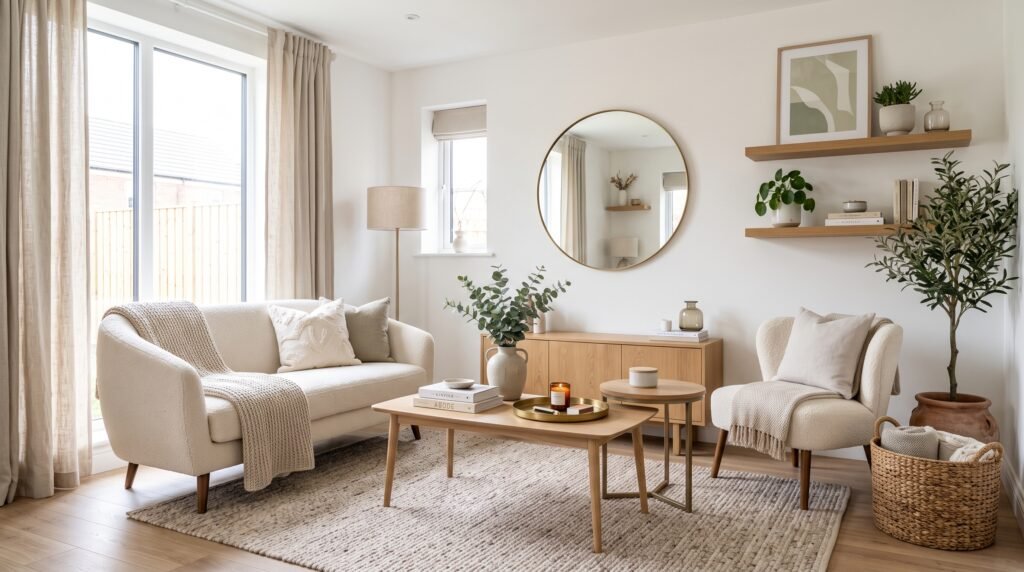
Place the table within easy reach of your usual seat, about 2 to 4 inches from the arm of the sofa, and keep its surface mostly clear. A small drawer or a lower shelf gives you a place for a remote control and a book, so the top stays free. If floor space is very tight, choose a C-shaped side table that slides partly under the sofa, so it takes up almost no extra floor at all.
5. Size the Rug to the Seating Area, Not the Room
Most people skip rugs in small spaces because they worry a rug will make the room feel smaller. The opposite is true when the rug is the right size. A rug that is too small makes the seating look scattered. A rug that fits the seating area pulls the sofa and chairs together into one group and makes the room feel planned.
Measure your seating area first, then choose a rug that extends at least 6 inches beyond the front legs of the sofa and chairs on each side. In most small living rooms, that means a rug around 5 by 8 feet for a two-seat sofa and one chair, or 8 by 10 feet for a three-seat sofa and two chairs. Choose a low-pile rug that is easy to vacuum and that will not catch on chair legs, and choose a pattern that is simple enough not to fight with the cushions and the curtains. If you have pets or children, choose a washable rug or one you can spot-clean easily, and check the care instructions before you buy.
6. Place Mirrors to Reflect Light, Not Clutter
Mirrors work in a small living room when they reflect something worth seeing: a window, a lamp, or a plain wall with a picture on it. Hang a mirror opposite a window so it bounces daylight across the room, or on a wall beside a window so it catches light without facing the window directly and creating glare.
Do not hang a mirror opposite a cluttered shelf, a television, or a messy corner, because it will double the clutter. One large mirror, hung at eye level with its center about 57 to 60 inches from the floor, has more effect than several small mirrors scattered around the room. Check the fixing before you hang a heavy mirror, and use a fixing rated for its weight. A well-placed mirror is one of the cheapest small living room decor ideas for adding light, because you only need one large mirror.
7. Layer Lighting at Three Heights
Overhead lighting alone flattens a small room and leaves corners dark. Layer light at three heights instead: a ceiling light for general light, a floor lamp or a table lamp for reading, and a small lamp or a candle on a shelf for warmth in the evening. Each layer should have its own switch or dimmer, so you can turn the bright ceiling light down and use the lamps when you want the room to feel cozy.
Use warm-white bulbs in the lamps you use in the evening, and keep the bulb wattage within the rating printed on the lamp. Place a floor lamp in a dark corner, behind a chair, or beside the sofa, where it lights the seating area without shining in anyone’s eyes. If the room has only one ceiling light, a plug-in floor lamp is the fastest way to add a second layer without any wiring work. Layered lighting is one of the most effective small living room decor ideas for a room with only one window.
8. Keep the Palette to Two or Three Finishes
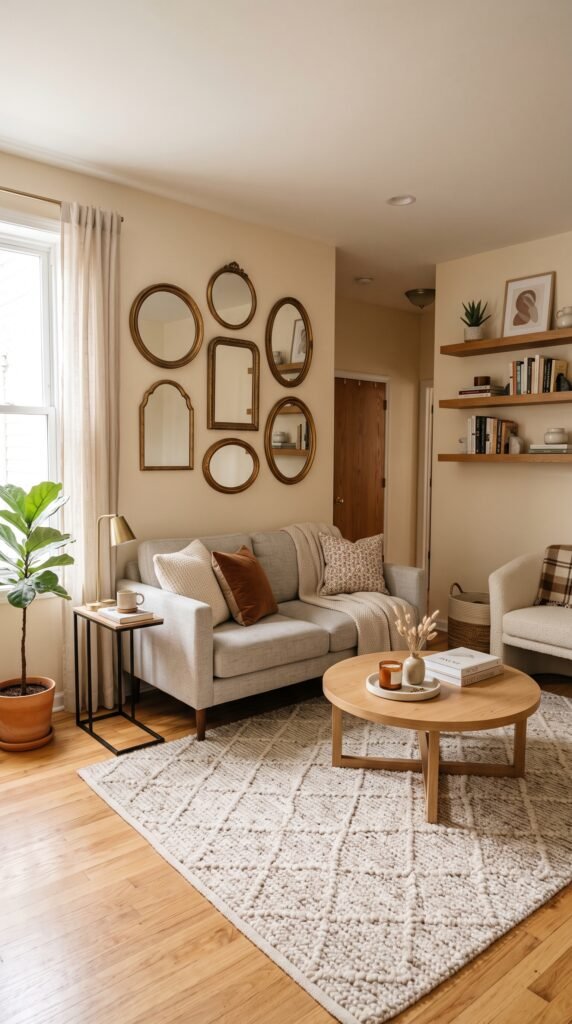
Small rooms feel busy when every surface is a different color, wood tone, or metal finish. Limit the room to two or three finishes and repeat them. For example, use light wood for the shelves and the side table, black metal for the lamp and the picture frames, and one fabric color for the cushions and the throw. That repetition makes the room feel organized, even when the room is full. A limited palette is one of the easiest small living room decor ideas to keep consistent, because you can check every new item against it.
Keep wall art to one wall, such as a gallery wall above the sofa, rather than spreading small pictures across every wall. A single group of pictures, hung with even spacing and with the center at eye level, reads as one feature. Several small pictures on different walls read as clutter.
9. Create Zones With Furniture, Not Walls
Even a small living room benefits from zones: a place to sit and talk, a place to read, and a place to work or eat if the room has to do more than one job. You do not need a wall or a screen to make a zone. Turn the back of the sofa toward the dining area, place a rug under the reading chair, or use a floor lamp to mark the reading corner. Each of those moves tells you what that part of the room is for.
Keep the zones open to each other. A low bookcase, a rug, or a change in lighting is enough to define a zone without blocking light or making the room feel divided. If a zone is not working, move one piece at a time and live with the change for a few days before you move anything else. Zoning is one of the most useful small living room decor ideas for a room that also serves as an office or a dining space.
How to Choose the Right Ideas for Your Room Shape
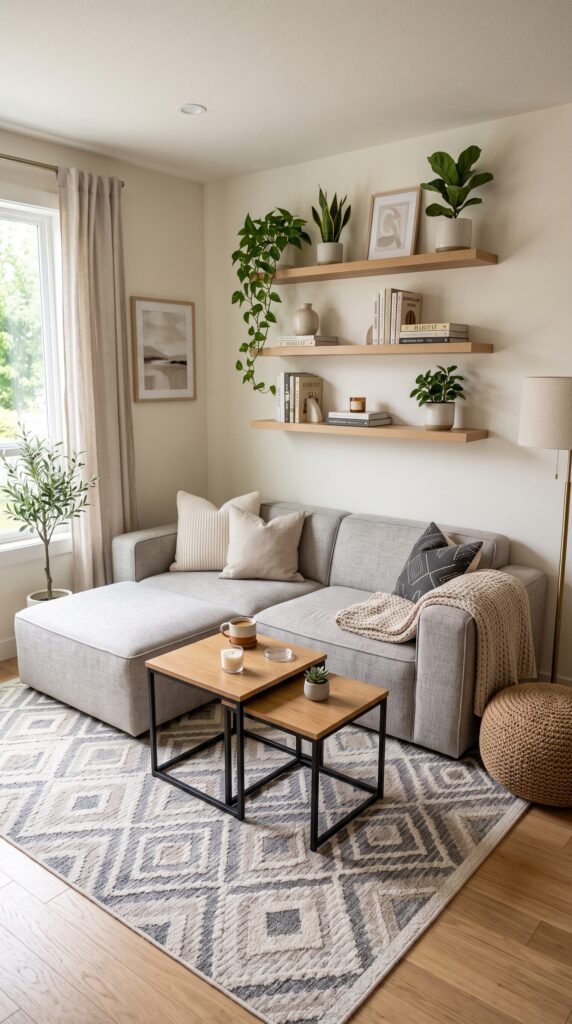
Not every approach works for every room. The shape of your room, and what else it has to do, should decide which of these small living room decor ideas you use first.
If your room is long and narrow, place the sofa along one long wall and use a narrow console or a row of shelves on the opposite wall. Avoid a coffee table that is wider than the sofa, because it will block the walkway. A runner rug, rather than a square one, follows the shape of the room. For more ideas in a modern style, see modern living room decor ideas for small spaces.
If your room doubles as a workspace, use a shelf or a narrow desk as a room divider, and keep work items in a box or a basket you can put away at the end of the day. A chair that works for both work and relaxing saves you from fitting two chairs into the same corner.
If your room lacks natural light, mirrors and layered lighting are your top priorities, followed by light-colored walls and a light rug. Avoid heavy curtains that block the window. Use a sheer curtain or a blind that lets light in during the day, and add a lamp near the darkest corner. See also Living Room Decor Ideas: 8 Simple Changes That Make a Massive Cozy Impact for more low-cost changes that make a room feel warmer.
Mistakes to Avoid in a Small Living Room
Most small living room decor ideas fail for the same few reasons, so avoid these mistakes first.
- Pushing all the furniture against the walls. A small gap behind a sofa, or a chair pulled a few inches away from the wall, makes the room feel less cramped than furniture pressed flat against every wall.
- Using too many small pieces. Five small tables, three small chairs, and a small sofa take up more floor and look busier than three well-chosen pieces.
- Choosing a rug that is too small. A rug that only fits under the coffee table makes the seating area look unfinished. Measure the seating area first, as described above.
- Blocking the window. A tall bookcase or a large plant in front of a window cuts the light that makes a small room feel open. Keep the window clear, or use a low piece there instead.
- Buying before measuring. A sofa, a rug, or a shelf that is a few inches too big can block a door or a walkway. Tape the footprint on the floor first, and check the delivery route through doors and stairs as well.
What to Buy First on a Tight Budget
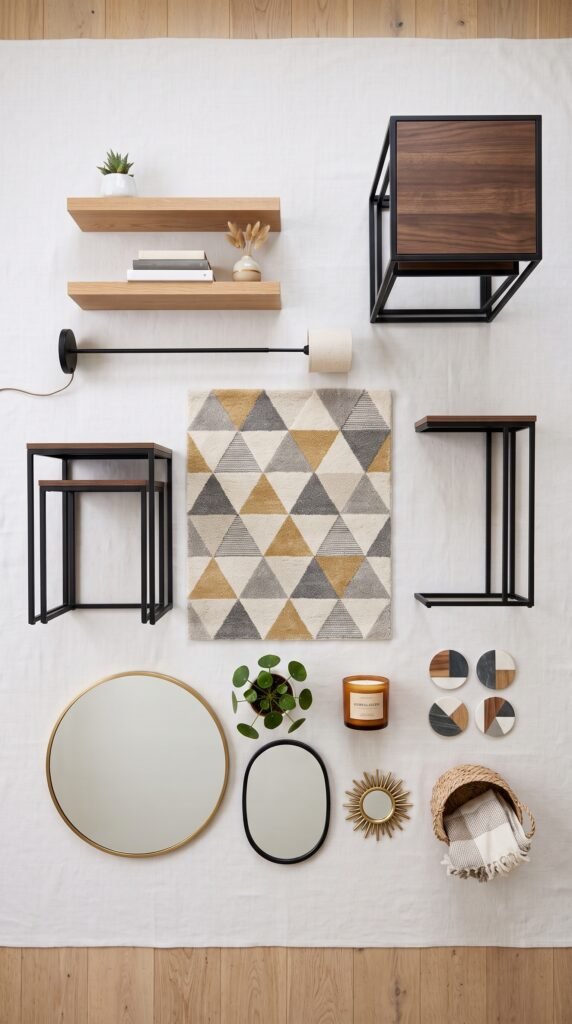
If your budget is tight, start with the changes that affect how you use the room every day. A side table and a set of floating shelves are usually among the lowest-cost changes, and they add a surface and storage you will use daily. Next, add a rug that fits the seating area, because it changes how the whole room looks at once. After that, add a floor lamp or a table lamp to fix the lighting. If you follow small living room decor ideas in the order in this guide, you will spend money on the changes that matter first.
Buy the sofa last, or only when you have measured carefully, because it is the most expensive piece and the hardest to return. Before you buy any piece, check the material and the care instructions: solid wood and metal frames last longer than particleboard in a room that is used every day, and a washable rug cover is worth choosing if you have pets or children. Keep the receipt and check the return policy, especially for a rug or a sofa, so you can return a piece that does not fit once it is in the room.
Frequently Asked Questions
How can I make my small living room look bigger?
Start with the layout and the light. Leave 30 to 36 inches clear on main walkways, choose a rug that fits the seating area, and add a mirror opposite a window. Keep the color palette to two or three finishes and avoid filling every wall. Those changes make a room feel open without changing its size.
What size rug should I use in a small living room?
Measure the seating area, not the room. The rug should extend at least 6 inches beyond the front legs of the sofa and chairs. In most small living rooms, that is a rug around 5 by 8 feet for a two-seat sofa and one chair, or 8 by 10 feet for a three-seat sofa and two chairs. If you are between sizes, choose the larger rug.
What is the best sofa for a small living room?
The best sofa is the one that fits your wall, leaves a clear walkway, and suits how you sit. Measure the wall, subtract space for a walkway, and choose a two-seat or compact three-seat sofa in that length. A modular sofa or a sofa with storage can help in a small room, but only if the size is right first.
Should I use a coffee table in a small living room?
You do not need a traditional coffee table. Nesting tables give you the same surface when you need it and tuck away when you do not. A side table beside the sofa can also replace a coffee table in a very small room. Leave 14 to 18 inches between the sofa and any table in front of it.
How do I add storage without making a small living room feel cluttered?
Use the walls and choose storage that does two jobs. Fit floating shelves or a tall, narrow bookcase, and use a storage ottoman or a bench with a lid for items you use often. Leave empty space on shelves, keep one color palette, and put away items you do not use every week. These small living room decor ideas work best when storage is planned, not added piece by piece.
Small does not have to mean compromised. It just means intentional. Start with one change, such as measuring the room and taping out the sofa footprint, then add the next fix when the first one is working. A small living room that is measured, organized, and lit well will feel comfortable every day, not just on the day you finish decorating it.