

If you have been searching for cozy bedroom ideas that truly move the needle on your sleep quality, you are not alone. A bedroom can look beautiful in photographs and still leave you waking up tired, restless or wired at 2 a.m. The problem is rarely effort. It is usually that the room is working against your body: too bright, too warm, too noisy or too dry.
In this guide:
- The Biggest Myth About Cozy Bedroom Ideas
- What the Research Actually Says
- 9 Cozy Bedroom Ideas That Solve Real Sleep Problems
- 1. Fix Your Light First
- 2. Set the Right Temperature for Sleep
- 3. Layer Your Bedding Like a Sleep Expert
- 4. Control Sound
- 5. Add Scent, Carefully
- 6. Improve Your Air Quality
- 7. Block Light at the Window
- 8. Create a Wind-Down Ritual Space
- 9. Keep the Routine
- The Bottom Line on Cozy Bedroom Ideas
- Frequently Asked Questions
The Biggest Myth About Cozy Bedroom Ideas
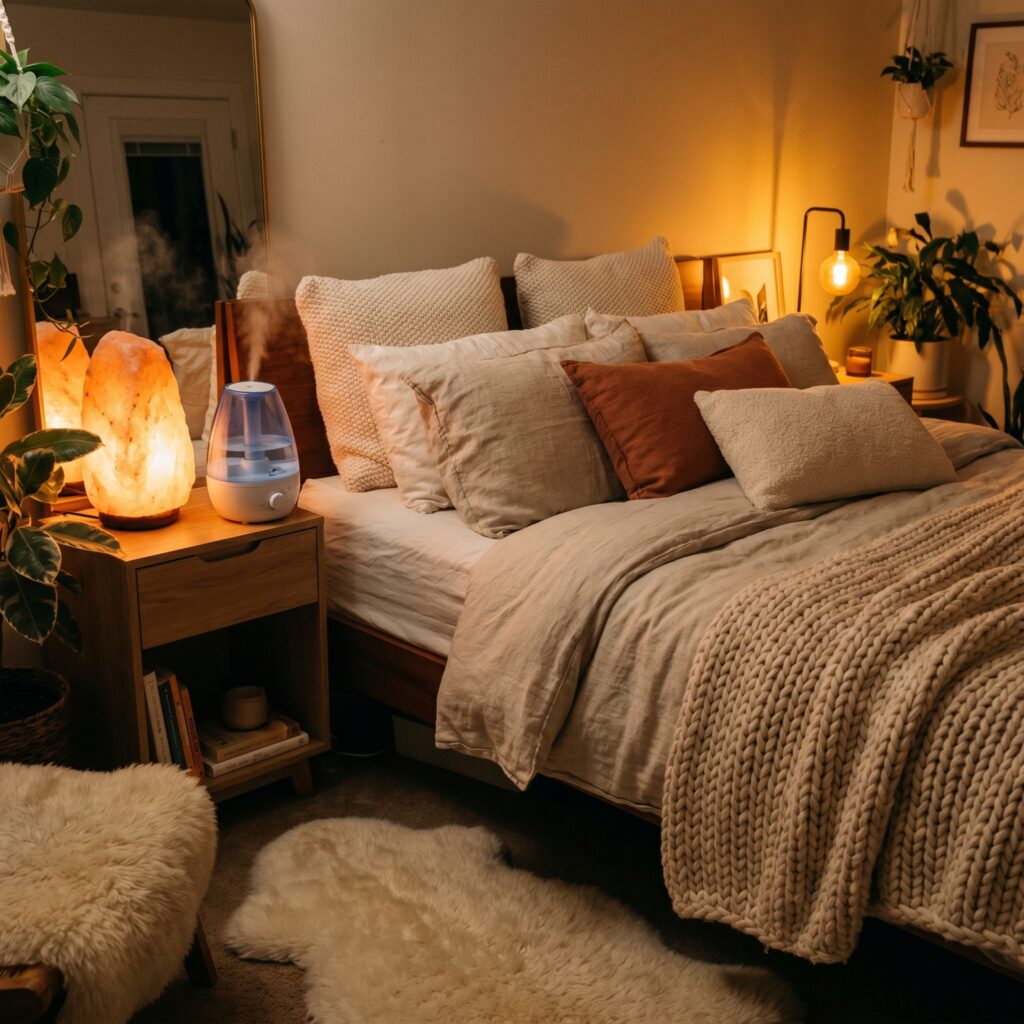
Most people believe a cozy bedroom is all about aesthetics — throw some fairy lights around, add a chunky knit throw, and you are done. That is the myth. A room can tick every decor box and still fail at its main job: helping you sleep.
The truth is that true bedroom coziness is a sleep science problem first and a styling problem second. Light, temperature, noise and air quality all affect how easily you fall asleep and how deeply you stay asleep. Get those four right and the room will feel cozy because it is calm, quiet and comfortable — not just because it looks the part.
Pinterest-worthy decor is lovely, but if your bedroom is too bright, too loud or too hot, no amount of texture will fix it. A genuinely cozy bedroom treats comfort as something you feel at 11 p.m., not something you photograph at noon.
The good news? You can solve both problems at once. The cozy bedroom ideas in this guide are chosen because they look good and they help you sleep — in that order of proof, not in that order of importance.
What the Research Actually Says
Light is the biggest lever. In a Harvard experiment, volunteers were exposed to blue light and to green light of comparable brightness for 6.5 hours. Blue light suppressed melatonin for about twice as long as green light, and it shifted circadian rhythms by twice as much — 3 hours, compared with 1.5 hours for green light. The 3 hours is the size of the circadian shift, not how long melatonin stayed suppressed. Harvard Health explains how blue light affects sleep, and its practical advice is simple: dim the lights in the evening and avoid bright screens for two to three hours before bed.
Noise is the second biggest disruptor. Quieter bedrooms support deeper sleep, and steady background sound — often called white noise — can help mask the sudden sounds that wake you, such as traffic, a neighbour’s television or a creaking floor.
Humidity matters too. The US Environmental Protection Agency (EPA) recommends keeping indoor relative humidity below 60%, ideally between 30% and 50%. Dry air below 30% relative humidity irritates nasal passages and skin, which is one reason a bedroom can feel uncomfortable even when the temperature is right. Air that is too damp, on the other hand, encourages mould and dust mites.
Temperature is the fourth piece. The National Sleep Foundation suggests 60–67°F (15–19°C) for sleep, and the Sleep Foundation puts the ideal range at 65–68°F, with about 65°F (18.3°C) as a sweet spot. Your body temperature naturally drops as you fall asleep, and a cool room helps that process along. A room that is too warm is one of the most common reasons for restless sleep.
These are not design preferences. They are physiological facts. And the best cozy bedroom ideas work with them, not against them. A warm lamp, a heavy blanket and a cool room can all belong in the same bedroom — that is the point.
9 Cozy Bedroom Ideas That Solve Real Sleep Problems
Work through these nine cozy bedroom ideas in order. The first three — light, temperature and bedding — make the biggest difference, and most of them cost little or nothing. The rest are finishing touches that turn a sleep-friendly room into a room you actually look forward to spending time in.
1. Fix Your Light First
Swapping your existing bulbs for tunable smart bulbs is one of the highest-impact changes you can make. They let you shift from bright, cool white light during the day to a dim, warm amber glow in the evening. Set them to fade down automatically an hour before bed, so you do not have to remember to do it. Warm light around 2700K is a good evening choice: it feels soft and it is far less likely to keep you alert than cool daylight-white light.
For an even softer ambient option, a salt lamp or any small lamp with a warm, dim bulb gives a gentle glow that is easy on the eyes after dark. Keep the brightest light in the room — the ceiling light — off in the evening and use lamps at bed height instead. If you want budget-friendly ways to do this well, see Bedroom Lighting Ideas Under $40.
2. Set the Right Temperature for Sleep
Aim for about 65°F (18.3°C) in the bedroom at night. The National Sleep Foundation suggests 60–67°F (15–19°C), and the Sleep Foundation puts the ideal range at 65–68°F. If 65°F feels cold at first, try 67°F and work down a degree at a time over a week rather than changing everything in one night. Your bedding matters here too: a lighter duvet in a cool room usually sleeps better than a heavy duvet in a warm one.
Practical ways to get there: turn the thermostat down an hour before bed, close the blinds or curtains during the day to stop heat building up, open a window for a short while in the evening if the air outside is cooler, and use a fan to move air across the room. A warm bath an hour or two before bed can help as well — your body cools down afterwards, which supports the natural drop in temperature that comes with falling asleep.
3. Layer Your Bedding Like a Sleep Expert

Your bed is the centerpiece of any cozy bedroom, and the right layers make it both inviting and easy to adjust through the night. Start with breathable sheets — cotton or linen work well because they let air move and do not trap heat. Add a duvet or comforter that suits the season, then finish with a throw you can pull on or push off without remaking the bed.
Layers beat one very heavy blanket because you can adjust them. If you wake up warm, push the throw aside. If you are cold, pull it back. Keep a spare blanket folded at the foot of the bed so the choice is easy at 3 a.m. Choose washable fabrics where you can — bedding you can wash easily stays fresh, and fresh bedding is part of what makes a bed feel cozy.
A weighted blanket is worth considering if you like the feeling of gentle, even pressure. A 2020 randomised controlled trial in the Journal of Clinical Sleep Medicine, with 120 adults who had insomnia and a psychiatric diagnosis, found that using a weighted blanket for four weeks eased insomnia severity and improved sleep maintenance and daytime functioning. A small single-night crossover study also found about 30% higher pre-sleep salivary melatonin with a weighted blanket than without one. That is promising, not proof that it works for everyone — and studies have not found a meaningful change in cortisol under a weighted blanket, so do not buy one expecting it to lower stress hormones. Choose a blanket that is about 10% of your body weight, try it for a few weeks, and keep it if you sleep better with it.
4. Control Sound
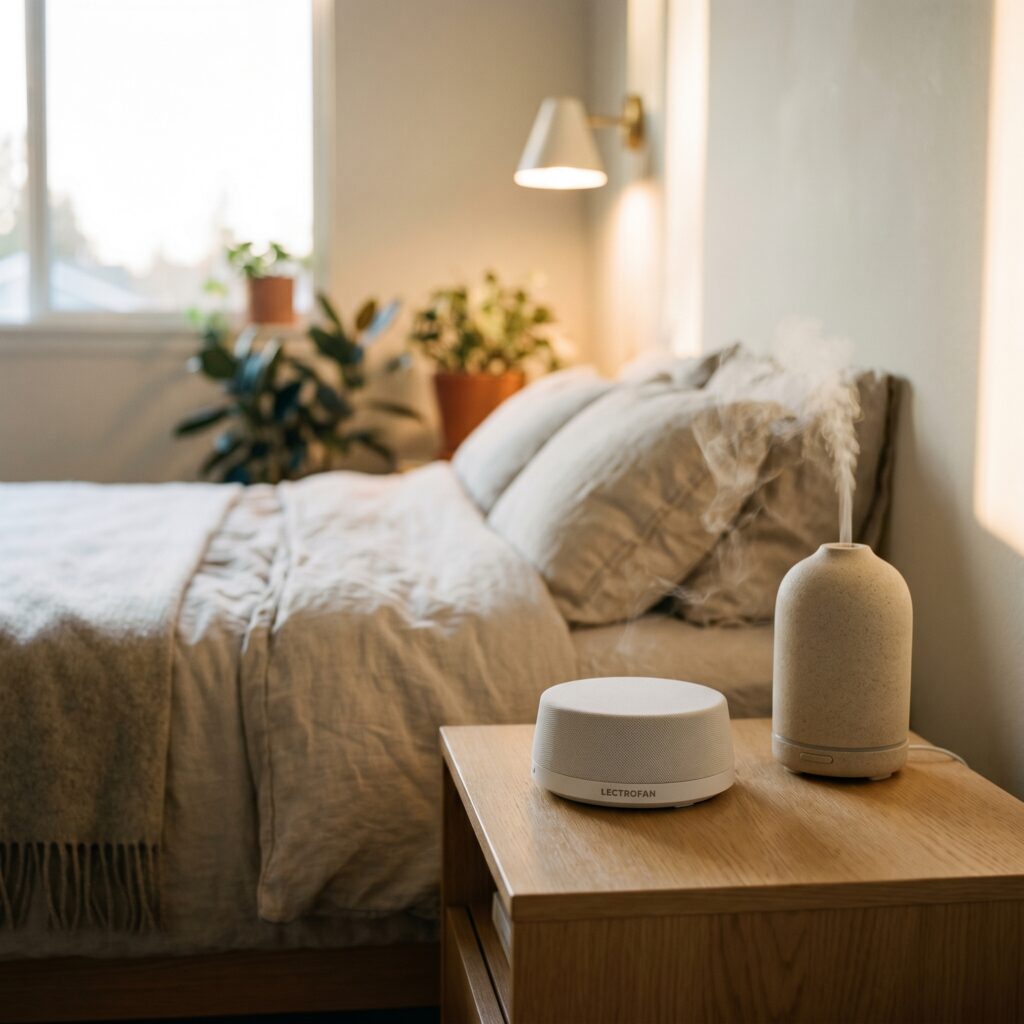
Noise masking is worth taking seriously if you live in a busy area or share a home with different schedules. A white-noise machine, or a phone app played through a small speaker, produces a steady sound that makes sudden noises less jarring. Set the volume low — it should sit in the background, not dominate the room — and try a few sounds (steady fan noise, rain, brown noise) to find what you find relaxing. Earplugs are a cheaper alternative, although some people find them uncomfortable; soft foam plugs are usually the easiest to sleep in.
Soft furnishings help too. A rug, heavy curtains, an upholstered headboard and a full wardrobe all absorb sound and reduce echo, which is one reason carpeted, well-furnished bedrooms feel calmer than bare ones. If you can hear the street clearly with the windows closed, start with the curtains and the rug before buying any gadget.
5. Add Scent, Carefully
A gentle scent can be a useful wind-down cue, as long as you keep it light. Lavender has the best evidence of any bedroom scent for relaxation — it is the one most often studied in sleep research, and it is the safest starting point. Eucalyptus, by contrast, is mainly a fresh, clean scent; the evidence that it calms you is weak, so use it because you like the smell, not because it will make you sleepy. A few drops of lavender oil in an ultrasonic diffuser, run for 30 minutes before bed and switched off when you get into bed, is enough. Strong, continuous scent through the night is not better — it can irritate airways and wake you.
If you have asthma, allergies or a scent-sensitive household, skip the diffuser and use scent-free options instead: freshly laundered bedding, an open window for fresh air, or a lavender sachet in a drawer rather than in the air you breathe all night. Scent should be a background note, not the main feature of the room.
6. Improve Your Air Quality
Dry bedroom air is a stealth sleep thief. A cool-mist humidifier can bring a dry bedroom back into the EPA’s recommended range of 30–50% relative humidity, and it can help if you wake with a dry throat or nose. Keep it clean — a dirty humidifier breeds bacteria and mould, which defeats the purpose. Rinse and refill it daily and clean it thoroughly at least once a week, following the maker’s instructions. This is also one of those cozy bedroom ideas where a cheap hygrometer earns its place: a small digital humidity meter costs little and tells you whether the room is actually in the 30–50% range, instead of leaving you to guess.
Ventilation matters as much as humidity. Open a window or a door for a short time each day, even in winter, to let stale air out. Houseplants make a room look and feel better, but do not rely on them to clean the air — a few plants in pots cannot purify a room. Their value in a bedroom is that they soften the space and give you something living to look at, which is reason enough.
7. Block Light at the Window
Bedroom lighting is only half the light problem. Streetlights, a neighbour’s security light and early summer sunrises all get in through the window, and thin curtains do nothing to stop them. Close-fitting blackout curtains are the simplest fix. Hang them so they cover the whole window frame, not just the glass, and check for gaps at the top and sides — light leaking around the edges is the most common reason blackout curtains disappoint. A curtain rod that sits close to the wall, or curtains that overlap the frame by a few centimetres on each side, makes a real difference.
Layering works well here too: light-filtering blinds or a sheer curtain for daytime privacy, with blackout curtains drawn at night. If new curtains are not in the budget this month, a simple sleep mask is a good stopgap — keep it on the bedside table so it is easy to reach. For the bigger picture — when a bedroom feels dull even after the practical fixes — see Best Bedroom Ideas to Brilliantly Fix a Boring Space Fast.
8. Create a Wind-Down Ritual Space

One of the most underrated cozy bedroom ideas is designing a dedicated wind-down corner — a place that is not the bed and not a desk. A comfortable chair or a small reading nook with a supportive reading pillow, a soft throw and a dim lamp is enough. Keep a book there, not a phone charger. The point is to have somewhere to go for the last 30 minutes of the day that is already calm, so you do not have to create calm from scratch each night.
Repeating the same cues in the same place each night helps your brain learn the association: this chair, this lamp, this book, then bed. It is the same principle as always reading in bed — except you keep the bed for sleep, which is a healthier habit in the long run. Keep the corner simple. If it needs tidying before you can use it, you will not use it.
9. Keep the Routine
The last of these cozy bedroom ideas is the least decorative and the most important: keep the routine. Use the same wind-down steps, in roughly the same order, every night — dim the lights, cool the room, read or stretch for a while, then get into bed. Go to bed and get up at roughly the same times each day, including weekends, as far as your life allows. A regular rhythm is what turns a nice bedroom into a reliable sleep cue.
Do not turn the routine into a test. If you miss a night, or a late evening out throws the timing off, just pick the routine up again the next night. A wind-down ritual that you can only do perfectly is one you will abandon. A short, repeatable version — lights down, room cool, 20 minutes with a book — is better than an elaborate one you only manage twice a week. If your earlier changes did not seem to help, read Why Your Bedroom Ideas Aren’t Working (And the Simple Fix) before buying anything new.
The Bottom Line on Cozy Bedroom Ideas
The most effective cozy bedroom ideas are not about spending the most money or following the latest trend. They are about making the room darker, cooler, quieter and calmer at night — and then adding the textures and colours that make it feel like yours. Start with light, set the temperature, layer the bedding, and only then worry about the finishing touches. If you are new to this and want a broader starting point, Cozy Bedroom Design Tips Every Beginner Needs to Know is a good companion to this guide.
Do all of that, and your bedroom will not just look cozy — it will actually help you sleep. That is the test that matters. A bedroom that photographs well and sleeps badly is a failed design, however many compliments it gets.
Frequently Asked Questions
What is the best bedroom temperature for sleep?
About 65°F (18.3°C) is a good target for most adults. The National Sleep Foundation suggests 60–67°F (15–19°C), and the Sleep Foundation puts the ideal range at 65–68°F. Start at 67°F if 65°F feels cold, and adjust a degree at a time. A room that is too warm causes more sleep problems than a room that is slightly cool, because your body needs to cool down to fall asleep.
Does blue light really affect sleep?
Yes. Blue light suppresses melatonin more powerfully than other colours of light. In a Harvard experiment, blue light suppressed melatonin for about twice as long as green light of comparable brightness, and it shifted circadian rhythms by twice as much — 3 hours versus 1.5 hours. Dimming the lights and avoiding bright screens for two to three hours before bed are the most practical steps.
What humidity level is best for a bedroom?
The EPA recommends keeping indoor relative humidity below 60%, ideally between 30% and 50%. Below 30%, dry air can irritate your nose and skin; above 60%, damp encourages mould and dust mites. A small digital hygrometer will tell you where your bedroom actually sits.
Do weighted blankets actually help you sleep?
They can help some people. A 2020 trial in the Journal of Clinical Sleep Medicine found that a weighted blanket used for four weeks eased insomnia severity and improved sleep maintenance and daytime functioning in 120 adults with insomnia and a psychiatric diagnosis. A small single-night study also found about 30% higher pre-sleep salivary melatonin. They do not work for everyone, and studies have not found a meaningful change in cortisol, so try one for a few weeks and keep it only if you sleep better.
What is the fastest cozy bedroom change to make tonight?
Dim the lights and cool the room. Switch off the ceiling light, use a warm lamp instead, turn the thermostat down towards 65°F (18.3°C) and draw the curtains. Those three changes take five minutes, cost nothing, and are the fastest of all these cozy bedroom ideas to feel working.