
I have a confession. For nearly two years, I had over 800 pins saved in a board called “Living Room Ideas.”
Eight hundred.
And do you know what my actual living room looked like during those two years? A beige sofa I didn’t love, a coffee table that was the wrong size, a rug that looked great in the photo and terrible in real life, and a single floor lamp casting harsh white light onto everything.
I would sit there at the end of long days, scroll through my Pinterest board, and feel a quiet, specific kind of frustration: I know what I want it to feel like. So why can’t I make it happen?
If you’re reading this, I’m guessing you know that feeling.
Here’s what I learned, slowly and expensively: the gap between Pinterest and your actual home is not a talent gap. It’s not a budget gap. It’s a process gap. Designers don’t just have better taste — they have a sequence they follow, and that sequence prevents 90% of the mistakes the rest of us make.
This post is going to walk you through the exact sequence. By the end, you’ll know:
- Why your room doesn’t feel “cohesive” even though you love every individual piece
- The five stages every successful makeover follows (in order — the order matters)
- The most common decorating mistakes and how to avoid them
- A specific question to ask yourself before every purchase that will save you hundreds, possibly thousands of dollars
Let’s get into it.
Why Most Room Makeovers Fail (And It’s Not What You Think)
Most decorating advice on the internet skips the most important part of the process: knowing what you actually want.
I don’t mean “I want a cozy living room.” Everyone wants a cozy living room. I mean: cozy how? Modern-farmhouse cozy with linen slipcovers and warm wood? Or Japandi cozy with empty space and one quiet ceramic vase? Or boho cozy with layered vintage rugs and brass everywhere?
These are radically different rooms. They use different palettes, different furniture, different lighting. And yet most people start shopping before they’ve answered the question. They buy a beautiful sage velvet pillow because it was on sale at Target, then later they buy a navy striped throw because it was cute on Amazon, then a brass lamp because it was trending on Instagram — and a year later they wonder why nothing in the room talks to anything else.
The mistake isn’t what you bought. The mistake is buying before you decided.
The five stages I’m about to walk you through fix this in a specific order:
- Discover your style (before anything else)
- Assess the room (measure, photograph, name what’s not working)
- Build the vision (mood board, palette, lighting plan)
- Plan the budget and shopping (allocate, then prioritize)
- Execute and track (timeline, to-do list, before/after)
Skipping ahead is what causes most decorating regret. Let’s go through them.

Stage 1: Discover Your Style
Here’s a question that sounds easy but isn’t: what is your style?
Not the style of the rooms you pin. Your style. The style that fits your actual life — your kids, your pets, your climate, your job, the way you actually use your home on a Tuesday night at 9 PM.
Most of us don’t know. We’re a hybrid of a few different aesthetics, and we’ve never sat down to define which one dominates and which one accents.
The fix is a style quiz — but not a fluffy 5-question Buzzfeed one. A real one, with thirty questions about how you actually live (your dream coffee table, the fabric you’d choose for a sofa, the candle scent you’d burn). Then you tally your answers across five dominant styles:
- Modern Farmhouse (cozy, warm, quietly worn-in)
- Japandi (calm, quiet, intentional)
- Coastal (breezy, light, sun-washed)
- Boho Eclectic (soulful, layered, well-traveled)
- Mid-Century Modern (polished, graphic, confident)
Your top letter is your dominant style. Your second-highest is your accent style. That mix — usually a 70/30 split — is what makes a home feel like you instead of a showroom.

When a Room Feels Overwhelming: The Room Reset System
We all have that one room that gets away from us. The bedroom chair. The kitchen counter. The spare room that’s quietly becoming a storage unit.
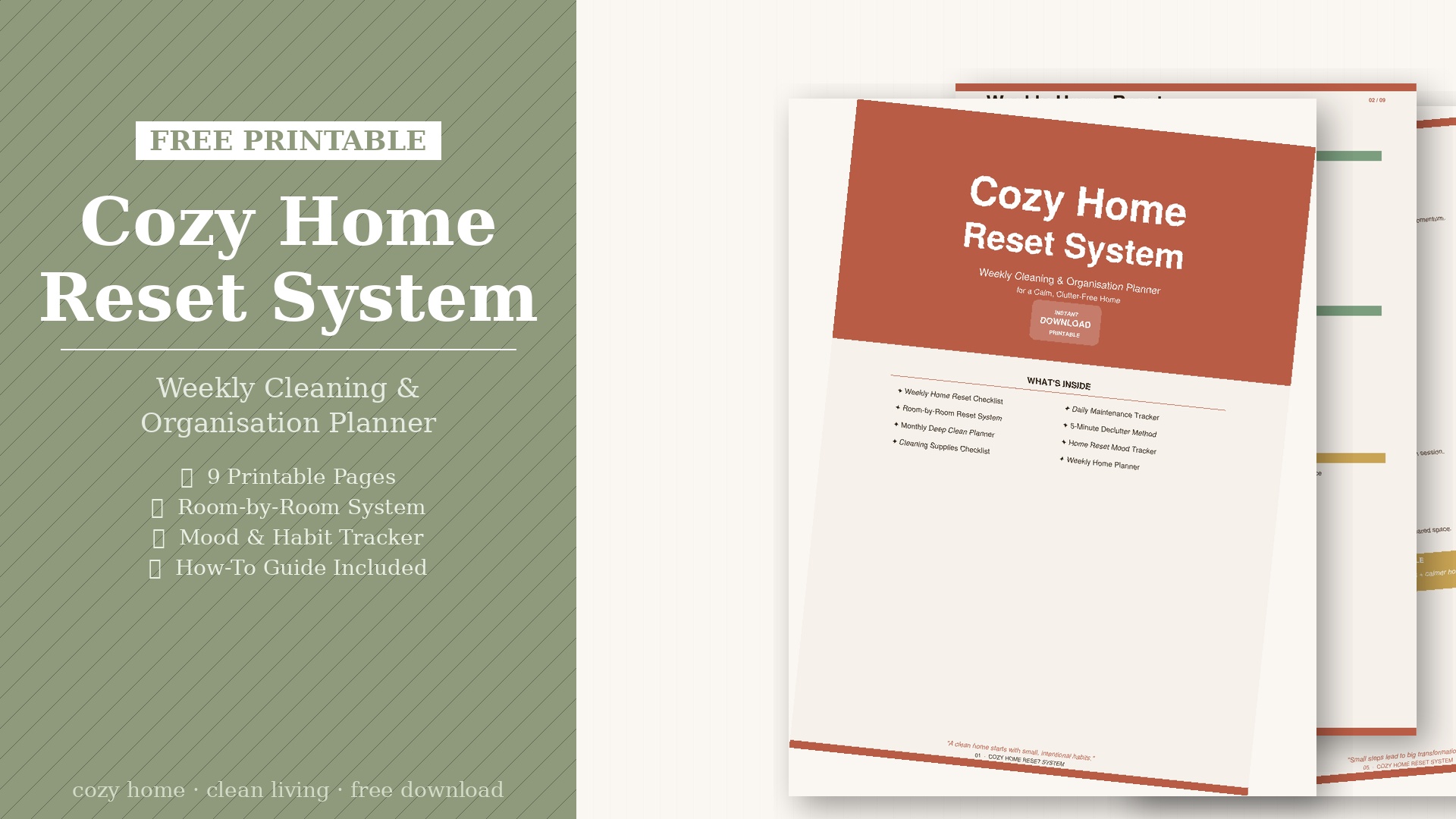
For those moments, the Room-by-Room Reset System is your best friend. It breaks each room into just four tasks, with a simple 0/4 progress counter. You focus on one room at a time, track your progress, and get the satisfaction of completing it before moving on.

The 5-Minute Declutter Method: Your Secret Weapon
Clutter is the enemy of a calm home. But decluttering feels overwhelming because we think we have to do it all at once.
The 5-Minute Declutter Method solves this with a five-step system you can run on any small area — a drawer, a shelf, a corner of the kitchen counter:
- Pick one small area — start tiny, build momentum
- Sort into three piles — Keep, Donate, Discard
- Ask the golden question — “Do I use this or love this?”
- Remove at least 5 items — challenge yourself every session
- Reset the space visually — arrange what’s left and enjoy it
The golden rule? “Fewer items = easier cleaning + calmer home.”
The Feature Most Planners Miss: The Mood Tracker
Here’s what makes the Cozy Home Reset System different from a standard cleaning checklist — it acknowledges that your home and your mental state are connected.
The Home Reset Mood Tracker lets you rate your daily energy levels (1–5) across the month and check in on how your home feels each week — calm, cosy, cluttered, or chaotic.
When you track both together, a pattern emerges. The weeks you stayed consistent with your daily habits? Higher energy scores. The weeks the clutter crept back? You can feel it in the data.
It’s a quiet but powerful reminder that a tidy home isn’t just about aesthetics — it genuinely affects how you feel.

Going Deeper: The Monthly Clean Planner
The monthly planner is what separates a “clean” home from a truly fresh home.
Most of us wipe the counter but forget the inside of the microwave. We vacuum the floor but skip under the bed. The Monthly Deep Clean Planner covers those easy-to-miss jobs by dividing the month into four zones:
- Week 1 — Kitchen: oven, fridge shelves, exhaust fan, kettle descale
- Week 2 — Bathroom: grout, toilet, medicine cabinet, shower curtain
- Week 3 — Bedroom: mattress rotation, duvet wash, wardrobe sort
- Week 4 — Living Spaces: upholstery, light switches, windows, junk drawer
One zone per week. Fifteen minutes at a time. A home that actually feels deep-cleaned by month’s end.

Everything You Need to Get Started: Cleaning Supplies Checklist
Before you can reset your home, you need the right tools. The Cleaning Supplies Checklist covers four categories — cleaning solutions, tools and equipment, paper and disposables, and organisation extras — so you can do one quick stock-check and know exactly what to grab on your next shopping run.
No more stopping mid-clean because you ran out of bin bags or can’t find the glass spray.

Why This Works When Other Systems Don’t
Most cleaning systems fail for one of three reasons:
They’re too rigid. Miss one day and the whole schedule falls apart. The Cozy Home Reset System is built around flexible daily habits and a single weekly reset day — not a rigid hour-by-hour timetable.
They’re overwhelming. The 5-Minute Declutter Method and the Room Reset System both work on the principle of starting small. One drawer. One room. One habit at a time.
They ignore how you feel. The Mood Tracker is the only cleaning planner feature I’ve seen that actively connects your cleaning habits to your wellbeing — and that connection is exactly what keeps you motivated on low-energy days.
Ready to Reset Your Home?
If you’re tired of the Sunday scramble — of cleaning reactively instead of maintaining consistently — the Cozy Home Reset System is exactly what you need.
It’s simple. It’s beautiful. It works.