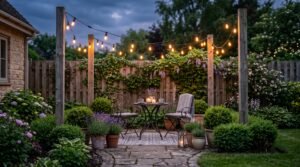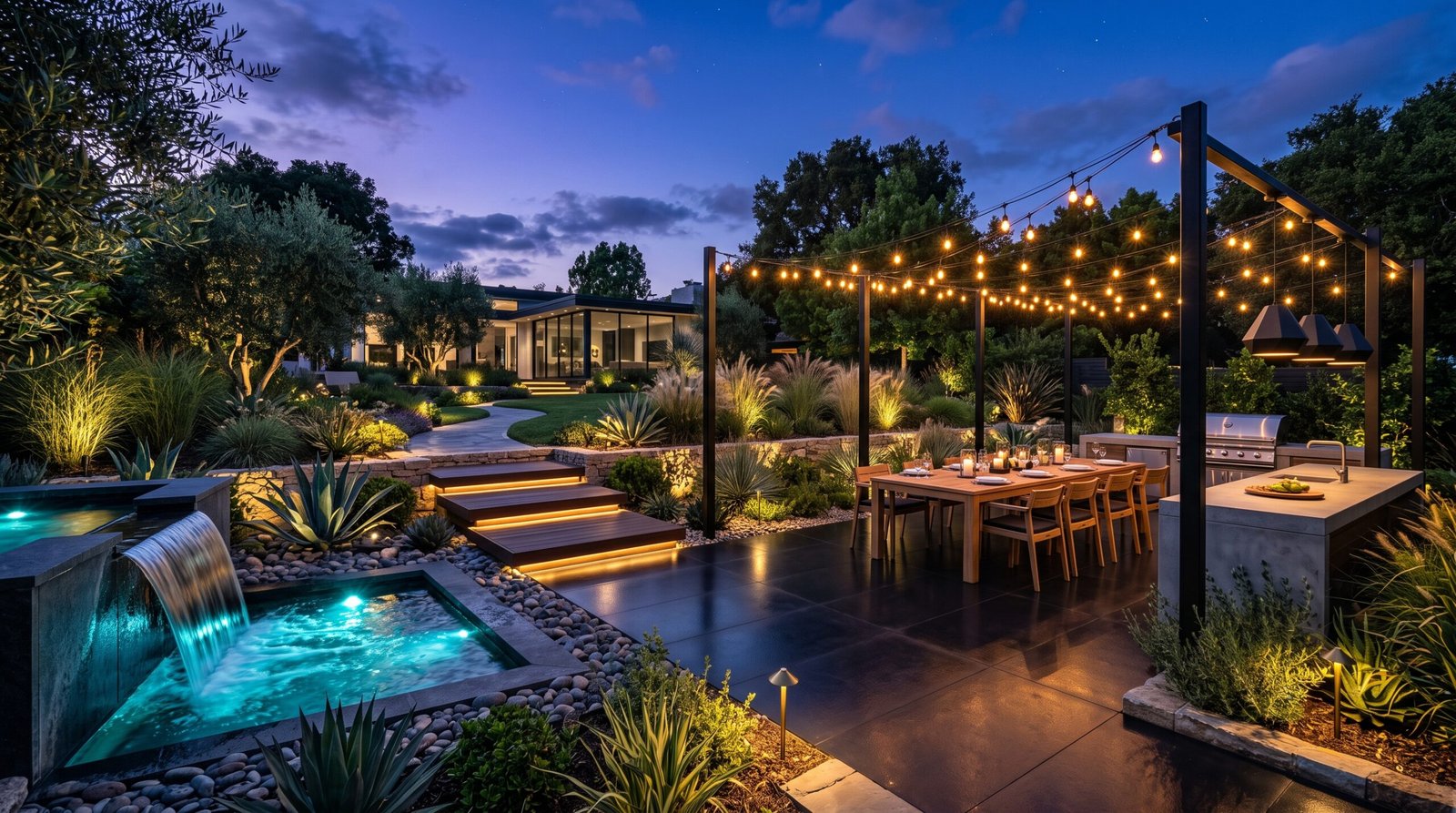
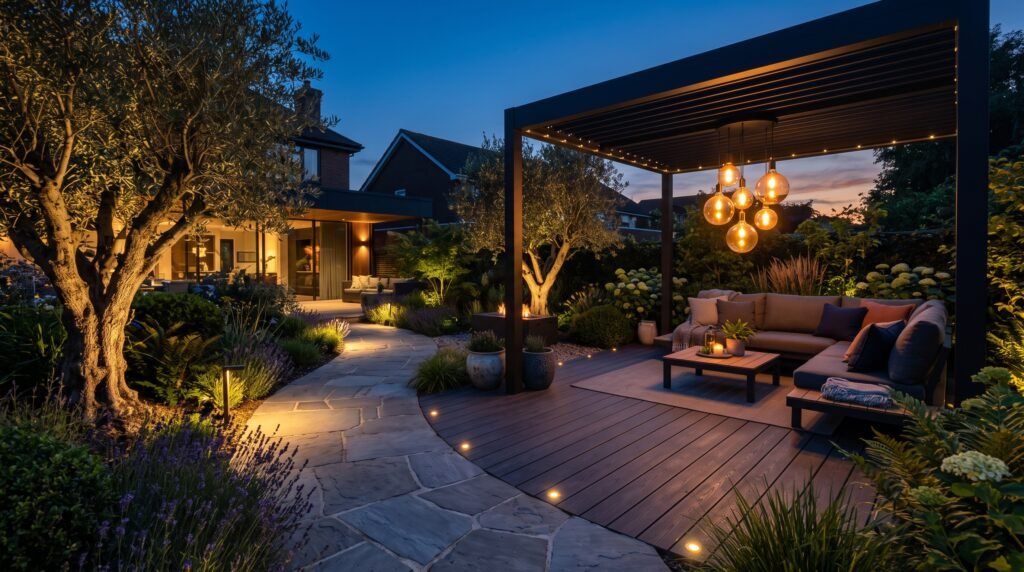
If you have been searching for modern outdoor lighting ideas that make your garden feel magical after dark, start with a plan, not a purchase. The gardens that glow best are rarely the ones with the most lights. They are the ones where each light has a job: marking a path, warming a seating area, or drawing your eye to a tree, a wall, or a planting bed you love. This guide walks through the ideas that work in real gardens, with the spacing, brightness, and weatherproofing details that make the difference between a garden that feels inviting and one that feels like a runway.
You do not need a large garden or a large budget. Most of the ideas below work in a small yard, and several need no wiring at all. Work through them in order, test each layer at night before you add the next one, and stop when the garden feels finished. That last step is the one most people skip.
In this guide
- How to plan modern outdoor lighting ideas in three layers
- Solar path lights that actually work
- String lights without the sag
- Spotlights and uplighting for trees and walls
- Pergola, deck and patio lighting
- LED strips for steps, beds and edges
- Lanterns, candles and tabletop glow
- Smart controls, timers and dimmers
- Choose the right brightness and color temperature
- Weatherproofing and safety basics
- Mistakes to avoid
- Frequently asked questions
How to plan modern outdoor lighting ideas in three layers
Good outdoor lighting has three layers, and each one does a different job. The ground layer marks paths and steps so people can move safely. The overhead layer adds warmth and a sense of enclosure, usually with string lights or a pergola fixture. The accent layer picks out one or two features, such as a tree, a textured wall, or a water feature, and leaves the rest in soft shadow. When all three layers are present, a small garden can feel larger and more finished than a big garden lit with a single floodlight.
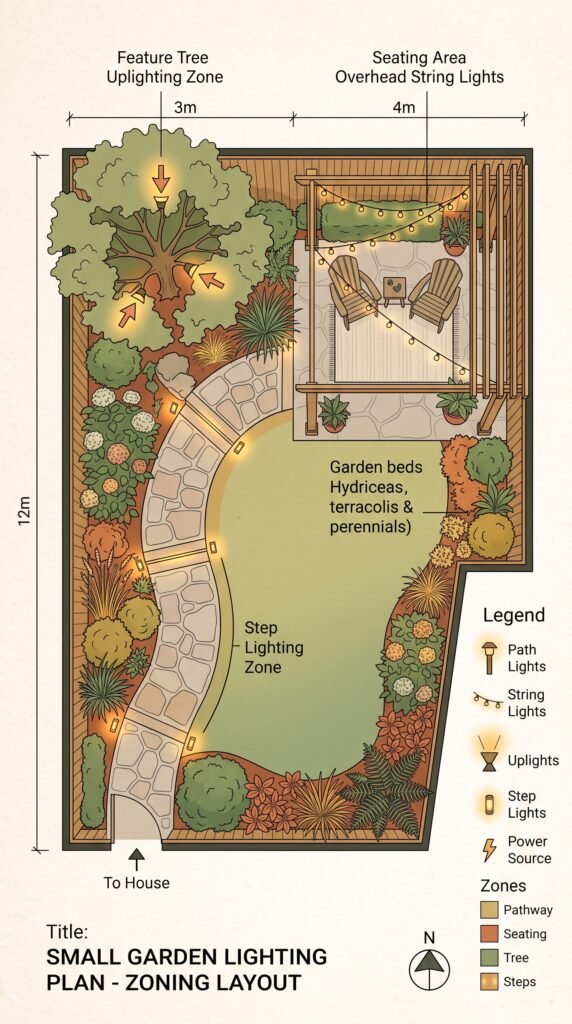
Before you buy anything, walk the garden at dusk and note where it goes dark first. Those are your priority zones. Then sketch the garden in four zones: paths, seating, planting beds, and focal points. Plan one layer at a time, and decide what each light is for before you choose it. If the seating area itself needs work first, these outdoor living spaces for small backyards show how to lay out a compact patio before you light it.
A useful test is to light one layer, then stand inside the house and look out. If the garden reads clearly from the window, the layer is working. If you can see the fixtures but not the garden, the lights are too bright, too high, or pointed at the viewer instead of at the garden.
Solar path lights that actually work
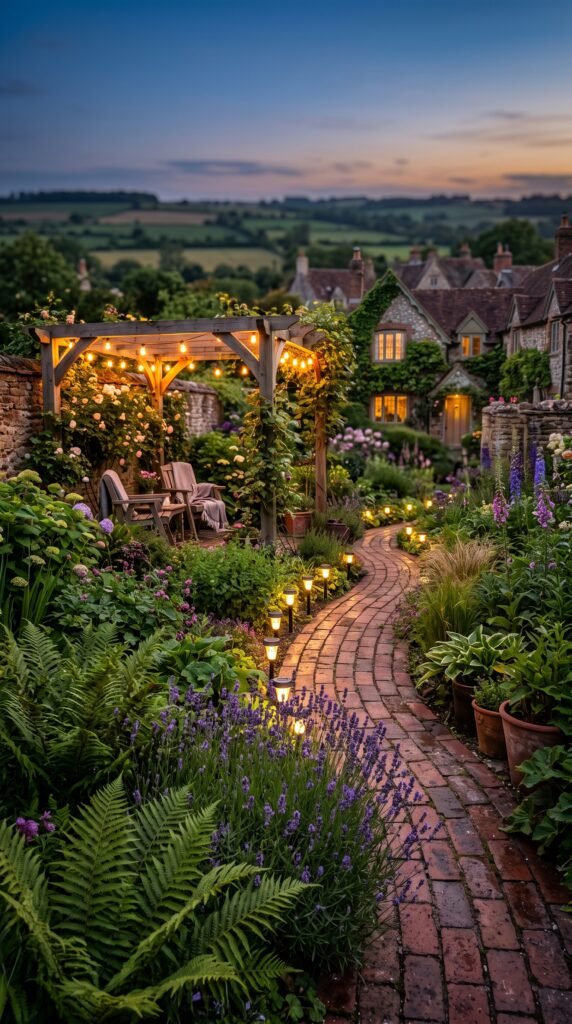
Path lights are the foundation of a well-lit garden. They show where to walk, they anchor the space visually, and they look just as good from inside the house as they do from the patio. Solar stake lights are the simplest way to start because there is no wiring, no transformer, and nothing to plug in.
Place path lights about 2 to 3 feet apart, alternating from one side of the path to the other, so the pools of light overlap without forming a solid line. For a short, straight path, 6 to 8 lights are usually enough. For a curved path, add a light at each bend so the turn is visible. Push the stake firmly into the soil and keep the small solar panel facing open sky, not shaded by a fence or a shrub.
Solar lights only work as well as the sun they receive. A panel that gets less than a few hours of direct sun each day will glow weakly and fade early. Wipe the panel clean once a month, because dust and pollen cut charging noticeably, and expect to replace the rechargeable batteries every year or two when the lights start fading before midnight. Choose warm white light, around 2700K, and metal or stainless-steel stakes rather than thin plastic, which tends to crack after a winter outdoors. These modern outdoor lighting ideas are also the easiest to move: if a light ends up in shade, pull the stake out and try a sunnier spot for a week before deciding it is faulty.
String lights without the sag
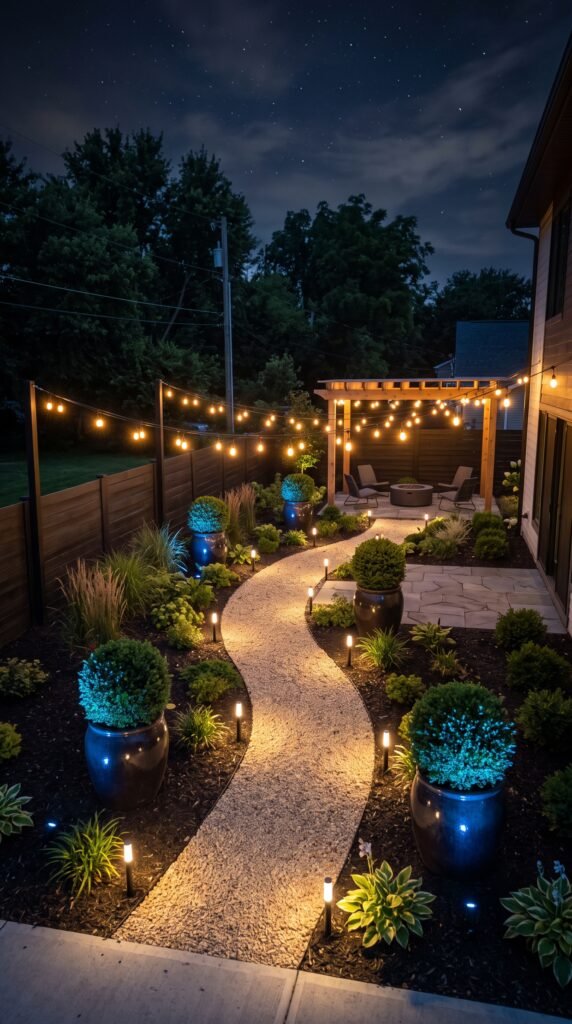
String lights are the single most transformative addition in most small gardens, because they add a ceiling of warm light where there was none. They work best when they are hung with intention. Measure the span first, then add a little slack so the strand hangs in a gentle curve instead of a tight straight line. For spans longer than about 10 feet, run a taut stainless-steel guide wire first and clip the strand to it every couple of feet. The wire carries the weight, so the strand itself never sags or pulls its fixings out of the wall. Among modern outdoor lighting ideas, string lights give the most visible change for the least effort, which is why they are a good first overhead layer.
Choose outdoor-rated, shatterproof bulbs in warm white, and hang the strand 8 to 10 feet above the ground over a seating area, high enough to walk under without ducking. Plug it into a ground-fault protected outdoor outlet, keep plugs and connections raised off the ground, and take the strand down or protect it before heavy snow. String lights also set the scene for evening gatherings. See these small garden party ideas guests will love for seating and table layouts that work well underneath them.
Spotlights and uplighting for trees and walls
Uplighting is where a garden goes from pleasant to genuinely impressive. A single well-aimed spotlight can turn an ordinary tree into the feature of the whole garden. Place the fixture at the base of the tree, a foot or two out from the trunk, and aim it up through the branches. For a wall, set the light low and close, and wash the light upward so the texture of brick or stone shows. Keep the beam off windows and out of the eyes of anyone sitting nearby, and light one or two features only. When everything is lit, nothing stands out.
Most garden spotlights run on a 12-volt low-voltage system, which is safer to install than mains-voltage lighting and easy to extend later. Add up the wattage of every fixture on the run, then choose a transformer with headroom above that total so it is never working at its limit. Bury the low-voltage cable a few inches below the surface, and leave a little slack at each fixture so you can adjust the angle later. These modern outdoor lighting ideas work best when they follow the principles in DarkSky International’s Five Principles for Responsible Outdoor Lighting: use light only where it is needed, keep it targeted and low-level, and choose warm color where possible.
Pergola, deck and patio lighting
A pergola gives you somewhere to hang light, which is why it changes a patio so much after dark. A single warm pendant or a pair of small lanterns hung from the beams creates a pool of light over the table, while string lights along the beams soften the edges. Keep the brightest light over the table and let the corners stay a little darker. That contrast is what makes a patio feel cozy rather than flat. For a small patio, modern outdoor lighting ideas should start at the table, not at the edges: one warm light over the table, then a softer layer around it.
On a deck, use low, recessed lights in the steps and along the deck edge. Step lights should be small and shielded so they mark the edge of each tread without shining into anyone’s eyes. Wall lights on the house should wash downward, not outward, so they light the deck surface instead of glaring across it. If you are planning the space from scratch, these modern garden ideas to transform your outdoor space cover layouts and planting that pair well with layered lighting.
LED strips for steps, beds and edges
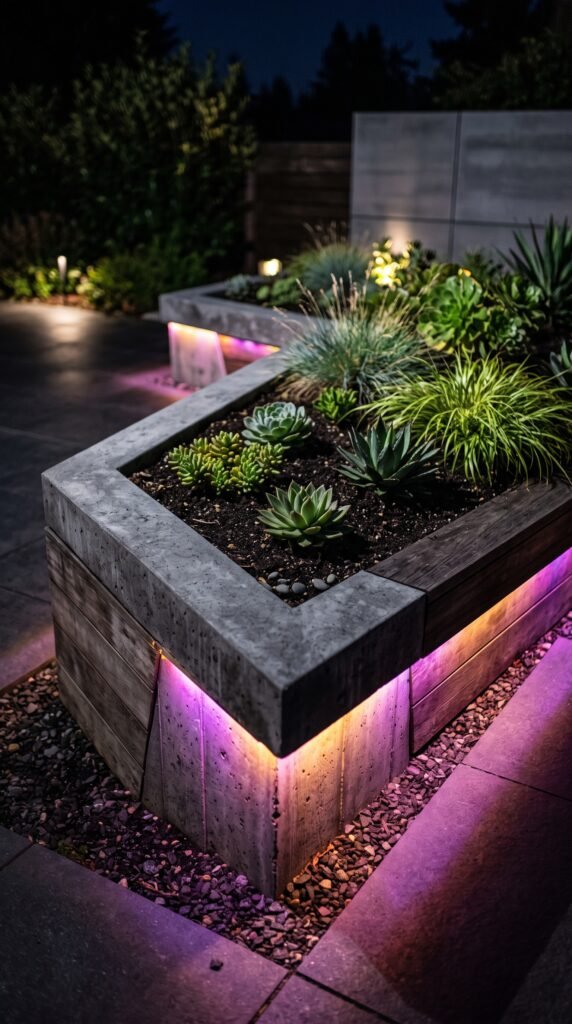
LED strips are useful wherever you want a line of light with no visible fixture: under a bench, along the edge of a raised bed, under a stair tread, or behind a planter. Mount the strip in a shallow aluminum channel with a diffuser, and set it back so you see the glow on the surface below, not the individual dots of the strip itself. That one detail is the difference between a polished look and a strip that looks stuck on. Modern outdoor lighting ideas for small gardens often rely on strips like these, because a single strip can light a whole bed without a visible fixture.
Choose warm white for everyday use, and save color-changing strips for parties. For any strip that will be rained on, choose an outdoor-rated strip and keep the power supply and connections in a dry, covered spot. Measure the run before ordering, and leave a little extra length at each end so the strip can be cut cleanly to size at the marked cut points.
Lanterns, candles and tabletop glow
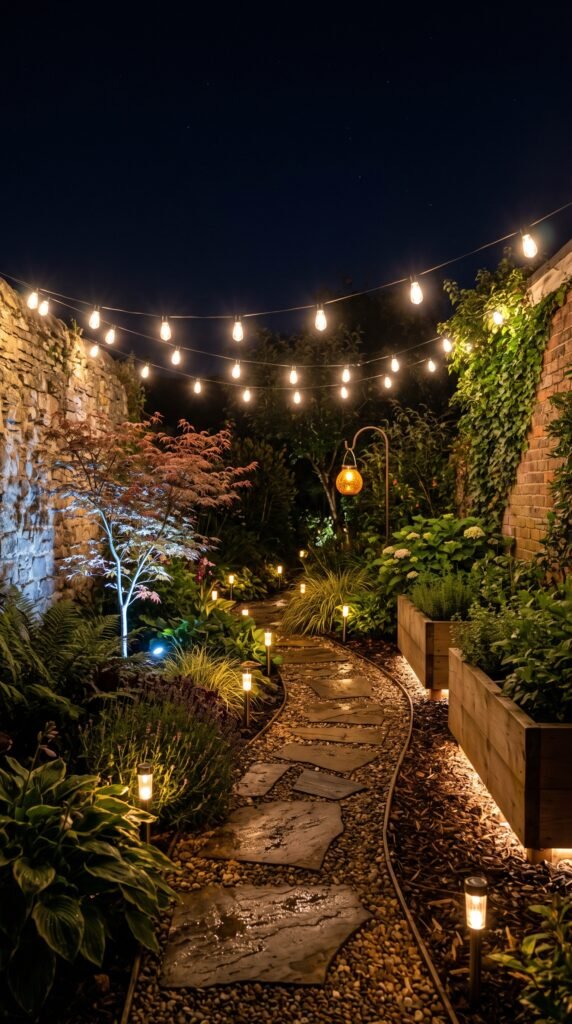
Lanterns are one of the simplest modern outdoor lighting ideas to try first, because they need no installation at all. Group two or three lanterns of different heights on a table or on the ground beside a chair, rather than spacing one lantern evenly around the patio. The uneven heights look natural and give a warmer pool of light than a single lantern on its own. Battery-operated candles and flameless lanterns are the practical choice outdoors, because they cannot blow out, they stay cool to touch, and you can set them on a timer so they come on at dusk without anyone remembering.
If you do use real candles, keep them inside a glass lantern with a stable base, place them on a flat surface away from cushions and low branches, and never leave them burning unattended. Solar lanterns work well on a table that gets sun during the day, but bring them in during long spells of rain if they are not fully weatherproof, and store them dry over winter.
Smart controls, timers and dimmers
Controls matter as much as fixtures. A garden that comes on automatically at dusk and switches off when you go to bed will be used far more than one that needs someone to plug it in. Modern outdoor lighting ideas are only as good as their controls, so choose the control before you buy the fixtures, not after. A simple plug-in timer or a dusk-to-dawn sensor is enough for most gardens. Smart plugs and smart switches add schedules and dimming from a phone, and they are worth it if you have several zones, because you can dim the path lights and brighten the table separately.
Set a switch-off time. Lights left on all night waste energy, disturb wildlife, and make a garden feel less special because it is never dark. Motion sensors suit a side passage or a driveway, where light is needed only when someone is there, but they are a poor choice for a seating area, where they will keep switching off while you sit still. Put the seating and path lights on a timer, and the security lights on a sensor, so each one does its own job.
Choose the right brightness and color temperature
When you compare modern outdoor lighting ideas, brightness and color matter more than the number of fixtures. For a calm garden, choose warm white light, around 2700K to 3000K, which reads as candlelight. Cool white light above 4000K looks harsh outdoors and makes plants look grey. Check the lumens on the box rather than the watts: a path light of around 50 to 100 lumens is a good starting point, and a spotlight for a tree can be brighter, around 200 to 300 lumens, because it has further to travel and more to cover. Start dim, test at night, and only add brightness where you genuinely cannot see.
LEDs are the right choice for almost every outdoor fixture because they use far less energy than older bulbs and last much longer. The ENERGY STAR guide to LED lighting notes that LED lighting products produce light up to 90% more efficiently than incandescent lighting, which is why they are now the standard for landscape lighting. Look for the ENERGY STAR label when you buy, and keep the same color temperature across the whole garden so the light feels consistent from the path to the patio.
Weatherproofing and safety basics
Outdoor fixtures need to survive rain, frost, and the occasional hose. Check the IP rating on the box: IP44 is splash-proof and suits a sheltered wall light, while IP65 is protected against water jets and is a better choice for path and ground lights that sit in open rain. Make sure seals and gaskets are fitted properly when you install a fixture, and check them each spring for cracks or perished rubber. The modern outdoor lighting ideas in this guide assume fixtures that can survive a wet winter, so check the rating before you fall in love with the design.
Plug outdoor lights into a ground-fault protected outlet, use cables and extension leads rated for outdoor use, and keep every connection raised off the ground and out of puddles. Low-voltage 12-volt systems are the safest choice for a do-it-yourself garden project. Anything that connects directly to mains power, including a new outdoor outlet or a wired wall light, should be installed by a licensed electrician, and the work should follow local electrical codes.
Mistakes to avoid
- Lighting everything at the same brightness, so nothing stands out and the garden feels flat.
- Using cool white bulbs outdoors, which make plants look grey and a patio feel clinical.
- Pointing lights at seating or windows, so people see glare instead of the garden.
- Putting solar lights in shade, where the panel cannot charge during the day.
- Skipping the night test, and only judging the garden in daylight when the lights are off.
- Leaving lights on all night, which wastes energy and takes away the sense of occasion.
Frequently asked questions
How many outdoor lights do I need for a small garden?
For a small garden, modern outdoor lighting ideas should start small: 6 to 8 path lights for the main route, one string of lights over the seating area, and one or two spotlights on a tree or wall. That is usually enough for a small garden. Add more only after you have tested the first layer at night, because it is easier to add a light than to remove glare.
What color temperature is best for outdoor lighting?
Warm white, around 2700K to 3000K, is the best choice for most gardens. It makes wood, stone, and planting look natural and feels relaxing in the evening. Cool white above 4000K looks harsh outdoors, so save it for a driveway or a work area where clear visibility matters more than atmosphere.
Are solar outdoor lights bright enough?
Solar lights are bright enough for paths, steps, and tabletop accents, provided the panel gets direct sun for most of the day. They are not the best choice for uplighting a large tree or lighting a whole patio, where a low-voltage wired system will be brighter and more reliable. Keep solar panels clean and replace the rechargeable batteries every year or two.
How do I keep outdoor lights working in rain and winter?
Choose fixtures rated IP44 or higher, with IP65 for lights in open rain, and keep connections raised off the ground. Check seals each spring, wipe solar panels monthly, and store lanterns and battery candles indoors over winter if they are not fully weatherproof. Low-voltage wired lights generally cope with winter better than solar lights, which charge less on short, cloudy days.
What is the best way to control outdoor lights?
A timer or dusk-to-dawn sensor is the simplest reliable control: the lights come on at dusk and switch off at a set time, so you never have to remember them. Smart plugs add dimming and separate zones from a phone, which helps if you want the table bright and the paths dim. Use motion sensors only for passages and driveways, not for seating areas.
The modern outdoor lighting ideas in this guide all follow the same rule: light the path, warm the seating, pick one feature to highlight, and then stop. Start with the ground layer, test it at night, and add the next layer only where the garden still feels dark. A garden lit that way will feel magical without needing a single extra fixture.