A plain concrete slab, a couple of mismatched chairs and a patio that only gets used on the warmest evenings — if that sounds familiar, the problem is rarely the size of the space. These backyard patio ideas focus on the four things that make a patio look considered rather than thrown together: a clear layout, one focal point, layered light and a restrained colour palette. None of them needs a rebuild, and most of them can be done in a weekend.
The backyard patio ideas below are ordered by impact, not by cost. Start at the top, measure before you buy anything, and stop when the space feels finished — adding more is usually what makes a patio look cluttered, not expensive.
In this guide:
- Why Your Patio Feels Underwhelming — and How to Fix It
- 12 Backyard Patio Ideas That Look Expensive on a Budget
- Mistakes That Make a Patio Look Cheap
- How to Prioritise These Ideas on a Budget
- Frequently Asked Questions
Why Your Patio Feels Underwhelming — and How to Fix It
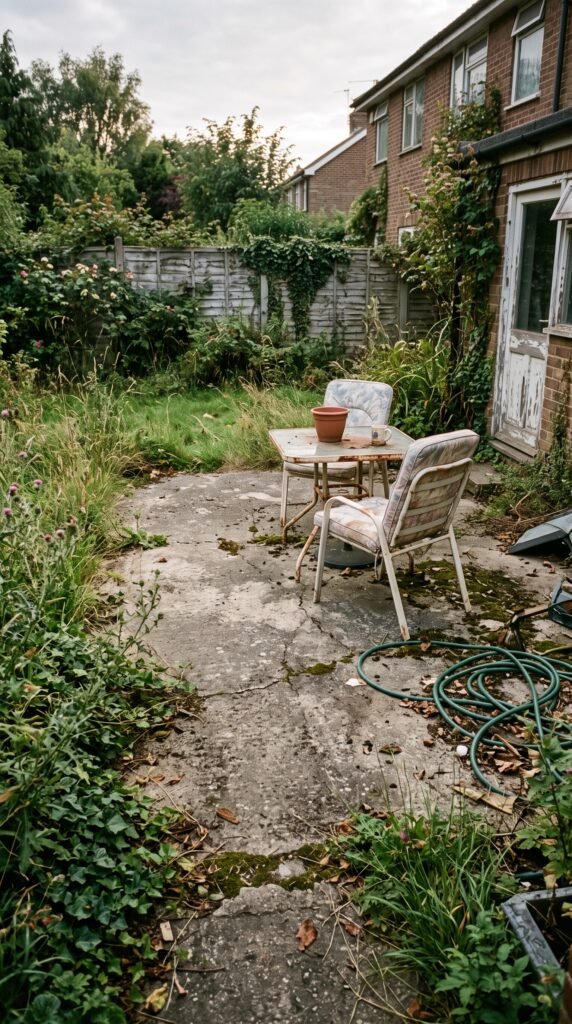
Most patios do not look cheap because the furniture is cheap. They look unfinished because nothing in the space has a clear job. The best backyard patio ideas start with four decisions, made before anything is bought: where people sit, what they look at, how the space is lit after dark, and which two or three colours will repeat throughout.
Start by measuring the slab and sketching it on paper, even roughly. Mark the door, the sunniest corner, the view you want to screen and the route people walk from the door to the garden. Leave at least 75 cm of clear walking space around the main seating group — a patio feels cramped when chairs have to be pulled across a rug or around a planter every time someone stands up. Then divide what is left into one or two zones, such as a seating zone and a small planting or dining zone, instead of spreading furniture evenly across the whole slab.
Next, choose a single focal point. It can be a fire bowl, a large planter, a feature wall or a pergola — but it should be one thing, placed where the eye lands first from the back door. Everything else supports it. Finally, pick one neutral base colour, one secondary colour and one accent, and repeat them in the rug, cushions and planters. That repetition is what the eye reads as “designed”. Bold colours are fine, as long as they stay within that three-colour limit.
12 Backyard Patio Ideas That Look Expensive on a Budget
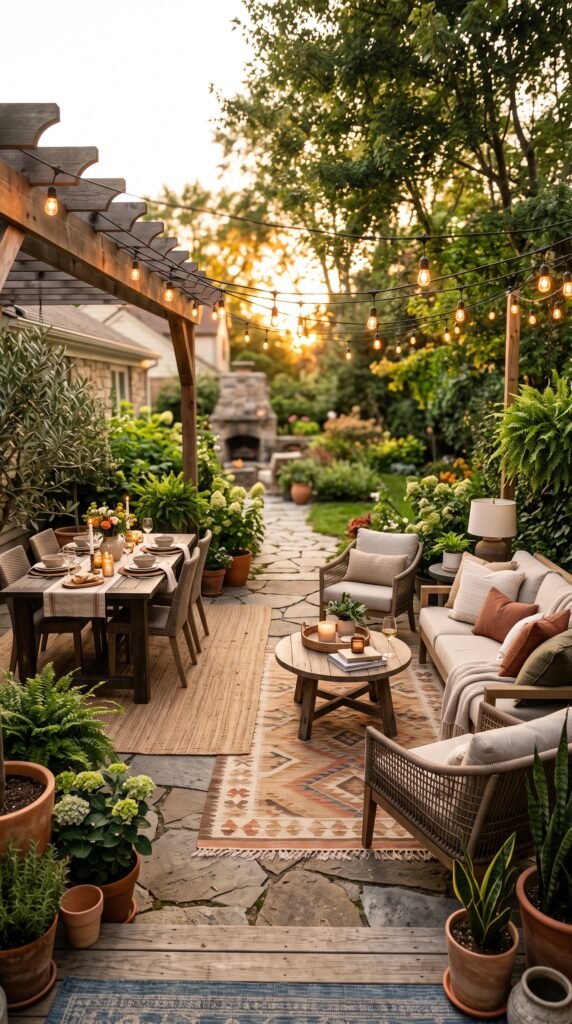
Each idea below works on its own. Together they build up in layers, so you can stop after three or four and still have a patio that looks finished.
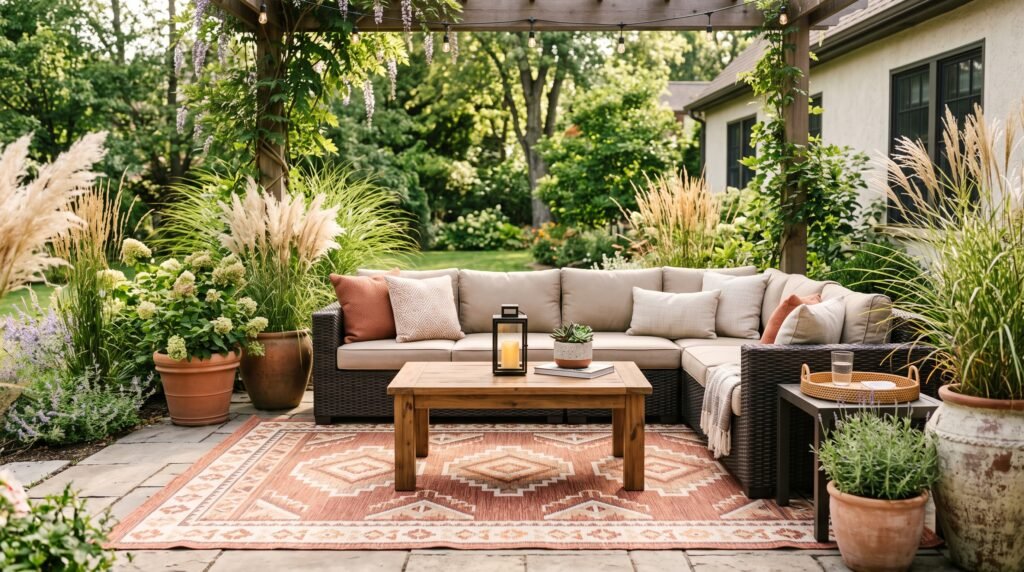
1. Lay an Outdoor Rug to Define the Zones
An outdoor rug is the fastest way to make a patio feel designed rather than assembled. It turns a bare slab into a room, softens hard edges and gives you a colour anchor for everything else. Choose a flat-weave polypropylene rug: it dries quickly, can be hosed down, and will not hold damp the way a natural fibre rug does outdoors.
Size matters more than pattern. Measure the seating group, then choose a rug at least 15 cm wider than the group on each side, with the front legs of every seat sitting on the rug. A rug that is too small is the single most common mistake — it makes the furniture look as though it has drifted apart. For a two-chair and small table set-up, a rug of about 1.6 m by 2.3 m is a good starting point; for a four-seat sofa group, look at 2.4 m by 3 m. If your patio is small, see these small backyard patio ideas that make a small patio feel bigger before you buy.
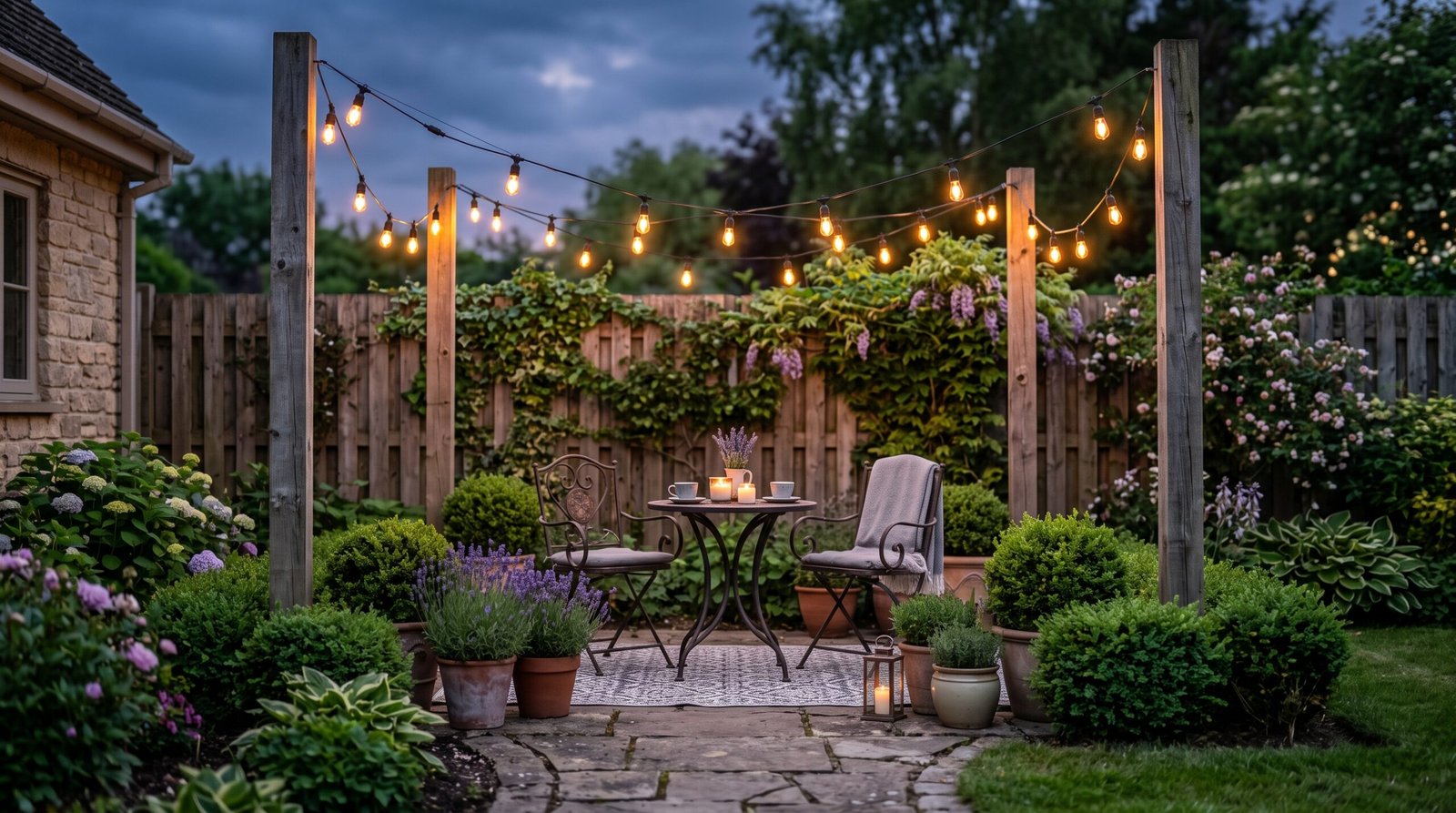
2. Hang String Lights — and Hang Them Properly
Of all the backyard patio ideas here, lighting changes the feel of the space most after dark. Warm-white festoon lights (2700K on the packaging) give a soft glow that flatters skin and stone; cool-white bulbs make a patio look like a car park. Hang the strand in a straight run or a gentle V, pulled taut on a guide wire so it does not sag, with the bulbs about 2.4 m to 3 m above the ground so nobody walks into them.
Plan first, buy second. Measure the run, add about 1 m of slack for the drop to the socket, and check whether the set you are buying is rated for outdoor use and can be joined end to end — the packaging will say. Mains-powered sets give steadier light than solar ones, but solar sets avoid trailing cables across a walkway. Whichever you choose, add a second, low layer of light: a lantern or two on the ground, or small solar path lights along the edge of the slab. One layer of light looks flat; two layers look intentional.
3. Add a Pergola or Simple Shade Structure
A pergola is one of the backyard patio ideas that most changes how a space feels: it gives height, frames the seating zone and gives you somewhere to hang lights and curtains. Freestanding kits are widely available, and a basic timber build uses pressure-treated posts (at least 10 cm square), cross beams and rafters, fixed to the slab with post bases rather than set in concrete where the slab is sound.
Before you buy, check three things: that the structure will not block the light into the rooms behind it, that you have a clear route for any cables, and that the footprint leaves your 75 cm walkways clear. A pergola over a seating group of about 2.5 m by 2.5 m suits most patios; anything much bigger starts to dominate a small garden. If a full pergola is out of reach, a retractable shade sail or a large cantilever parasol gives the same shelter for a fraction of the work — just make sure the base is heavy enough that wind cannot topple it.
4. Use Large-Format Pavers Over Existing Concrete
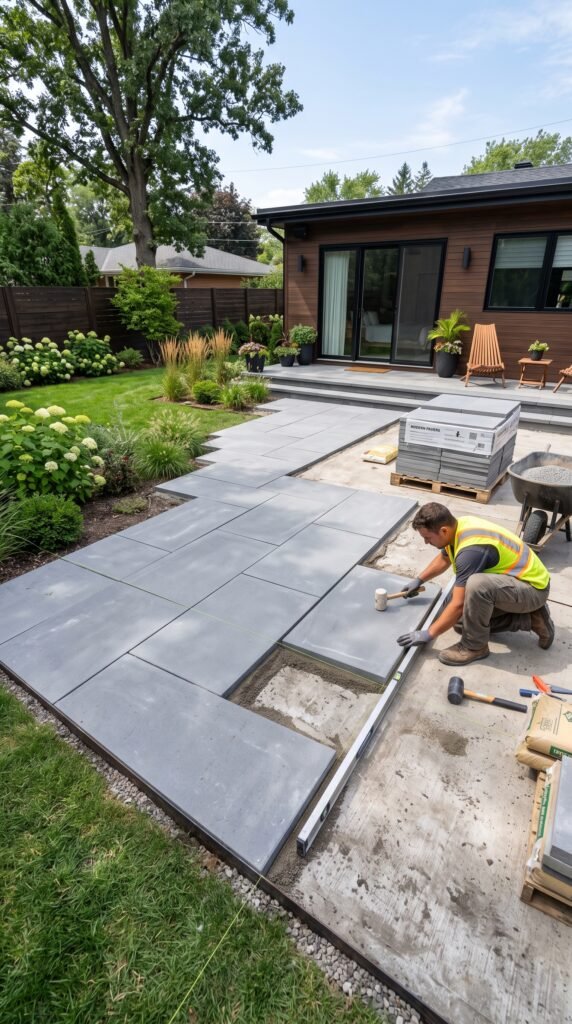
If you are working with a cracked or stained concrete slab, you do not have to demolish it. Large-format concrete pavers or porcelain tiles can be laid directly over a sound existing surface, creating the look of a high-end stone patio in a weekend. The key is to choose pavers with a clean, restrained pattern — large grey or warm-toned slabs mimic natural stone, while small, busy pavers make a patio look fussy.
This is a job to plan carefully rather than improvise. The slab must be level, clean and free of loose material, drainage must still fall away from the house, and the finished surface must not raise the threshold so high that a door cannot open. Family Handyman’s guide to installing pavers over a concrete patio walks through the preparation, the border course and the drainage checks step by step, and puts a full overlay project at $600 to $1,200 — a useful benchmark to compare against any quote you get. If the slab is badly cracked, heaved or draining towards the house, fix that first; pavers will not hide a structural problem.
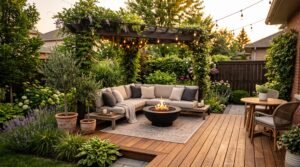
5. Create a Focal Point with a Fire Feature
A fire bowl is one of the most sociable backyard patio ideas: it immediately draws the eye and gives the seating group a reason to face inwards. Place it at the centre of the zone — not against the house wall — and leave at least 1 m of clear space around it for chairs and for people to move safely. Surround it with a simple gravel ring or a low stone border to make it feel deliberate rather than dropped in place.
Check two practical points before you buy: whether your local rules allow open flames or smoke in a residential garden, and whether a smokeless design or a gas table suits your space better than a wood-burning bowl. Keep a lid or cover on it when it is not in use, store cushions away from sparks, and never light it under a pergola without enough clear height above the flame. A fire feature that is easy to light gets used; one that is awkward to set up becomes a decoration.
6. Paint or Stain the Existing Concrete
Concrete stain is one of the most underestimated patio upgrades. It works best on a clean, sound slab: pressure-wash first, let the surface dry for at least 24 hours, and test the stain on a small corner, because the final colour depends on the concrete underneath. Acid-based stains give a mottled, stone-like finish; water-based stains give a flatter, more even colour.
Work in thin coats and seal afterwards with an outdoor concrete sealer, or the colour will fade and mark within a season. Paint is the cheaper alternative, but it sits on the surface and will peel where chairs drag — use a paint made for concrete floors, not wall paint, and accept that it will need touching up. Either way, compare prices by coverage — how many square metres a tin covers — rather than by the price on the shelf, and buy the sealer at the same time so the job is finished in one go.
7. Layer Your Outdoor Seating
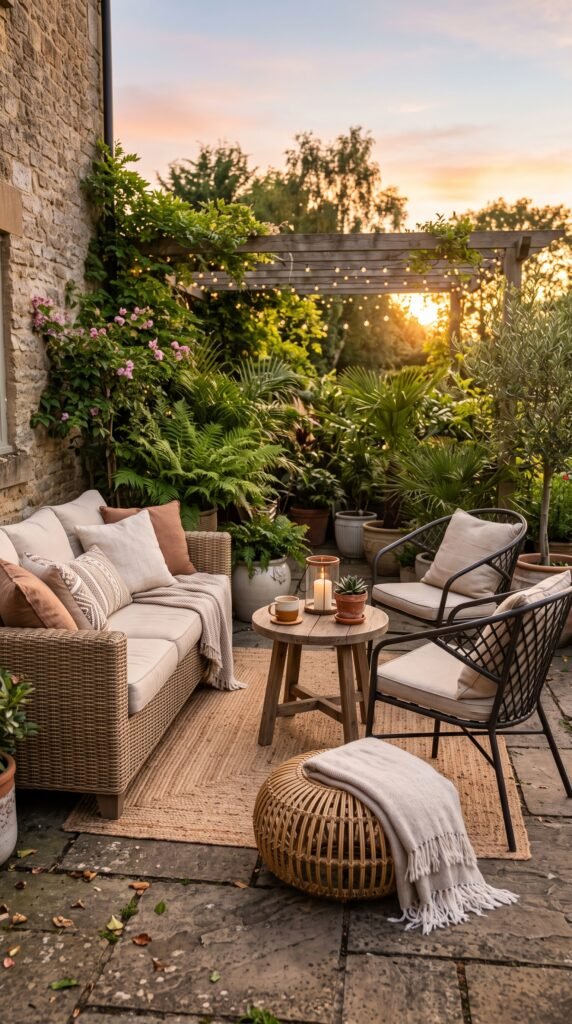
Layered seating is one of the simplest backyard patio ideas: expensive-looking outdoor spaces never rely on a single matching furniture set. Mix materials — wicker, metal and wood — to add texture, and refresh what you already own with outdoor cushions in your chosen palette instead of replacing the frames. Two seat heights work well: a lower lounge seat with a table, and a taller chair or bench for the edge of the zone.
Comfort is the test. Sit in every seat for a minute before you decide: seat height around 40 cm to 45 cm, a seat depth of about 50 cm, and a cushion that does not slide when you stand up. Add a small side table within arm’s reach of each seat — a patio where nobody has anywhere to put a glass is a patio people leave. Keep one spare chair folded nearby rather than crowding the space with seats that are rarely used.
8. Add Vertical Interest with Climbing Plants or Trellises
Vertical planting makes a patio feel lush and enclosed, and it uses wall space that would otherwise stay bare. A simple trellis panel fixed to a wall or fence, a row of tall narrow planters, or a climber trained up a pergola post all soften hard edges and add privacy without taking up floor space.
Choose plants for your actual light and climate, not for a photo: a climber that needs full sun will sulk on a north-facing wall. Give any climber a proper support from day one — screw-in vine eyes and wire, or a sturdy trellis — rather than letting it find its own way up a drainpipe. Water the base, not the leaves, and leave enough clearance behind the trellis for air to circulate, or damp will build up on the wall. For more seasonal styling, these backyard patio decorating ideas for summer show how to dress the same structure through the year.
9. Add a Simple Water Feature
A water feature is one of the quieter backyard patio ideas, but the sound of moving water gives a patio a calm quality that furniture alone cannot. A small solar-powered tabletop fountain or a wall-mounted spout over a basin is enough — the aim is a gentle trickle, not a waterfall. Site it near the seating zone so you can hear it, and on a level, stable base where it cannot be knocked over.
Keep it realistic to maintain: a small reservoir needs topping up in hot weather, and a pump left running dry will burn out. Choose a feature you can lift out and clean, use rainwater or tap water as the maker suggests, and empty it before the first hard frost if it is not frost-proof. Pair it with river rock around the base and one or two shade-tolerant plants to make it look settled rather than new.
10. Use Planters Strategically
Large planters are an architectural element as much as a gardening one. One oversized planter with a small tree or a tall grass does more for a patio than six small pots scattered around, and it is easier to water and keep looking good. Group planters in odd numbers — threes or fives — and vary the heights; a run of identical pots at the same height looks like a shop display.
Match the planter to where it will live: heavy stone or concrete for windy spots, lighter fibreglass or resin where you need to move it, and always a drainage hole and a tray. Plant for the season you actually use the patio, in your palette — one tall upright plant, one trailing plant and one filler per large pot is a reliable combination. And water them on a routine rather than when they look thirsty; by then the soil has usually shrunk away from the sides and water runs straight through.
11. Hang Outdoor Curtains for Privacy and Softness
Outdoor curtains make a pergola feel like a room. They soften the edges, cut glare, give privacy from neighbours and make the space usable on a breezy evening. Use all-weather outdoor fabric in a linen-look weave rather than indoor curtains, which will rot and stain in the first wet spell.
Hang them on a taut wire or a proper curtain rod fixed to the pergola frame, and make the panels long enough to just brush the floor — too short looks accidental, too long drags and gets dirty. Tie them back with simple ties when you want the breeze, and take them down or store them in a dry box over winter if they are not rated to stay out all year. If the view you are screening is a fence or a neighbouring window rather than the garden, affordable outdoor privacy screens are a sturdier, more permanent option for the same job.
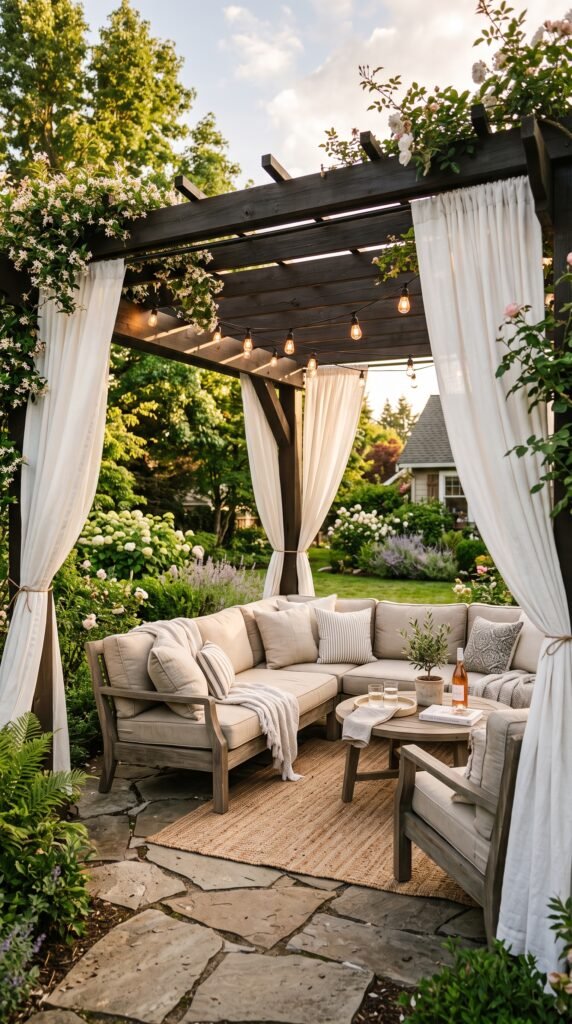
12. Coordinate Your Colour Palette
This last of the backyard patio ideas ties everything together, and it is the one most people skip. Choose a neutral base — white, grey or natural wood — a secondary colour for cushions and the rug, and one accent colour for small touches such as a lantern, a pot or a throw. Stick to that palette across every purchase, and the patio will look coherent even if the individual pieces are inexpensive.
Test the palette where it will be used: colours look different in bright sun than in a shop. Lay the rug, cushions and a planter together on the patio and look at them in morning and evening light before committing. Keep the accent colour to about one item in ten — a single terracotta pot or a pair of ochre cushions — so it reads as a deliberate note rather than a second scheme. If in doubt, drop the accent altogether; a calm two-colour patio always looks more expensive than a busy one.
Mistakes That Make a Patio Look Cheap
Most failed backyard patio ideas share the same few errors. Avoid these and the rest of the ideas above will do far more work for you:
- A rug that is too small. If the front legs of the chairs are off the rug, the furniture looks as though it has drifted apart. Measure the seating group first.
- Too many small pots. Six tiny planters look cluttered; one large planter looks considered. Use odd-numbered groups and vary the heights.
- Mixing too many colours. Five or six colours across the cushions, rug, pots and lights will fight each other. Keep to three and repeat them.
- Sagging or dim lighting. Strings that dip into faces, cool-white bulbs, or a single light source make a patio feel temporary. Pull runs taut on a guide wire and add a second layer of light at ground level.
- Ignoring water. Buying cushions, rugs or a pergola without planning for rain — no drainage, no storage, no cover — means the space looks tired within a season. Store what can be stored, and let everything else dry.
- Overcrowding the slab. If every corner is filled, nobody can move comfortably. Leave at least 75 cm of walking space around the main seats.
How to Prioritise These Ideas on a Budget
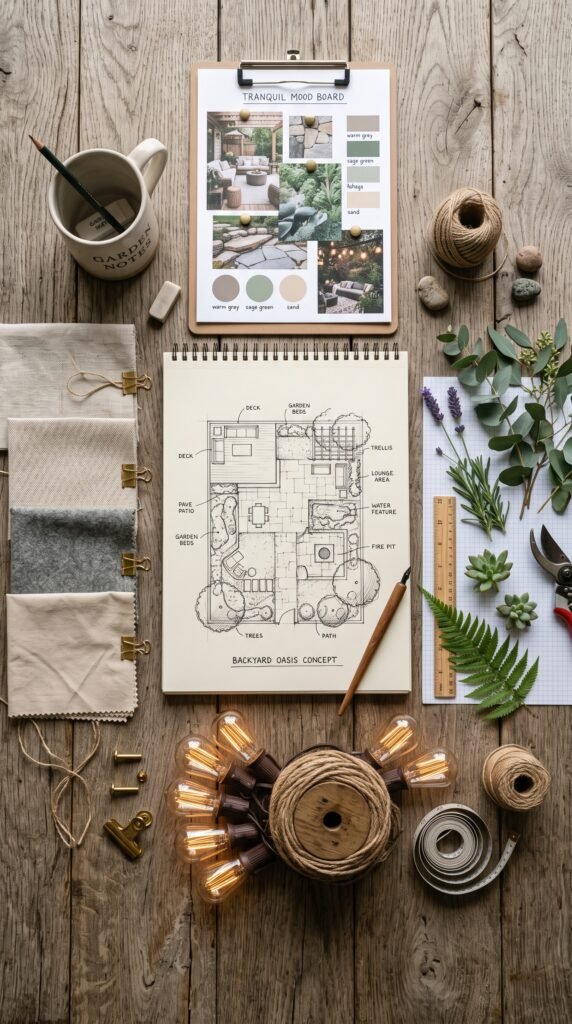
Not every patio needs all 12 ideas at once. If you only try three backyard patio ideas, start with these: clean the slab, lay a rug that fits the seating group, and hang warm string lights. That combination — a clean surface, a defined zone and good light — does most of the work, and each step is easy to undo if you change your mind.
Then add a focal point from idea 4 or 5, depending on your slab, and layer in planting and textiles from ideas 8, 10 and 11. Leave the bigger structural work — pavers, a pergola, a water feature — until you have lived with the layout for a few weeks and know where you actually sit, where the sun falls and where the wind comes from.
Budget honestly, with numbers from the shop rather than from memory. Measure every area, write down the square metres and the quantities, and compare like with like: rug price per square metre, paver price per square metre including edging, sealer and grout, and stain price by coverage. Add a small margin for fixings, sealant and delivery, which are the costs most often forgotten. A sketch and a swatch, as in the photo above, will save more money than any single purchase — they stop you buying a rug, a cushion and a planter that do not go together.
Frequently Asked Questions
How can I make my backyard patio look expensive on a small budget?
Start with the backyard patio ideas that change the structure of the space rather than the decoration: clean the slab, define the seating zone with a rug that fits, and add warm layered lighting. Those three steps cost less than most single furniture pieces, and they are what make everything else look intentional. Then add one focal point — a fire bowl, a large planter or a pergola — before buying any more accessories.
What size outdoor rug should I buy for a patio?
Measure the seating group first, then choose a rug at least 15 cm wider than the group on each side, with the front legs of all seats on the rug. As a starting point, a two-chair set-up suits about 1.6 m by 2.3 m, while a four-seat sofa group needs about 2.4 m by 3 m. A rug that is too small is the most common mistake, so measure twice and buy once.
Are string lights enough to light a patio at night?
On their own, string lights create atmosphere but leave dark corners. Hang them as your main layer — warm white, about 2.4 m to 3 m above the ground, pulled taut — and add a second low layer, such as lanterns on the ground or small path lights along the edge of the slab. Two layers of light make a patio look finished and are far more usable than one bright source.
Can I lay pavers over an existing concrete patio?
Yes, if the slab is sound, level and draining away from the house. Large-format pavers or porcelain tiles can be laid over it, but the threshold, the drainage fall and any loose or cracked sections need to be dealt with first. Family Handyman’s step-by-step guide covers the preparation and puts a full overlay project at $600 to $1,200. If the slab is badly cracked, heaved or draining towards the house, fix that before you spend anything on pavers.
How do I keep outdoor cushions and curtains looking good?
Choose outdoor-rated fabrics and bring cushions in when they are not in use, or keep them in a storage box on the patio. Shake them out and let them dry fully before storing, and clean them with mild soapy water rather than harsh cleaners. Outdoor curtains should be taken down and stored over winter unless they are rated to stay out all year.
These backyard patio ideas work because they follow a simple order: plan the layout, add one focal point, get the light right, then repeat a small colour palette everywhere. Start with the rug and the lights this weekend, live with the layout for a few weeks, and only then decide what the space still needs.