
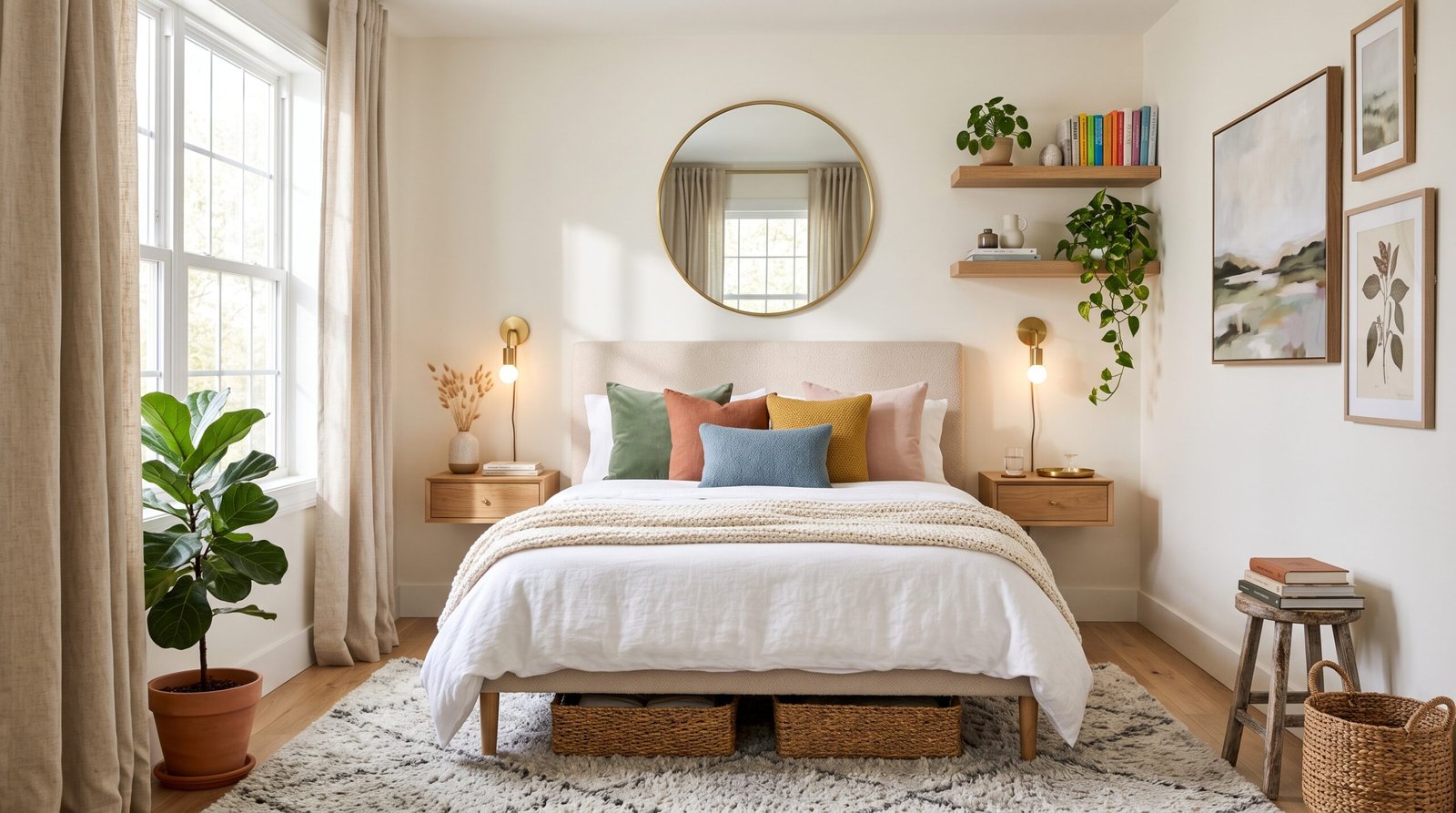
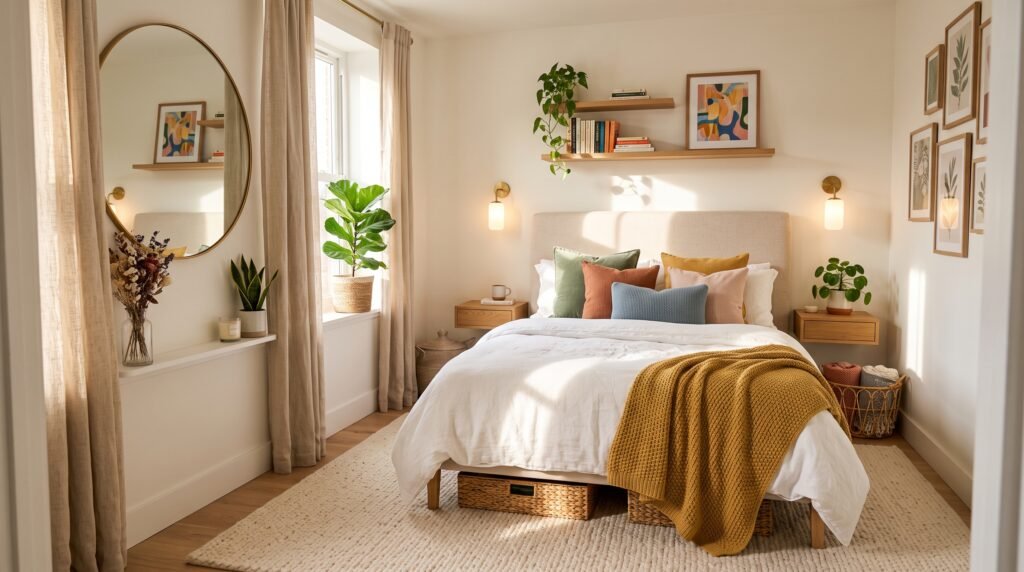
Getting small bedroom decor right is one of those things that looks simple on Pinterest but feels completely overwhelming when you’re standing in a 10×10 room wondering where your dresser is supposed to go. Most people assume a small bedroom is a design dead end. It’s not. The truth is, the constraints of a small space actually force smarter, more intentional decisions — and the results can look better than rooms twice the size.
📋 Table of Contents
- Why Small Bedroom Decor Feels So Hard (And Why It Doesn’t Have To Be)
- The Color and Light Foundation of Good Small Bedroom Decor
- Furniture That Works For Your Small Bedroom Decor, Not Against It
- Strategic Storage That Keeps Small Bedroom Decor Looking Clean
- The Visual Tricks That Make Small Bedroom Decor Look Professionally Done
- Putting It All Together: A Small Bedroom Decor Plan That Actually Works
Why Small Bedroom Decor Feels So Hard (And Why It Doesn’t Have To Be)
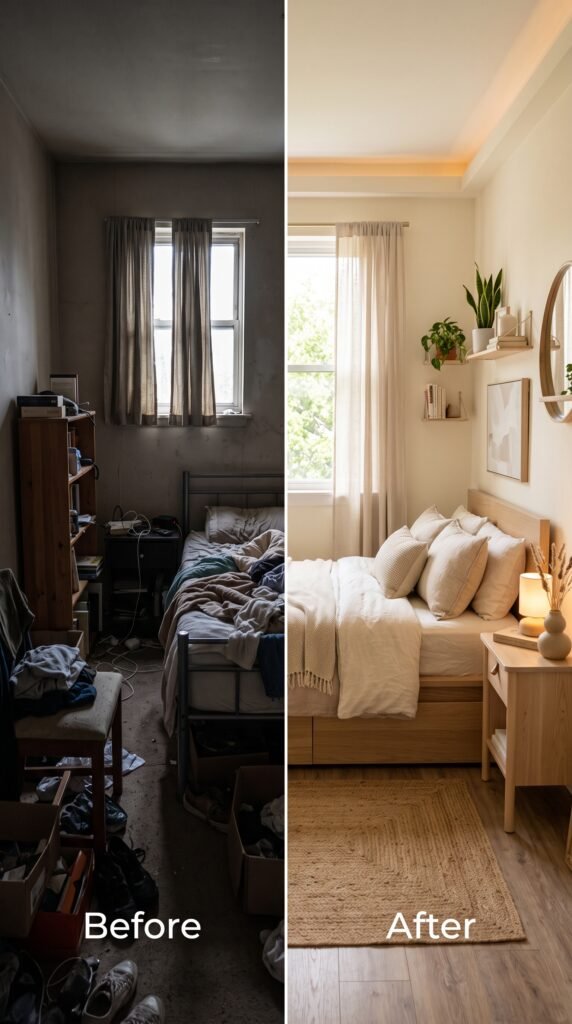
Picture this: you move into a new apartment, drag in your full-size bed, and suddenly your bedroom looks like a storage closet with a mattress in it. No floor space. No breathing room. The furniture doesn’t fit right, the lighting is terrible, and the whole thing feels like a mistake.
That’s not a you problem. That’s a design problem. And design problems have design solutions.
The biggest mistake people make with small bedroom decor isn’t buying the wrong furniture. It’s thinking about the room as a collection of individual pieces instead of as a single, unified system. Every choice, from the color on the walls to the height of your curtain rod, sends a signal to your brain about how large the space is. Work with those signals, and a small room feels intentional and cozy. Work against them, and it feels cramped and chaotic.
So here’s the thing: you don’t need to knock out walls, hire a contractor, or blow your savings. You need to understand which visual levers to pull.
Best Bedroom Ideas to Brilliantly Fix a Boring Space Fast
The Color and Light Foundation of Good Small Bedroom Decor
Color is the cheapest renovation you’ll ever do. And it’s wildly underestimated.
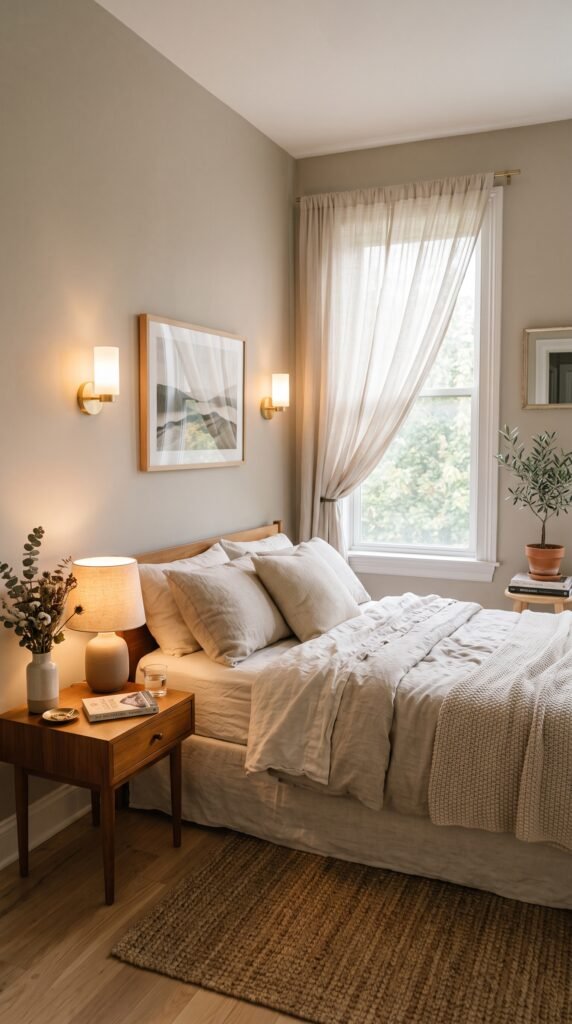
Light, warm neutrals — think soft whites, warm creams, pale greiges — bounce light around a room in a way that literally makes the walls feel further apart. This isn’t just an aesthetic preference. There’s real science behind it. Light-colored surfaces reflect more lumens back into the space, increasing the perceived volume of a room. According to research published by the Lighting Research Center at Rensselaer Polytechnic Institute, the way light interacts with wall surfaces has a measurable effect on how people perceive room size and comfort.
But here’s what most people get wrong about small bedroom decor and color: they stop at the walls.
Your ceiling matters just as much. Paint it the same color as your walls, or go one shade lighter. The traditional “bright white ceiling” rule actually creates a visual ceiling that cuts the room short. When the ceiling and walls blend, the eye travels upward and outward without interruption. The room feels taller.
And floors. If you have hardwood floors, lay a large rug that extends at least 18 inches beyond all sides of the bed. A rug that’s too small — or no rug at all — fragments the floor plane into isolated islands. One large rug unifies everything and makes the floor feel more expansive.
Now, lighting. Most small bedrooms rely on a single overhead fixture. That’s the design equivalent of illuminating a stage with one spotlight from above: it flattens everything, creates harsh shadows, and makes the room feel like a box. Layer your light sources. A warm table lamp on each nightstand, a dimmer on the overhead, and if you can swing it, some LED strip lighting tucked behind the headboard or under a floating shelf. Layers of light create depth. Depth makes rooms feel bigger.
7 Best Cozy Bedroom Ideas That Work Brilliantly in Every Season
Furniture That Works For Your Small Bedroom Decor, Not Against It
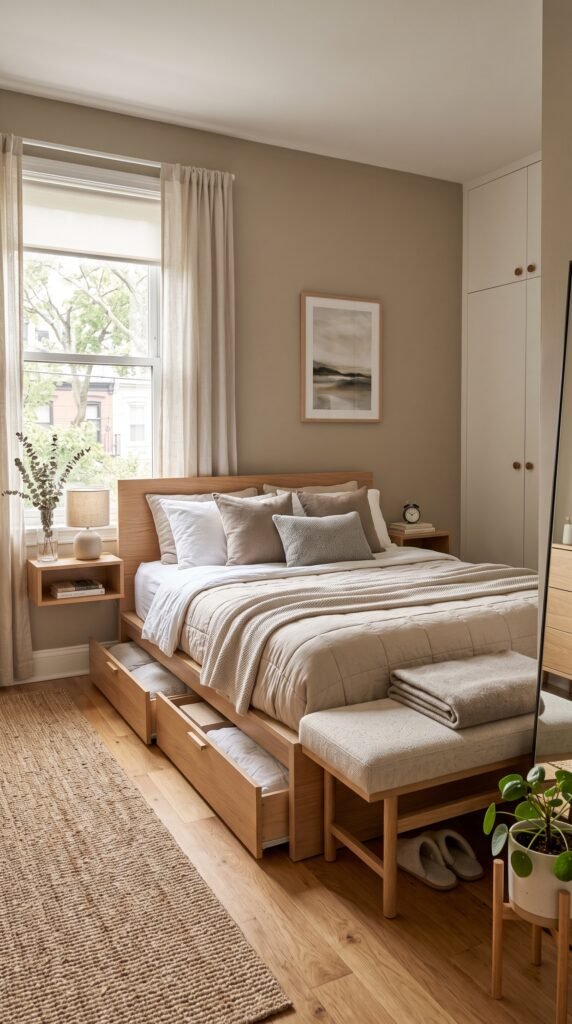
Furniture scale is where small bedroom decor goes wrong most often. Not because people buy bad furniture. Because they buy furniture sized for a larger room and then wonder why everything feels stuffed.
The bed is the first domino. In a small bedroom, a platform bed with a low-profile frame immediately lowers the visual center of gravity in the room. The eye has more wall space above the bed to travel, and the room reads taller. Add built-in storage drawers underneath, and you’ve just eliminated the need for a separate dresser — which in a small room is often the single biggest space eater.
Here’s a counterintuitive move: ditch the nightstands. Or at least replace them with floating wall shelves. A bulky nightstand can eat 18-24 inches of floor space on each side of the bed. A floating shelf at nightstand height takes up zero floor space, keeps the visual plane clear, and looks deliberately minimalist rather than cramped.
The same logic applies to other furniture. A slim-profile upholstered bench at the foot of the bed functions as a seat, a place to lay out clothes, and a visual anchor, all without the bulk of a chair and ottoman. Wall-mounted sconces instead of table lamps free up shelf space. A mirror-front wardrobe or a wardrobe with sliding doors instead of swinging doors saves the clearance space that hinged doors require.
Every piece of furniture in a small bedroom should earn its place twice: once for its primary function, once for a secondary function. If it only does one thing, think hard about whether it belongs.
According to Apartment Therapy’s design guides, one of the most effective principles for small space furniture is the concept of “visual weight.” Furniture with legs, open frames, or transparent materials (like acrylic or glass) read as lighter and less imposing than solid, boxy pieces that sit directly on the floor. It’s a simple swap that changes how a room feels without changing the square footage.
Strategic Storage That Keeps Small Bedroom Decor Looking Clean
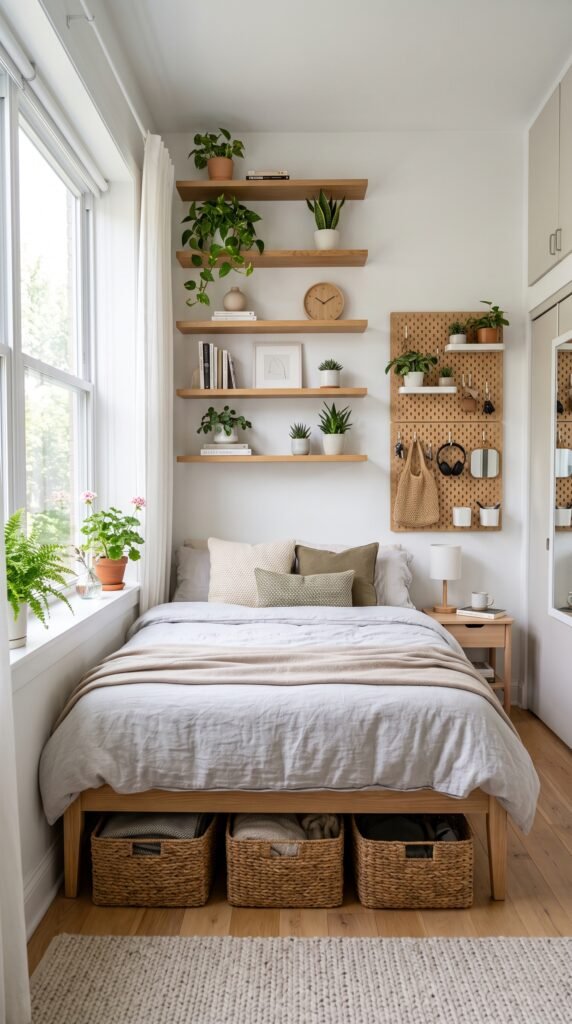
Clutter is the enemy of small bedroom decor. Full stop.
And the reason small bedrooms feel cluttered faster than larger rooms isn’t that the people living in them are messier. It’s that there’s less visual buffer between objects. In a large room, a pile of books on a dresser barely registers. In a small room, it becomes a focal point.
The solution isn’t to own less (though that helps). The solution is to go vertical and get everything off the floor.
Think about the wall space between the top of your furniture and the ceiling. In most homes, that zone goes completely unused. Floating shelves that run from furniture height all the way to the ceiling draw the eye upward and create storage without consuming any floor space. Style the upper shelves with less-used items and some greenery. Keep the lower shelves accessible and functional. The vertical rhythm alone makes the room feel taller.
Under the bed is another zone most people use poorly. Random bins that slide out, collect dust, and create visual chaos under the frame. Invest in matching, lidded storage containers that slide neatly under the bed and disappear. Or go back to the platform bed with built-in drawers. Either way, treat the space under the bed as prime real estate, not a junk drawer.
Behind the door is often the most overlooked storage opportunity in small bedroom decor. A slim over-door organizer can hold shoes, accessories, books, even a full wardrobe of folded items. It doesn’t interrupt the visual flow of the room at all because it’s only visible when the door is open.
Cozy Bedroom Ideas You Can Pull Off in One Weekend
The Visual Tricks That Make Small Bedroom Decor Look Professionally Done
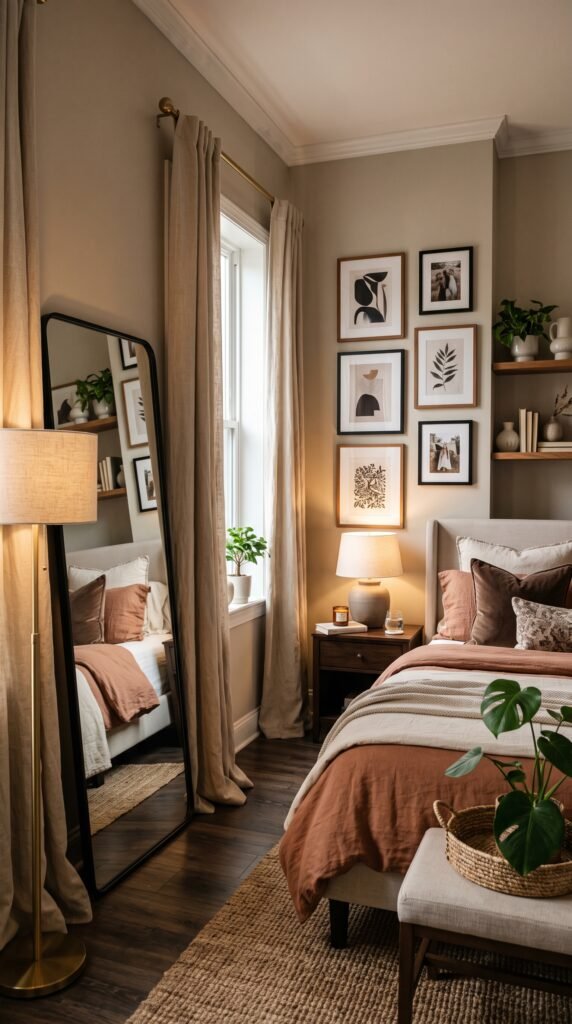
Here’s where you start to see the difference between a small bedroom that feels cramped and one that feels like a boutique hotel suite.
Mirrors. A single large mirror, either leaning against the wall or mounted on it, doubles the perceived depth of a room. It’s not a trick so much as a physics reality: reflected light and reflected space create the impression of additional square footage. The key is placement. A mirror positioned to reflect a window or a light source amplifies the effect. A mirror facing a cluttered corner just amplifies the clutter.
Curtain height is one of the most underrated tools in small bedroom decor. Most people hang curtain rods at window height. That’s a mistake. Hang your rod as close to the ceiling as possible, and let the curtains fall all the way to the floor. The vertical line from ceiling to floor makes the window look larger, the ceiling feel taller, and the whole room feel more expansive. It’s a $40 change (new longer curtain panels) that makes a $4,000 difference in how the room looks.
Art and gallery walls work on the same vertical principle. Choose pieces that are taller than they are wide, or arrange a gallery wall in a vertical cluster rather than a wide horizontal spread. The eye follows the orientation of what it sees. Vertical lines in a room create the perception of height. Horizontal lines create width. In a small bedroom, height is almost always your friend.
And texture. This one’s subtle but real. A room with one texture (all smooth, all matte, all the same) feels flat and small. A room with layered textures, a linen duvet, a knit throw, a jute rug, a velvet pillow, a wooden frame, creates visual complexity that makes the eye linger. A room the eye lingers on feels larger than a room the eye immediately scans and dismisses.
According to the American Society of Interior Designers, textural variety is one of the most effective non-structural tools for changing how people perceive and feel in a space. The brain processes texture as depth information. More texture equals more perceived depth.
Putting It All Together: A Small Bedroom Decor Plan That Actually Works
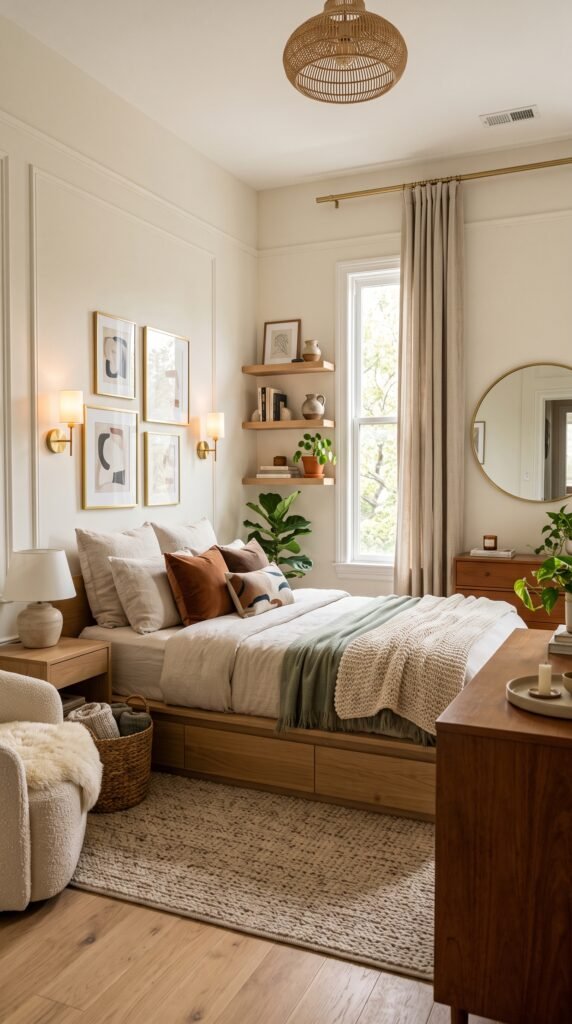
The reason most small bedroom decor projects fail isn’t lack of effort. It’s lack of sequencing.
People buy a new duvet, then a new lamp, then a new rug, and end up with a collection of nice individual pieces that don’t add up to a cohesive room. The visual logic isn’t there, so the room still feels off, just with newer stuff in it.
Start with the walls and ceiling: commit to a light, unified color palette. Then the floor: one large rug. Then the bed: right scale, right height, hidden storage underneath. Then the lighting: overhead on a dimmer, ambient sources on both sides of the bed. Then storage: vertical, behind doors, under the bed. Then the finishing layer: mirrors for depth, curtains hung at ceiling height, textural variety in soft goods.
That sequence matters. Each layer builds on the last. And by the time you’re adding the throw pillows and the art, you’re not trying to fix a room that doesn’t work — you’re styling a room that already does.
Small bedroom decor done well doesn’t announce itself. The room just feels good. Calm, put-together, bigger than it should be. People walk in and can’t quite explain why it works. But you’ll know exactly why.
Because you built it that way. On purpose. Without moving a single wall.