


Most people searching for cozy bedroom ideas start in the right place but end up lost in a sea of Pinterest boards that all look the same — soft neutrals, fairy lights, a chunky knit throw draped just so over a perfectly rumpled duvet.
Here’s the thing: those rooms don’t actually feel cozy when you’re living in them. They look cozy in photos. Big difference.
Real coziness is engineered. It’s the result of specific decisions about light, texture, scale, and smell that work together below the level of conscious awareness. You walk into the room and your nervous system exhales. That’s what you’re building. And once you understand why it works, you can recreate it in any space, any budget, any style.
📋 Table of Contents
- Why Most Cozy Bedroom Ideas Fail Before You Even Start
- The Lighting Layer That Every Cozy Bedroom Ideas Guide Gets Wrong
- Texture Is Doing More Work Than You Realize
- The Scale Problem Nobody Talks About in Cozy Bedroom Ideas
- Scent, Sound, and the Invisible Architecture of Cozy Bedroom Ideas
- Pulling It All Together: Your Cozy Bedroom Ideas Action Plan
Why Most Cozy Bedroom Ideas Fail Before You Even Start
Picture this: someone spends a Saturday afternoon rearranging their bedroom. They swap out the cold white bulbs, buy a new throw pillow set, hang some curtains. The room looks better in photos. But at the end of the night, crawling into bed still feels… flat. Nothing has really changed about how the room feels.
That’s because most cozy bedroom ideas get applied like a coat of paint when the real work is structural.
The problem isn’t taste. It’s sequence. People add cozy elements on top of an environment that’s still working against them. Cold overhead lighting. Hard surfaces with no acoustic softness. Furniture at the wrong scale for the room. Colors that read warm on a screen but go gray on the wall.

So the first lesson is this: coziness is subtracted as much as it’s added. Before you bring anything new in, you need to identify what’s actively making the space feel sterile or disconnected. Nine times out of ten, it’s the lighting. But we’ll get there.
The science here is real. Research from environmental psychology consistently shows that humans associate warmth, low lighting, and enclosed spaces with safety. It’s basically a primal response — the cave instinct. Studies from the Scandinavian design tradition, which gave us the concept of hygge, show that perceived warmth in a space correlates directly with lower cortisol levels. Your bedroom should be triggering your rest response the moment you walk through the door.
Most bedrooms trigger the opposite.
how to declutter your bedroom for better sleep
The Lighting Layer That Every Cozy Bedroom Ideas Guide Gets Wrong
Here’s what most guides tell you: swap your bulbs for warm-toned ones. Use 2700K or lower. Add a lamp or two.
That’s not wrong, exactly. But it’s incomplete. And the part they skip is actually the most important.
The real trick isn’t the color temperature of your bulbs. It’s the placement of your light sources relative to your eye level.
Overhead lighting is the enemy. Full stop. When you’re lying in bed, a ceiling fixture is shining directly into your eyes from above, which is the exact opposite of every natural low-light environment humans evolved in. Firelight, candlelight, the light from a setting sun — all of it comes from below eye level or at the same height. Your brain reads overhead light as daytime. Which means “stay alert.”
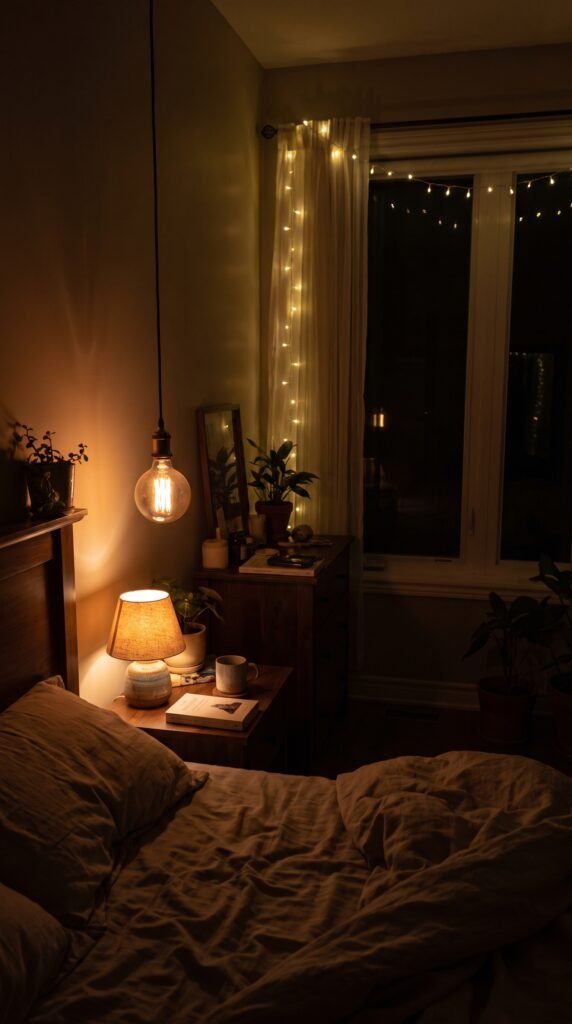
This is why hotel rooms that feel instantly cozy almost always have lamps at bedside height, sometimes even lower. Floor lamps behind furniture. Sconces at shoulder height. The ceiling fixture, if it exists at all, is either very dim or completely off.
So here’s the actionable version: get your overhead light off. Not dimmed. Off. Replace it with two or three light sources that sit at mattress height or lower. A bedside lamp. A small table lamp in the corner. Even a cluster of candles on a low dresser.
And go lower in color temperature than you think you need. 2200K is better than 2700K for a bedroom. Look for bulbs labeled “ultra-warm” or “candlelight.” The difference is significant.
According to the Sleep Foundation, exposure to blue-spectrum light in the evening suppresses melatonin production. Warm light doesn’t. Your lighting choices are literally affecting your sleep quality, not just your aesthetic.
Fair warning: once you experience a properly layered low-light bedroom, you won’t be able to tolerate ceiling lights again. It’s a one-way door.
Texture Is Doing More Work Than You Realize
This is where cozy bedroom ideas really start to separate the rooms that look good from the ones that feel transformative.
Texture isn’t decoration. It’s sensory information. When your eye scans a room and registers multiple textures — linen, wood grain, knitted wool, worn leather, smooth ceramic — your brain interprets that complexity as warmth and life. Smooth, flat, uniform surfaces read as institutional. Hospitals are full of them.

Most people accidentally build sterile bedrooms without knowing it. A platform bed with upholstered panels, smooth walls, a polyester duvet cover, a shiny metal lamp. Every surface is the same tactile temperature. The room looks clean but feels cold.
The fix is to deliberately introduce contrast. Not clash — contrast. Rough against smooth. Matte against slightly reflective. Soft against hard.
Start with the bed, since that’s where your eye goes first. Layer bedding rather than relying on a single duvet set. A linen base layer reads completely differently to the eye than cotton or microfiber. A waffle-weave blanket on top of that adds another layer of visual texture. Then a chunky knit throw at the foot, even if you never use it. Your eye registers all of this as “complex” and interprets it as warm.
Dreamy Bedroom Ideas You Can Actually Recreate (Step-by-Step Guide)
Move to the floor. A rug with a higher pile — a Moroccan-style beni ourain, a shaggy wool rug, even a woven jute — interrupts the hard floor and adds another layer of acoustic softness that most people underestimate. Sound echoes differently in a room with a rug. It feels quieter. Quieter feels safer. Safer feels cozy.
The Scale Problem Nobody Talks About in Cozy Bedroom Ideas
Walk into a room where everything feels slightly too small for the space. Little furniture, bare walls, wide-open floor. You feel exposed, not cozy. Your brain is looking for enclosure and finding none.
This is a scale problem. And it’s incredibly common in modern apartments and houses with open-plan sensibilities applied to bedrooms.
The solution is to work with your room’s natural architecture to create pockets of enclosure. That doesn’t mean cramming in furniture. It means being intentional about where you create ceiling-to-floor visual weight.
Tall headboards help dramatically. Not because they look good in photos (they do), but because they create a sense of backing — your brain reads it as a wall behind you, which is a primal signal of security. Same principle as why people prefer booths to tables in restaurants.
Curtains hung high and wide do double duty here. When you hang curtains close to the actual window frame, the room shrinks. When you hang them close to the ceiling and wider than the window, the room gains visual height and the window becomes a feature rather than a gap in the wall. The curtains themselves, when closed, create soft walls. Enclosure.

Heavy, floor-length curtains in a fabric with some texture — linen, velvet, cotton canvas — absorb sound, reduce drafts, and add enormous visual weight that makes a room feel curated and purposeful.
According to Architectural Digest’s design principles, curtains hung 4-6 inches above the window frame and extending 6-12 inches beyond the window on each side are the standard for rooms that feel designed rather than furnished by accident.
Small changes here make the room feel like a different space. Not more decorated. More intentional.
Scent, Sound, and the Invisible Architecture of Cozy Bedroom Ideas
Most cozy bedroom ideas guides stop at the visual. Which is a huge missed opportunity.
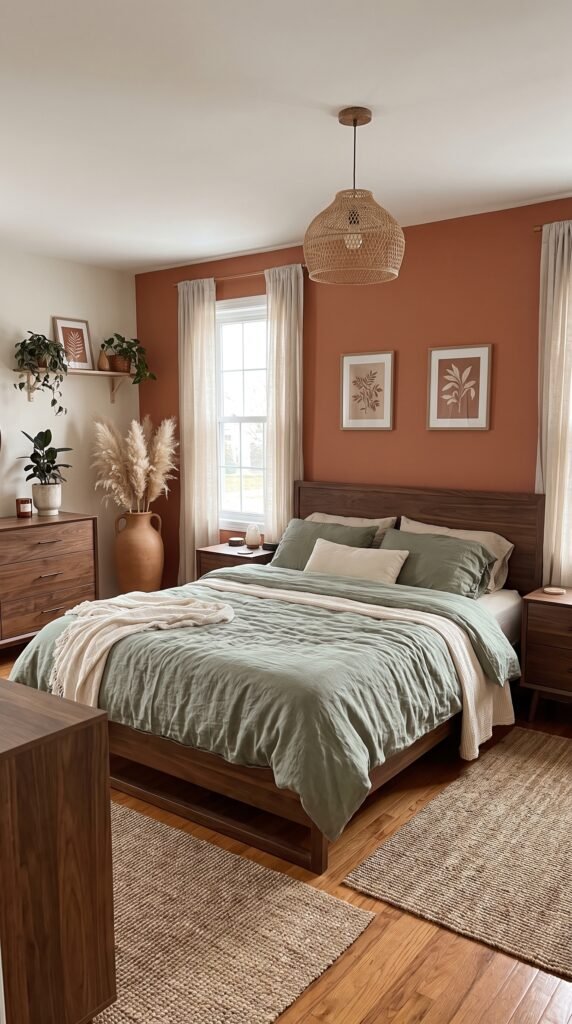
Coziness is multi-sensory. The rooms that people remember as genuinely cozy almost always have a distinct, subtle scent. Not air-freshener fake. Something organic and quiet. Beeswax candles. Cedar. Dried lavender in a dish. A small diffuser with sandalwood or cedarwood oil.
Scent is the fastest pathway to the limbic system — the part of the brain that handles memory and emotion. A room that smells safe and warm triggers a completely different physiological response than one that smells of nothing or, worse, synthetic cleaning products.
Sound is the other invisible layer. Hard rooms are loud rooms. Every footstep, every rustling sheet, every outside noise reflects off hard surfaces and keeps the room feeling activating rather than restful. A rug helps. Curtains help. But so does adding a white noise machine or even a small fan if you live in an urban environment.
7 Best Japandi Bedroom Transforms You Can Do This Weekend
The goal is to build a room where all five senses are being met with gentleness. Vision: warm, layered light and soft colors. Touch: multiple textures, both smooth and plush. Sound: softened and muffled, with optional gentle background noise. Scent: organic, warm, faint. Even taste connects here — a small ritual like chamomile tea before bed, experienced in that room, deepens the association over time.
This is not woo-woo. It’s Pavlovian conditioning, applied intentionally to your own nervous system.
Pulling It All Together: Your Cozy Bedroom Ideas Action Plan

So here’s what this actually looks like in practice.
Start with the lighting. Kill the overhead. Add two bedside lamps with 2200K bulbs. If budget is tight, one good lamp beats two mediocre ones. This single change makes a bigger difference than any other single thing you can do.
Then address the textiles. Your bedding should have at least three different visible textures. Add a rug if you don’t have one. If you have one, make sure it’s large enough to extend under the foot of the bed.
Next, look at your curtains. If they’re short or close to the window frame, rehang them. This is a Sunday afternoon project that pays back every single night.
Then introduce one scent anchor. A candle you burn for 30 minutes before sleep, always the same one. A small sachet in your pillowcase. A diffuser set to the lowest possible output.
Finally, check the acoustics. If your room echoes, it needs softness. More textiles, a thicker rug, heavier curtains.
None of this requires a renovation. None of it requires a big budget if you’re methodical about it. The Sleep Foundation’s environmental sleep research is consistent: the physical environment has a measurable effect on sleep quality, and the changes that matter most are low-cost and immediate.
The most irresistible cozy bedroom ideas aren’t the most expensive. They’re the most considered. And the difference between a bedroom you sleep in and one you actually look forward to retreating to at the end of the day? It’s smaller than you think. Mostly, it’s just knowing where to look.