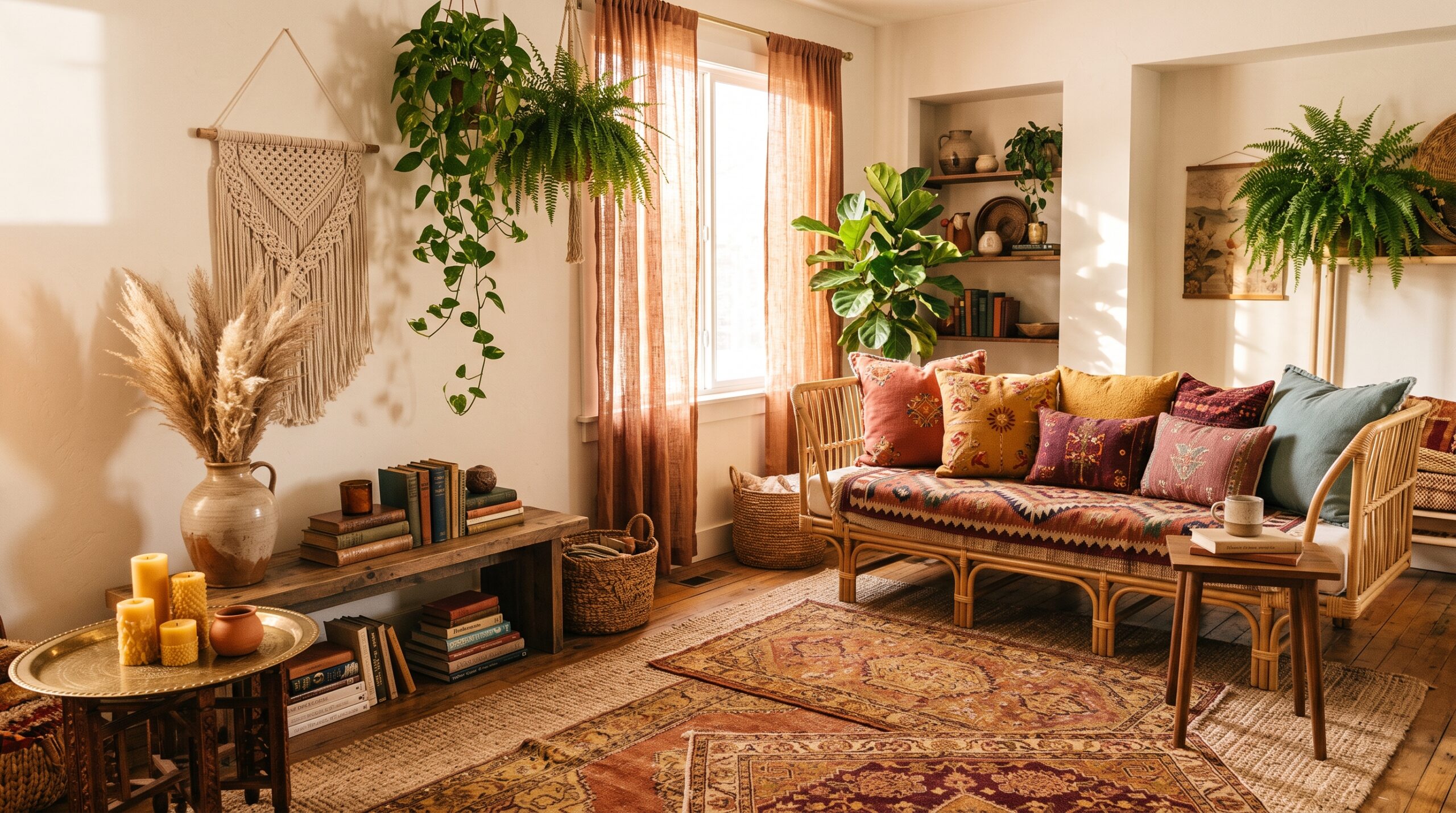
How to Style Bohemian Home Decor Without Overwhelming Your Space

Bohemian home decor done right means layering texture, color, and pattern without the chaos. Here's how to pull it off in a real home without it looking like a thrift store exploded.

5/13/202617 min read

Photorealistic editorial vignette of three hammered brass Moroccan-style tealight lanterns in slight

Affiliate Disclosure: This post contains affiliate links. If you buy through them, I may earn a small commission at no extra cost to you. I only recommend products I'd genuinely consider for my own home, and my recommendations are based on the criteria I explain in this post — not on which brand pays the highest commission.

You've been pinning bohemian rooms for months. The mood boards are gorgeous — woven wall hangings, mismatched textiles, trailing plants, warm wood tones. So you go shopping, bring everything home, arrange it all, and then stand back and think: why does this look like a storage unit someone threw a rug into? You're not imagining it. The room feels cluttered, not curated, and you can't figure out what went wrong.

I've been in that exact spot. My first attempt at bohemian decorating in my own apartment resulted in a living room that had seventeen throw pillows (yes, I counted after the fact), four different rug patterns on top of each other, and a wall hanging that was so large it made the ceiling feel like it was pressing down on my head. I thought "more = more bohemian." That's the mistake almost everyone makes. Bohemian style isn't actually about abundance — it's about intention.

In this post, I want to cover the real principles behind bohemian home decor before we talk about a single product. What makes a boho room feel collected and alive rather than chaotic and suffocating comes down to three specific things, and once you understand them, shopping actually becomes easier. You'll stop buying everything with fringe and start buying the right things. I'll share product recommendations too — real ones with honest trade-offs — but only after you have the framework to know whether they'll actually work in your home.

Why Most Bohemian Home Decor Advice Misses the Point

Most boho decorating advice you'll find online boils down to a shopping list: get a macrame wall hanging, layer some rugs, add plants, toss in a rattan chair. That's not advice — that's a category page dressed up as an article. The problem is that it treats bohemian style as a collection of objects rather than a visual language, and when you follow a shopping list without understanding the language, you end up with all the right nouns and none of the grammar.

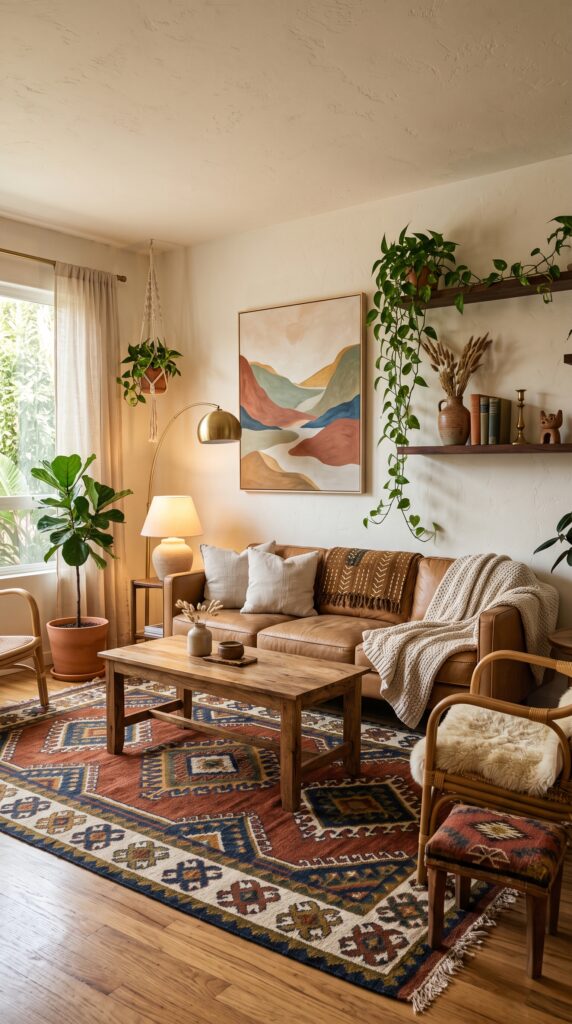
The real principle behind bohemian decorating is controlled contrast. Every beautiful boho room you've ever admired has a strong visual anchor — usually one dominant neutral foundation — and then layers of color, texture, and pattern that are added with restraint. Think of it like seasoning food. A little cumin is transformative. Half a jar is inedible. The rooms that photograph well on Instagram didn't get there by buying more stuff; they got there because someone edited ruthlessly before the photo was taken.

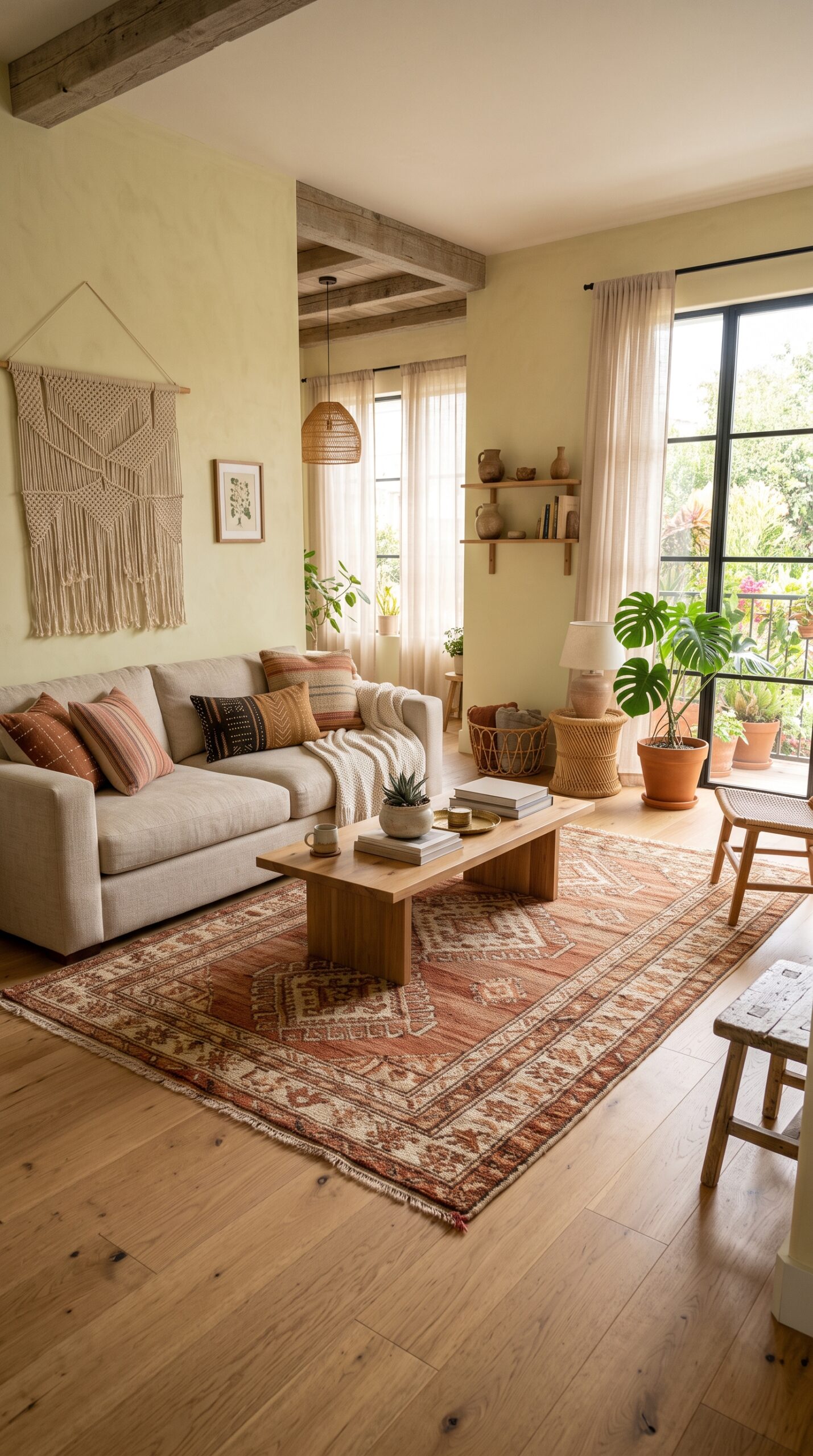
hotorealistic editorial interior of a living room demonstrating the three principles in action — a l
The Bohemian Home Decor Principles That Actually Matter

Before I started actually understanding bohemian style, I wasted probably two years and several hundred dollars collecting things that individually looked great and collectively looked like chaos. The three principles below are what I wish someone had explained to me before I bought a single throw pillow. They apply whether you're starting from scratch or trying to fix a room that already feels like too much. None of them require spending money — in fact, the first one might mean getting rid of something you already own.

Principle 1 — Anchor First, Layer Second

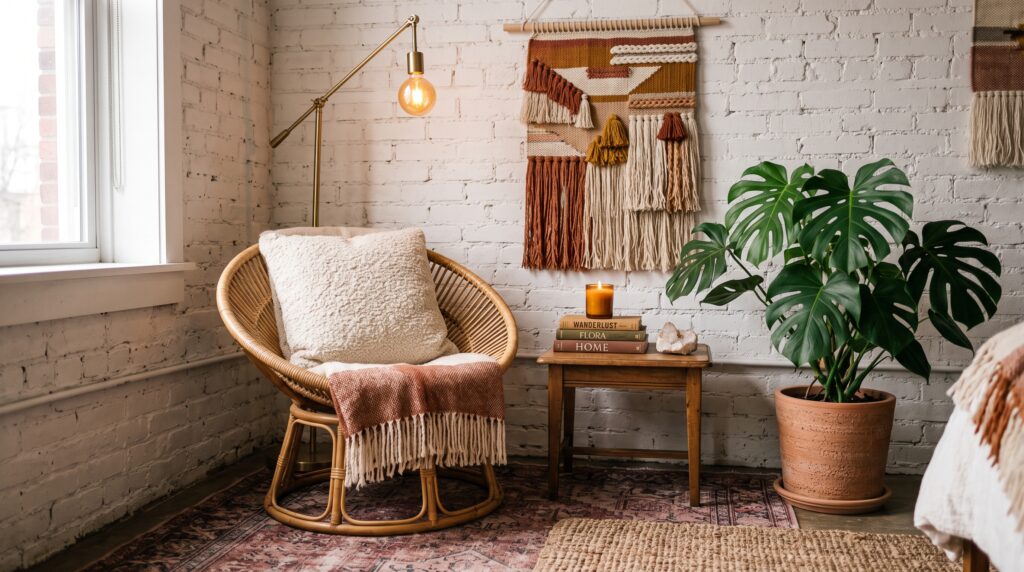
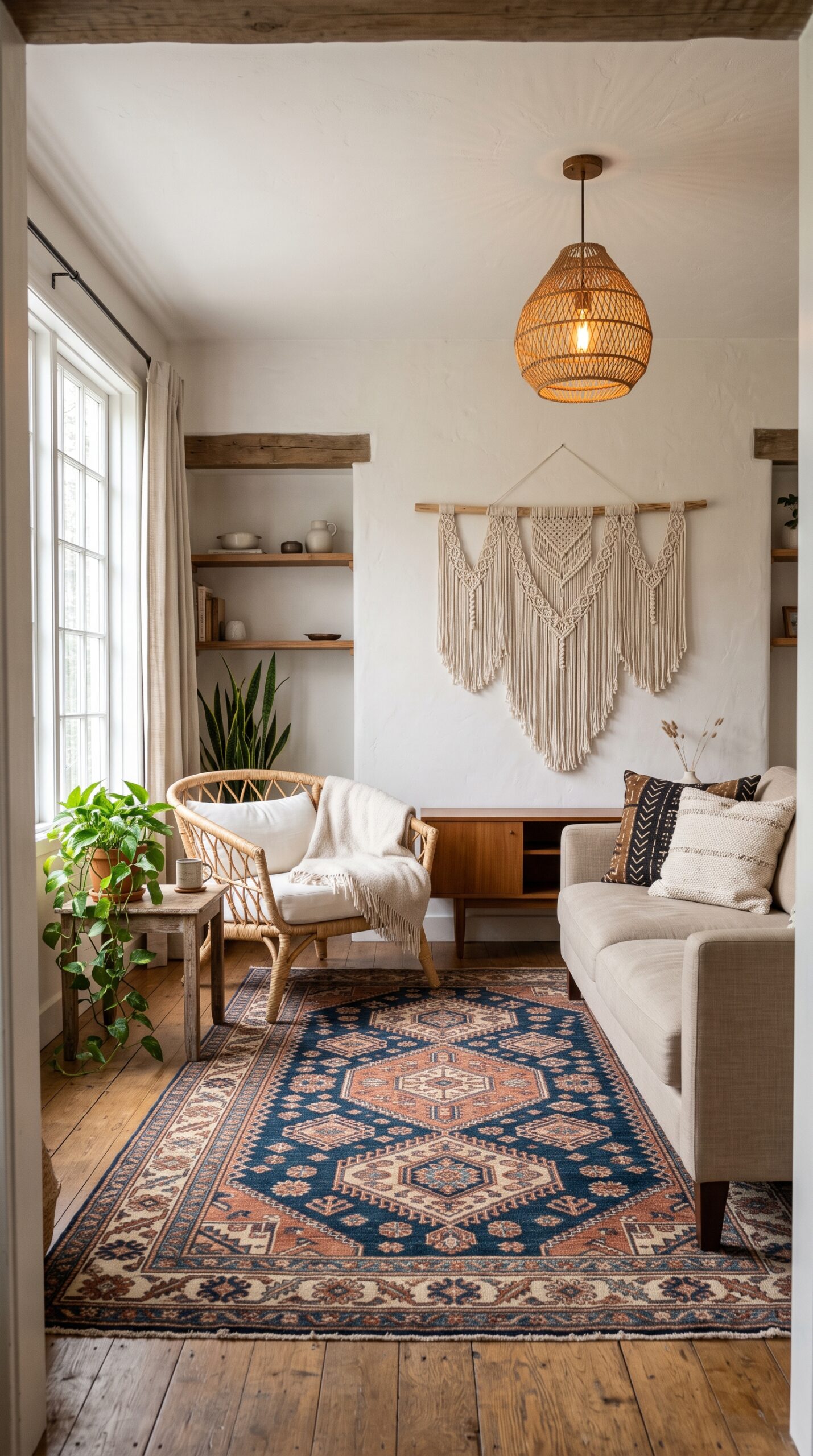
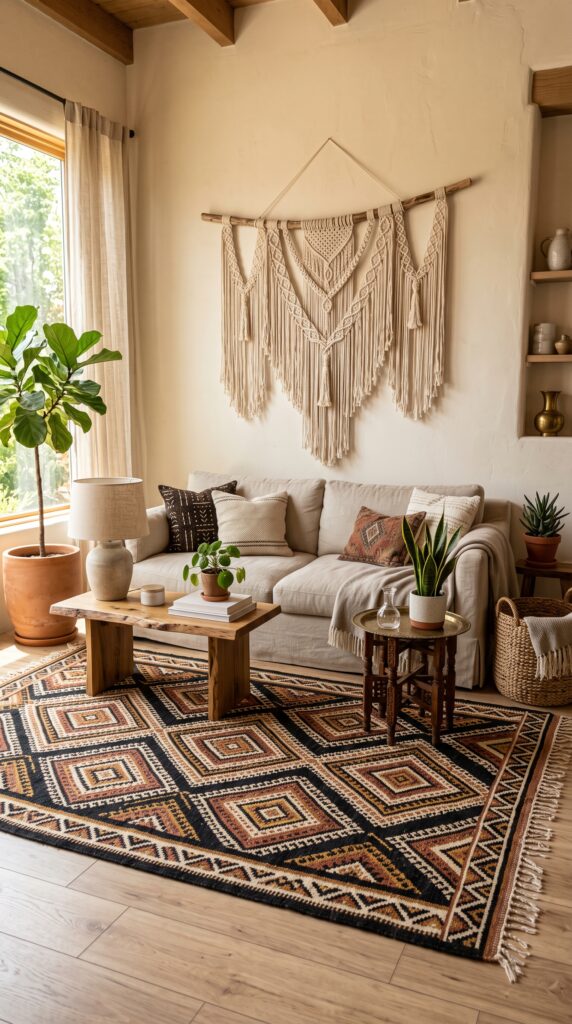
Every well-styled bohemian room has one dominant visual anchor that everything else orbits around. In most rooms, that's either the rug or a single large wall piece — something big enough that your eye finds it first before it starts exploring the rest of the space. The mistake most people make is building the room by adding things simultaneously from all directions, so there's no hierarchy — just noise. Try this: pick one thing to be the undisputed star of the room, and then make every other decision in service of that piece. If your rug has a lot of pattern and color, your wall hanging should be simpler — natural fibers, minimal pattern, muted tones. If your wall art is bold and detailed, the rug underneath should breathe. I followed this rule in my own living room and removed three decorative items the same afternoon — the room immediately felt like it had more in it, not less, because what remained had room to be seen.

Principle 2 — Limit Your Color Story to Three Base Tones
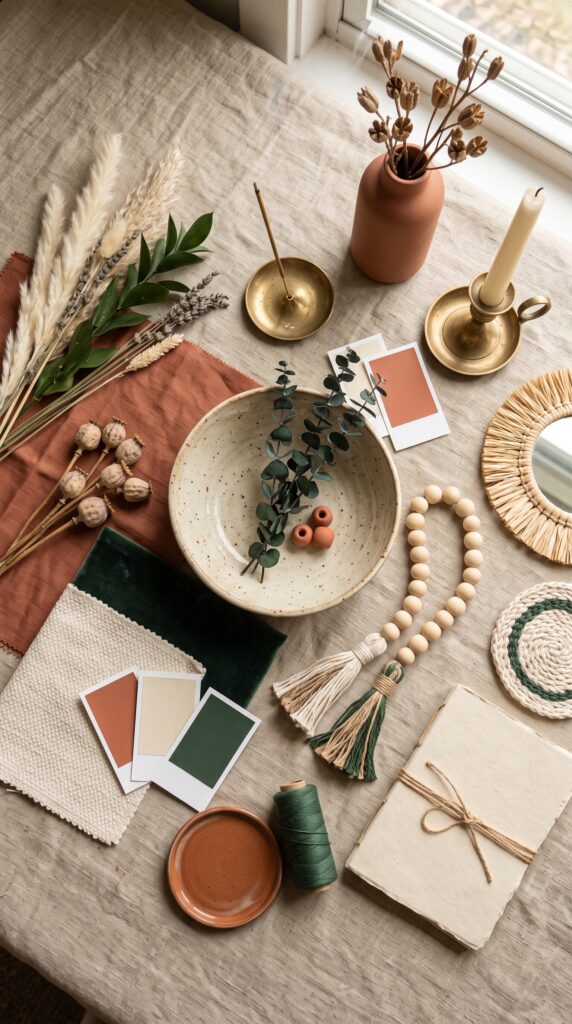
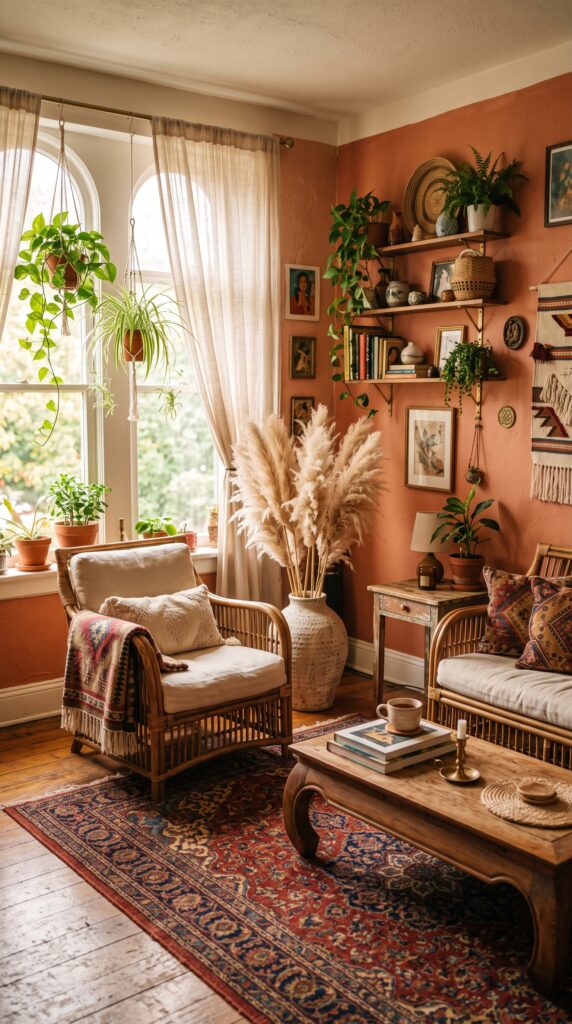
This one took me embarrassingly long to internalize. Bohemian style can use a lot of colors, but the rooms that work stick to roughly three base tones — usually two neutrals and one warm accent — and then allow variations and shades of those tones to create depth. The chaos you see in poorly styled boho rooms almost always comes from too many competing hues that have nothing to do with each other: a cool-toned purple pillow next to a warm rust throw next to a bright teal vase. None of those are wrong on their own. Together, they have no conversation. Pick a palette anchor — say, warm sand, terracotta, and deep olive — and then let your textiles, ceramics, and plants all live within that family. Variations within a palette read as richness. Colors from different palettes read as clutter.

Principle 3 — Texture Carries More Weight Than Pattern

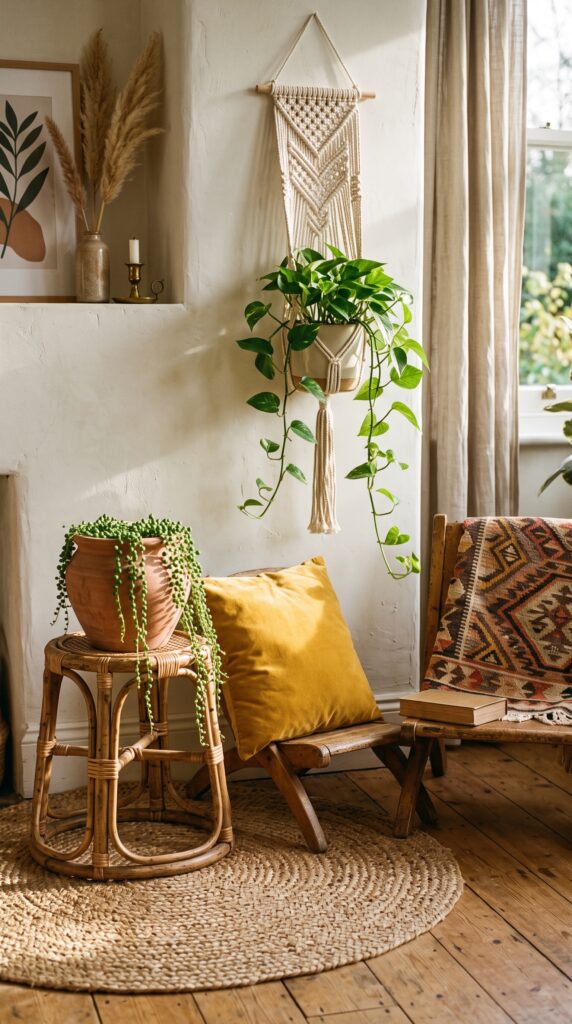
Most people trying to achieve bohemian style reach for patterned everything — printed pillows, patterned rugs, patterned curtains. But in the rooms that actually feel luxurious and layered, texture does most of the heavy lifting. A chunky hand-knotted rug in solid cream reads as richer than a flat-woven busy print at twice the price. A linen pillow with a woven stripe, a smooth clay vase next to a rough jute basket, a velvet cushion beside a macrame throw — these contrasts of surface feel are what creates that deeply layered boho warmth. Pattern is a supporting player, not the lead. When in doubt, buy the interesting texture in a simpler pattern rather than the flat fabric with a complicated print.

Photorealistic editorial vignette of a hand-knotted terracotta and cream kilim rug on light oak hard
Two Products Worth Considering First

Now that you have the framework, here's where I'll be upfront: the next two products contain affiliate links, and I've placed them here — before the deeper dives later in the post — because most readers don't make it to the end, and these two picks address the most common starting point mistakes directly. Both tie to Principle 1 (anchoring the room) and Principle 3 (texture over pattern), which are the two principles that give you the fastest visible improvement. I'll be honest about the trade-offs because a product that's wrong for your space is just money sitting on your floor.

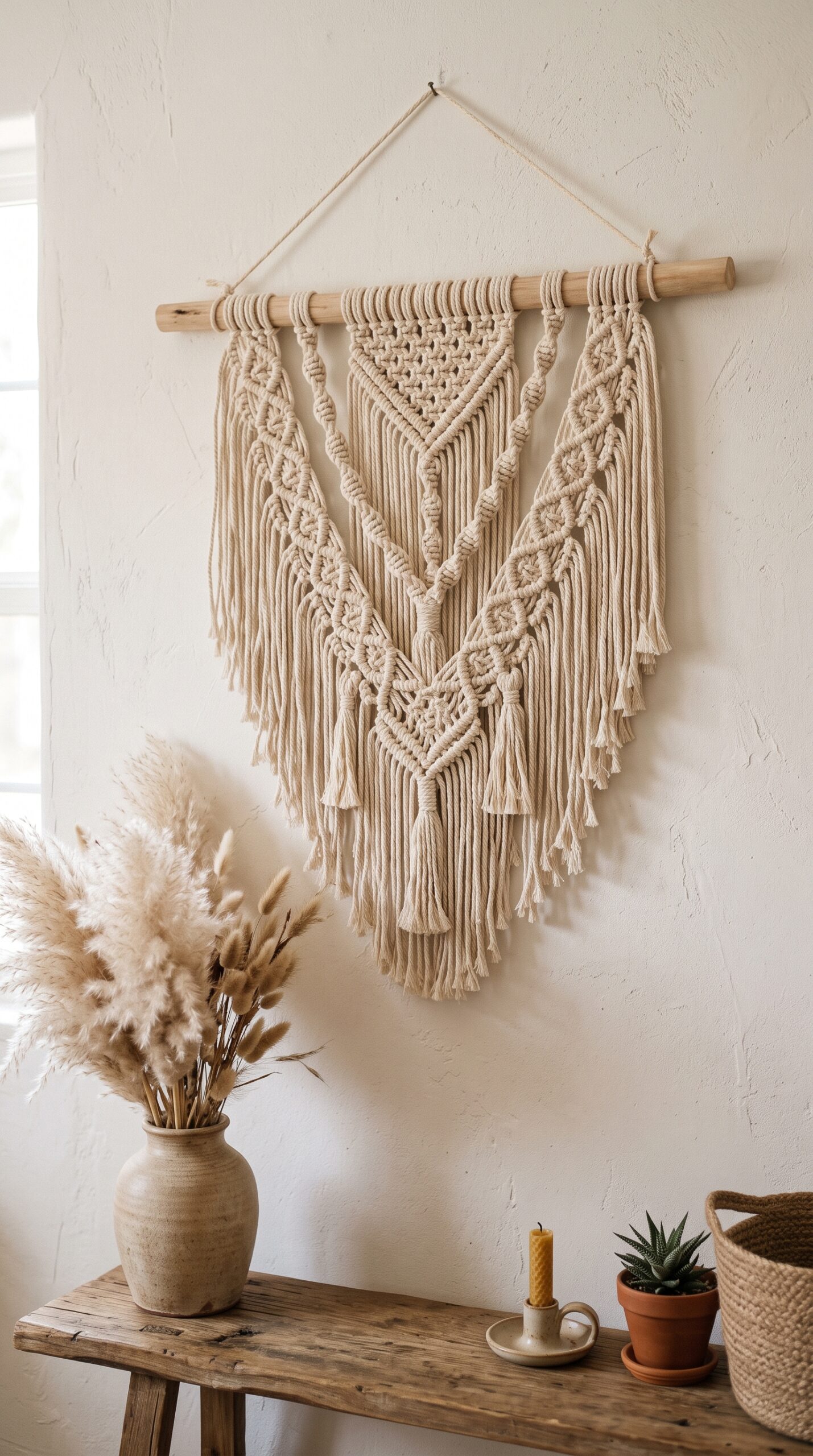
Large Natural Cotton Macrame Wall Hanging with Driftwood Rod — Hand-Knotted Fringe in Off-White

"A well-proportioned macrame wall hanging in natural cotton does more for a bohemian room's sense of texture and warmth than almost anything else at this price."

Best for: Any wall that feels empty or undefined, especially above a sofa, bed, or console table in a room with moderate ceiling height — skip this if your ceilings are below 8 feet, as a large macrame piece will make the space feel lower and smaller

What I look for in a macrame wall hanging is natural, undyed cotton rope — not the bright white synthetic versions that look stark and plastic-y in person — and a driftwood or raw wood rod that adds to the organic feel rather than detracting from it. A good one should have visible knotting variation, meaning different knot types and fringe lengths that give it depth rather than a flat, uniform look. This style works especially well for Principle 3 because it introduces pure texture with almost no pattern, which means it can sit beside a patterned rug without the two fighting each other. The downside worth knowing: macrame collects dust noticeably, particularly in the fringe, and gentle spot-cleaning is the only realistic maintenance option — it can't go in a washing machine and it can't be vacuumed without the fringe tangling.

  • —Natural undyed cotton ages to a warm ivory rather than yellowing, which looks intentional rather than neglected

  • —Driftwood rod adds visual weight at the top so the piece hangs flat against the wall without needing additional anchoring

  • —Fringe collects dust and pet hair noticeably — plan to shake it out gently every few weeks, especially in high-traffic rooms

Why it stands out: This applies Principle 3 directly — it layers texture onto the wall without adding another competing pattern to the room's visual mix.

What problem it solves: It transforms a flat, unfinished wall into the kind of layered, tactile backdrop that makes bohemian rooms feel intentional rather than accidental.

Photorealistic editorial vignette of a large natural cotton macrame wall hanging with a driftwood ro
Two Smart Add-Ons Once You've Got the Basics

Now that you've got your foundation and you know the traps to avoid, these two picks are worth adding when you're ready to push the room a little further.

Photorealistic editorial interior vignette of a natural open-weave rattan drum pendant light glowing
Shop This Pendant Light
Product Details

Handwoven Seagrass Storage Basket Set — Belly Basket Style, Set of Two

"Boring description, genuinely useful object — the belly shape specifically holds its form on the floor better than most cheaper alternatives."

Best for: Anyone who needs functional storage but wants it to double as a visual element — not worth buying if you're already using similar woven baskets and the room is feeling texture-heavy

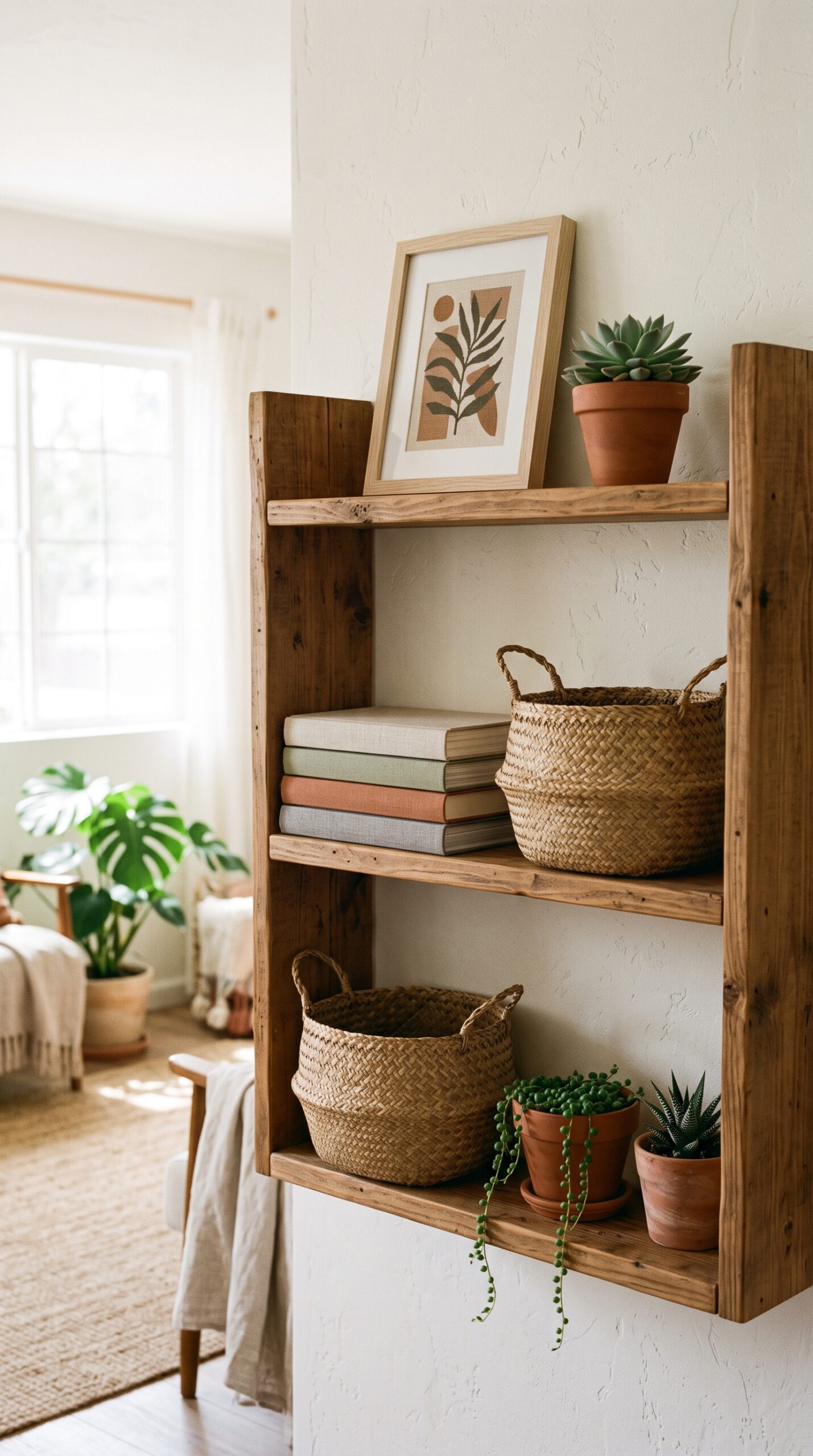
Seagrass belly baskets are one of those items I initially dismissed as overused, and then I put two of them in my living room and couldn't believe how much visual work they did for under $40 total. The rounded belly shape sits flat without tipping, holds blankets without looking stuffed, and because they taper at the top, they read as sculptural rather than utilitarian. A set of two in slightly different sizes creates that casual, collected look that's central to the whole bohemian approach — things that look like they were found rather than bought as a matching pair. The limitation is honest: these are not durable storage for heavy items, and the weave can loosen over time if you're constantly pulling things in and out, so they work best for light items like throw blankets, magazines, or extra cushions.

  • —Natural seagrass construction in classic rounded belly shape

  • —Two-size set creates natural height variation on the floor

  • —Weave loosens with heavy daily use — best for display-style storage

Why it stands out: Adds floor-level texture and visual grounding that pulls the eye downward and balances taller room elements.

What problem it solves: The too-smooth, too-contemporary feeling that happens when a room has good upper layers but no warmth at floor level.

Shop These Storage Baskets
Product Details
Two More Picks for Readers Who Want to Go Further

Most people reading this should stop at the first four product picks — those cover the core of what a boho room actually needs. These final two are for a specific kind of reader: someone who has the basics working, has done the edit, and now wants to push the room into more personal or more specific territory.

Common Bohemian Home Decor Mistakes That Ruin the Look

After helping friends pull together their first boho rooms and making plenty of my own expensive errors, I've noticed the same four mistakes come up in almost every home that tries this style and ends up feeling chaotic instead of layered. These aren't small tweaks — they're the difference between a room that looks thoughtfully collected and one that looks like a yard sale happened indoors. I'll cover each one in plain terms, including why the mistake makes sense at the time you make it, so you can catch yourself before it costs you. No judgment here — I made every single one of these at some point.

Mistake 1 — Buying Every Texture at Once

The logic is: bohemian style is all about layering, so more textures must mean more character. What actually happens is that your eye has nowhere to rest. I once styled a living room corner with chunky jute, a velvet pillow, a cotton macramé wall piece, a rattan lamp, and a fringe throw — all within about six square feet — and it looked genuinely exhausting to look at. The fix is to let one dominant texture anchor the whole room (usually something natural and matte, like linen or jute) and then introduce two others as supporting layers, no more than that. Pick your anchor first, then add.

Mistake 2 — Using Too Many Statement Colors

Bohemian palettes look colorful in magazine photos, but if you zoom in, most of those rooms actually have a very controlled color story underneath the warmth. People see a rich terracotta cushion and a deep teal throw and a mustard blanket and think they should all live together — and technically they can, but not at full saturation in the same corner. The result is visual noise that reads as clutter even when the room is tidy. Choose one or two dominant warm tones (terracotta and camel work in almost any room) and use everything else as an accent in small doses. Honestly, muted or washed versions of boho colors do more work than bright ones.

Mistake 3 — Hanging Art Too Low

This one trips up almost everyone, including people who've read the "eyes-level" rule a dozen times. In a boho room specifically, art placed at standard gallery height — about 57 inches to the center — can actually feel too low, because the room often has layers of objects on the floor (poufs, plants, baskets) that need visual breathing room above them. I learned this the hard way in my own bedroom, where a large woven wall hanging at standard height felt like it was sitting on top of the bed rather than floating above it. For most boho wall art, try the center at 62 to 65 inches, especially for large pieces, and see if the whole composition suddenly relaxes.

Mistake 4 — Treating Every Surface as an Opportunity

Bohemian style is generous and layered, but that doesn't mean every shelf, table, and corner needs an object. The mistake is filling every surface because the style seems to call for it — and I completely understand that impulse, because empty space in a boho room can feel unfinished when you're first building it. But those empty or near-empty moments are what make the layered areas feel intentional rather than cluttered. The rule I use in my own home: every room needs at least one surface that holds only one thing, or is completely clear. That pause is what lets the rest of the room breathe.

Macramé Wall Art Panel — Large Knotted Cotton Rope with Wooden Dowel

"More dimensional than a print and better at filling vertical space, but only works if your color palette is already neutral enough to support it."

Best for: Rooms with a large blank wall above a console, bed, or sofa — not the right pick if you've already got significant wall art and the room is feeling busy

A large knotted macramé panel does something framed art can't — it adds actual depth and shadow to a wall, which is exactly the kind of organic dimension boho rooms are built on. The best versions use thick, loosely twisted cotton rope (not the polished, tightly wound kind that reads as craft-fair) with a raw wooden dowel at the top that leans into the natural materials story. In my own bedroom, I replaced a gallery wall of three prints with a single large macramé panel and the room immediately felt calmer and more intentional — there was just less to look at, but more to actually see. The honest limitation is that large macramé pieces collect dust in ways that prints don't, and they need an occasional gentle shake to stay looking fresh.

  • —Large-format knotted cotton construction adds physical dimension and soft shadow

  • —Raw wooden dowel detail reinforces the natural materials story

  • —Collects dust over time and isn't as easy to clean as framed art

Why it stands out: Gives the wall a tactile, handmade quality that no print or poster can replicate in a boho room.

What problem it solves: The flat, decorator-showroom feeling that can persist even when a room has all the right accessories at floor and furniture level.

Photorealistic editorial interior of a warm bohemian living room with a linen sofa, one terracotta t

Hand-Knotted Wool and Cotton Blend Vintage-Style Kilim Area Rug — Natural Flatweave in Terracotta and Cream

"A hand-knotted kilim in warm neutrals is the single fastest way to make a bare or confused room start to look like it was decorated on purpose."

Best for: Living rooms and bedrooms where you need a strong anchor piece with visual warmth but don't want a thick pile that shows every footprint; not ideal for homes with very young children who spend time on the floor, as flatweave rugs offer very little cushioning

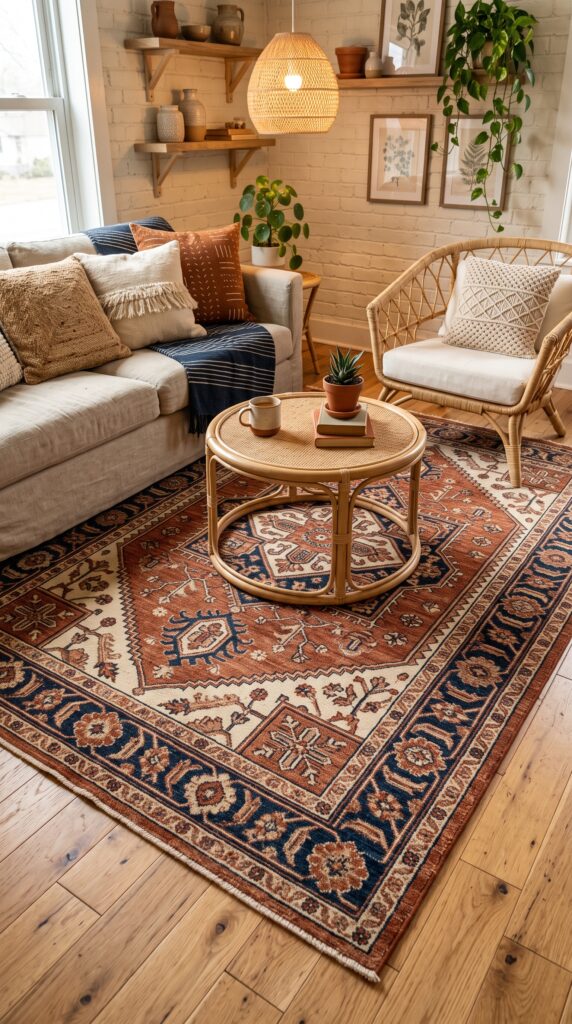
This type of rug sits flat, ages beautifully, and because it's hand-knotted rather than machine-made, the slight irregularities in the weave are part of the appeal — they give it that collected-over-time quality that's central to the bohemian aesthetic. The wool-cotton blend means it's durable enough for real daily foot traffic while still feeling substantial underfoot, not papery the way some flatweaves do. The terracotta and cream colorway is flexible enough to anchor a range of palettes, which matters if your room is still evolving. The honest downside is the price point: a quality hand-knotted rug in a size large enough to actually anchor a room — you want at least 8x10 feet for a standard living room — will cost you. Machine-made versions exist at a fraction of the price, but they don't have the texture variation that makes this work as a statement piece.

  • —Hand-knotted construction creates natural texture variation that photographs and ages better than machine-made flatweaves

  • —Works on hardwood, tile, or over carpet with a thin rug pad underneath

  • —Shedding is minimal at purchase but the rug will loosen slightly in high-traffic areas over the first 6 months — vacuum with low suction only

Why it stands out: This directly applies Principle 1 — it gives the room a strong, beautiful anchor that everything else can orbit around without competing.

What problem it solves: It fixes the most common boho decorating problem: a room that has interesting individual pieces but no single thing for the eye to land on first.

Bring Home This Rug
Product Details
Shop This Wall Hanging
Product Details

Woven Rattan Pendant Light Shade — Natural Open-Weave Drum Style

"One of the most effective single changes you can make if your room still feels generic, but only if your ceiling height is at least 8 feet."

Best for: Renters and homeowners who can swap a ceiling bulb without rewiring — not suitable for anyone without an existing ceiling fixture or who wants a fully enclosed shade

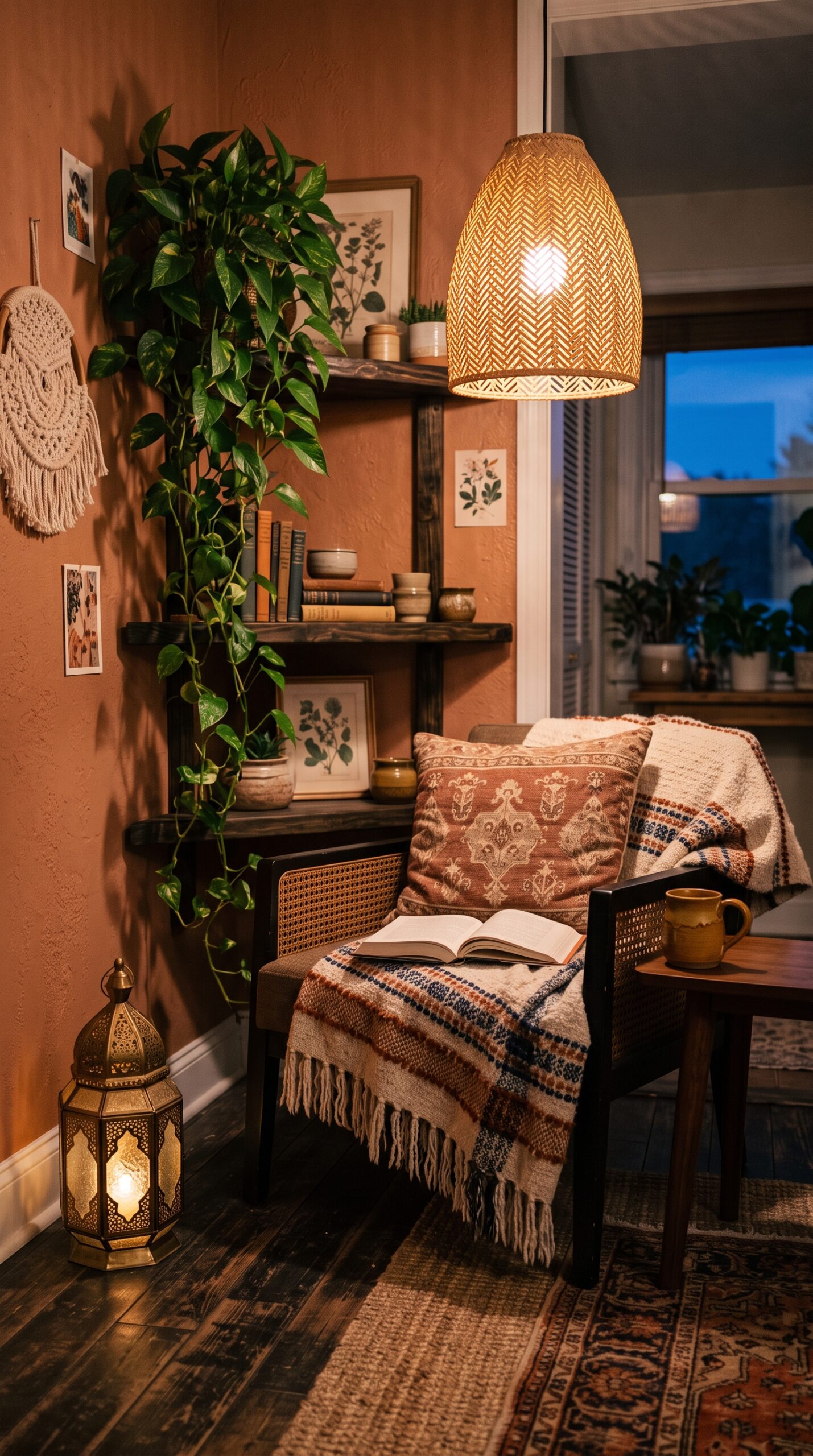
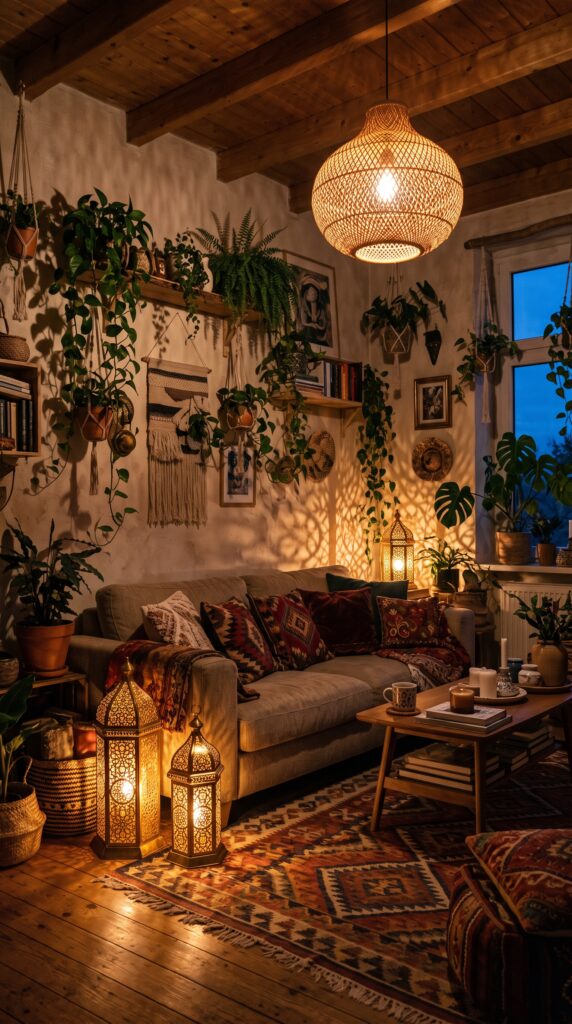
A drum-style open-weave rattan pendant shade does something no floor lamp can quite replicate — it casts dappled warm light downward and scatters small patterns across the ceiling and upper walls, which is exactly the kind of layered, organic effect boho rooms need. I put one in my dining area about two years ago and it immediately stopped the room from feeling like a well-decorated Airbnb and started feeling like an actual home. Natural rattan in a warm honey or bleached tone works in almost any color scheme, and the open weave means a warm-tone bulb (2700K is ideal) does most of the styling work for you. The honest limitation is durability: rattan shades don't love high-humidity spaces, so skip this for kitchens directly over a stove or any bathroom application.

  • —Open-weave construction casts organic light patterns across walls and ceiling

  • —Fits most standard E26 pendant bulb setups without rewiring

  • —Not suitable for humid spaces or rooms without an existing overhead fixture

Why it stands out: Adds the warm, layered ambient light that makes a boho room feel finished rather than assembled.

What problem it solves: The flat, overhead lighting problem that makes even well-styled rooms feel like a furniture showroom.

Shop This Boho Wall Art
Product Details

Moroccan-Style Brass Tealight Lantern — Hammered Finish, Medium

"For under $30, it delivers more warmth in the evening than almost any other single object in this price range."

Best for: Anyone who wants warm candlelight ambiance in the evening without committing to a major lighting change — skip this if you're not a candle person, because it's purely an atmospheric piece and not functional lighting

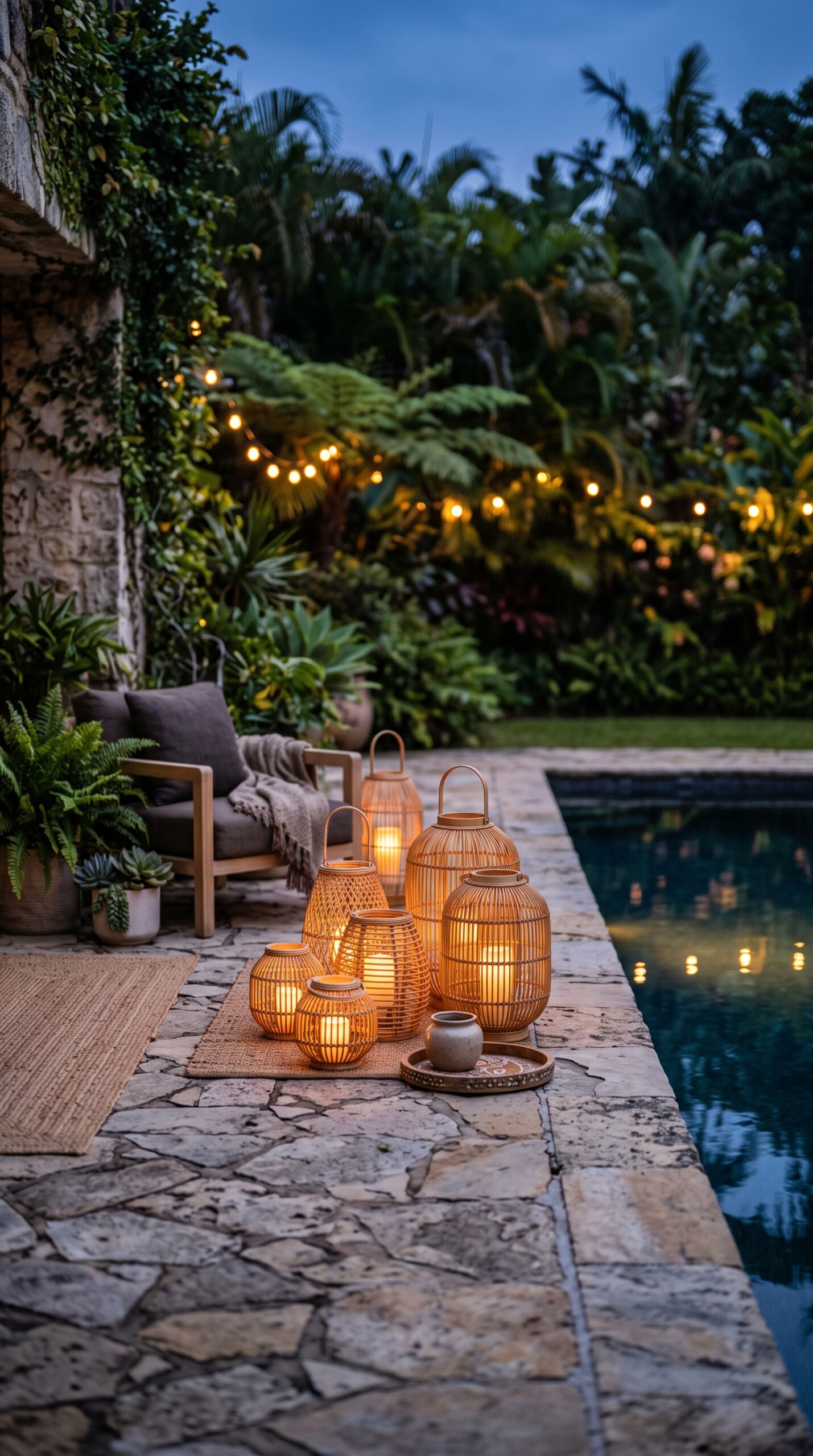
A hammered brass tealight lantern is one of those objects that looks marginal in the product photo and genuinely beautiful in person, especially in the evening when everything else in the room is doing its job. The Moroccan-influenced star or geometric cutout pattern throws small points of warm light across surrounding surfaces when a tealight is inside, and even during the day the hammered brass texture reads as a warm metallic accent without competing with the softer natural materials around it. I have three of these in different sizes clustered on a low tray in my living room — the clustering is important, because a single lantern can look lonely while three together read as an intentional vignette. The trade-off is real: this is purely atmospheric, it doesn't add meaningful light to the room, and if candles aren't part of how you actually live, it'll sit unused within a month.

  • —Hammered brass finish with geometric cutout pattern casts warm scattered light

  • —Works with standard tealight candles, no special inserts needed

  • —Purely decorative in terms of light output — not a practical lighting source

Why it stands out: Adds the warm, flickering evening ambiance that makes a boho room feel genuinely cozy rather than styled-for-photos.

What problem it solves: The gap between a room that looks great in daylight and one that also feels warm and alive after the sun goes down.

Shop This Lantern
Product Details
How to Decide What's Right for Your Space

Every room is different and so is every person's relationship with clutter, pattern, and bold choices. The best way I can help you without seeing your actual room is to give you a set of honest if-then situations and let you self-select. If you tend toward feeling overwhelmed by busy rooms, you want fewer items with stronger individual presence — a single large macramé panel instead of a gallery wall, one oversized plant instead of five small ones. If you tend toward feeling like rooms look sparse or unfinished, you probably need to be more patient with the layering process rather than adding more objects — the issue is usually color temperature or lighting, not quantity. Think about which tendency sounds more like you before you spend another dollar.

If you're working with a small space

Keep your dominant texture very light and smooth (linen or loosely woven cotton rather than chunky jute) because heavy textures in small rooms make the walls feel closer. Use tall vertical elements — a floor plant, a tall woven wall panel — rather than spreading objects horizontally across every surface, because vertical lines draw the eye up and make ceilings feel higher. Stick to a three-item maximum on any single surface, and give yourself permission to leave at least one full wall completely clear.

If you have pets or kids

Natural fibers are mostly your friend here, but with some exceptions — seagrass and rattan are more claw-resistant than cotton macramé, which pulls and frays with almost no effort from a cat. For textiles, choose tightly woven cotton or linen in medium tones (not white, not black) that hide daily wear without disappearing entirely. Avoid anything with long fringe at floor level unless you're prepared to either replace it or accept that it won't look magazine-perfect for long, and that's genuinely okay.

If you're on a tight budget

Here's the honest truth: boho is one of the more budget-friendly styles to pull off because it rewards the imperfect, the found, and the secondhand. Spend real money (relatively speaking) on two things only — your rug and your main light source, because those two items affect every other element in the room. Everything else — baskets, cushions, plants, small objects — can come from thrift stores, markets, and discount shops without anyone being able to tell. I've styled rooms where the rug was $120 and every other object cost under $15, and they looked completely finished.

Final Thoughts

If there's one thing I want you to take away from this post, it's that bohemian style is more about restraint than abundance — which sounds completely backwards until you actually try it and see how right it is. The rooms that do this well aren't the ones with the most objects; they're the ones where every object feels like it has a reason to be there. Start with one thing: the rug, the light, a single well-placed plant. Get that right before you add the next layer. Your taste will genuinely develop through the doing of it — each room you style teaches you something you couldn't have learned by reading, and that knowledge compounds over time. If anything here was useful or if you try any of these principles in your own home, I'd love to hear how it went in the comments.