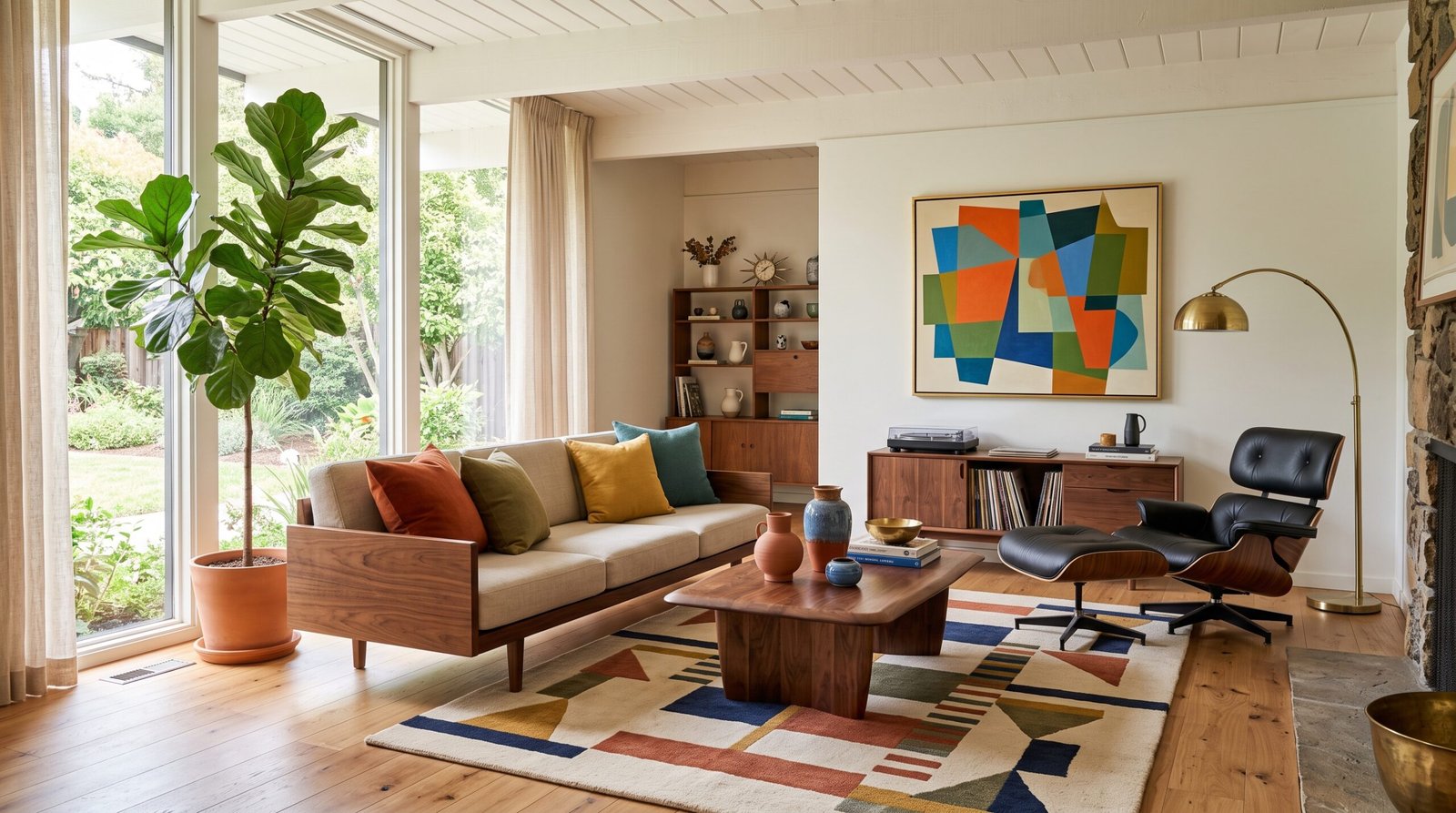
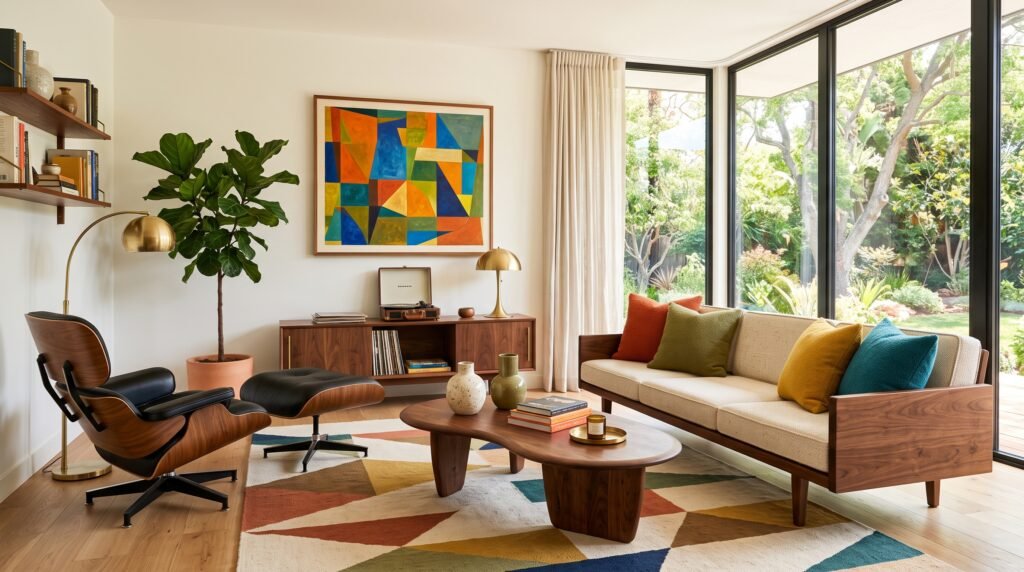
A well-done mid century modern living room is one of those rare design achievements that feels both timeless and completely of-the-moment. You know it when you walk in. The clean lines. The warm wood tones. That specific combination of sculptural furniture and uncluttered space that makes you want to sit down, stay a while, and maybe put on some Chet Baker.
But here’s the thing — most people who try to pull off MCM end up with something that looks more like a furniture showroom than a real home. Or worse, they buy one iconic-looking piece and surround it with totally incompatible stuff, and the whole vibe just… doesn’t land.
That’s exactly what this guide is here to fix.
Whether you’re starting from scratch or just trying to inject some mid century modern living room ideas into a room that already exists, these 15 ideas are practical, budget-friendly, and genuinely worth stealing.
📋 Table of Contents
- What Actually Makes a Mid Century Modern Living Room Work
- The Sofa: Your Anchor Piece for Any Mid Century Modern Living Room
- Seating: The Accent Chair is Non-Negotiable
- Tables and Surfaces: The Details That Make or Break the Room
- Lighting: Where Mid Century Style Gets Sculptural
- Rugs, Textiles, and the Art of Layering
- How to Pull These Mid Century Modern Living Room Ideas Together
- Frequently Asked Questions About Mid Century Modern Living Room Ideas
What Actually Makes a Mid Century Modern Living Room Work
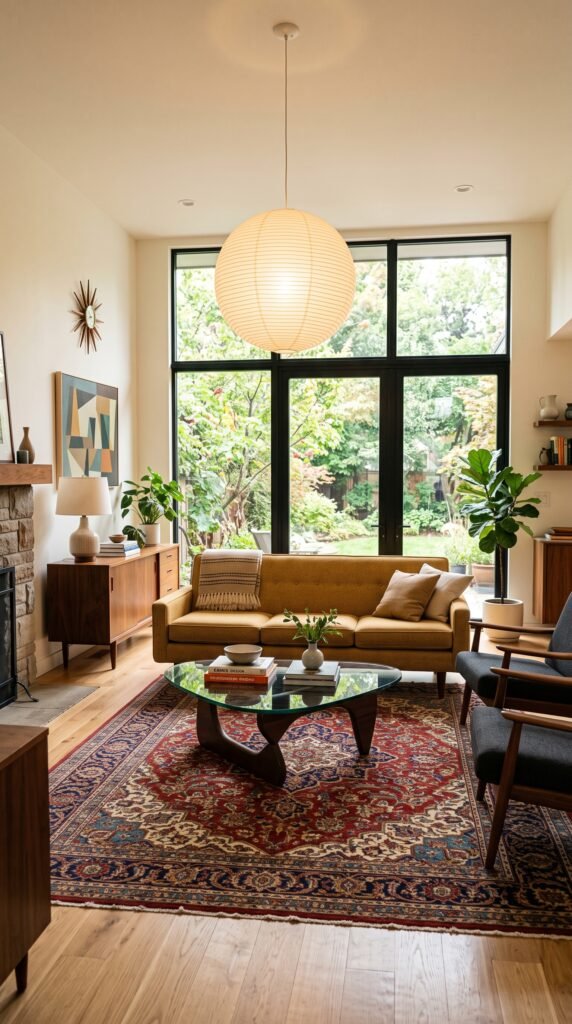
Before you buy a single piece of furniture, you need to understand the actual logic behind the style. Mid century modernism wasn’t just an aesthetic. It was a design philosophy built around a few core beliefs: that furniture should be functional AND beautiful, that nature and the indoors should feel connected, and that clean forms beat unnecessary ornamentation every single time.
Here’s what that means practically.
The silhouette matters more than anything else. Low-slung profiles, tapered legs, gently curved edges. If a piece of furniture looks heavy, boxy, or overly ornate, it doesn’t belong in a mid century modern living room. Full stop.
Natural materials are your best friends. Walnut, teak, wool, leather, rattan. Synthetic textures don’t read the same way, even if the shape is right. And warm, earthy tones — ochre, burnt orange, avocado green, warm white — beat cold grays and stark whites every single time in this style.
Get those two things right, and the rest of the ideas below will start to click into place.
The Sofa: Your Anchor Piece for Any Mid Century Modern Living Room
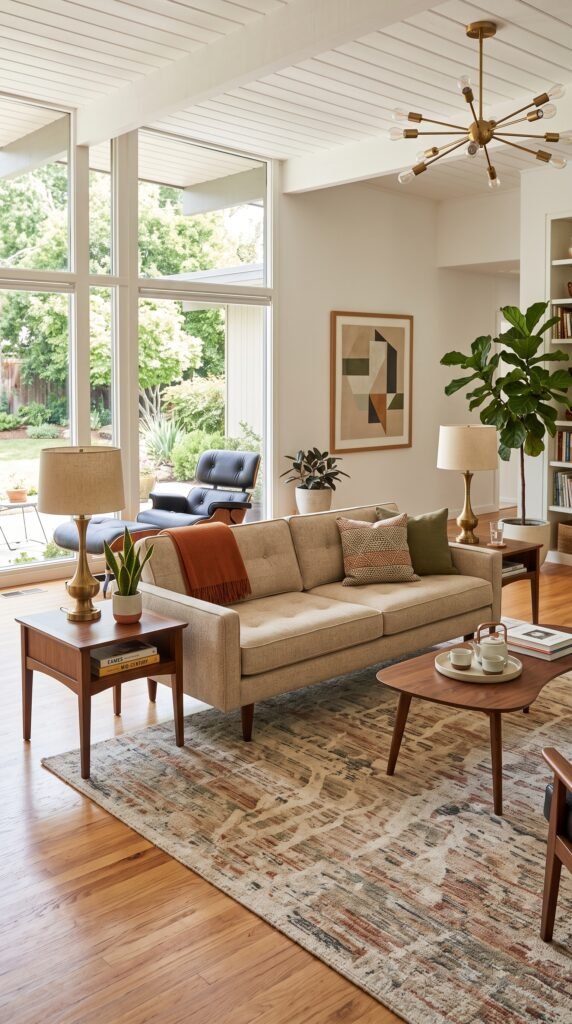
Start here. The sofa is the gravitational center of the room, and in a mid century modern living room, it needs to check very specific boxes: low profile, clean lines, tapered legs (ideally wood), and upholstery in a solid, earthy, or jewel tone.
Idea 1: Go Low-Profile, Always
High-backed, oversized sectionals kill the MCM vibe instantly. The silhouette you want sits close to the floor with a backrest that stays below eye level when you’re seated. This creates that open, airy quality that makes mid century spaces feel so breathable.
If you are working to a tighter budget, the Stone & Beam Westbrook Sofa is a clean-lined option worth shortlisting: a low, straight back, slim tapered legs and a seat deep enough to lounge on without swallowing a small room. Measure your wall and the walkway in front of it first — the sofa should leave a clear path to move around it, and its back should sit below a windowsill if it stands against a window.
Idea 2: Size Up for Bigger Rooms with a Sectional
Bigger living rooms actually benefit from a sectional, as long as it has those signature mid century legs. The West Elm Mid-Century Sectional brings clean lines and a low profile to a larger room — choose a left or right chaise to suit the way traffic moves through the room, and check the overall length against the wall it will sit on before you order, because a sectional that is too long leaves no space for a side table or a floor lamp.
Idea 3: Choose Upholstery Color with Intention
Picture this: you find the perfect MCM sofa shape, but you order it in gray because it feels “safe.” You put it in the room and something just feels off. Flat. Almost corporate. That’s the gray problem. Mid century modern living rooms need warmth. Mustard yellow, terracotta, olive green, cognac leather, even a deep teal — these are the colors that make the whole room feel intentional rather than accidentally assembled.
If your room is on the small side, our small living room decor ideas work through the fixes that help a low-profile sofa fit without crowding the room.
Seating: The Accent Chair is Non-Negotiable
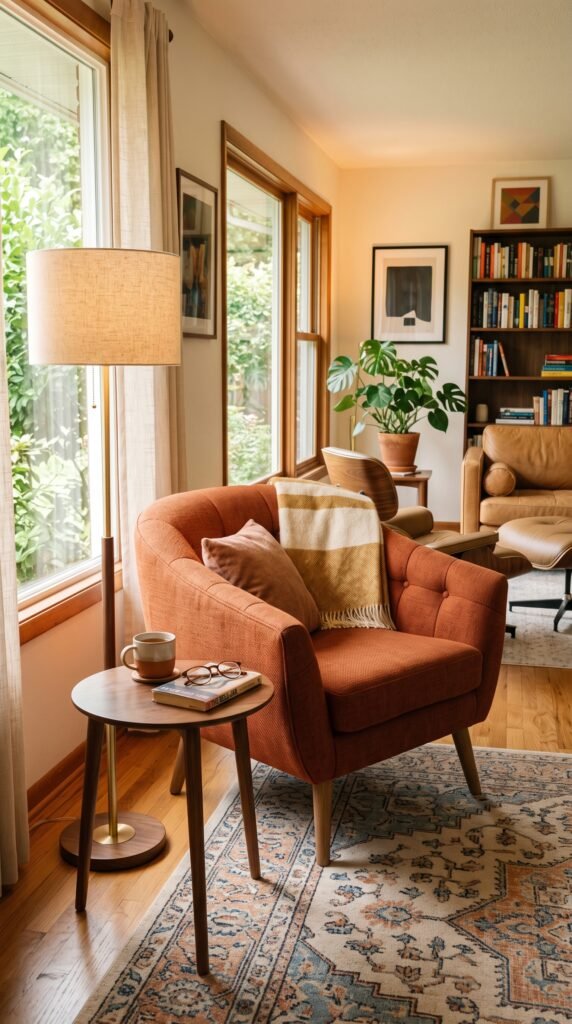
This is where MCM design gets fun. The accent chair is your opportunity to add personality, and in the mid century vocabulary, that usually means one of a few iconic forms: the tulip chair, the barrel chair, the Eames lounge, or the wishbone-style side chair.
Idea 4: The Barrel Chair (Eero Saarinen Vibes on a Budget)
The Rivet Revolve Modern Upholstered Accent Chair is a barrel chair with a curved back and wooden legs that echoes Eero Saarinen’s Womb Chair at a fraction of the look. It works best angled into a corner or beside the sofa, with a small side table within reach. Before you buy, check the seat width against the space — a barrel chair needs room around it to show its curve, so leave a gap from the wall and angle it towards the sofa rather than pushing it flat.
Idea 5: The Eames Lounge Chair (at Every Price Point)
There is arguably no more recognizable MCM furniture form than the Eames lounge chair and ottoman. It’s been in production since 1956. And yes, the original matters.
The Herman Miller Eames Lounge Chair and Ottoman is made in the USA with genuine walnut veneer and premium leather. Charles and Ray Eames designed it in 1956 for Herman Miller, and it has been in continuous production since — look for the genuine article’s moulded plywood shell, swivelling base and matching ottoman, and check the veneer and leather options before you commit, because this is a piece you hand down to someone.
That said — not everyone is ready for that investment. The Eames-Style Lounge Chair and Ottoman Replica by Modway delivers the silhouette and the comfort at a far lower outlay. Before you buy a replica, check the shell (look for moulded plywood rather than a flat board), the cushion thickness and the base — a good replica swivels smoothly and the ottoman is the same height as the chair seat. For most people, a well-chosen replica is a genuinely smart bridge between budget and aesthetic.
Idea 6: Mix Seating Styles (This Is the Secret)
Most people think MCM means everything has to match. It doesn’t. A low sofa, a barrel accent chair, and a slimmer side chair in a contrasting material — that combination is more authentic to actual 1950s and 60s interiors than a perfectly matched suite. Real mid century modern living rooms had personality. They mixed things.
Tables and Surfaces: The Details That Make or Break the Room
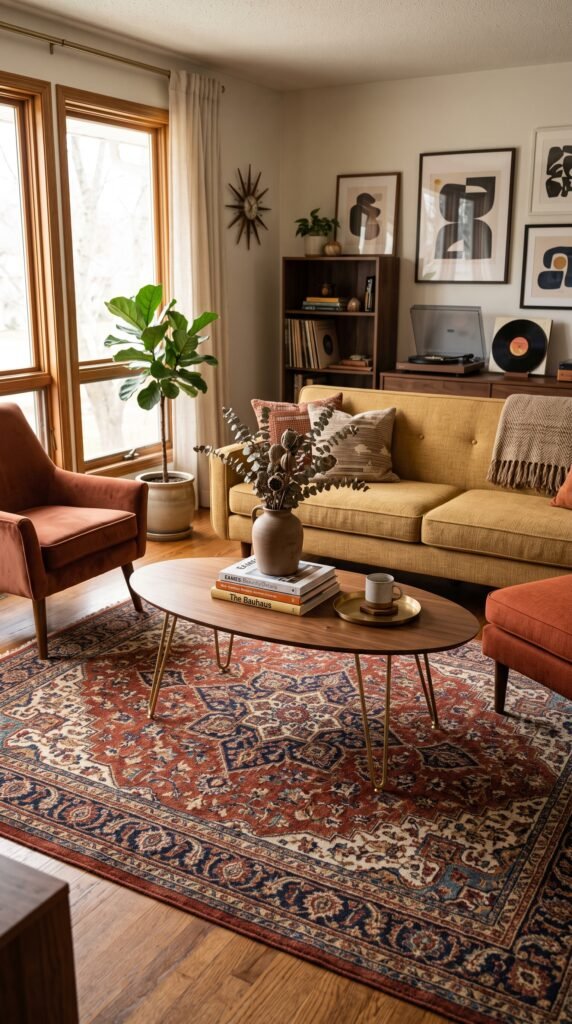
Tables are where the MCM aesthetic lives in the details. And here, two specific elements separate a room that reads as genuinely mid century from one that just kind of gestures at it: hairpin legs and walnut veneer.
Idea 7: Hairpin Legs on Everything
Hairpin legs are a signature detail of the style, and they work on coffee tables, side tables, consoles, and even benches. They’re slim, graphic, and they make heavy wood surfaces feel like they’re floating.
The George Oliver Walnut Coffee Table with Hairpin Legs combines both of those elements in one piece — a walnut top and hairpin legs in a silhouette that reads as pure 1950s. Choose a coffee table the same height as your sofa seat or a touch lower, so it is easy to reach from the sofa, and pick a top you can see across easily. Avoid thick, chunky legs, which make the table read as a dining table rather than a mid century piece.
Idea 8: Use a Bold Side Table as a Color Moment
Here’s an idea most people overlook: the side table doesn’t have to be neutral. In fact, a jewel-toned or lacquered side table is one of the quickest ways to add that playful, optimistic energy that defined 1950s and 60s interiors.
The Jonathan Adler Malachite Lacquer Side Table is exactly that. Bold malachite green, geometric form, and a finish that reads as art. Use it as a single accent beside a chair rather than as a pair, and keep the other side tables plain so it stays the focal point. Skip matching sets: one statement side table is stronger than two identical ones.
Idea 9: Don’t Skip the Console Table
A slim console table against one wall — especially if it’s in walnut or teak with tapered legs — gives you a surface for a lamp, some art objects, and a plant. And in an MCM room, that styling moment against a blank wall is where the room gets its soul. Look for pieces under 18 inches deep so the proportions stay light.
If you want a step-by-step approach to pulling the whole room together, our fall living room decor guide walks through starting with the sofa, choosing one accent colour, and layering warm light and natural texture.
Lighting: Where Mid Century Style Gets Sculptural
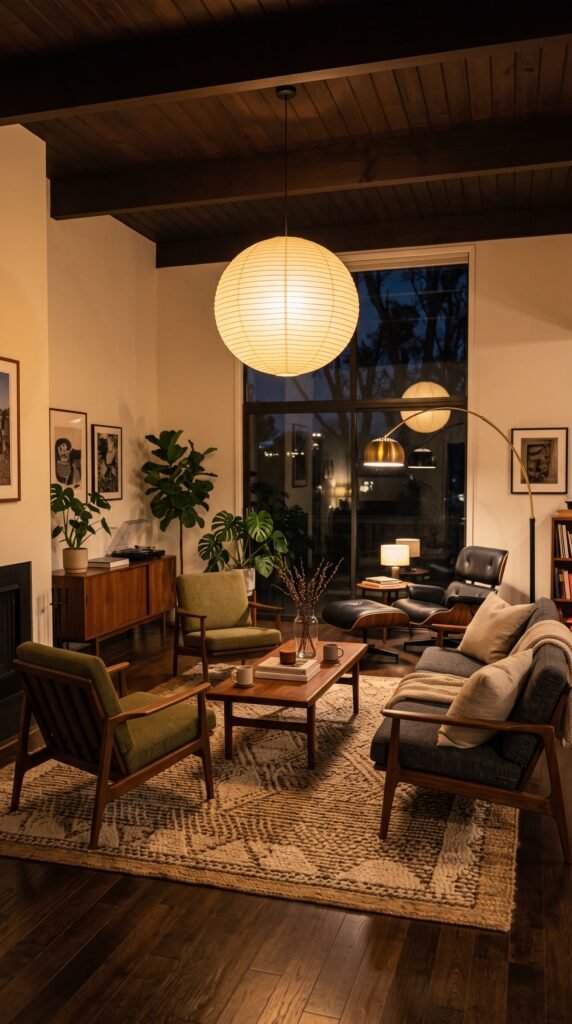
Lighting in a mid century modern living room is never an afterthought. The shapes themselves are part of the design. Sputnik chandeliers, paper globe pendants, arc floor lamps, ceramic table lamps — these aren’t just light sources. They’re sculptural objects that contribute to the visual rhythm of the room.
Idea 10: The Paper Globe Pendant (Noguchi’s Lasting Influence)
Isamu Noguchi designed his Akari paper lanterns in 1951, and they’ve never stopped feeling right in an MCM space. The organic, warm glow they produce is completely different from harsh overhead lighting. And most pendant versions install without an electrician.
The Noguchi Style Rice Paper Pendant Light by MOTINI delivers that exact quality. Hang it low over a coffee table or in a reading corner at eye level when seated, and fit a warm-white bulb, so the paper glows amber rather than glaring white. Avoid hanging it so high that it only lights the ceiling.
Idea 11: Layer Your Light Sources
Most people run into this exact problem when decorating a mid century modern living room: they rely on one overhead light and the room ends up feeling flat. MCM interiors use light at multiple levels — overhead, floor lamp, table lamp — to create depth and warmth. You want pools of light. Not one big bright ceiling wash.
Mid century designers treated light as a mood element, not just a utility, and they built rooms around that idea. The goal is layered light — a pendant for general light, a floor lamp for reading, and a small table lamp for the evening — so one switch does not have to carry the whole room.
Idea 12: Go Sculptural with Your Floor Lamp
An arc floor lamp with a round shade is a period-appropriate choice that also solves a real problem: how do you get light over a seating area without a table in the way? Arc lamps do exactly that. Look for ones with a weighted marble or stone base for stability, and a shade in a warm material — paper, fabric, or spun metal.
Rugs, Textiles, and the Art of Layering
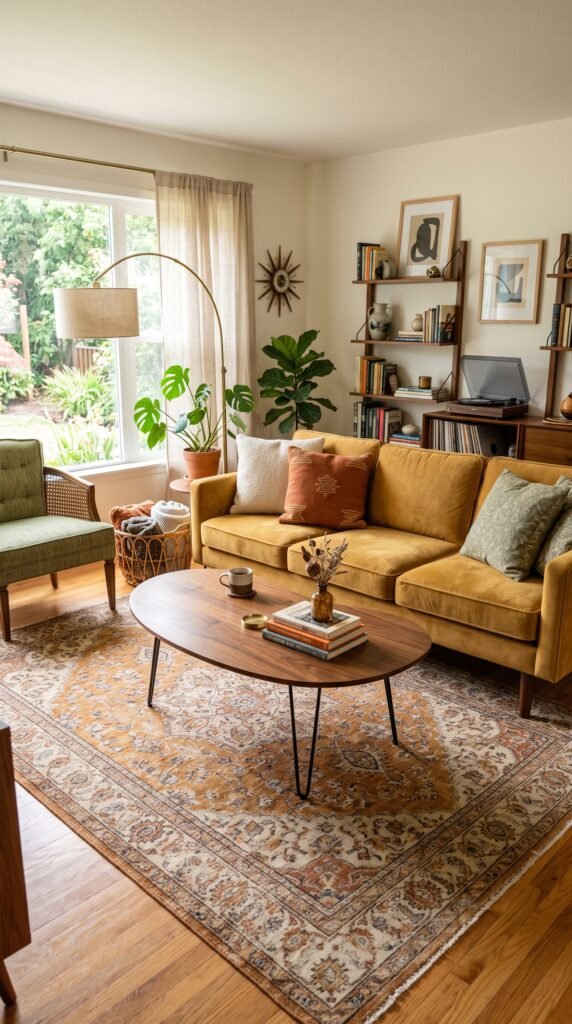
Textiles are the element that softens all those clean lines. And in a mid century modern living room, the layering approach matters just as much as any individual piece.
Idea 13: Start with a Vintage-Toned Area Rug
The rug anchors the seating area and sets the color conversation for the whole room. For MCM spaces, you want either a geometric abstract rug OR a muted vintage Persian — both are period-appropriate, and both work because they add visual warmth without competing with the furniture silhouettes.
The nuLOOM Vintage Odell Persian Area Rug hits the right palette — warm terracotta, muted amber and deep indigo in a faded, low-contrast finish, which is the look mid century rooms need. Size it so the front legs of the sofa and chairs sit on the rug; a rug that is too small makes the seating look as if it is floating on the floor. If the budget only stretches to one rug, put it in the seating area and leave the rest of the floor bare.
Idea 14: Layer Throw Pillows in Geometric or Botanical Prints
Solid upholstery on your sofa means your throw pillows can do the pattern work. Look for geometric prints, abstract shapes, or botanical motifs in period-appropriate colors. Burnt orange, avocado, mustard, walnut brown. Mix textures — a chunky boucle pillow next to a flat graphic-print pillow is exactly the kind of collected-over-time energy that MCM rooms should have.
The most convincing contemporary MCM interiors balance warm textiles with the harder material qualities of the furniture rather than leaning fully into one or the other. That tension is part of what makes the style feel alive.
Idea 15: Don’t Forget the Plants
This one sounds obvious. But a mid century modern living room without plants is missing something. The style was deeply invested in bringing the outdoors inside — it’s why so many MCM homes had floor-to-ceiling windows. If you don’t have those windows, a large fiddle leaf fig, a bird of paradise, or a cluster of sculptural cacti near your seating area does the same work. It connects the interior to the natural world. And against walnut furniture and warm textiles, green foliage just looks extraordinary.
If you are furnishing on a budget, our affordable living room finds show how a few well-chosen pieces can warm up a room without blowing the budget — the same rule applies to plants: one large plant does more than five small ones.
How to Pull These Mid Century Modern Living Room Ideas Together
Here’s the hard truth about designing a mid century modern living room that actually works: it’s not about buying the right individual pieces. It’s about understanding the relationships between them.
Low furniture needs breathing room. Warm wood needs warm textile partners. Sculptural lighting needs a clean ceiling to read clearly. Bold accent pieces need neutral backgrounds to pop against. And the whole room needs enough empty space to feel like a statement rather than a storage situation.
The mid century modern movement was fundamentally about democratising good design — making beautiful, functional things available to real people living real lives. That’s still the right frame for approaching it today.
Start with one or two anchor pieces that you love. Build outward from there. And resist the urge to fill every surface.
The restraint is the point. The space is part of the design. And a truly great mid century modern living room knows exactly when to stop.
Ready to start? Pick one anchor piece first — a low-profile sofa or a statement chair — then add a walnut coffee table, a warm rug and layered lighting around it. Your room is one good decision away from looking like something out of a 1962 design magazine. In the best possible way.
Frequently Asked Questions About Mid Century Modern Living Room Ideas
What defines a mid century modern living room?
Low-profile furniture, clean lines, tapered legs, walnut or teak wood, and an earthy, muted palette — plus a few sculptural pieces from the mid-twentieth century. The icons most people start with are the Eames lounge chair, designed in 1956, and Noguchi’s Akari lights, from 1951.
What colour sofa works best in a mid century modern living room?
Warm neutrals — cream, camel or warm grey — with one accent colour picked up from the rug or artwork and repeated in cushions and a chair. In a small room, the lightest-coloured sofa makes the space feel larger.
How do I keep a mid century modern living room from looking like a showroom?
Mix eras. Pair two or three true mid century pieces with a modern sofa, then soften everything with textiles and plants and leave some surfaces unstyled. One statement piece beats a matching set every time.
What size rug should I use in a mid century modern living room?
Choose a rug large enough for the front legs of the sofa and chairs to sit on it. In a large room that usually means a 10-by-14-foot rug; in a small room, go one size up from the size that feels right — a rug that is too small makes the seating look adrift.