Small apartment decor ideas work best when they solve a real problem instead of adding more stuff. A small flat does not need more furniture or more color. It needs better light, a calmer base, and a few pieces that earn their floor space. This guide gives you seven small apartment decor ideas that do exactly that, with the measurements, materials and mistakes to avoid for each one.
Use the ideas in order if you are starting from scratch, or jump to the one that fixes the thing that bothers you most. Every one of these small apartment decor ideas works in a rented flat, none of them needs structural work, and most of them cost less than replacing a single piece of furniture.
In this guide
- Why these small apartment decor ideas work
- Layer your lighting before anything else
- Build a neutral base, then layer texture
- Bring in plants, real or faux
- Use mirrors to double light and space
- Make every piece of furniture work harder
- Add a gallery wall that looks intentional
- Treat your bed like the centerpiece
- Putting it all together: a one-weekend plan
- Frequently asked questions about small apartment decor ideas
Why these small apartment decor ideas work
Most small flats feel cramped for the same three reasons: one harsh overhead light, too many competing colors, and furniture that only does one job. Fix those three things and the flat feels bigger without moving a wall. That is the thread running through all seven ideas below: add light, calm the base, and choose pieces that work twice as hard.
A note on honesty: none of these ideas will make a 30-square-meter studio feel like a house. What they will do is make the space you have feel calmer, brighter and more deliberate, which is what people actually mean when they say a small flat feels expensive.
Layer your lighting before anything else
If you change one thing, change the lighting. The flat, cool ceiling light that comes with most rentals flattens everything, removes depth, and makes even a well-decorated room feel like a waiting room.
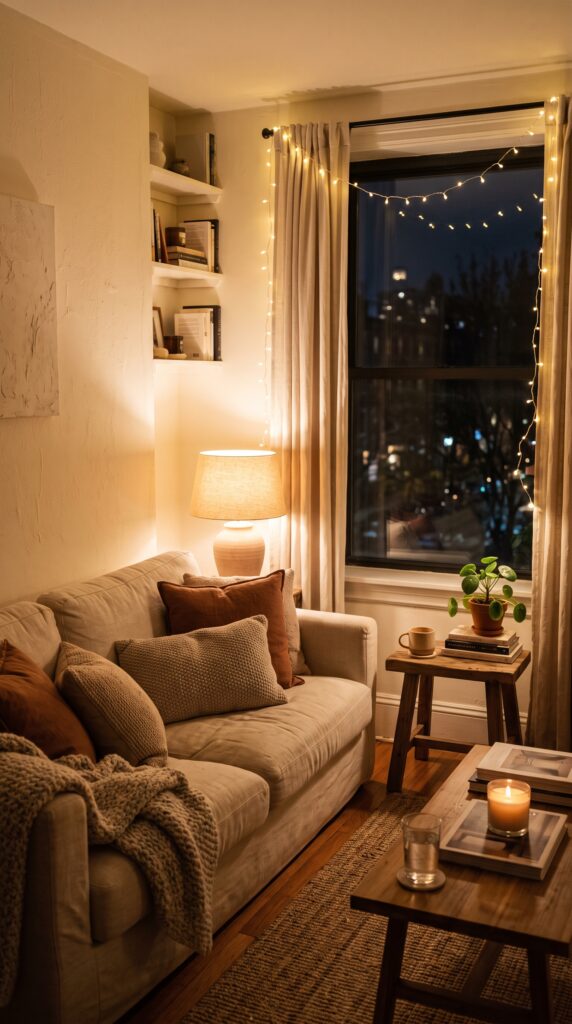
The fix is layering: several smaller sources of warm light at different heights instead of one bright source from above. Aim for three layers, a table lamp on a side table, a floor lamp near the sofa, and something low and ambient, such as candles or string lights along a shelf.
Choose warm white bulbs and look for 2700K on the packaging. That number is the color temperature, and 2700K gives the golden glow that makes wood, linen and skin tones look richer. Cool white bulbs above 4000K make the same room feel stark.
Switch to LED bulbs while you are at it. LED bulbs produce light far more efficiently than old incandescent bulbs, and they last far longer, so you are not replacing bulbs in a hard-to-reach fitting every few months. The ENERGY STAR guide to LED lighting puts the efficiency difference at up to 90 percent.
The mistake to avoid is mixing color temperatures in one room. A warm lamp next to a cool ceiling light makes both look wrong. Pick warm white for every bulb in the room, and put the main lamp on a dimmer or a smart plug so you can lower the light in the evening. It is a small detail, but it is one of the small apartment decor ideas that makes the biggest difference for the least money.
If the bedroom is the room that bothers you most, start there. Bedroom Lighting Ideas Under $40 covers the same layering approach for bedrooms.
Build a neutral base, then layer texture
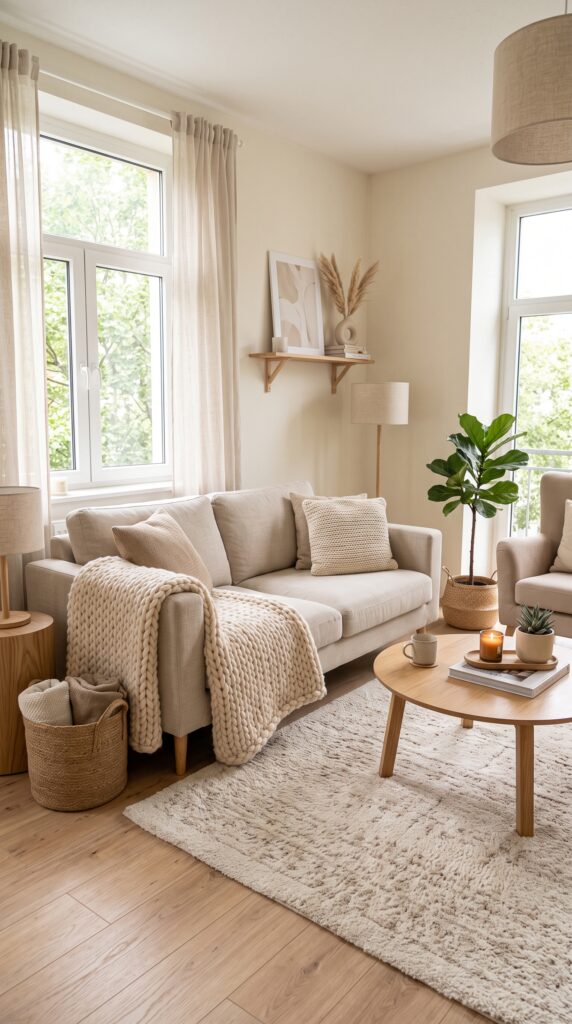
The most common mistake in these small apartment decor ideas is trying to make the space interesting with color. Bold colors on every wall and every cushion compete with each other, and the room ends up looking busy rather than bold.
Start neutral instead. Warm white, soft beige, oat and light gray for the large surfaces, walls, sofa, bedding, give the eye somewhere to rest. Then add personality through texture: a chunky knit throw, linen cushions, a woven basket, a wooden tray. Texture adds interest without adding visual noise.
Keep the palette to three neutrals plus one accent color, and repeat the accent in at least three places, a cushion, a throw and a print, for example. Repetition is what makes a color look deliberate instead of accidental.
If you buy one thing for the living area, make it a rug that is big enough. A rug that only sits under the coffee table makes the seating area look smaller. A rug that the front legs of the sofa and chairs sit on pulls the whole arrangement together. Measure the seating area first and buy the rug to fit it, not the other way round.
The mistake to avoid is buying texture in a single material. Five linen cushions in slightly different shades of beige look flat. Mix knit, linen, wood and rattan, and the same neutral palette suddenly has depth.
Bring in plants, real or faux
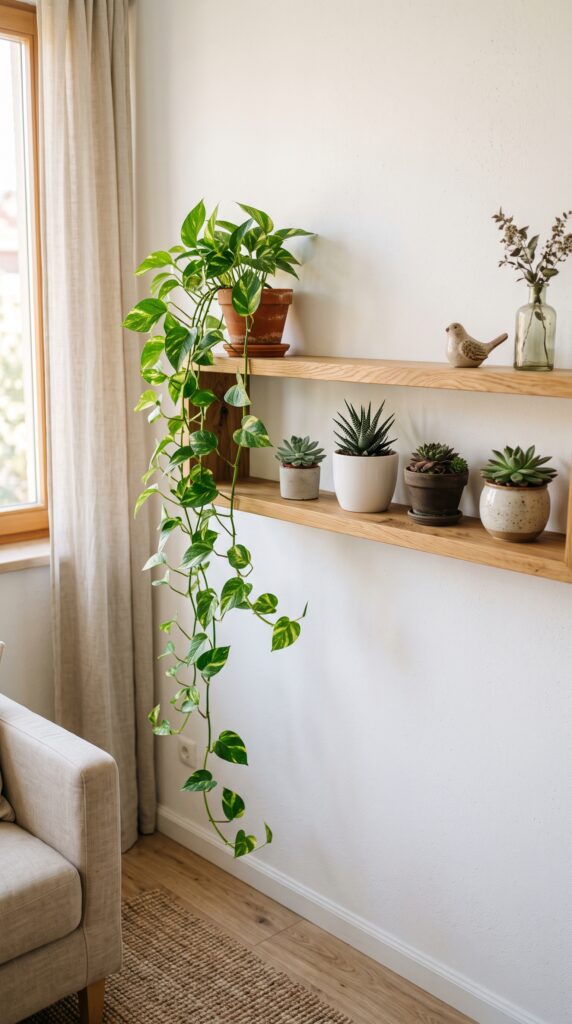
Plants do something no amount of styling can replicate: they add life and a soft, irregular shape to rooms full of straight lines. One large plant in a corner changes the whole feel of a living room, and three small ones grouped on a shelf do the same for a desk or a kitchen sill.
If you enjoy plant care, start with forgiving varieties. Pothos, snake plants and ZZ plants cope with irregular watering and lower light, which makes them sensible first plants for a flat. Water only when the top 2 to 3 cm of soil feels dry, and empty the saucer so the roots are not sitting in water.
If you travel often or your flat gets little direct light, good faux plants are the honest choice. Small artificial succulents are convincing at that size because there is less foliage to give them away, and a faux trailing plant on a high shelf needs no light at all. Mix one or two faux plants with real ones rather than filling the flat with plastic.
Place plants in odd-numbered groups, three or five, at different heights, and keep them off the floor where you walk. A plant on the floor in a walkway gets knocked over, while the same plant on a stool or a plant stand becomes a feature.
The mistake to avoid is buying a large plant for a dark corner and hoping for the best. Most houseplants need a bright spot near a window. If the only free corner is dark, put a faux plant there and keep the real ones where they can actually grow.
Plants work hardest in the living room, where they soften the largest piece of furniture in the flat. For the room as a whole, see Dream Apartment Living Room Decor Ideas You Will Love.
Use mirrors to double light and space
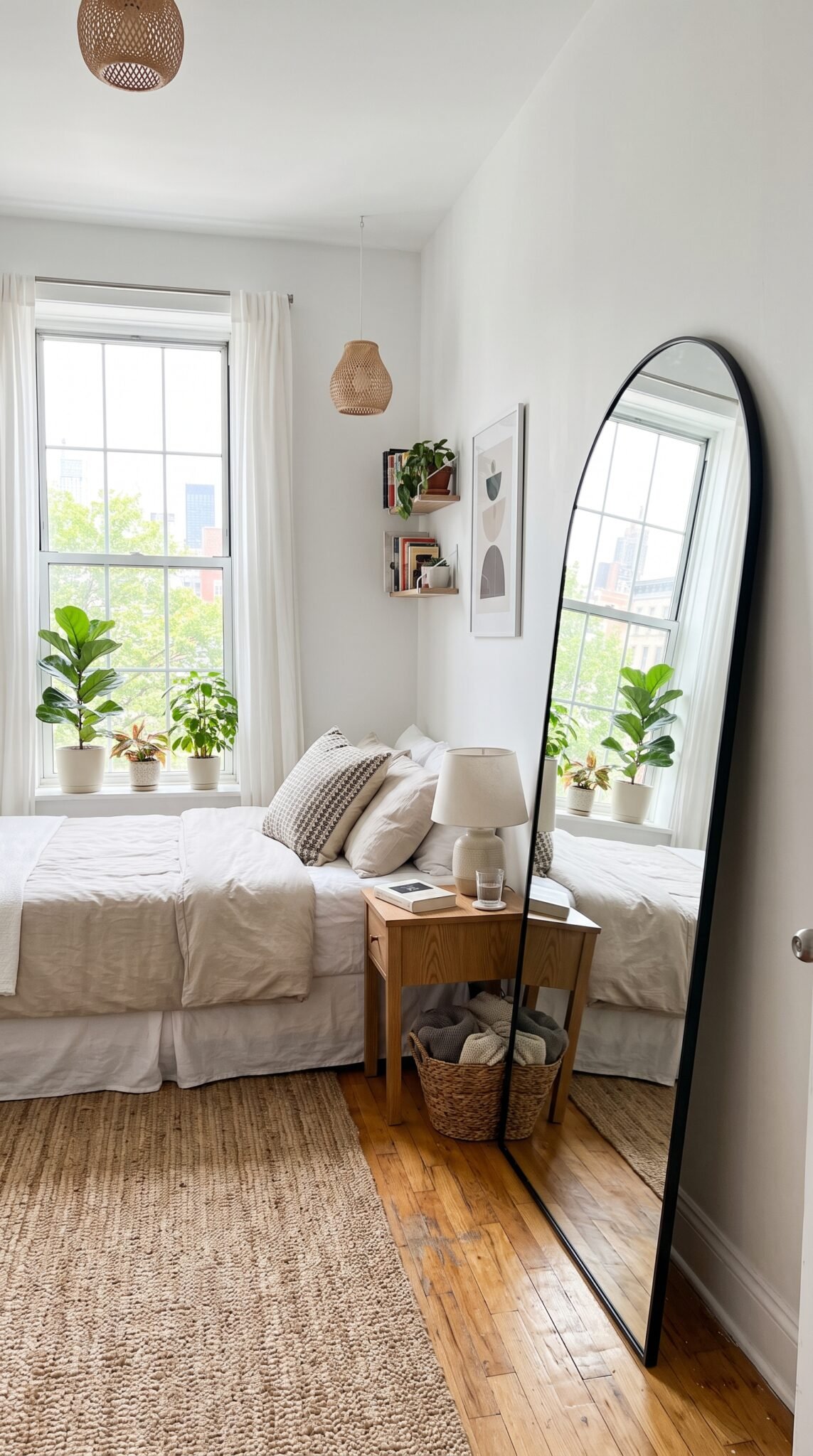
Mirrors are the closest thing to a shortcut among these small apartment decor ideas. Placed well, a single large mirror makes a room feel brighter and more open, not because it changes the dimensions, but because it bounces light and gives the eye more to look at.
The most effective placement is opposite or next to a window, where the mirror catches daylight and pushes it back into the room. That matters most in winter, when natural light is limited and a north-facing flat can feel dim by mid-afternoon.
A tall leaning mirror works well in a small flat because it needs no fixings: lean a full-length mirror, roughly 150 to 170 cm tall, against the wall in a bedroom or hallway, and angle it slightly so it reflects the brightest part of the room. An arched top softens the shape and suits the calm, neutral look of the rest of the flat.
Beyond function, mirrors add a design element that feels considered. A large mirror with a slim frame reads as intentional, while several small mirrors scattered across a wall read as indecision.
Avoid placing two mirrors directly facing each other. It creates a tunnel effect that feels unsettling rather than spacious, and it doubles every bit of clutter in the room. One well-placed mirror is almost always more effective than two poorly placed ones.
Make every piece of furniture work harder
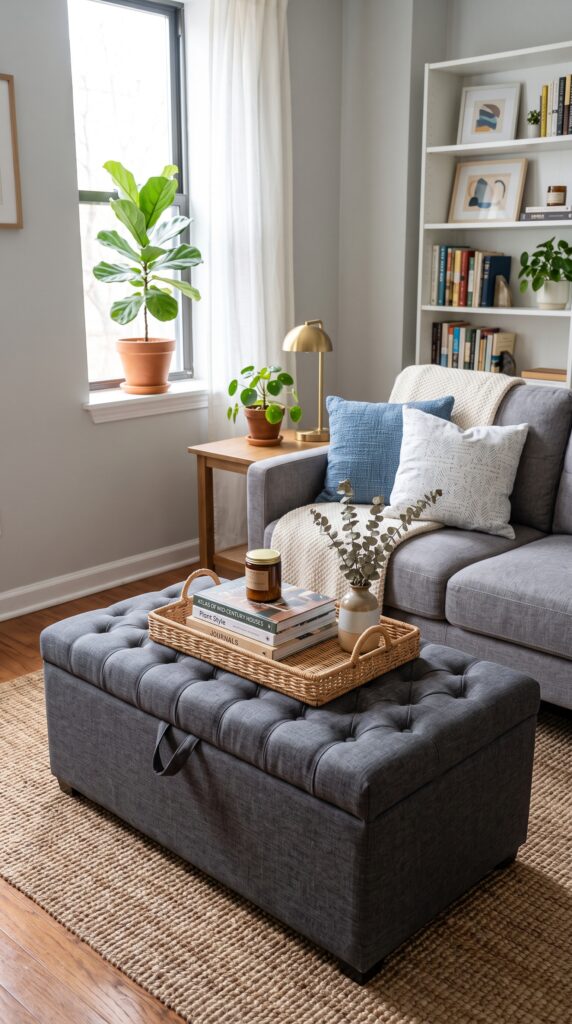
Of all the small apartment decor ideas in this guide, this one saves the most space. In a small flat, single-purpose furniture is a luxury you cannot really afford, not financially, but spatially. Every piece that takes up floor space should justify itself with more than one job.
Before buying anything, ask two questions: what else can this do, and where will the things that live in it go? If the answer to the first is nothing and the second is nowhere, the piece is probably wrong for a small flat.
A storage ottoman is the best example: it works as a coffee table, extra seating when friends visit, a footrest, and hidden storage for spare blankets. Style the top with a small tray, a candle and a book and it looks intentional rather than purely practical.
Other pieces worth considering: beds with built-in drawer storage underneath, extendable dining tables, and wall-mounted desks that fold flat when not in use. Each of these removes the need for an extra storage unit, which keeps your floor space clear.
Measure the walkways, not just the furniture. Leave around 75 cm clear for the routes you walk every day, between the sofa and the coffee table, and past the bed. If you have to turn sideways to get past a piece of furniture, the furniture is too big for the room.
The same thinking applies to awkward layouts. For tall ceilings, sleeping platforms and storage in rooms where the floor plan does not behave, see Insider Tricks to Maximize Space in a Loft Apartment.
Add a gallery wall that looks intentional
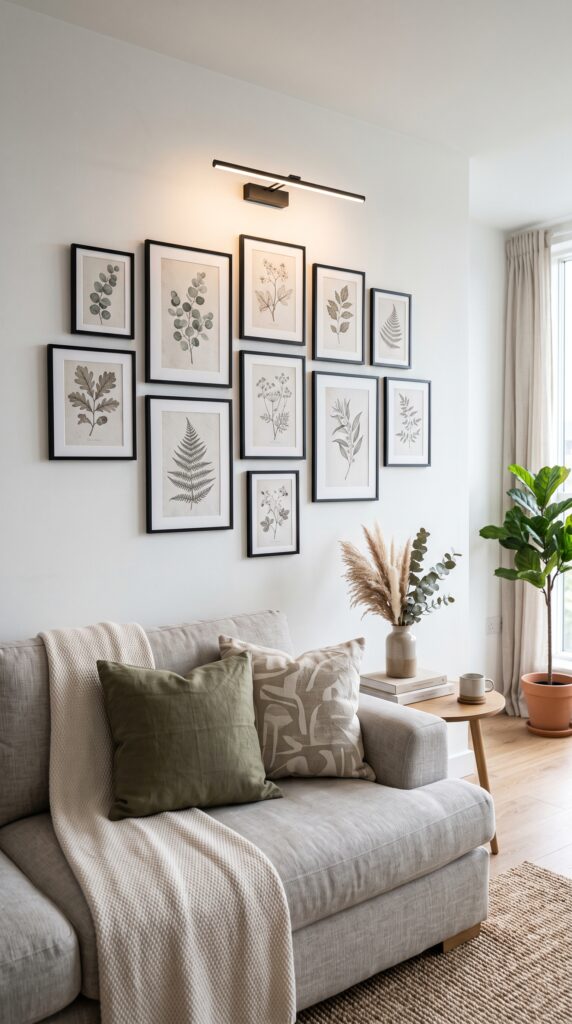
Blank walls are one of the quietest ways a small flat signals that it is unfinished. You do not need to cover every surface, but one strong feature wall transforms a space from temporary to truly lived-in.
A gallery wall is the most flexible of these small apartment decor ideas because you can build it slowly and adjust as you go. The key, and this is where most people go wrong, is cohesion. Matching or complementary frames, a consistent color palette in the prints, and a clear visual anchor point matter more than the number of pieces.
Start with three to five pieces rather than jumping straight to twelve. A smaller, tighter arrangement often looks more deliberate than a sprawling wall of mismatched frames. Neutral botanical or abstract prints in thin black or natural wood frames have a timeless quality that works in almost any flat, and they tie back to the plant styling in the rest of the room.
Lay all your frames out on the floor first to test the arrangement before making a single hole. Keep the gaps between frames even, about 5 cm, so the group reads as one composition. Tight groupings feel curated, while widely spaced frames feel sparse.
The mistake to avoid is hanging frames at different heights with no shared line. Pick one horizontal line, the center of the arrangement, about 145 to 150 cm from the floor, and align the middle of the group to it.
Treat your bed like the centerpiece
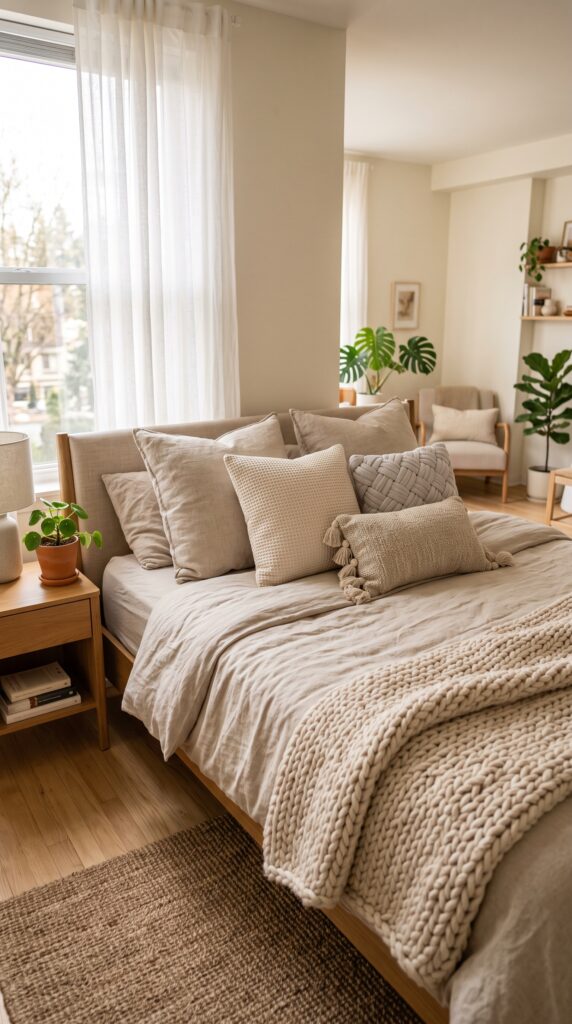
In a studio flat especially, your bed is visible from almost everywhere. It is the largest piece of furniture you own, and it takes up the most visual real estate in the room. That means an unmade, uninspiring bed drags down the whole space, and a beautifully styled one elevates everything around it.
Layering is the difference between a bed that looks styled and one that just looks slept in. The formula: a fitted sheet, a flat sheet, a duvet or comforter, a textured throw folded at the foot, and two or three cushions stacked at the head. The depth created by those layers is what gives bedding that rich, hotel-quality look without any real effort.
Neutral tones work best here for the same reasons they work in the rest of the flat, they make the room feel light and calming, and they pair with almost everything. A beige or warm white bedding set is a strong anchor piece: it photographs beautifully, and more importantly, it makes the room feel genuinely restful.
One honest limitation: lighter bedding shows marks more easily, so it is worth choosing a set that is machine-washable and holds its color after multiple washes. Check the care label before you buy, not after the first wash.
Putting it all together: a one-weekend plan
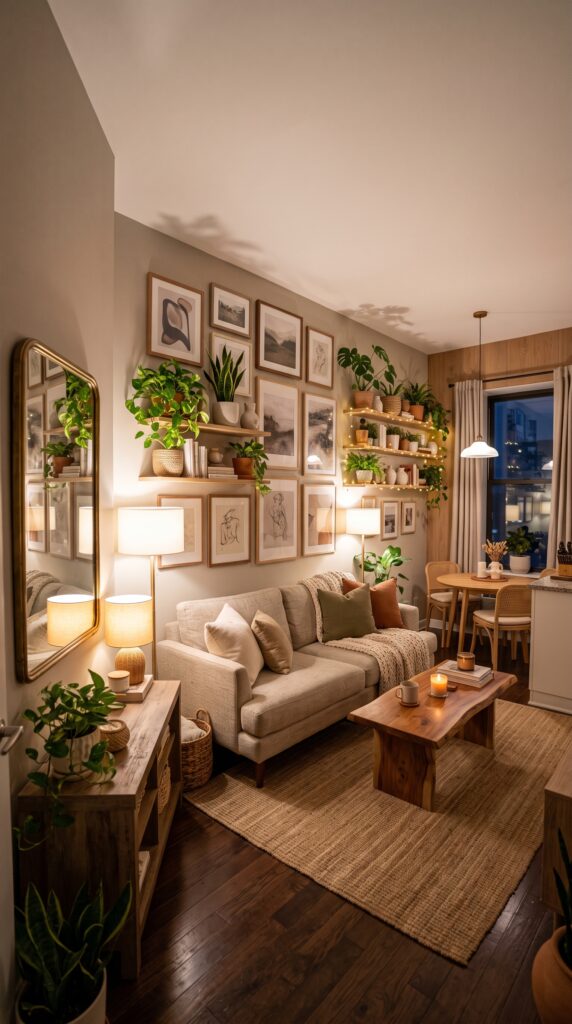
You do not need to do all seven small apartment decor ideas at once, in fact, you should not. Change one thing, live with it for a week, and only then add the next. Small flats reward patience more than any other kind of space.
- Saturday morning: swap every bulb in the living room to warm white 2700K LEDs and add one table lamp.
- Saturday afternoon: lay out the gallery wall frames on the floor and hang the first three.
- Sunday morning: move the mirror opposite the window and group the plants in threes.
- Sunday afternoon: put the storage ottoman where the old coffee table was and clear one surface completely.
That is four changes in one weekend, and each one makes the next easier to judge. If the room still feels off after that, the problem is usually the rug size or the furniture scale, not a missing decoration.
Frequently asked questions about small apartment decor ideas
What is the cheapest way to make a small apartment feel expensive?
Of all the small apartment decor ideas in this guide, lighting and texture are the cheapest. Warm 2700K LED bulbs, one decent table lamp and a chunky throw cost far less than new furniture, and they change how the whole room feels. Start there before spending on anything larger.
How do I decorate a small apartment on a budget?
Work in the order in this guide: light first, then a neutral base, then texture. Buy the rug and the mirror second-hand if you can, both are easy to find used, and add plants last, since they are the cheapest way to fill an empty corner.
What colors make a small apartment look bigger?
Warm whites, soft beige and pale gray reflect the most light, which is why they make a room feel larger. Keep the large surfaces neutral and put color in the smaller pieces, cushions, throws and prints, so you can change the accent without repainting anything. That is why a neutral base leads most small apartment decor ideas.
Are mirrors really effective in a small apartment?
Yes, when they are placed opposite or next to a window so they bounce daylight into the room. A single large mirror works better than several small ones, and a leaning full-length mirror needs no drilling, which suits rented flats.
How many plants should I put in a small apartment?
Three to five, grouped in odd numbers at different heights, is enough for most flats. One large plant makes more impact than six tiny ones, and fewer plants are easier to keep alive, especially if you choose forgiving varieties such as pothos, snake plants and ZZ plants.