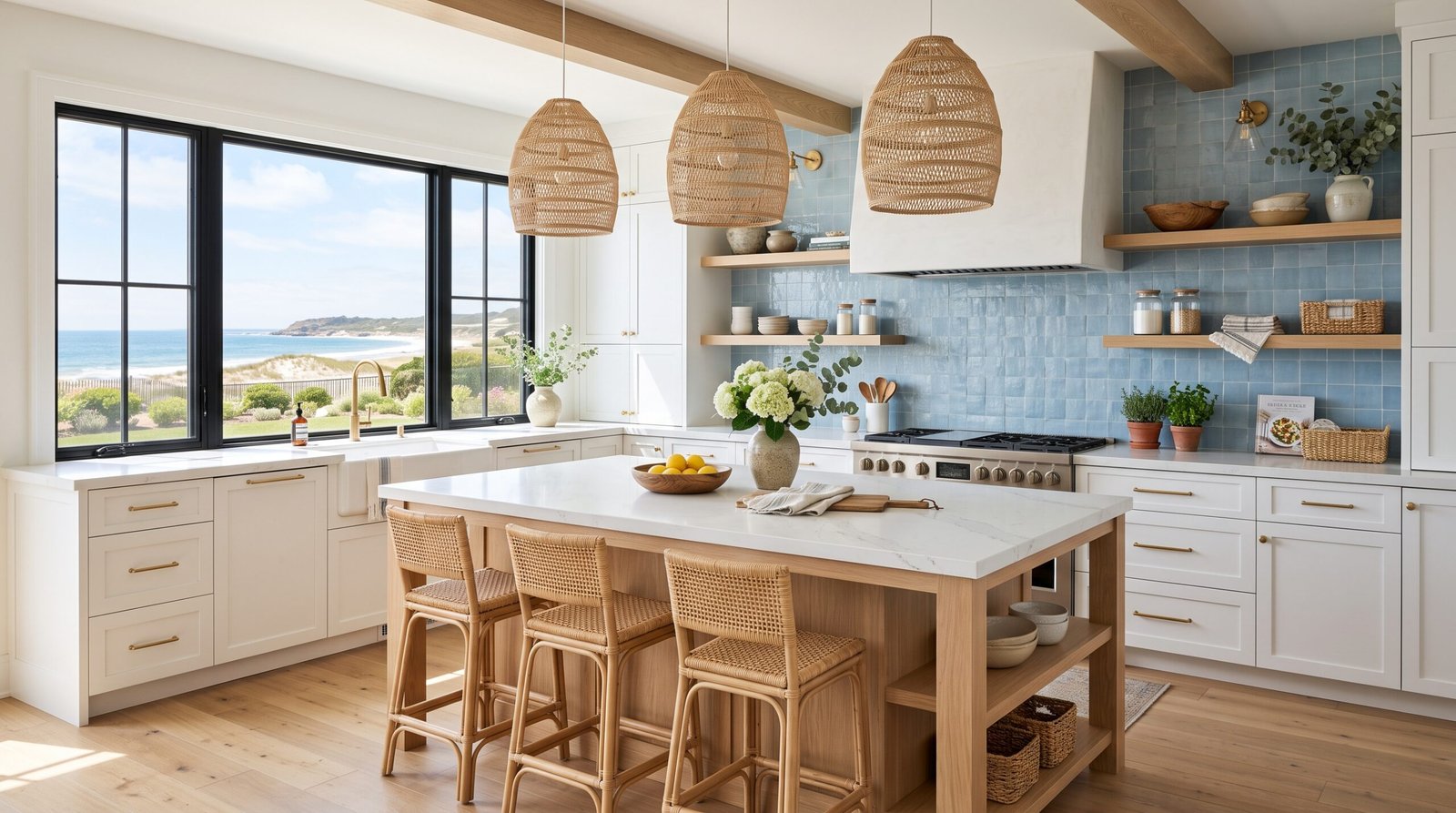
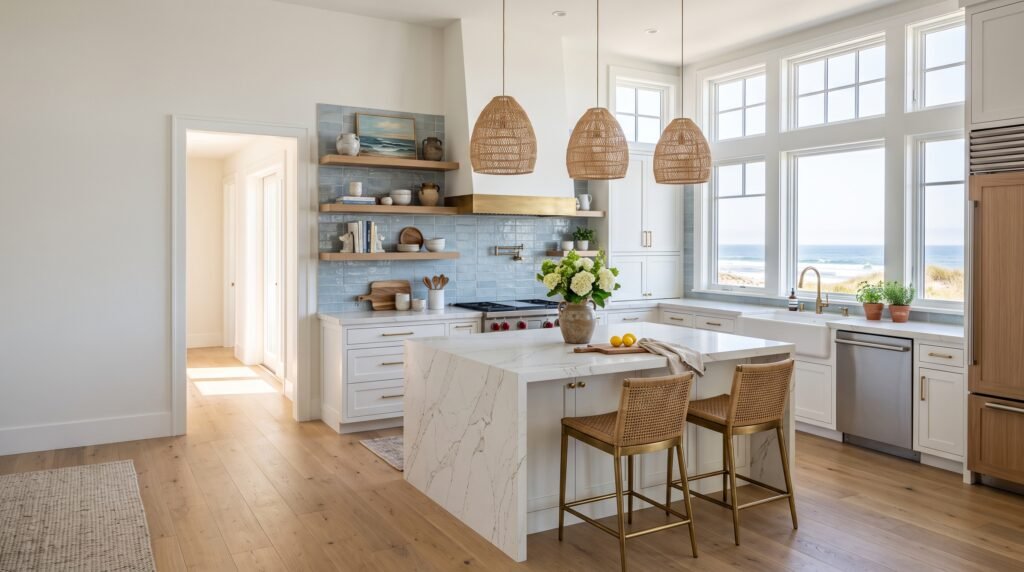
A coastal kitchen isn’t just a design trend — it’s a lifestyle choice that brings the calm, breezy feeling of the shore into the heart of your home. Whether you live steps from the beach or simply love the look of whitewashed cabinets, sea-glass greens, and natural textures, remodeling your kitchen with a coastal aesthetic is one of the most rewarding projects you can tackle as a homeowner. This coastal kitchen remodel guide walks you through every major decision, from budget-friendly swaps to premium upgrades, so you can build a space that feels both beautiful and built to last.
In This Guide
- Why So Many Homeowners Are Choosing a Coastal Kitchen Style
- The Foundation: Cabinets, Paint, and Hardware in a Coastal Kitchen
- Backsplash and Countertops That Define the Coastal Kitchen Look
- Sinks, Faucets, and Fixtures for a Hardworking Coastal Kitchen
- Lighting That Transforms Your Coastal Kitchen Atmosphere
- Premium Appliances That Elevate a Coastal Kitchen Remodel
- Pulling It All Together: Your Coastal Kitchen Remodel Roadmap
- Ready to Start Your Coastal Kitchen Remodel?
- Mistakes to Avoid in a Coastal Kitchen Remodel
- Frequently Asked Questions
Why So Many Homeowners Are Choosing a Coastal Kitchen Style
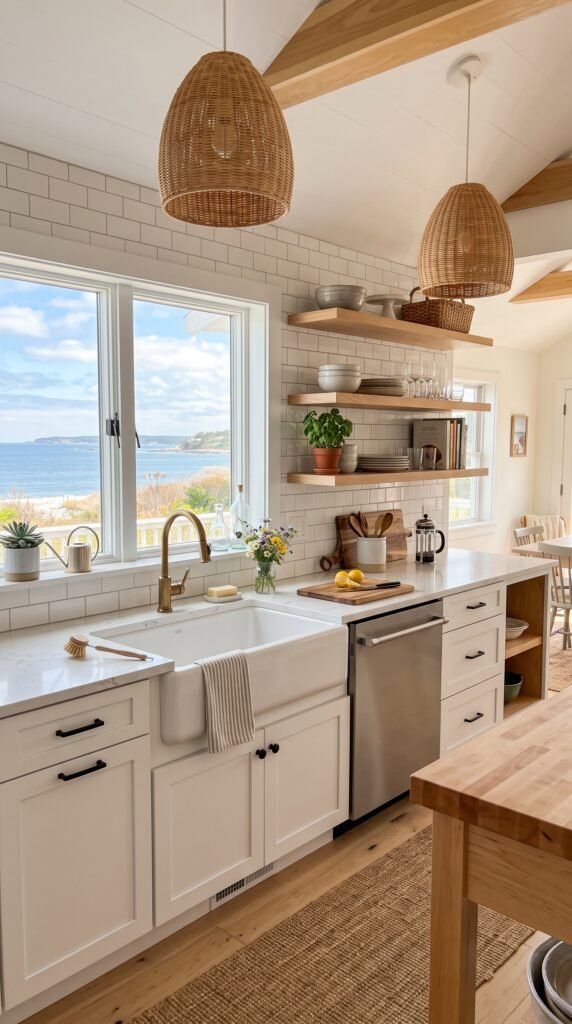
The appeal of a coastal kitchen goes far deeper than aesthetics. Coastal-inspired spaces tend to prioritize light, openness, and natural materials — qualities that make any kitchen feel more welcoming and functional. In the 2026 Houzz U.S. Kitchen Trends Study of 1,780 homeowners, wood cabinets (29%) overtook white (28%) for the first time, with off-white at 15%. White is still a strong choice for the airy, sun-drenched quality that defines coastal design — but wood, especially in light and medium tones, is now the leading look.
The bigger challenge most homeowners face isn’t finding inspiration — it’s figuring out where to start. Cabinet painting, hardware swaps, backsplash installation, new lighting, countertops, and appliances all compete for your attention and budget at the same time. The good news is that a coastal kitchen remodel doesn’t have to happen all at once, and it doesn’t require a six-figure budget to look stunning.
Breaking the project into tiers — budget, mid-range, and premium — gives you a clear roadmap and lets you prioritize the upgrades with the highest visual impact per dollar.
The Foundation: Cabinets, Paint, and Hardware in a Coastal Kitchen
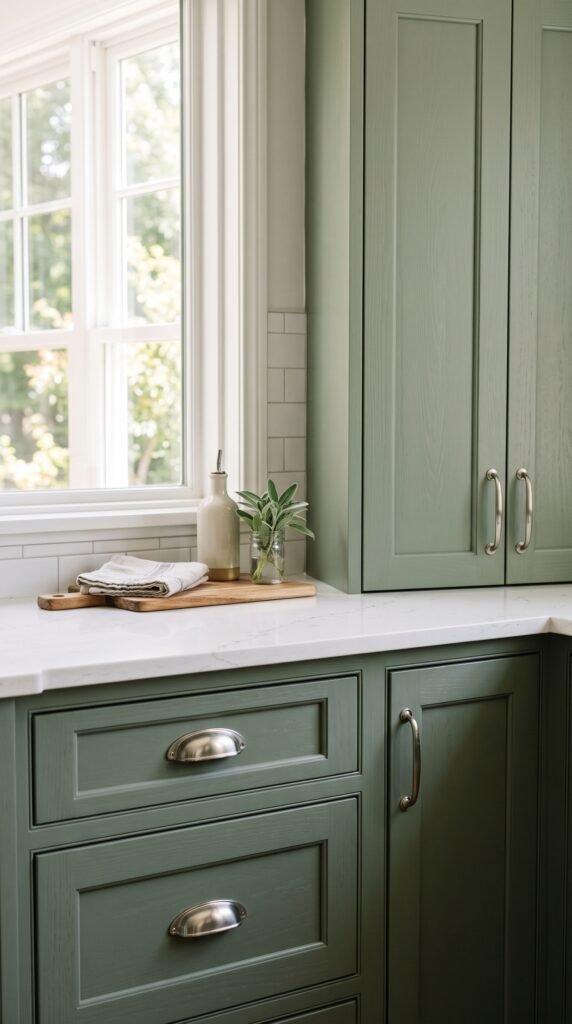
Your cabinets are the single largest visual element in your kitchen, which means they’re the highest-leverage starting point for any coastal kitchen remodel. You don’t necessarily need to replace them — a fresh coat of paint and new hardware can transform the entire room for a fraction of the cost. Before you order cabinets, read the 7 costly kitchen cabinet blunders every homeowner must dodge — most of them are decided before a single cabinet is ordered.
For coastal colour palettes, soft whites, warm creams, sage greens, and muted blues are the go-to choices. For cabinet paint, Benjamin Moore Advance is a popular, durable choice: Saybrook Sage and Newburyport Blue are consistently cited as quintessential coastal cabinet shades, and Advance is a satin finish specifically suited for cabinetry, offering a durable, wipeable surface that holds up in the humid conditions common to coastal homes. Advance lists at $88.99 per gallon and typically sells for $80–$95 per gallon, so repainting your cabinets yourself is still one of the most dramatic improvements you can make without demolishing a thing.
Once your paint is dry, upgrading your hardware is the fastest way to reinforce the coastal look. Cup pulls in brushed nickel or antique brass have become synonymous with coastal cottage and farmhouse-style kitchens. The Shaker Cabinet Hardware Pulls (Cup Bar in Brushed Nickel) by Liberty Hardware are an easy swap — measure the hole spacing (usually 3 inches centre-to-centre) before you order. It’s a Saturday afternoon project with an outsized visual payoff.
Once the cabinets are sorted, storage is the next bottleneck — these small kitchen organization ideas on a tight budget show how to use every cupboard and drawer you already have.
Backsplash and Countertops That Define the Coastal Kitchen Look
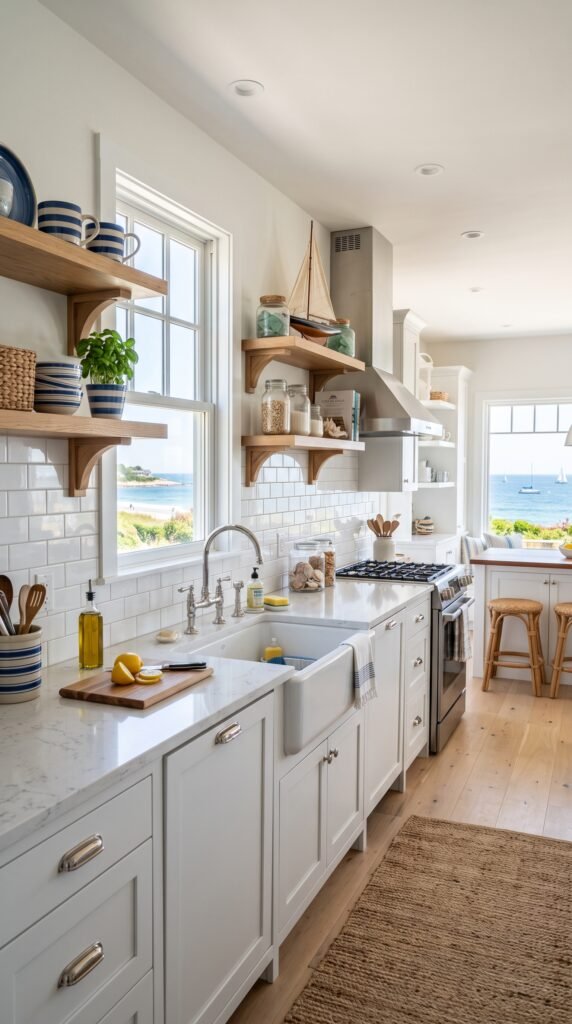
Once your cabinets are handled, the next layer of your coastal kitchen remodel is the backsplash and countertops. These two surfaces work together to define the overall texture and tone of your space.
For the backsplash, few materials are more timeless or cost-effective than classic white subway tile. The Anchors Away Subway Tile Backsplash (3×6 White Glossy) by MSI International is one of the most accessible upgrades on this entire list. White glossy subway tile reflects light, keeps the palette clean and crisp, and provides the kind of neutral backdrop that lets your other coastal elements — pendant lights, open shelving, plants — really pop. It’s also a legitimate DIY project for homeowners with basic tiling skills.
For countertops, quartz has become the material of choice in coastal kitchens, and for good reason. Unlike natural marble or granite, quartz is non-porous, which means it resists moisture, salt air, and the heavy use that comes with a busy beach house kitchen. The Calcutta Quartz Countertop Sample Kit by MSI Surfaces lets you evaluate the white-and-grey veined pattern — which mimics sea-worn marble beautifully — before committing to a full installation. Expect quartz to cost $50–$100 per square foot installed in most kitchens, which puts it in the premium tier but offers the durability to justify the investment long-term.
Countertops are worth the splurge for more than looks: a Zillow analysis of more than 2 million U.S. home listings found that homes mentioning quartz countertops sold for about 3% more than expected — ahead of soapstone (2.7%), marble (1.9%) and onyx (1.6%), though quartzite (5.3%) leads overall.
Sinks, Faucets, and Fixtures for a Hardworking Coastal Kitchen
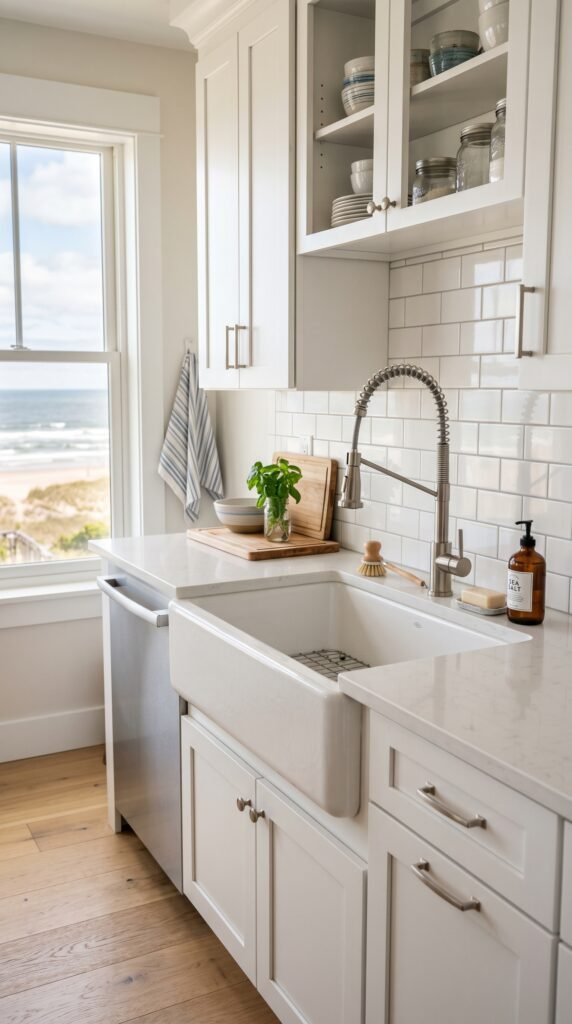
Plumbing fixtures sit at the intersection of function and form, and in a coastal kitchen, they deserve as much attention as any decorative element. The right sink and faucet pairing can anchor the entire aesthetic.
The white fireclay farmhouse sink is practically a symbol of the coastal cottage kitchen. Deep, durable, and strikingly beautiful, a farmhouse sink creates a focal point that coordinates naturally with white subway tile and quartz countertops. The Farmhouse Apron-Front Kitchen Sink (33-inch Fireclay White) by Rohl is a premium choice, not a mid-range one: a quality 33-inch fireclay farmhouse sink typically runs $500–$1,200, and Rohl’s Shaws Original is at the premium end, around $1,000–$1,400 for the 30-inch model. Fireclay is dense, chip-resistant, and naturally resistant to stains — all important qualities in a coastal home where the kitchen sees heavy use after beach days and outdoor entertaining. Set a firm budget before you shop, and measure the cabinet base — a farmhouse sink needs a suitable cabinet base.
Pair that sink with the Moen Arbor One-Handle Pulldown Kitchen Faucet, which is available in brushed nickel and matte black finishes. Moen’s spot-resist technology is particularly valuable in a coastal environment, where humidity and salt air can cause water spots and tarnish to appear more quickly on lesser faucets. At $180–$230 (the standard 7594SRS model is currently around $191), the Arbor sits comfortably in the mid-range tier.
The brushed nickel finish also creates a cohesive through-line when combined with matching cabinet hardware, tying the entire coastal kitchen palette together without any effort.
Lighting That Transforms Your Coastal Kitchen Atmosphere
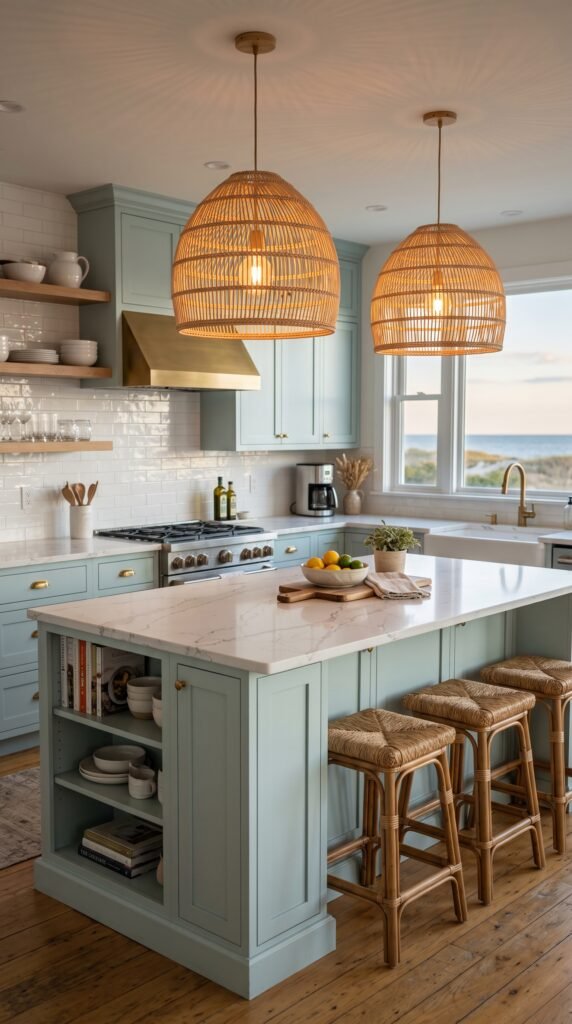
Lighting is one of the most underestimated upgrades in any kitchen remodel, and in a coastal kitchen, the right fixture can completely shift the atmosphere. Natural woven materials — rattan, bamboo, seagrass — are hallmarks of coastal decor because they add organic texture that balances the clean lines of white cabinets and tile.
The Rattan Pendant Light (Woven Bamboo Shade) by JONATHAN Y is a standout choice for the island or above a farmhouse sink. Hung over a kitchen island, a pair of woven bamboo pendants instantly signals the coastal aesthetic — without requiring any structural changes or electrical work beyond a standard fixture swap. The warm glow that filters through the woven shade adds to the relaxed, sunlit feeling that defines a well-executed coastal kitchen. Hang pendants about 30 inches above the island worktop, so they light the task without blocking sight lines.
For broader lighting strategy, layering your sources matters. Recessed can lights provide overall illumination, under-cabinet LED strips handle task lighting at the countertop, and pendant lights provide the visual warmth and style. In a coastal kitchen specifically, maximizing natural light is equally important — consider keeping window treatments minimal and opting for sheer or no curtains over the sink window.
For more small-space ideas, see these kitchen decor ideas for small spaces.
Premium Appliances That Elevate a Coastal Kitchen Remodel
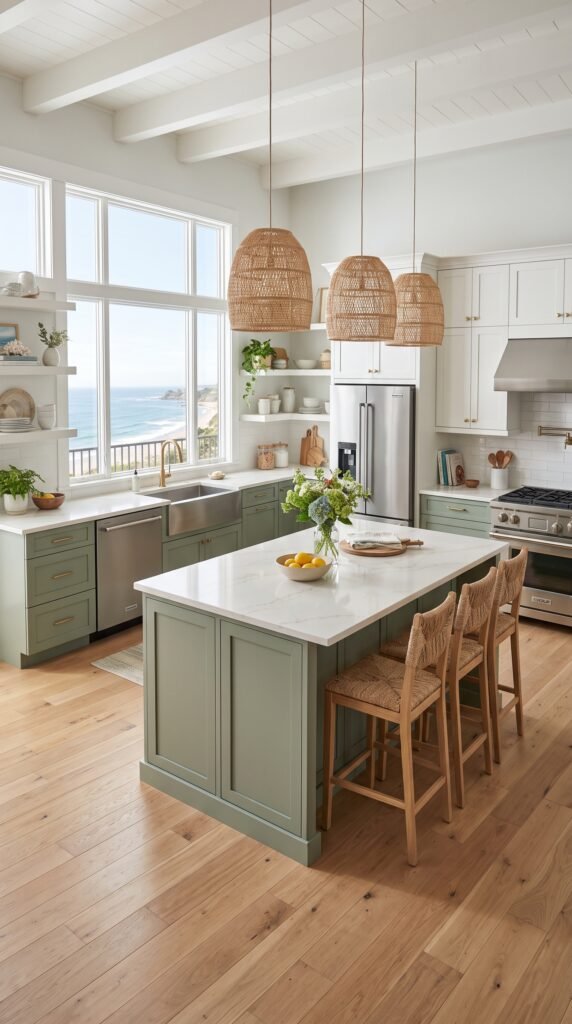
If your budget allows for a premium anchor piece, the refrigerator is often the best place to invest. It’s the largest appliance in the room, it’s always visible, and a high-quality model will outlast every other upgrade you make.
The KitchenAid French Door Refrigerator with PrintShield Finish is an ideal choice for a coastal kitchen for reasons beyond its looks. PrintShield technology resists fingerprints and smudges — an important practical feature in a high-traffic beach house where kids and guests are constantly in and out of the kitchen. The French door configuration also allows wide access to fresh food storage without requiring a full door swing, which matters in galley-style coastal kitchens where space can be tight.
At $2,200–$3,000, this is a significant investment. Before you buy, compare energy use, storage layout, and warranty cover, and read current owner reviews — a good French-door fridge can serve a household for well over a decade, which spreads the upfront cost over many years of use.
The slate or stainless finish pairs beautifully with both white and sage green coastal cabinetry, and the clean lines of the French door silhouette complement the unfussy, natural aesthetic that coastal kitchen design is built on.
Pulling It All Together: Your Coastal Kitchen Remodel Roadmap
A successful coastal kitchen remodel doesn’t have to mean tearing everything out and starting over. The most effective approach is to think in phases and prioritize the upgrades that deliver the biggest visual transformation for your specific starting point.
If you’re working with a tight budget, begin with cabinet paint and hardware. Painting the cabinets in a sage green like Saybrook Sage, combined with new cup pulls, can completely redefine your kitchen’s character for the cost of a gallon or two of paint, a set of cup pulls, and a few runs of subway tile. Add a few runs of Anchors Away Subway Tile Backsplash (3×6 White Glossy) as your next phase, and you’ll already have a kitchen that reads as intentionally coastal.
In the mid-range phase, swapping out your sink and faucet makes a powerful statement. The Farmhouse Apron-Front Kitchen Sink (33-inch Fireclay White) paired with the Moen Arbor One-Handle Pulldown Kitchen Faucet creates a focal point that anchors the coastal look and improves the functionality of the space simultaneously.
When you’re ready to invest at the premium level, the Calcutta Quartz Countertop Sample Kit helps you select the right slab before committing, and the KitchenAid French Door Refrigerator with PrintShield Finish finishes the room with an appliance worthy of the design surrounding it.
Throughout every phase, keep coming back to the core principles of coastal kitchen design: light colours, natural textures, durable materials, and a relaxed sensibility that makes the space feel as good to cook in as it does to look at. An island only helps if it is organised — these kitchen organization ideas show how to plan drawers and shelves so clutter has somewhere to go.
Ready to Start Your Coastal Kitchen Remodel?
Your coastal kitchen transformation starts with a single decision — and it doesn’t have to be an expensive one. Start with a gallon of paint and a set of cup pulls, photograph your progress, and let each upgrade inform the next. The phased approach is how most successful kitchen remodels actually happen, and the coastal aesthetic is forgiving enough to evolve beautifully over time.
If you found this guide helpful, explore our other kitchen remodel content for more specific advice on layout planning, contractor hiring, and return-on-investment considerations. The coastal kitchen of your dreams is closer — and more affordable — than you might think.
Mistakes to Avoid in a Coastal Kitchen Remodel
- Overdoing the nautical theme — one or two seaside touches read as coastal; an anchor on every wall reads as a theme park.
- Choosing a porous countertop for a busy kitchen — quartz needs no sealing and stands up to salt air and spills.
- Ordering a farmhouse sink before checking the cabinet base — it needs a suitable base cabinet, not a standard one.
- Skipping the lighting plan — layer recessed, task, and pendant lighting instead of relying on one ceiling fitting.
- Painting cabinets without preparation — clean, sand, and prime first, or the finish will peel in a humid kitchen.
Frequently Asked Questions
How much does a coastal kitchen remodel cost?
It depends on the scope. A paint-and-hardware refresh costs little more than a gallon or two of Benjamin Moore Advance ($80–$95 per gallon) plus new cup pulls, while a full coastal kitchen remodel with new countertops, sink, and appliances is a five-figure project. Work in phases, get three quotes for any contracted work, and spend first where you will see it every day — cabinets and countertops.
What cabinet colour is most popular for coastal kitchens in 2026?
Wood leads the way: in the 2026 Houzz U.S. Kitchen Trends Study, wood cabinets were chosen by 29% of renovating homeowners, ahead of white at 28% and off-white at 15%. For a coastal kitchen remodel, light and medium wood tones work best, with white still a strong second choice.
Can I paint my kitchen cabinets instead of replacing them?
Yes — painting is one of the best-value moves in a coastal kitchen remodel. Clean, sand, and prime the cabinets first, then use a cabinet paint such as Benjamin Moore Advance in a coastal shade like Saybrook Sage or Newburyport Blue. At $80–$95 per gallon (list price $88.99), a gallon or two covers most kitchens, plus new cup pulls for the finishing touch.
What countertop works best in a coastal kitchen?
Quartz, for most households. It is non-porous, so it resists moisture and salt air, it needs no sealing, and white quartz with soft grey veining suits the pale coastal palette. Expect $50–$100 per square foot installed in most kitchens, and a Zillow analysis found homes mentioning quartz countertops sold for about 3% more than expected.
How do I keep a coastal kitchen from looking themed or dated?
Lean on natural materials — wood, rattan, linen, and stone — rather than nautical motifs. Keep the palette pale and warm, choose one or two seaside accents at most, and let texture do the work. A coastal kitchen remodel should feel calm and lived in, not decorated like a beach shop.