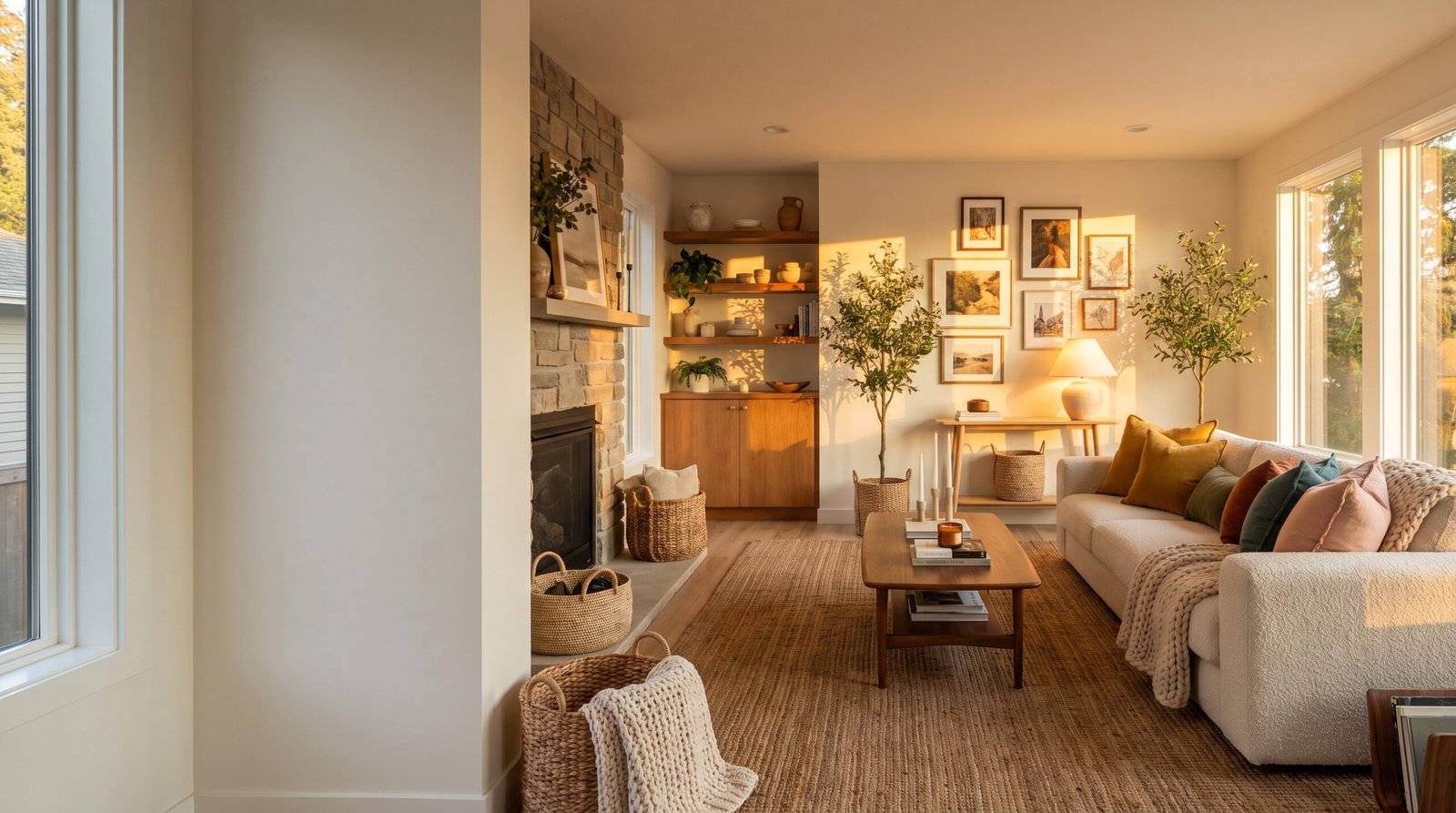
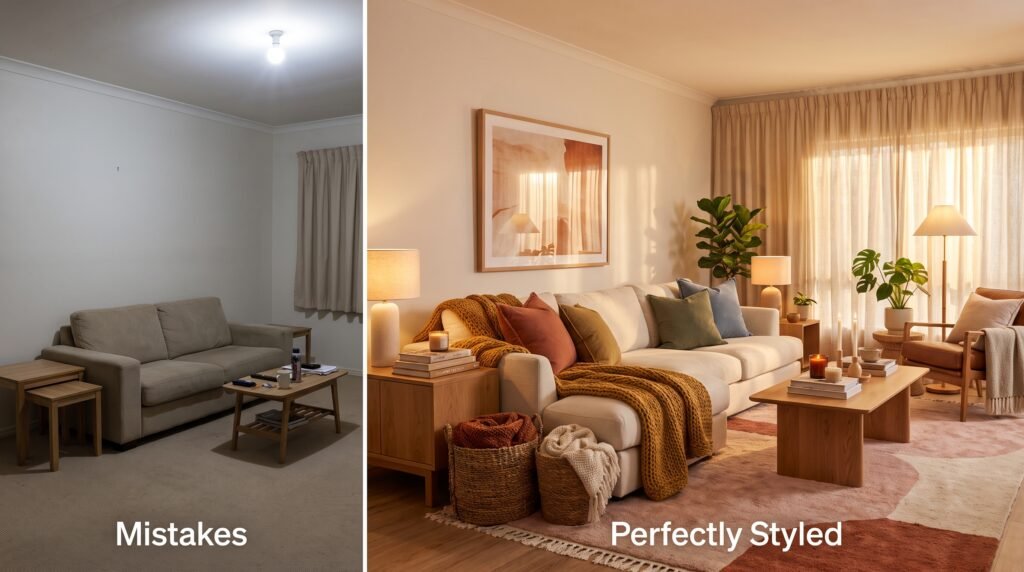
Cozy Home Ideas sound simple enough — warm blankets, soft lighting, maybe a candle or two — but the gap between a space that feels cozy and one that just looks like a Pinterest board gone wrong is wider than most people think.
Here’s the thing: most decorating mistakes don’t announce themselves. They creep in slowly, one “harmless” decision at a time, until you’re standing in your living room wondering why it feels more like a furniture showroom than a home.
📋 Table of Contents
- The Quick Answer: What Kills Cozy Fastest?
- Mistake #1: Overhead Lighting Is Doing All the Work
- Mistake #2: Furniture Pushed Against Every Wall
- Mistake #3: Ignoring Texture (Or Using Just One)
- Mistake #4: A Color Palette That’s Too Stark or Too Safe
- Mistake #5: No Defined Zones or Focal Points
- Mistake #6: Choosing a Rug That’s Too Small
- Mistake #7: Filling Every Surface (and Leaving No Breathing Room)
- Deep Dive: Why These Mistakes Compound Each Other
- FAQ: Cozy Home Ideas Questions People Actually Ask
The Quick Answer: What Kills Cozy Fastest?
Before the deep dive, here’s what most people get wrong at a glance.
Rooms feel cold and stiff when the lighting is too harsh, the furniture sits too far apart, the colour palette is too stark, there is no layering of textures, the room has no zones, the rug is too small, and every surface is filled. Each one compounds the others, and together they can flatten even the most thoughtful cosy home ideas into something clinical and unwelcoming.
And the fix isn’t always expensive. Sometimes it’s just a different lightbulb.
Mistake #1: Overhead Lighting Is Doing All the Work
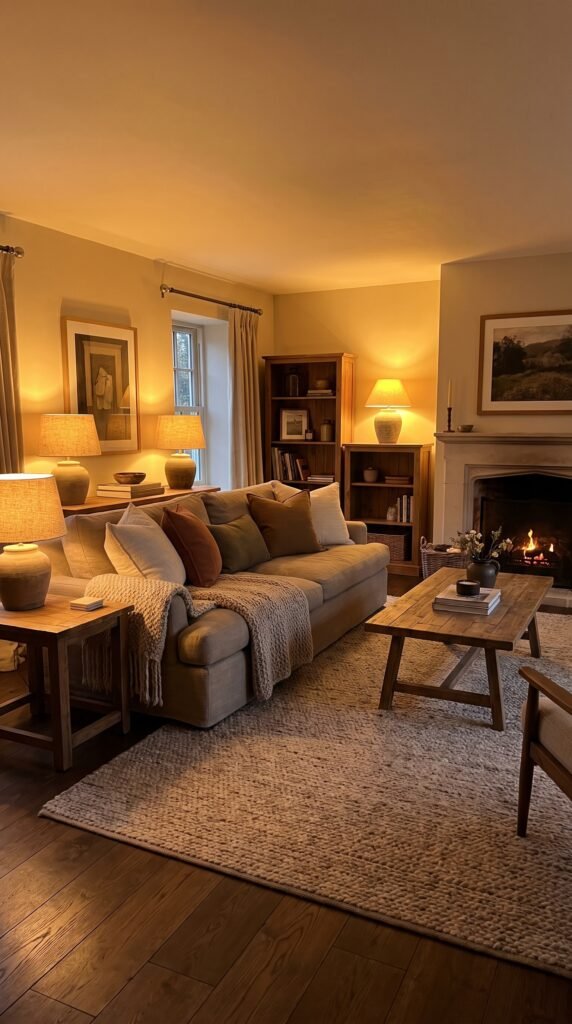
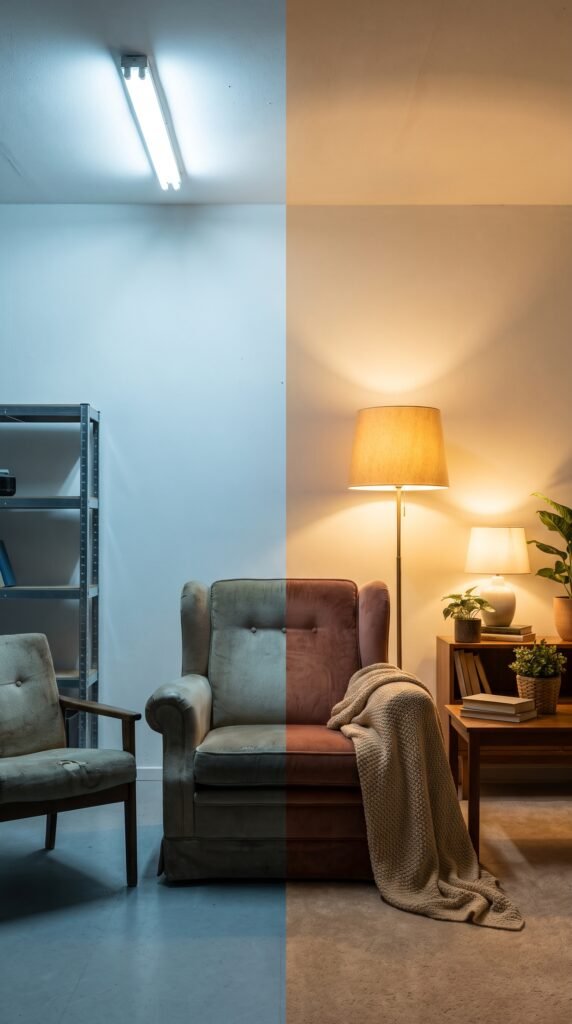
This one is everywhere. Walk into almost any rented apartment or newly built home and you’ll find a single overhead light fixture trying to carry the entire room. It can’t. It won’t. And no amount of Cozy Home Ideas pinned to your mood board will save a space lit like a dentist’s office.
Picture this: you’ve got a gorgeous textured throw, a beautiful area rug, candles on the coffee table — and then the overhead light blasts everything flat. The shadows disappear. The warmth disappears. The whole room reads as flat and slightly harsh.
The fix is layering. You want at least three light sources in any living space: ambient (your overhead or ceiling fixture), task (a reading lamp, a desk light), and accent (table lamps, floor lamps, candles, or even string lights tucked behind furniture). This combination creates depth. It creates corners. It makes a room feel like it has sections, which is a huge part of why some spaces feel so much cozier than others.
Warm white light in the 2700K–3000K range is what most people picture when they think of cosy — it reads as candlelight, not office light. Swap out any cool daylight bulbs for warm white ones and you will feel the difference before you even rearrange a single piece of furniture.
Bedroom lighting ideas under $40 show how to layer light in a small room without spending much, and they are the cheapest fix in this post.
Mistake #2: Furniture Pushed Against Every Wall
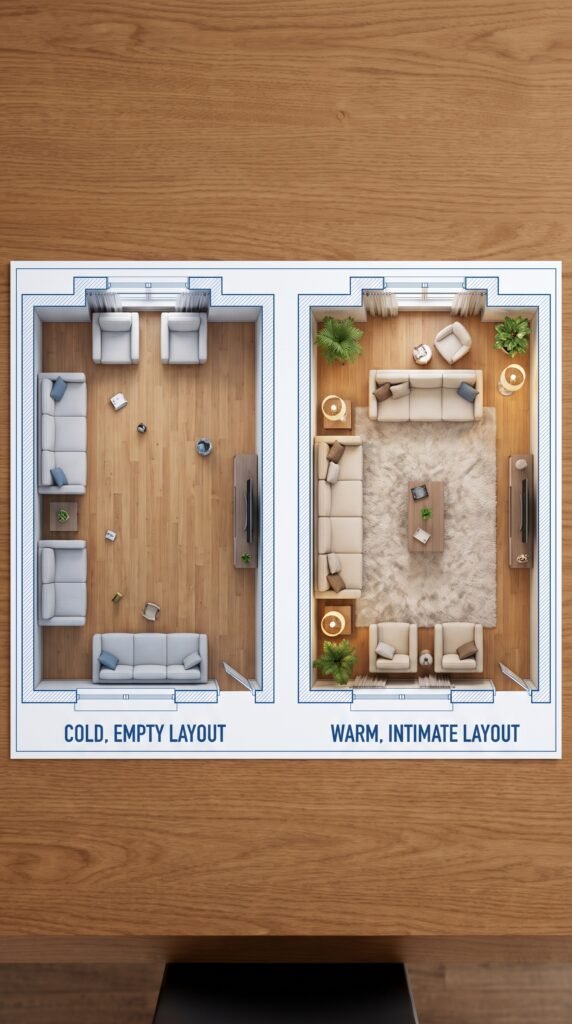
Most people do this instinctively. Bigger room, right? More floor space, right? And it makes total sense in theory. But in practice, pushing every sofa and chair to the walls creates a strange, echoing effect that actually makes rooms feel less comfortable, not more.
Most people run into this exact problem when they move into a new place and want it to “feel open.” So they shove the couch against the wall, the chairs against the opposite wall, and then wonder why conversations feel oddly formal and the room doesn’t invite you to settle in.
Cozy Home Ideas are built on proximity. Humans feel comfortable when furniture is close enough to encourage actual interaction — think 6 to 10 feet between seating pieces, not 15. Floating your sofa away from the wall and anchoring a seating arrangement around a central rug pulls everything together. It creates an intimate zone inside the larger room.
A good rule of thumb: if you have to raise your voice slightly to talk to someone sitting across from you, the furniture is too far apart.
Mistake #3: Ignoring Texture (Or Using Just One)
Color gets all the attention. Texture does all the heavy lifting.
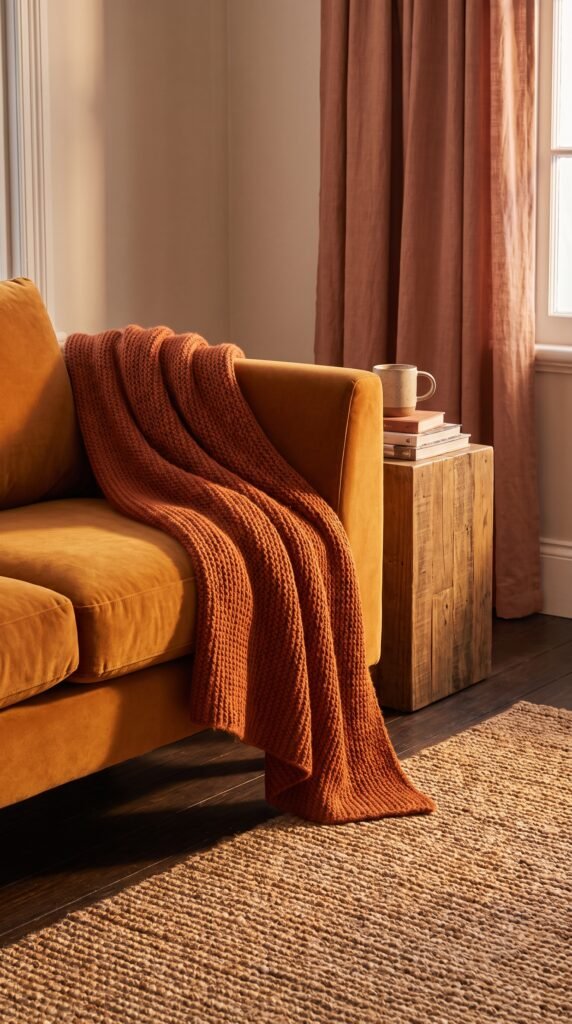
A room can be beautifully colored and completely cold if everything in it has the same surface feel. Smooth linen sofa, smooth cotton throw, smooth painted walls, smooth wood floors. All technically fine. Together? Flat and uninviting.
Cozy Home Ideas rely on tactile contrast. You want the brain to expect warmth before someone even touches anything, and texture is how you do that visually. Chunky knit throws next to smooth velvet cushions next to a jute rug next to a rough-hewn wood coffee table — each material tells a different sensory story, and together they read as rich, layered, and warm.
It is less about buying more stuff and more about making sure what you have does not all come from the same material family. Mix something soft, something woven and something smooth in the same warm colour family, and the room will read as layered rather than busy.
Affordable finds that transform cozy living room decor are the easiest way to add the throws and cushions this section is about.
Mistake #4: A Color Palette That’s Too Stark or Too Safe
Two opposite mistakes, same result.
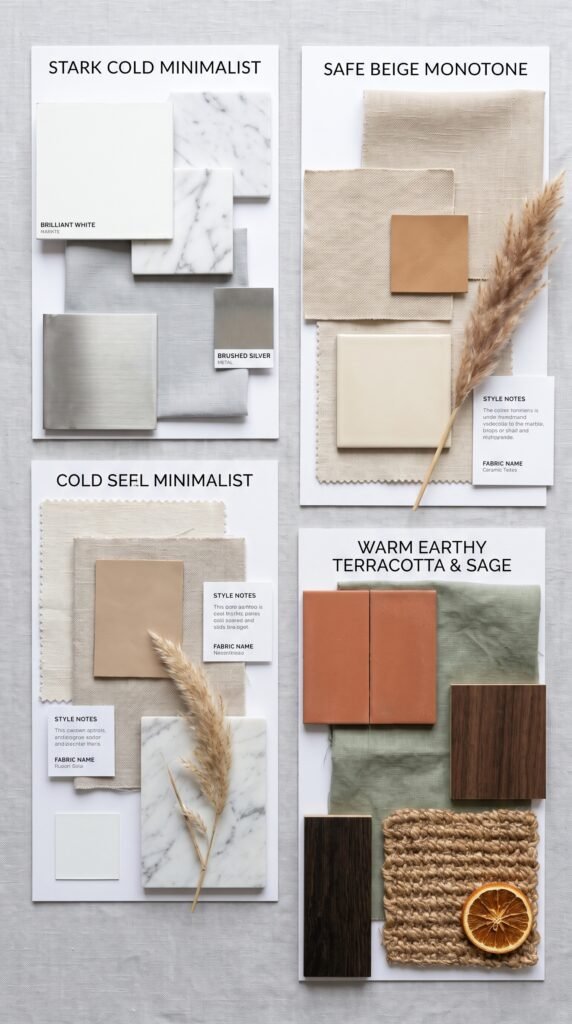
Some people go full minimalist — white walls, white furniture, white everything — and then can’t figure out why the room feels cold. Others overcorrect with beige on beige on beige, which feels safe but ends up feeling flat and slightly depressing by February.
Great Cozy Home Ideas use warmth as a foundation. Think earthy terracottas, deep sage greens, warm taupes, soft ochres. These tones absorb light rather than bouncing it around, which is part of why they feel grounding. The Spruce has a solid breakdown of paint colors that consistently read as warm and inviting across different lighting conditions.
And you don’t have to repaint everything. Warm tones in your textiles, rugs, and wood furniture can shift the energy of even a white-walled room significantly.
One accent wall in a deep, saturated tone can do more work than redecorating an entire space.
Mistake #5: No Defined Zones or Focal Points
Open plan living looked great in 2012. Now people are rediscovering why walls exist.
Without defined zones, a room has no anchor. Your eye doesn’t know where to land. There’s no sense of a “destination” within the space, which means nothing feels intentional and nothing feels cozy. The best Cozy Home Ideas use furniture arrangement, rugs, lighting, and even bookshelf placement to carve out smaller, more human-scale zones within larger rooms.
A reading nook in a corner. A window seat with cushions. A conversation area centered on a fireplace or a gallery wall. These aren’t just aesthetic choices — they’re psychological ones. Small, defined spaces signal safety and enclosure, which is biologically tied to how humans experience comfort.
Beginner’s roadmap to stunning cozy home ideas walks through the same layering idea for a whole home, starting with one zone at a time.

Mistake #6: Choosing a Rug That’s Too Small
A rug that is too small is one of the most common decorating mistakes, and it is the easiest to spot: if the front legs of your sofa and chairs are not sitting on the rug, the rug is too small. The seating floats, the coffee table looks like it is on its own island, and the room feels smaller than it is — the opposite of what the rug was meant to do.
The rule to use is the front-legs rule: all the front legs of your sofa and chairs should sit on the rug, which pulls the seating together into one conversation area. Most living rooms with a three-seater sofa need a rug of at least 8 by 10 feet, and if you are between sizes, size up — the living room rug sizing guide shows how this works for different sofa shapes.
Mistake #7: Filling Every Surface (and Leaving No Breathing Room)
A cosy room needs empty space the way a sentence needs pauses. When every shelf is styled, every wall is hung and every surface holds something, the eye has nowhere to rest and nothing reads as special. The room does not feel layered; it feels loud. If you are not sure whether you have gone too far, take three things off each surface — if the room feels calmer, those things were clutter, not decor.
Give each shelf and surface a job, and give it a limit: one anchor piece, one small stack of books or one plant, and the rest of the surface empty. Keep the pieces that are personal or useful, store the rest out of sight, and use a one-in, one-out rule for anything new. Breathing room is what lets the pieces you keep actually be seen.
Deep Dive: Why These Mistakes Compound Each Other
None of these mistakes exist in isolation. That’s what makes them so frustrating.
Harsh overhead lighting makes a room with bad furniture placement look even colder. A flat colour palette makes a room with no texture look even more lifeless. A rug that is too small makes the seating feel disconnected, and a room with no breathing room makes even good texture look like clutter. And a space with no focal point makes every other problem more visible because the eye has nowhere to rest.
The rooms that nail Cozy Home Ideas do so because every element is working together — not perfectly, but harmoniously. A little roughness in the materials, a little asymmetry in the arrangement, a little imperfection in the styling. That’s actually what makes a space feel lived-in instead of staged.
Cozy isn’t a product you can buy. It’s a quality that emerges when enough of the right decisions happen in the same room.
FAQ: Cozy Home Ideas Questions People Actually Ask
Why does my room look nice in photos but feel cold in person?
Photos flatten light and texture. What reads as warm on screen can feel stark in real life because your actual eyes perceive depth, shadow, and tactile contrast in ways a camera doesn’t. Focus on layering real-world texture and warm light sources, not just visual color.
What’s the single fastest change to make a room feel cozier?
Swap your light bulbs. Move to 2700K warm white LEDs in every lamp and fixture. It takes ten minutes and costs almost nothing, and it will shift the feel of a room faster than any piece of furniture.
Do small rooms have a harder time feeling cozy?
Actually, the opposite. Smaller rooms are naturally more enclosing, which is a huge component of that cozy feeling. The mistake in small rooms is usually trying to make them look bigger — which often sacrifices warmth for the illusion of space.
How many throw pillows is too many?
When you can’t sit down without rearranging half of them, you’ve crossed the line. Odd numbers tend to look more natural. Three to five per sofa is usually the sweet spot, mixing sizes and textures.
Can Cozy Home Ideas work in a modern or minimalist space?
Yes — but you have to be deliberate about warmth. Warm wood tones, a single oversized textured rug, and warm bulbs can bring heat into a minimalist space without cluttering it. The mistake is minimalism without warmth materials.
Why does my bedroom feel less cozy than my living room even though I have more soft things?
Lighting again, almost always. Bedrooms often have the harshest overhead lighting in the house. Add a bedside lamp on each side, ditch the overhead for evenings, and the whole feel shifts.