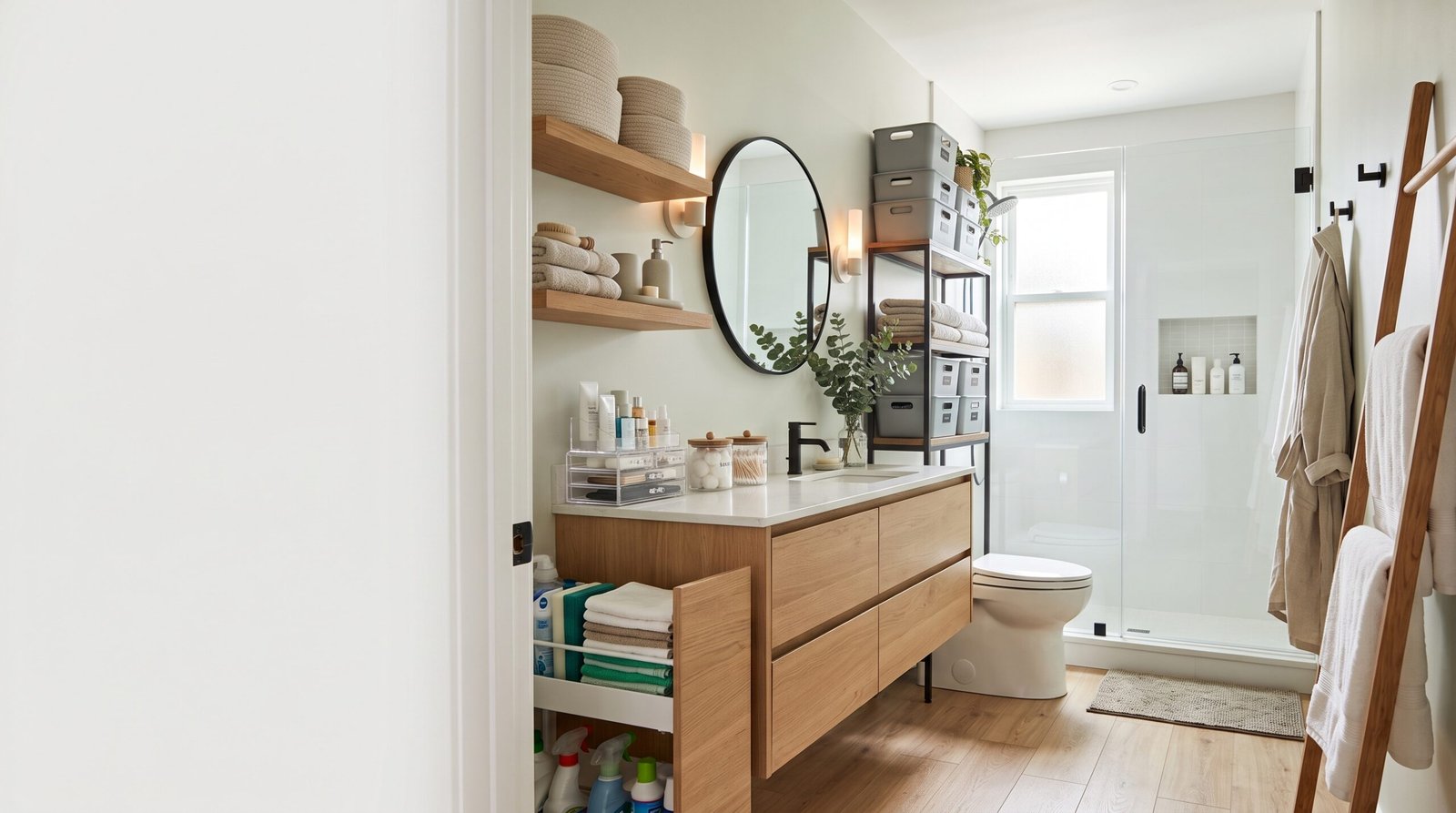
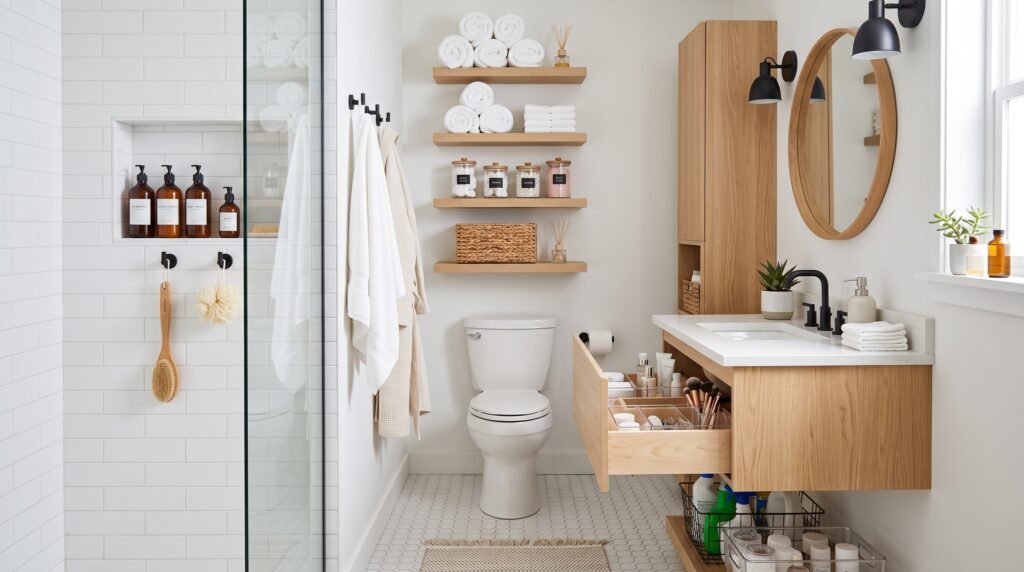
If you have ever stared at a cluttered counter and wondered how anyone manages tiny bathroom organization without losing their mind, you are in the right place. These are not show-home tips that need a renovation budget. They are real, repeatable wins that work in small bathrooms — the kind with no linen cupboard, one shelf and almost no counter space. Below are 18 of them: eight steps to set the system up, six tools worth buying, and four habits that keep it working.
Contents
Why Tiny Bathroom Organization Feels So Hard (And Why It’s Not Your Fault)
Many small bathrooms weren’t designed with real storage in mind. Builders toss in a vanity with one cramped cabinet and a medicine cabinet the size of a shoebox, then call it a day.
The good news? You don’t need more space. You need smarter systems.
Most tiny bathroom organization problems come down to three things: too much stuff, no clear home for what stays, and storage that does not fit the space. Fix those three and the room starts to look after itself.
18 Tiny Bathroom Organization Wins That Actually Stick
1. Edit Before You Organize
This is the step most people skip. They go straight to buying bins and baskets before they’ve dealt with the expired face wash from 2021 or the twelve half-empty shampoo bottles.
Pull everything out. Every single thing. Then sort into three piles: keep, toss, relocate. Keep only one of each daily item plus what you genuinely use weekly. Toss anything expired — check the dates — and anything dried out or broken. Relocate duplicates and backstock to a cupboard outside the bathroom, and bag donations the same day so they do not drift back onto the shelf.
Less stuff means less to organize. And less to organize means it actually stays organized.
2. Map Out Your Zones
Picture this: you brush your teeth every morning in a blur, reaching for the same five things in the same order. Your bathroom should reflect that sequence. Organize by habit, not by product category.
A simple zone map for most tiny bathrooms looks like this: a daily-use zone by the sink for toothbrush, toothpaste, cleanser and moisturiser; a shower zone for shampoo, conditioner and body wash; and a grooming zone in a drawer for hair tools, tweezers and nail care. Keep the daily zone within arm’s reach of the sink and move everything else one step further away.
When everything has a home that makes sense for how you move through your routine, you stop leaving things on the counter because you’re done using them.
3. Go Vertical Fast
Counter space is your most valuable real estate. Stop storing things on it that don’t earn their spot.
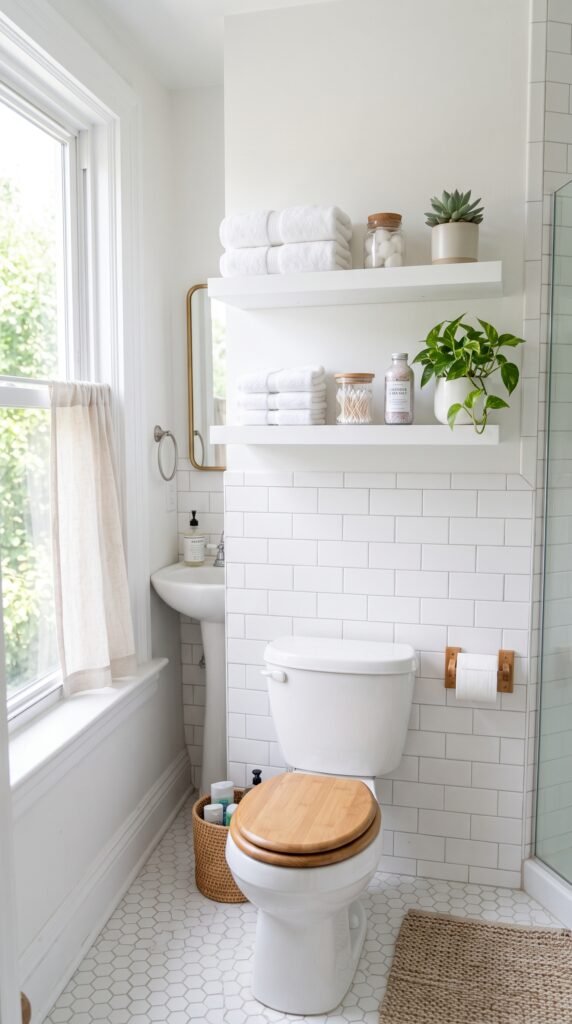
The wall above your toilet is one of the most underused spaces in a small bathroom. A simple over-toilet shelf for towels, toilet paper and cleaning products can add the equivalent of a small cabinet. Measure the width of the tank first, and mount the shelf high enough that you can still lift the cistern lid off for maintenance.
Vertical storage is the single biggest unlock for tiny bathroom organization in tight spaces.
4. Use the Inside of Every Cabinet Door
This one’s a game changer and it costs almost nothing.
A few adhesive hooks or an over-door organiser on the inside of your vanity cabinet suddenly gives you space for hair tools, cleaning cloths and spare toilet paper. Use hooks rated for the weight — a hair dryer needs a stronger hook than a flannel — and check that the door still closes and the organiser clears the frame before you load it.
You paid for every square inch of that cabinet. The door counts.
5. Decant and Consolidate
Mismatched product bottles from five different brands aren’t just visually noisy — they’re space inefficient. Different shapes stack badly, fall over, and make it hard to see what you have.
Decanting daily-use products into matching containers makes an immediate difference. Clear glass or simple white dispensers on the counter look intentional, and they make it faster to spot when something is running low before you are out mid-shower. Label each container with the product name, and note the expiry date somewhere you will see it.
You don’t need to do every product. Start with shampoo, conditioner, and hand soap. See how it feels.
6. Think in Layers Inside Drawers
Most bathroom drawers are a chaotic jumble of loose items. The fix isn’t a bigger drawer. It’s a divider.
Small bamboo or acrylic drawer organisers let you stack a second layer of small items — cotton rounds, lip balms, hair ties — above a first layer of flat items. Measure the inside of the drawer first — width, depth and height — then choose dividers that leave about 1 cm of clearance so they slide in without jamming. You double the storage in the same drawer with no renovation required.
For more ideas on making a small bathroom look intentional rather than improvised, see our bathroom decor ideas on a budget — the same edit-first, measure-first approach applies to decor as well as storage.
7. Make the Shower Work Harder
A cluttered shower ledge or perpetually falling over shampoo bottles is a daily annoyance that adds up. A corner tension pole caddy or a rust-proof hanging caddy frees up the ledge entirely and keeps products sorted by person or by use.
Bonus: give everyone in your household their own caddy colour or section. It stops the “who left this here” problem entirely. Before you buy a tension caddy, measure from floor to ceiling — tension poles come in different maximum heights — and pick a rust-resistant finish, since a cheap steel pole will stain in a damp shower.
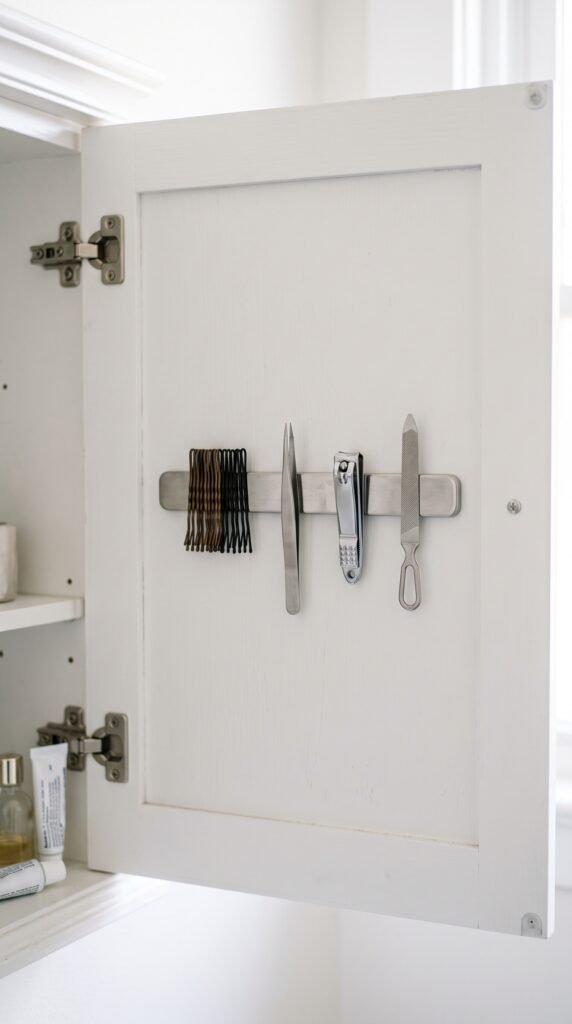
8. Use Magnetic Storage for Small Metal Items
Bobby pins. Nail clippers. Tweezers. These tiny things are responsible for more bathroom chaos than anything else because they disappear constantly and end up everywhere.
A small magnetic strip inside a drawer or on a cabinet door corrals them in seconds. Stick it where it will not get splashed, and keep it out of reach of small children, as small magnets are a swallowing hazard. You will wonder why you did not do this years ago.
Four More Wins That Keep It Working
The first fourteen wins set the system up. These four habits keep it working — and they are the difference between a bathroom that stays organised for a week and one that stays organised for a year.
15. Keep Only Daily Items on the Counter
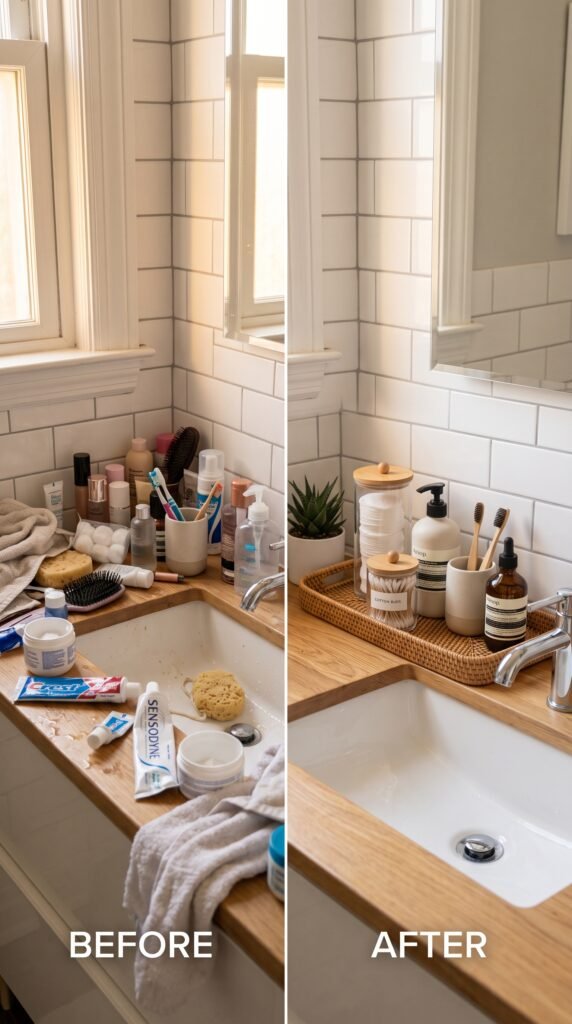
Keep the counter to what you touch every morning: soap, toothbrush holder, and one or two skincare items you actually use daily. Everything else — styling products, medicines, spares — lives in a drawer or cabinet. If the counter still looks crowded, remove one more thing; a clear counter is the fastest way to make a tiny bathroom feel bigger.
16. Store Backstock Outside the Bathroom
Keep one refill of each item in a cupboard or linen closet outside the bathroom, and bring it in only when the bottle in use is finished. Backstock belongs where you have space for it — not in the room where you are already short of it.
17. Do a Five-Minute Weekly Reset
Pick one day each week and spend five minutes putting everything back where it belongs, wiping the counter, and tossing anything empty. Set a phone reminder until it becomes automatic — a weekly reset takes five minutes and saves a full reorganisation later.
18. Give Every Item a Visible Home
Every item needs a named spot you can see: a labelled drawer section, a hook, a shelf zone. When a product has no home, it ends up on the counter. Check your zones once a month and move anything that has drifted back to where it does not belong.
Common Tiny Bathroom Organization Mistakes to Stop Making
Buying Storage Before Editing
This is the number one mistake, and it is easy to understand why it happens — organising feels productive, and new bins are satisfying to buy. But bins bought before the edit usually fit the clutter, not the system. You end up storing things you should have thrown away, in containers that do not fit the drawers you actually have.
Edit first. Always.
Choosing Style Over Function
A beautiful woven basket that lets dust and product residue fall through its gaps and then never gets cleaned is not helping you. Closed containers hide mess but need occasional clearing out. Open trays look great but require daily maintenance to stay tidy.
Be honest about which type of person you are before you buy. Neither is wrong, but buying the wrong one for your habits means the system fails.
Ignoring the Back of the Door
Most people use the inside of the bathroom door for exactly nothing. That’s real estate you’re leaving on the table. An over-the-door organizer with clear pockets holds an enormous amount of product without touching a single inch of counter or shelf space.
If the back of the door is still empty, it is the cheapest storage you own. Our bathroom storage ideas for clutter-free living show how over-door racks and hooks fit into a whole-room plan.
Keeping Backstock in the Bathroom
Backup toiletries — extra shampoo, a spare deodorant, three bottles of contact lens solution — take up prime real estate that your daily products need. Keep one refill of each item in a cupboard or linen closet outside the bathroom, and bring it in only when the current bottle is finished.
Move the backstock out and watch your bathroom suddenly feel twice as big.
Skipping Labels
Even if you live alone, labels matter. They turn “a place you put things” into “a system.” Labeled zones mean things get returned to the right spot instead of just… wherever.
A basic label maker is inexpensive and labelling a drawer takes a few minutes. It is one of the highest-return steps in this list: once a zone is labelled, everyone in the household can put things back where they belong.
Organizing Once and Walking Away
Tiny bathroom organization is not a one-time event. It is a habit. Plan a five-minute reset each week: return stray items to their zones, wipe the counter, and toss anything empty. Small, regular resets beat a big annual overhaul.
Without it, entropy wins. Every time.
Six Tools Worth Buying for Tiny Bathroom Organization
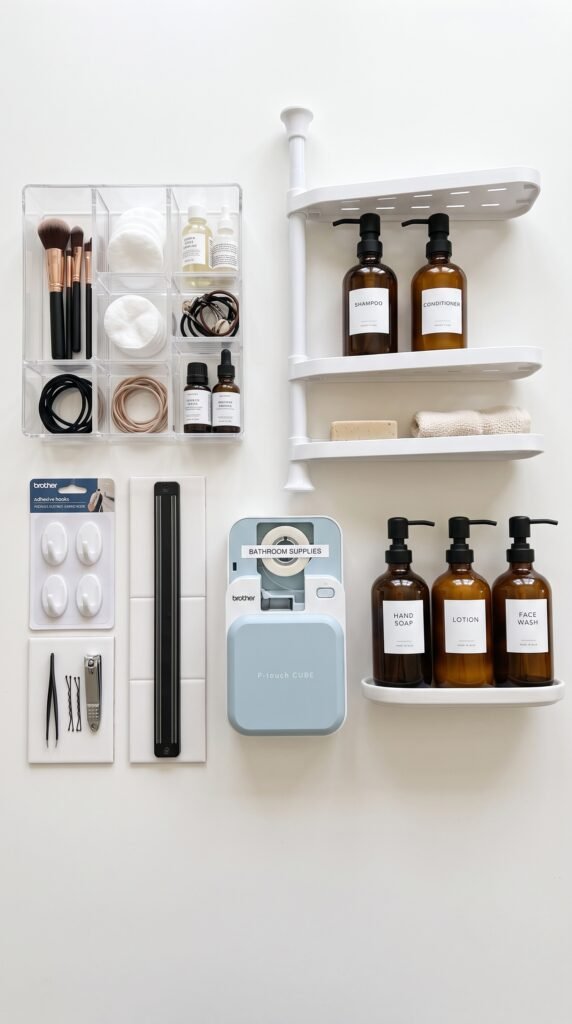
9. Acrylic Drawer Dividers
These are clear, stackable, and fit in almost any standard bathroom drawer. Measure the drawer interior first and choose a set with several sizes — small sections for hair ties and cotton rounds, and a longer section for brushes and tubes. Clear sides matter: you can see what is inside without pulling the whole drawer out.
Look for sets with multiple sizes — you’ll want small sections for hair ties and cotton rounds and a larger section for your full-size products.
10. Tension Corner Shower Caddies
No drilling, no adhesive damage to tiles, adjustable height. A good tension caddy sits between the floor and the ceiling and holds shampoo, conditioner and body wash within reach. Choose one with adjustable shelves so tall bottles and short jars can share the same pole.
For planning guidance, the National Kitchen and Bath Association publishes guidelines for bathroom layout and clearances — useful background before you buy built-in or over-toilet storage.
11. Over-Toilet Shelving Units
Freestanding versions require no installation and move easily if you rearrange. Wall-mounted versions hold more weight but need solid fixings — check whether your wall is plasterboard or masonry before you drill, and always leave the cistern lid accessible.
12. Magnetic Strips and Adhesive Hooks
Combined, these two products solve a surprising share of small-bathroom clutter: hooks take towels, robes and hair tools off surfaces, and a magnetic strip corrals the small metal items that otherwise scatter across counters and drawers.
Both are renter-friendly. Both are cheap. And both add usable storage without touching the floor or counter.
13. Clear Stackable Bins for Under the Sink
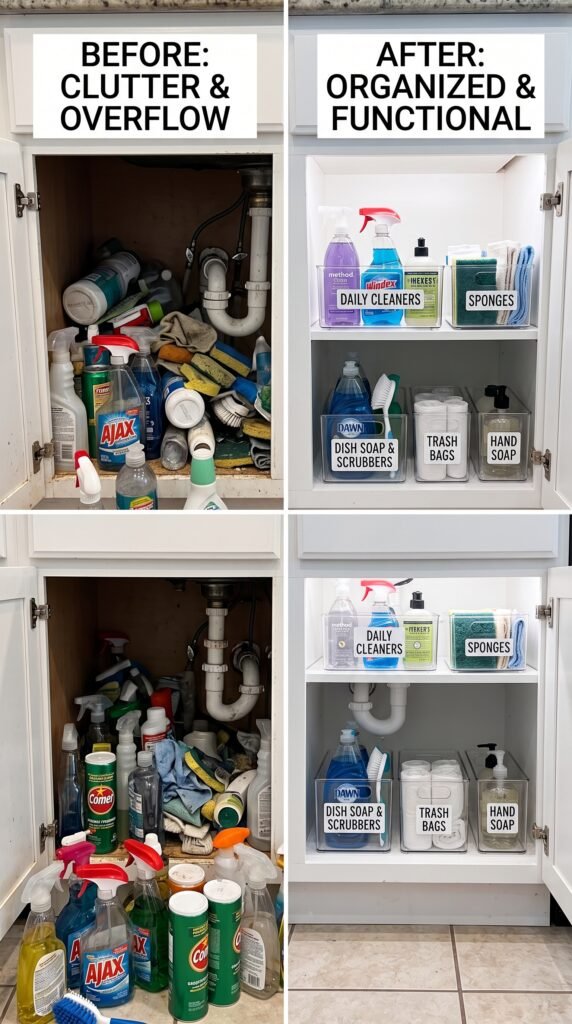
The under-sink area is usually wasted potential. Pipes cut through the space awkwardly, items fall to the back, and cleaning products leak. Stackable bins and a small turntable work around the pipes: measure around the trap first, keep the shut-off valves accessible, and put the products you reach for daily at the front.
The Container Store’s organization guides are a solid free resource for measuring and planning under-sink storage specifically.
14. Lazy Susans
Rotating trays under the sink or in a cabinet mean you never dig through things to reach the back again. Measure the cabinet width and depth first and choose a tray at least 5 cm smaller on each side so it spins freely, and pick a raised rim so bottles do not slide off while it turns.
For detailed product comparisons and rotating tray specs, Good Housekeeping’s bathroom storage roundups have done the testing legwork.
Your Tiny Bathroom Organization Game Plan
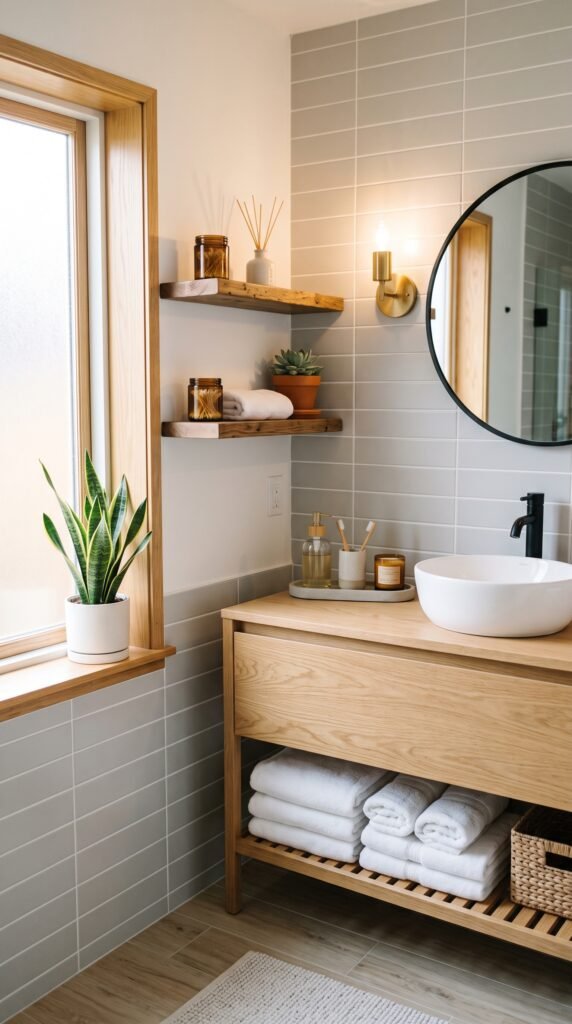
Tiny bathroom organization doesn’t require spending a lot of money or living like a minimalist monk. It requires thinking about the space like it’s working for you — every wall, every door, every drawer — and building systems that match your actual habits, not your aspirational ones.
Start with the edit. Map your zones. Go vertical. Spend ten minutes with a label maker. Then do a final check and actually enjoy using your bathroom again. Good tiny bathroom organization is a system, not a shopping list — and now you have one.
The bathroom that feels impossible to tame right now? It’s a system problem, not a space problem. And systems are fixable.
Frequently Asked Questions
How do I organize a tiny bathroom with no storage? Start with the edit in win 1, then use the door, the wall above the toilet and the inside of cabinet doors — those three spots alone usually free up enough space for daily items. For layout inspiration, see these tiny bathroom ideas that actually work.
What is the best storage for a very small bathroom? Vertical storage first: over-toilet shelves, wall-mounted caddies and tall, narrow bins. Under the sink, use stackable bins and a turntable sized to fit around the pipes, and keep only daily items on the counter.
How do I keep a tiny bathroom organized? Do the five-minute weekly reset from win 17 and follow a one-in, one-out rule: when a new product comes in, an old or empty one leaves. Systems stay working when they are small and regular.
Should I decant my toiletries? Only the products you use daily — shampoo, conditioner, hand soap. Label each container with the product name and expiry date, and skip decanting anything you use rarely or need in its original packaging.