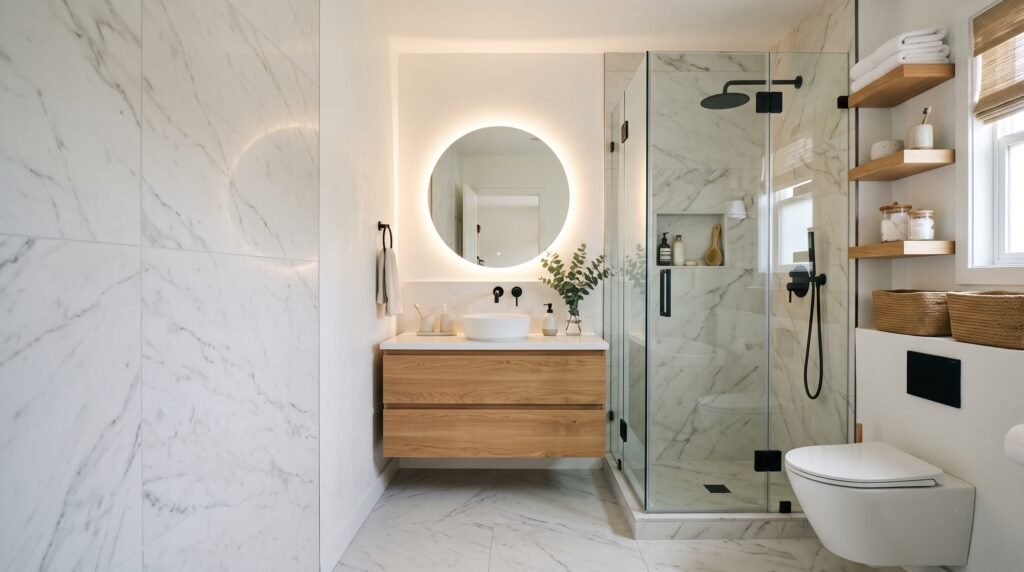
If you’ve ever stood in a tiny bathroom and wondered whether all those tiny bathroom ideas floating around Pinterest actually work in real life, you’re not alone. Most of us have seen the perfectly staged photos, the floating shelves, the cleverly angled mirrors, and thought: “Sure, but my bathroom is actually small.” Not “cozy small.” Not “quaint small.” Small like you have to turn sideways to shut the door.
Here’s the thing — a lot of those ideas DO work. But only if you understand which ones solve real problems versus which ones just look good in a photo. That’s exactly what this guide breaks down, step by step.
Why Tiny Bathroom Ideas Fail Before You Even Start
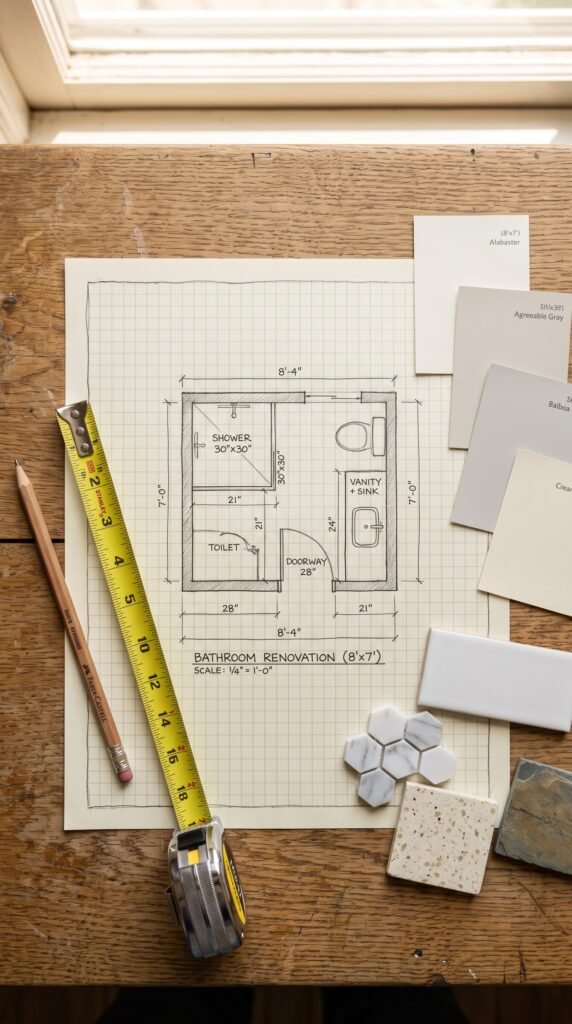
Most people jump straight to buying things. And that’s the first mistake.
Picture this: you spend an afternoon at a home goods store, grab a set of cute wicker baskets, a new mirror, and a tiered shelf. You get home, try to arrange it all, and suddenly the bathroom feels MORE cluttered than it did before. Sound familiar? It happens constantly because the shopping happened before the planning.
Before you try a single tiny bathroom idea, you need to know your actual square footage. Measure twice. Then write down the ONE problem that bothers you most — storage, lighting, it feels cramped, or water goes everywhere. Because different tiny bathroom ideas solve different problems, and treating them as one-size-fits-all is where things go sideways.
Also, don’t skip the “why does this space feel small” question. Sometimes it’s not about size at all. It’s about color, clutter, or bad lighting making the room feel like a cave.
Step 1: Start With Light, Not Storage (This Is the Part Everyone Skips)
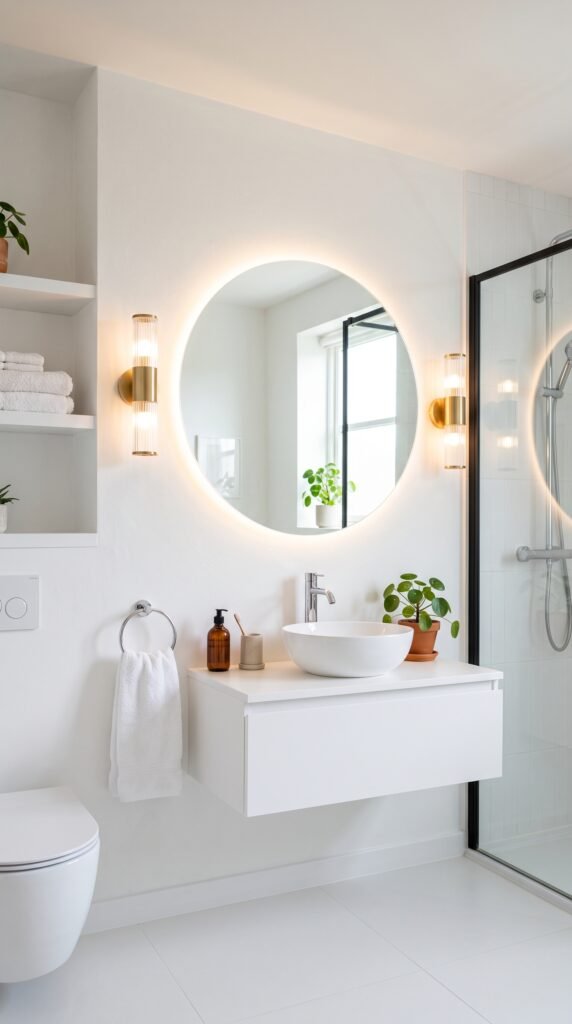
Light is the most underrated element in tiny bathroom ideas. Almost nobody thinks about it first.
Here’s the reality: a dark, small bathroom with perfect storage is still going to feel like a box. But a well-lit small bathroom with imperfect storage can actually feel calm and functional. Light is doing serious heavy lifting here.
Start by swapping out any old yellow bulbs for daylight LEDs in the 5000K-6500K range. According to the American Lighting Association, layered lighting in small spaces creates the illusion of depth in ways that a single overhead fixture simply can’t. That means at least two light sources: overhead AND side-mounted near the mirror.
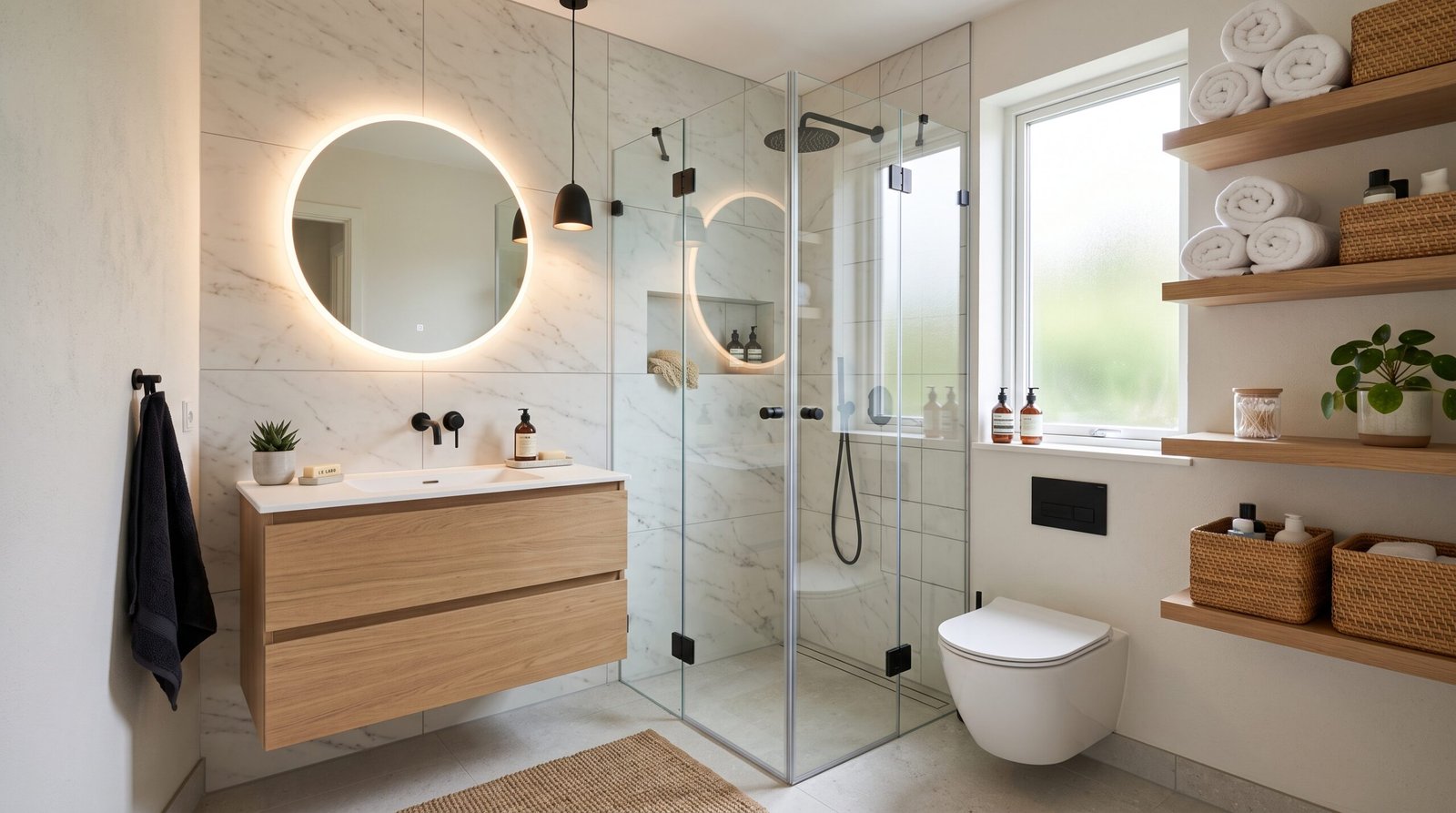
Speaking of mirrors, go bigger than feels comfortable. Most people buy a mirror that’s “appropriate” for the vanity size. Don’t. A mirror that extends close to the ceiling bounces light everywhere and tricks the eye into reading the wall as open space. It’s one of those tiny bathroom ideas that looks almost too simple to work.
But it works. Every time.
how to choose the right bathroom lighting
Step 2: Wall Space Is Your Best Friend
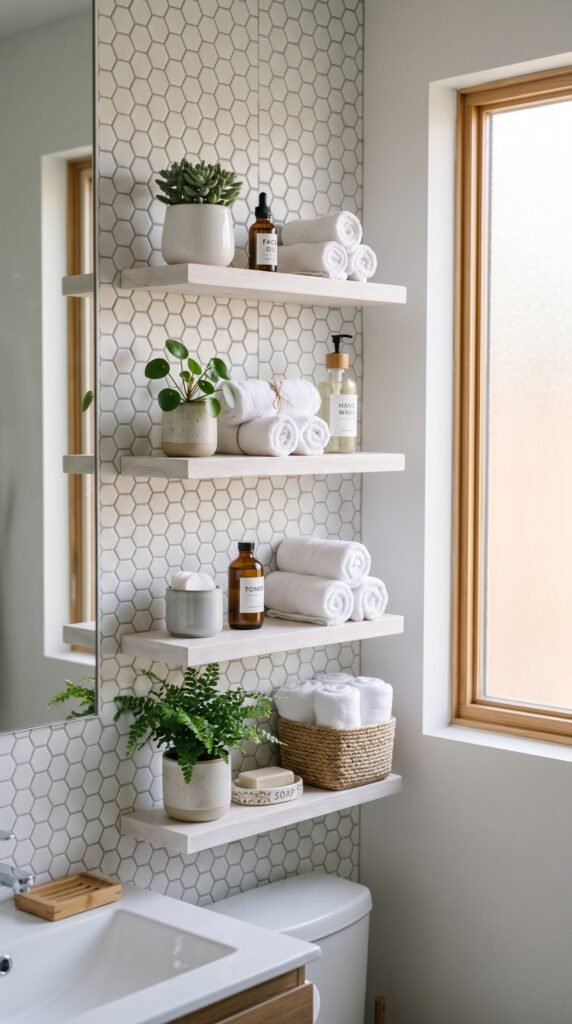
Floor space in a tiny bathroom is basically gold. So stop storing things on the floor.
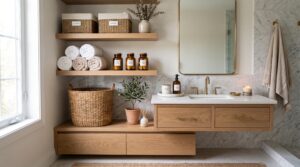
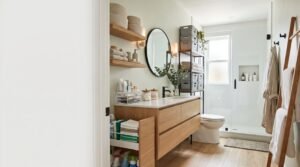
The vertical wall strategy is one of the most effective tiny bathroom ideas that genuinely transforms a space without any renovation. You’re moving storage UP rather than OUT. Tall, narrow shelving units that go from floor to nearly ceiling give you serious square footage of storage without eating into walkable floor area.
Think about the back of the toilet. That wall above it is almost always completely empty in most bathrooms. A simple two-shelf unit installed there (or even a freestanding one that straddles the toilet tank) can hold a surprising amount — extra rolls, small baskets, candles, products. It’s dead space that costs you nothing to reclaim.
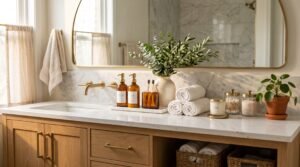
Wall-mounted soap dispensers, toothbrush holders, and even small magnetic strips for hair pins or nail clippers eliminate counter clutter without requiring any actual counter space. Less on the counter = more breathing room = bathroom feels larger.
And for hooks? Use the back of the door. A good over-the-door rack with multiple hooks is one of those tiny bathroom ideas that delivers an almost embarrassing amount of extra storage for the effort involved.
Step 3: Pick the Right Color Strategy (Not Just “Go White”)
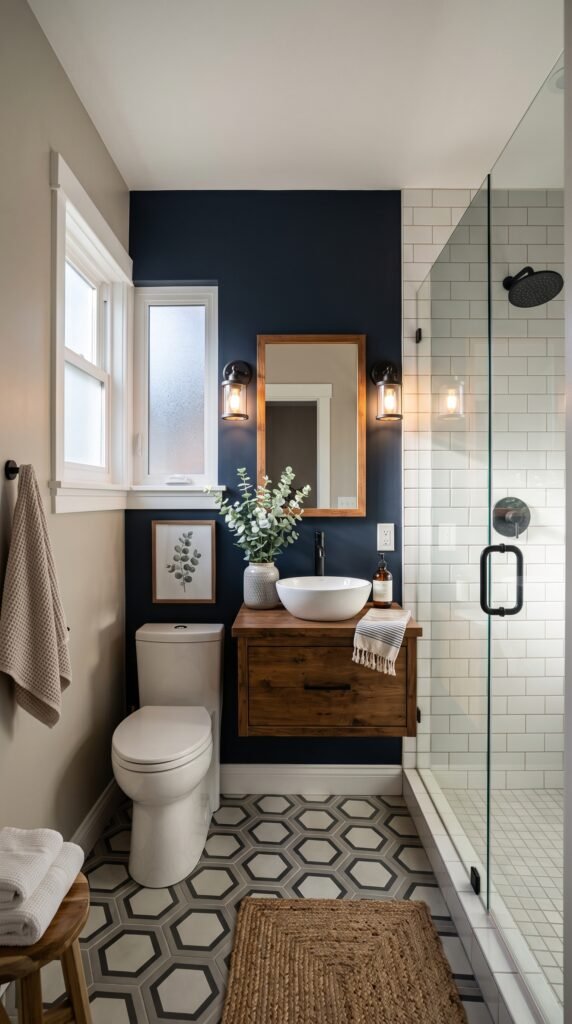
You’ve probably heard “paint it white” more times than you can count. And yes, light colors help. But “go white” is honestly an oversimplification of what actually makes tiny bathroom ideas work from a visual standpoint.
Here’s what the research actually shows: a study highlighted by Houzz found that monochromatic color schemes — using one color family throughout walls, tiles, and fixtures — make small rooms read as larger than rooms that use sharp color contrasts. A white wall with dark tile grout and a dark vanity creates visual chop. Everything becomes a stopping point for the eye.
So instead of just going white, try going TONAL. Soft sage walls with slightly deeper sage towels and lighter sage tile. Or warm putty walls with natural wood tones and cream fixtures. The eye travels smoothly through the space instead of bouncing around.
That said, a single accent wall works differently than contrast everywhere. A bold color or patterned wallpaper on just the wall behind the toilet or vanity creates a focal point that actually draws attention AWAY from how small the room is. The brain focuses on the interesting part, not the square footage.
Fair warning: don’t do busy pattern on more than one surface. That’s the version of this advice that goes wrong.
Common Mistakes People Make With Tiny Bathroom Ideas
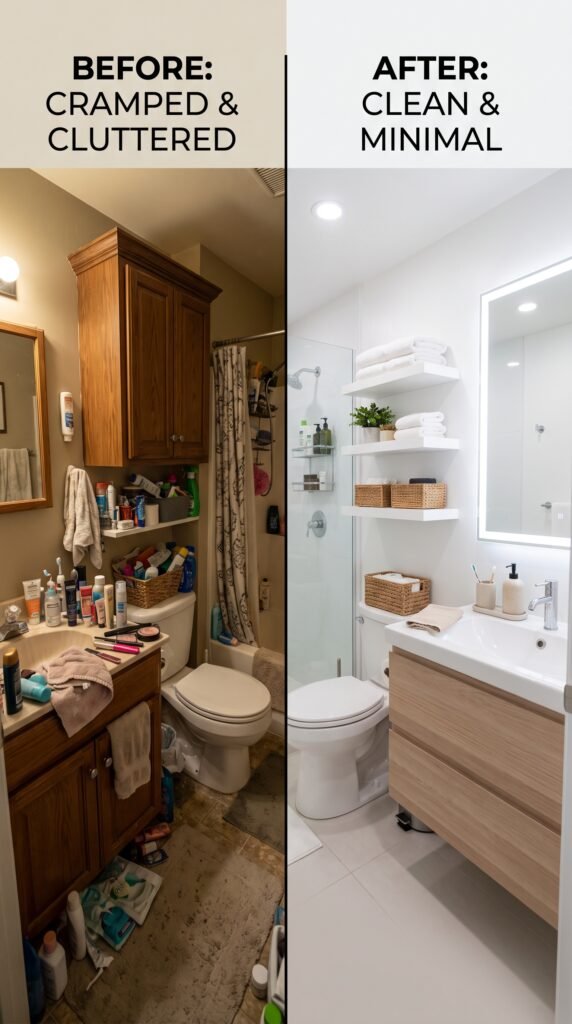
Now that you know what to do, let’s talk about what most people get wrong. Because even the best tiny bathroom ideas can backfire with the wrong execution.
Mistake 1: Buying furniture that’s “small” but still too big.
There’s no award for getting the smallest version of a full-size piece. A pedestal sink with a small footprint will always open up more floor space than even a “compact” vanity with doors. If floor space is the problem, the answer might be eliminating a piece of furniture, not just downsizing it.
Mistake 2: Overdoing the storage solutions.
This one stings a little, but it’s true. Too many organizers, baskets, shelves, and hooks create visual noise. The goal isn’t maximum storage. It’s EFFICIENT storage. Three well-placed, hidden-from-view storage spots beat twelve decorative baskets sitting on every surface.
Mistake 3: Ignoring the shower or tub area.
Most tiny bathroom ideas focus on the main room, but the shower is usually 30-40% of the total space. A clear glass shower panel (versus a curtain or frosted door) makes the entire bathroom look bigger because the eye can travel through it. According to HGTV’s design experts, this single swap is one of the highest-impact visual changes possible in a small bathroom.
Mistake 4: Getting the rug size wrong.
A rug that’s too small makes the bathroom feel unfinished and choppy. But too large and it fills the floor space you’re trying to preserve visually. In a tiny bathroom, no rug or one small bath mat kept outside the shower is almost always the right call.
Mistake 5: Not editing before you add.
This is the big one. Before adding any tiny bathroom idea to your space, take things OUT first. A 30-day bathroom shelf audit — where you only keep what you actually used in the last 30 days — often reveals that half the stuff taking up space wasn’t doing anything.
Best Tools and Products for Tiny Bathroom Ideas That Actually Work
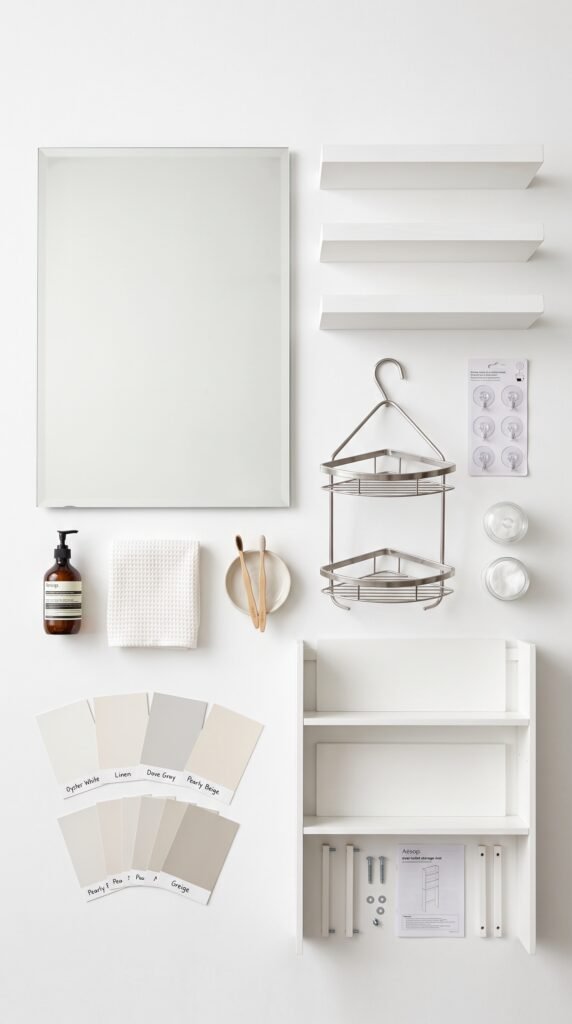
Let’s get practical. Here are the specific types of products that consistently make tiny bathroom ideas land in real life, not just in magazine photos.
A frameless or thin-framed large mirror. Size matters more than style here. Go as tall as possible. A frameless design disappears against the wall and adds perceived space without visual clutter.
Recessed shower niches or corner caddies. If you can’t install a recessed niche (which requires some wall work), a tension pole corner caddy is the next best option. It takes zero floor space and puts all your shower products at eye level.
A wall-mounted or folding towel bar. Towels on a ring or hook work fine, but a folding towel bar that folds flat against the wall when not in use is a small detail that adds real functionality without permanently occupying space.
Slim profile over-toilet storage. Not all of these are created equal. Look for ones with adjustable shelves and at least one closed cabinet section. Open shelves everywhere means visible clutter, even when everything is technically organized.
Peel-and-stick removable hooks. For renters especially, these are a game changer for implementing tiny bathroom ideas without losing your deposit. The newer generations hold much more weight than the original versions.
A tension corner shelf for the shower. Stick it in the corner of a shower at head height. Products are accessible, off the floor, and the tension means no drilling. Honestly one of the most underrated tiny bathroom ideas in terms of immediate impact.
renter-friendly bathroom upgrades that don’t require tools
How to Prioritize Tiny Bathroom Ideas When You Can’t Do Everything at Once
Most people don’t have a weekend and a full budget to overhaul everything at once. And that’s actually fine. The key is working in the right order so each change builds on the last.
Start with light. It’s almost always the lowest cost, highest impact swap. New bulbs plus a larger mirror can cost under $80 and change how the whole room feels inside a single afternoon.
Then tackle the counter. Get everything off it that doesn’t have to live there. Find wall homes for soap, toothbrushes, and anything else you can mount.
Then look at vertical storage. Fill the wall above the toilet, behind the door, and on any blank walls.
Color and tile are last because they require the most commitment. Get the small changes right first, live with them, and then decide if you still feel like the room needs a color update. Often, you’ll find it doesn’t.
The honest truth about tiny bathroom ideas is that most of them work. But only when you approach them as a system rather than a collection of individual hacks. One floating shelf won’t save a bathroom. A thoughtful, layered approach to light, storage, and visual flow absolutely will.
Start small. Edit more than you add. And give the changes time to breathe before you buy the next thing.
That last part is probably the advice people skip most. And it’s probably the most important one.