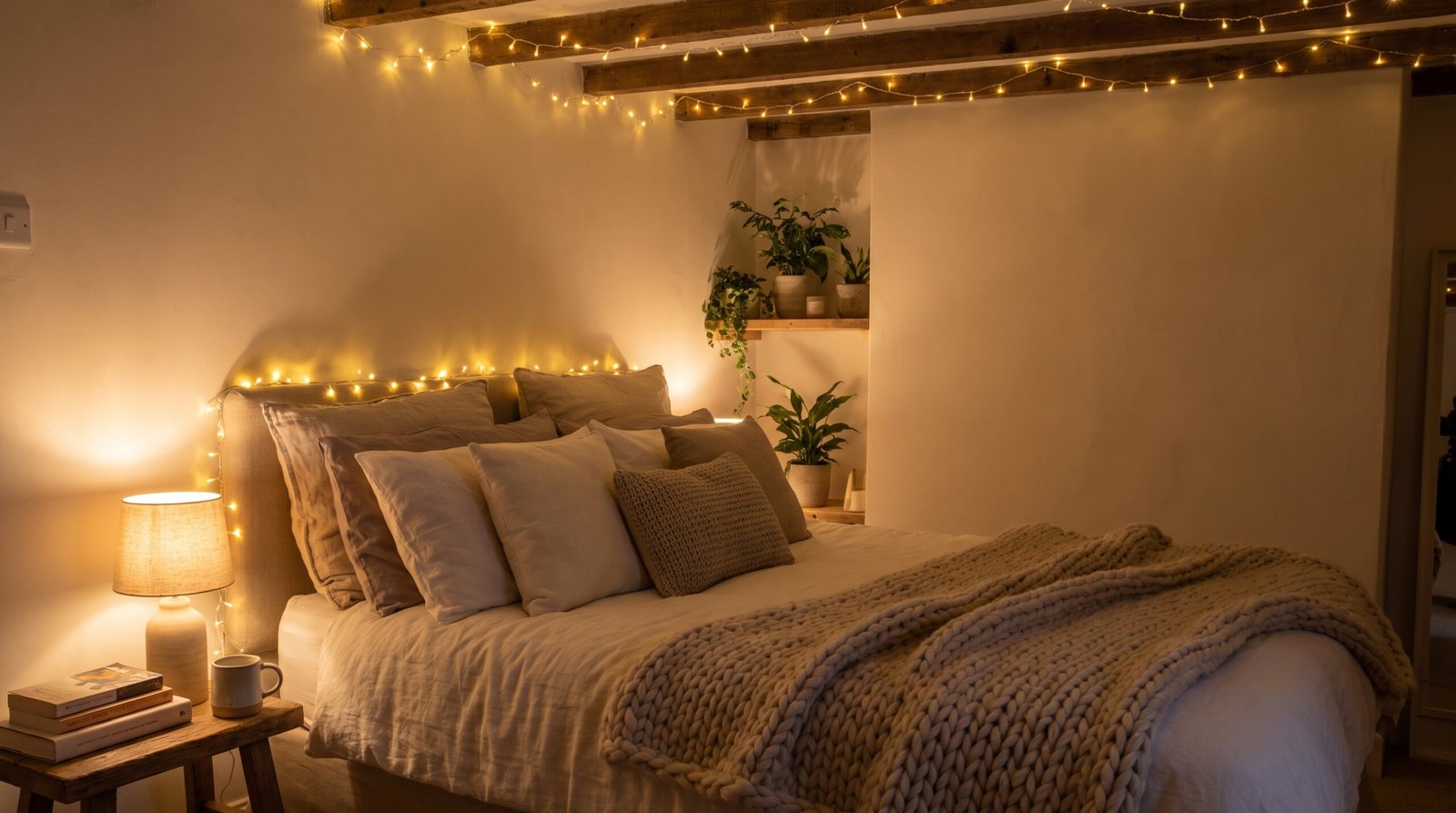
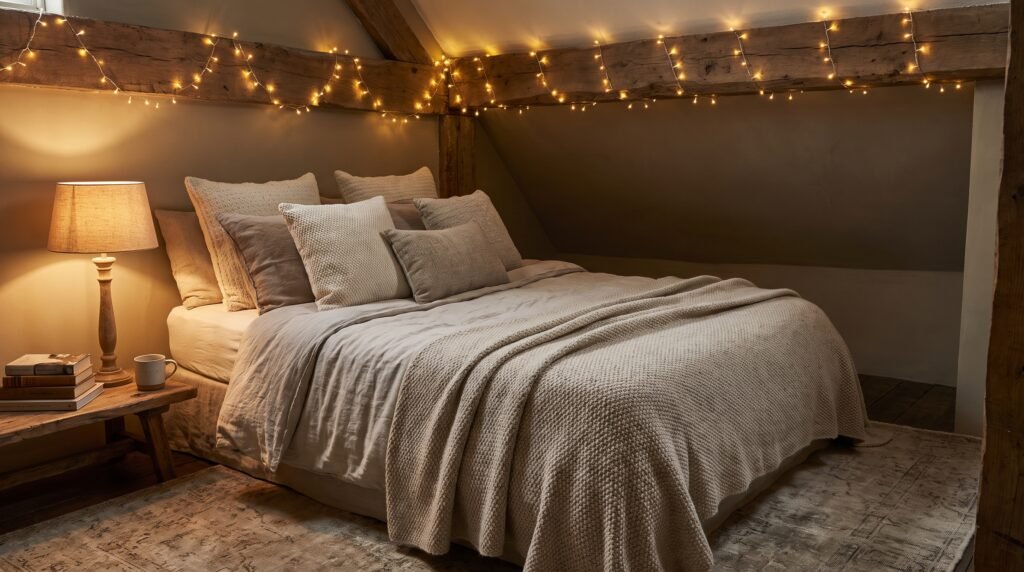
These cozy bedroom ideas for small spaces are for rooms where every centimetre counts. Most bedroom advice assumes generous floor space and a renovation budget. The 14 ideas below do not: each one works in a small room, uses furniture and materials you can measure before you buy, and can be done without a contractor.
Start by measuring the room and the bed, and note where the door swings, the window sits and the light falls. Ten minutes with a tape measure prevents most small-bedroom mistakes: furniture that blocks a walkway, a rug that is too small, or shelves hung where you reach for a glass of water at night.
The 14 ideas below are ordered from the biggest storage and layout wins to the finishing touches, so you can start at the top and stop whenever the room feels finished.
Table of Contents
1. Use a Storage Ottoman Bench at the Foot of Your Bed
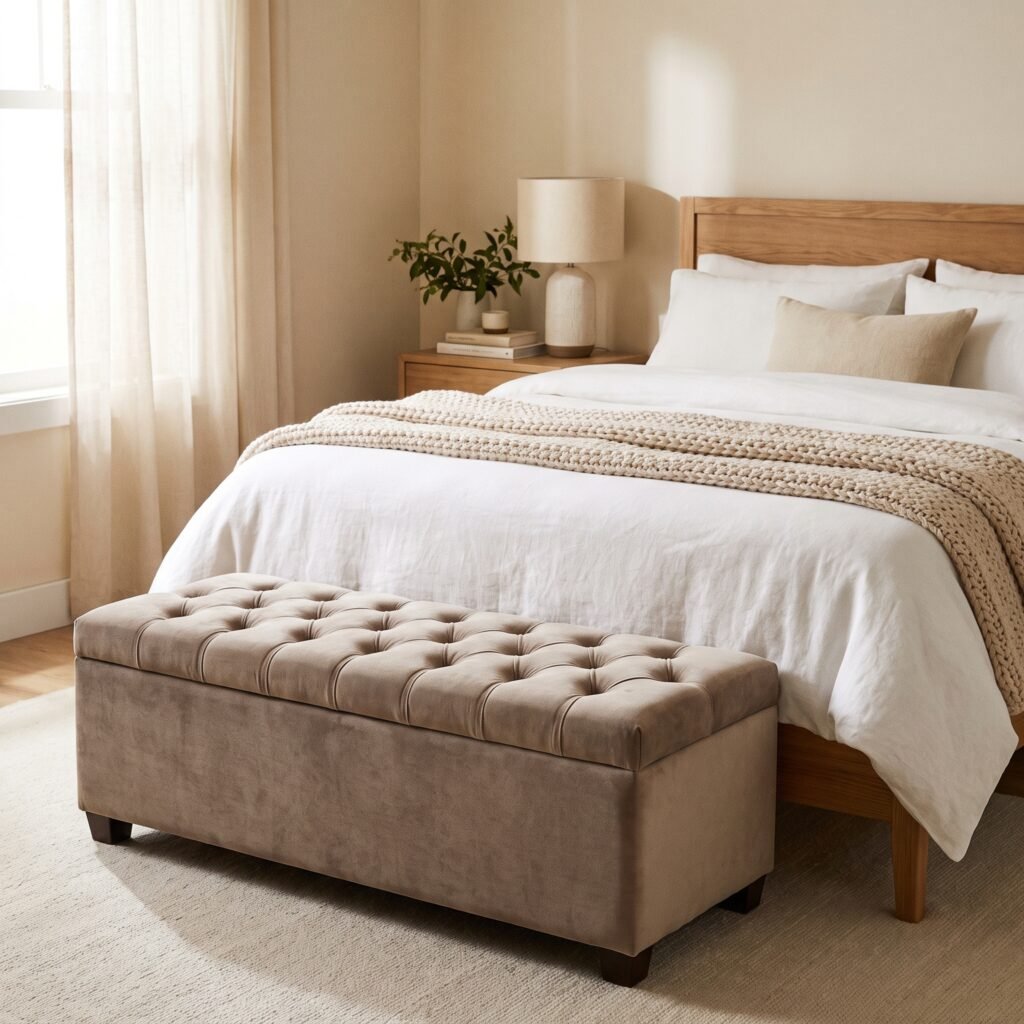
One of the most frustrating things about a small bedroom is visual clutter: extra blankets, books and chargers with nowhere to go. A storage bench solves the problem in one piece of furniture, because it gives those everyday items a home at the foot of the bed instead of on the floor or piled on a chair.
It functions as seating, as a place to set things down while you are getting ready, and as hidden storage for everything that does not have a home: off-season throws, spare pillows and the bedding sets you rotate through. Nothing is visible, nothing is on the floor, and the room immediately feels more pulled together.
The other thing nobody talks about is how much a bench changes the look of a bed. It anchors the whole space and gives it that intentional, hotel-suite feel without any real effort. If you’re going to invest in one piece for a small bedroom, this is the one I’d pick first.
Measure first: choose a bench 10–15 cm narrower than the bed width, about the height of the mattress top, and check the depth of the storage compartment before you buy.
2. Decorate Vertically With Floating Wall Shelves
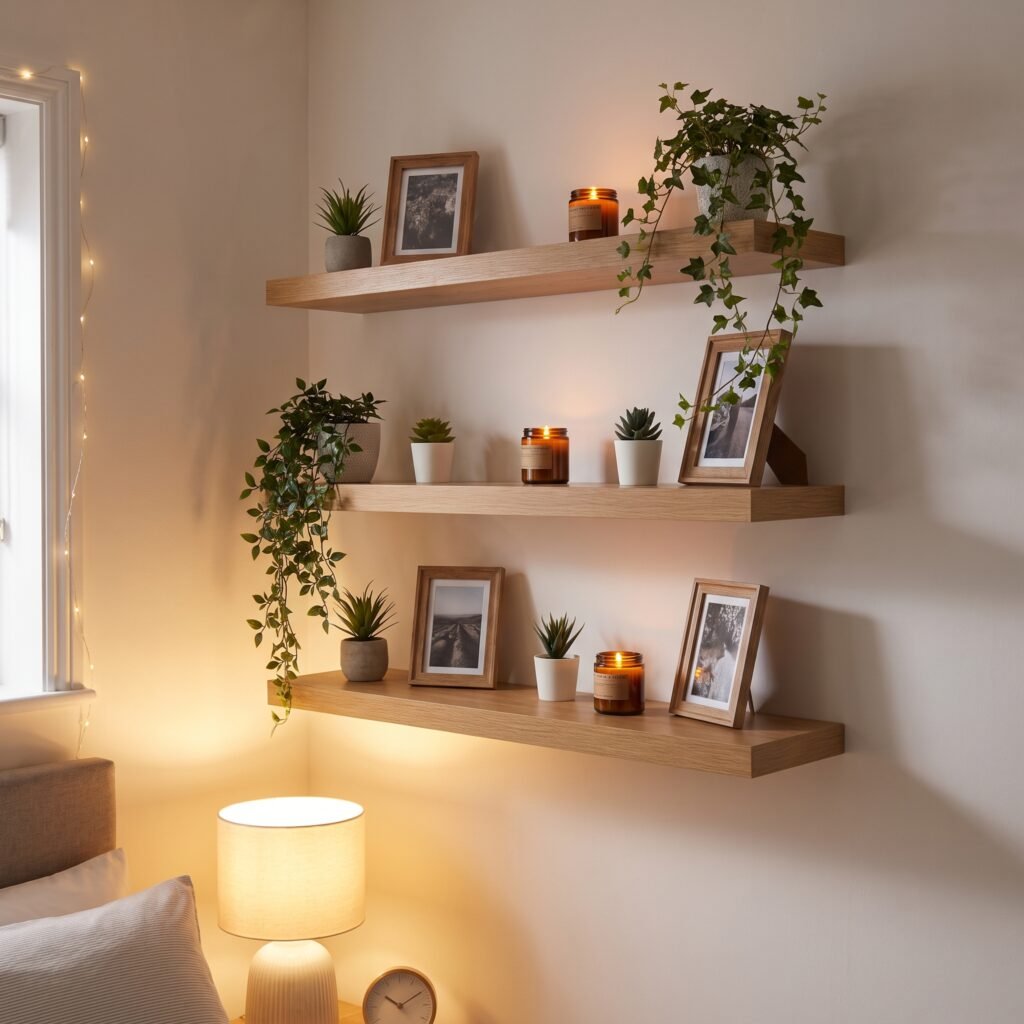
Floor space in a small bedroom is precious. Every square foot counts, which means the walls become your best design real estate. Floating shelves let you bring personality into the room — plants, candles, meaningful objects — without consuming any of that limited floor area.
The key to making them feel cozy rather than cluttered is restraint. Aim for a mix of heights and textures: a trailing pothos at one end, a small candle or two in the middle, maybe a single framed photo. Warm ambient lighting underneath or beside the shelves transforms them from functional to atmospheric.
A common mistake is overfilling shelves until they look cluttered. Leave about a third of each shelf empty, keep the heaviest items low, and fix shelves into studs or use fixings rated for the weight; floating shelves are not a place for stacks of heavy books.
Space shelves 30–40 cm apart vertically so books and plants fit without crowding, and hang the lowest shelf at a height you can reach without a step stool.
3. Try a Bedside Hanging Organizer Instead of a Nightstand
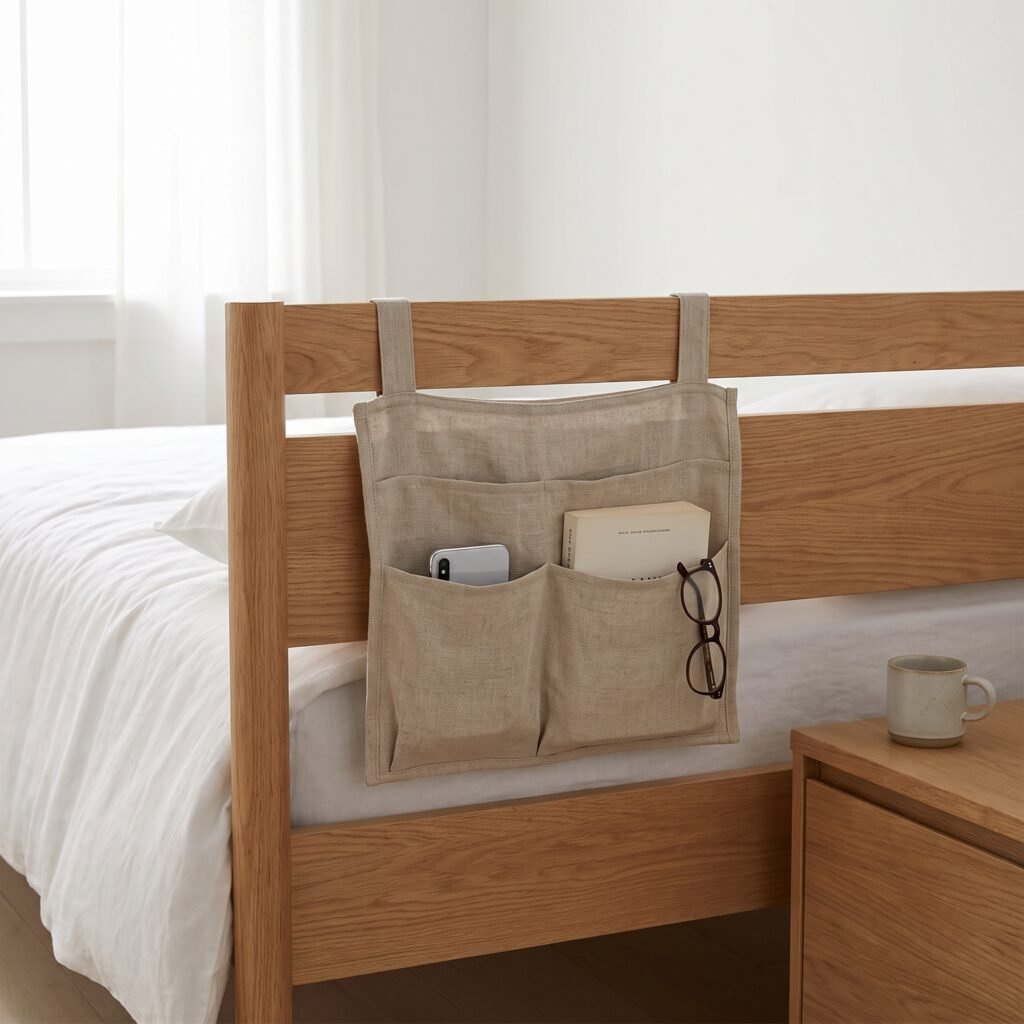
Nightstands are wonderful — until your room simply doesn’t have the width to accommodate one. If your bed is pushed against a wall or you’re working with a layout where traditional side tables feel impossible, a bedside hanging organizer is one of those underrated solutions that sounds basic until you actually use it.
It hooks directly onto your bed frame and gives you pockets for all the essentials: your phone, a book, your glasses, maybe a small notebook. Everything that used to live on the floor next to your bed or balanced precariously on the mattress edge now has a spot.
The minimalist look of a hanging organizer actually works well in small spaces — it takes up zero visual weight while solving a very real daily annoyance. Look for one in a neutral linen or canvas fabric so it blends into the bedding rather than standing out.
Measure the width of the gap beside the bed before you choose: most hanging organisers need only 5–10 cm of clearance, which is why they work where a table will not.
4. Layer in Warmth With LED Fairy Lights
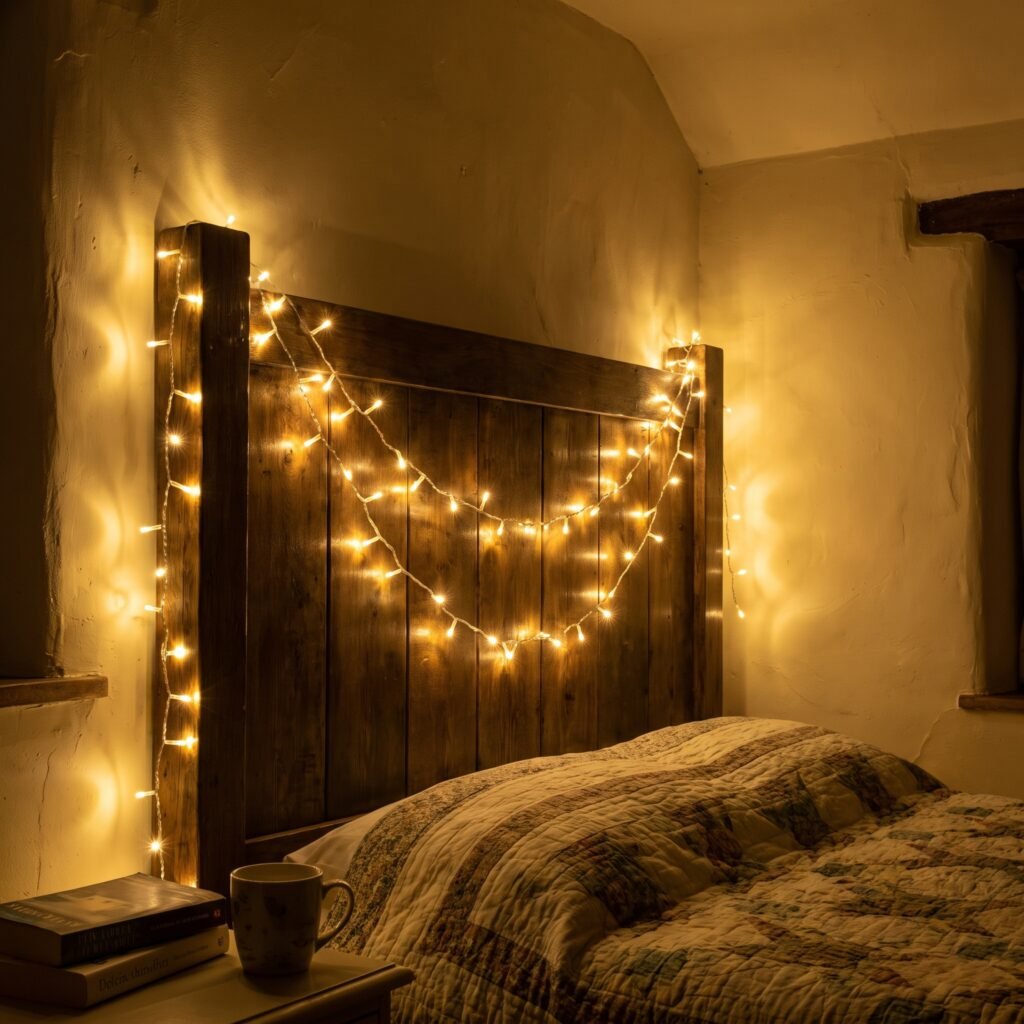
Lighting is probably the single most underestimated element in bedroom design. The difference between a room that feels cold and one that feels genuinely cozy is almost always the quality of the light — and overhead fixtures almost always lose.
Fairy lights are inexpensive, easy to move around, and deeply effective at creating that soft, amber warmth that makes a small bedroom feel like a sanctuary. Draped over a headboard, woven through floating shelves, or hung behind sheer curtains, they add a layer of ambient glow that no ceiling light can replicate.
One thing worth knowing: color temperature matters enormously. Stick with warm white (2700K–3000K range) rather than cool white or daylight tones. Cool light in a small bedroom reads as clinical rather than cozy, no matter how nice the other decor is.
Choose warm-white fairy lights on a timer plug so they switch off on their own, and keep them well away from bedding and curtains.
Bedroom Lighting Ideas Under $40
5. Switch to a Wall-Mounted Reading Lamp
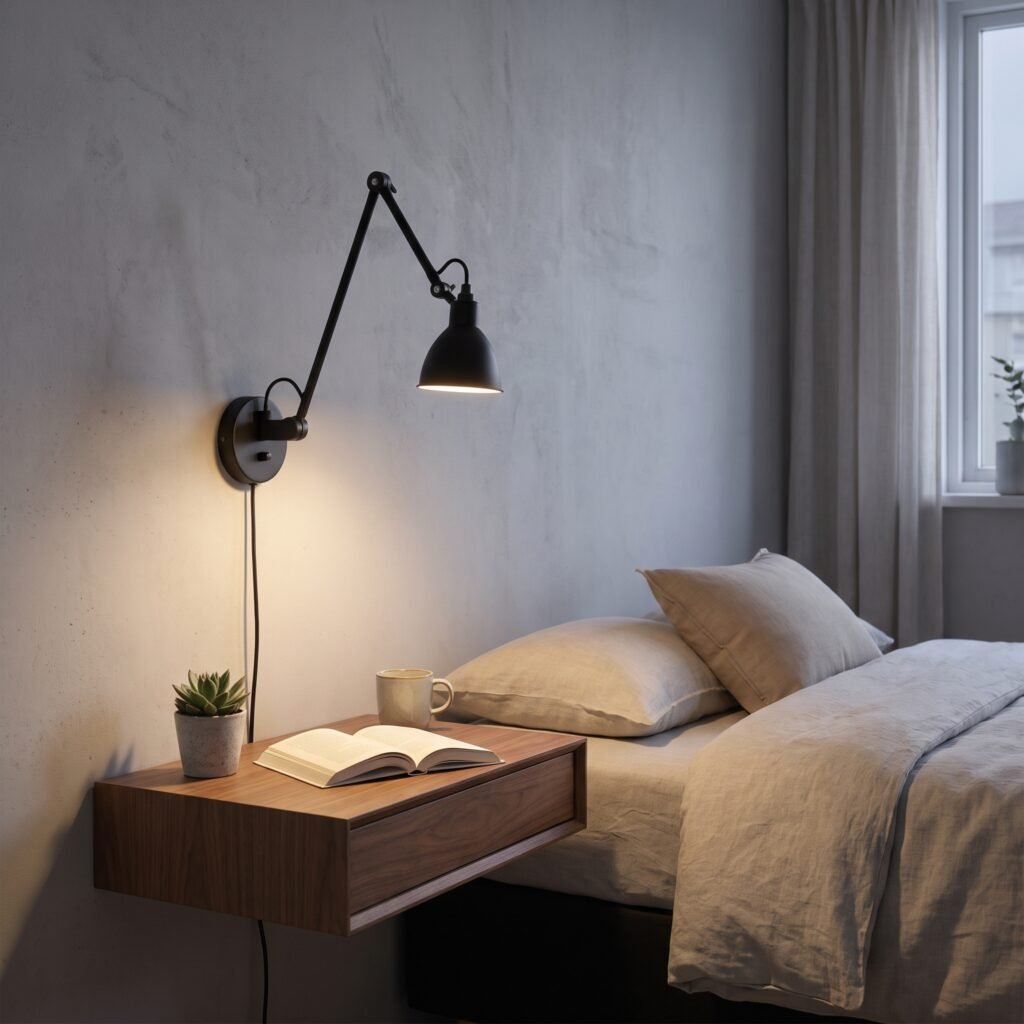
Table lamps are lovely, but they take up surface space — and in a small bedroom, surface space is non-negotiable. A wall-mounted reading lamp solves the lighting problem without claiming any real estate on your bedside table or floor.
The best versions are adjustable, so you can direct the light exactly where you need it for reading without disturbing a partner or flooding the whole room. They also tend to look more intentional than a standard table lamp in a tight space — they feel built-in rather than tacked on.
A wall lamp also frees the bedside surface for a book or a glass of water, and a swing-arm version lets you angle the light for reading without lighting the whole room.
Mount a reading lamp so the bulb sits about 40–60 cm above the mattress, at shoulder height when you sit up in bed. Too high and it lights the whole room; too low and it glares in your eyes.
6. Unlock the Space Under Your Bed
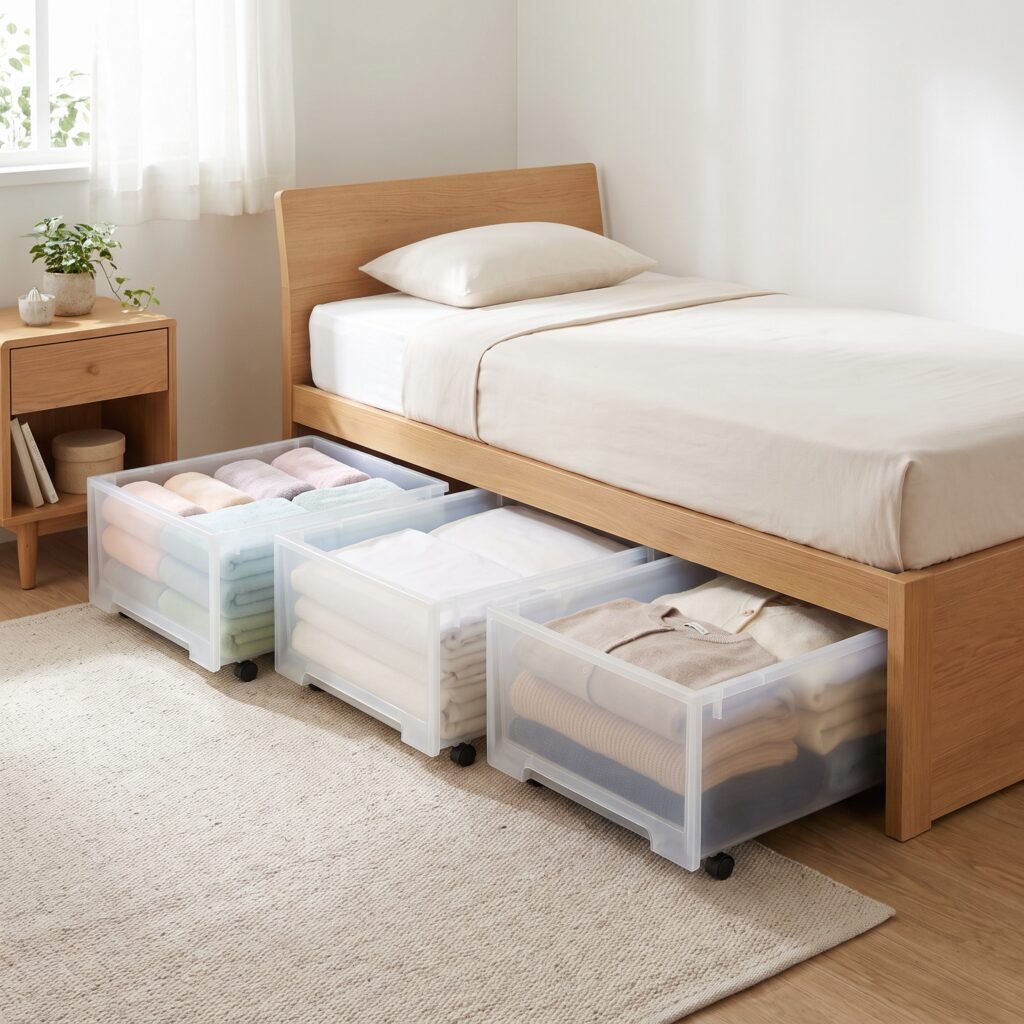
The area under a bed is routinely wasted in small bedrooms — either ignored entirely or used as a dumping ground for things that then become impossible to find. Treating it as intentional, organized storage changes your entire relationship with the room.
Rolling storage bins or shallow fabric containers let you store off-season clothing, spare bedding, towels, or shoes in a way that’s actually accessible. Transparent containers are particularly useful because you can see exactly what’s inside without pulling everything out.
One practical note: if your bed frame sits low to the ground, check the clearance before purchasing containers. Not all under-bed storage fits all frames, and it’s a frustrating mistake to make. Most product listings will include height measurements — double check before you buy.
Measure the clearance under the bed first: most rolling bins need at least 10–15 cm, and a lift-up storage bed needs room to open fully without hitting a radiator or bedside table.
7. Add a Throw Blanket for Instant Texture and Warmth
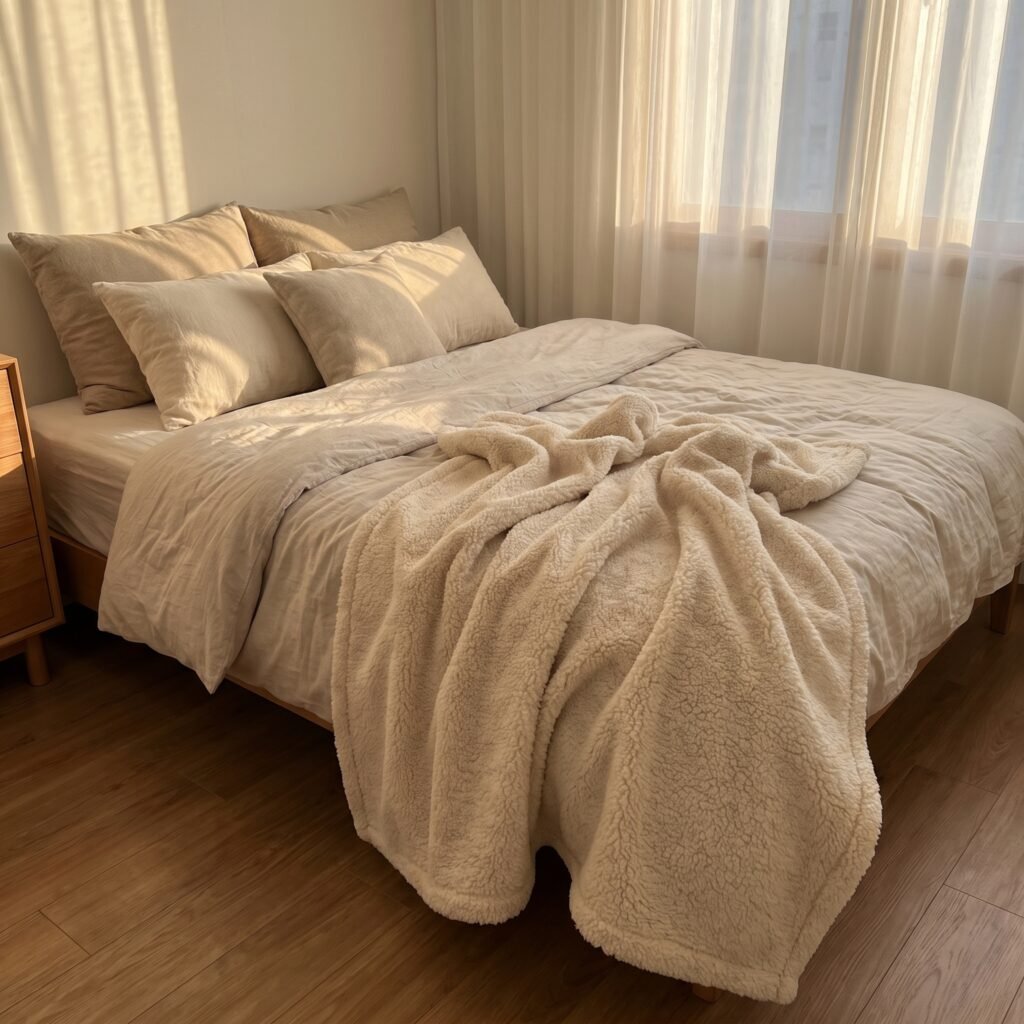
A well-chosen throw blanket is one of the cheapest and most effective upgrades you can make to a small bedroom. It adds texture, color, and that visual softness that transforms a flat, functional bed into something that looks lived-in and inviting.
The trick is in how you drape it. A throw folded neatly across the foot of the bed looks polished. Casually tossed over one corner looks effortlessly relaxed. Both work — it just depends on the vibe you’re going for. Sherpa and chunky knit materials photograph and read as particularly cozy, especially in neutral tones like cream, oatmeal, or warm grey.
Beyond aesthetics, a throw on the bed means you always have something to grab when the temperature drops without having to fully unmake the bed. It’s one of those things that sounds small but genuinely improves daily quality of life in a small space.
Choose a throw in a washable material if it will be used daily, and a size that covers the foot of the bed without trailing on the floor — about 130 × 180 cm for a double bed.
8. Choose a Slim Bedside Table That Works With Your Space
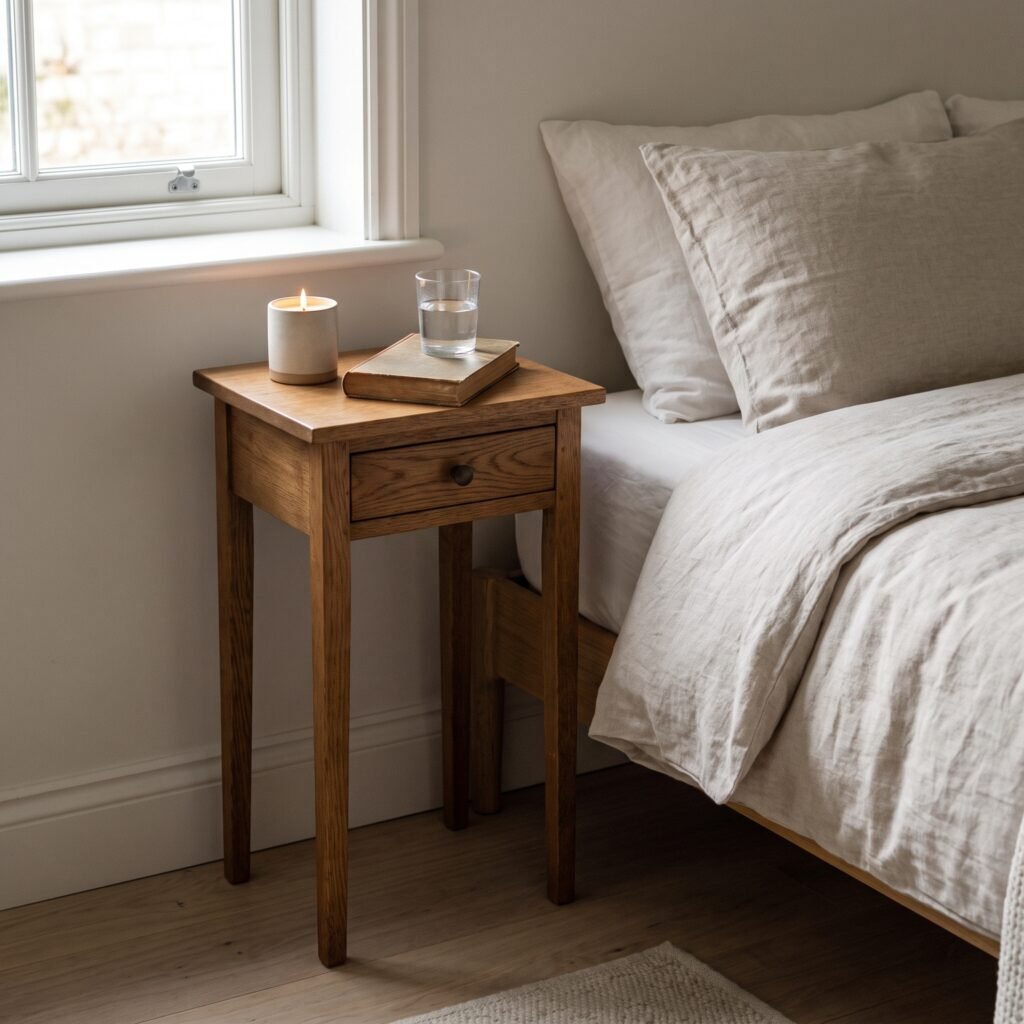
If you do have room for a nightstand but the standard 24-inch versions overwhelm the space, a slim bedside table is a much smarter fit. Look for something in the 12–16 inch depth range — narrow enough to leave breathing room around the bed but functional enough to actually hold your essentials.
Drawers or a small lower shelf are more useful than a flat surface alone, because vertical storage becomes critically important when floor space is tight. A small drawer keeps clutter contained and out of sight, which makes the whole room feel calmer.
Material and finish matter here too. Lighter wood tones, white, or natural rattan all tend to make a small space feel more open than dark, heavy furniture. When in doubt, go lighter.
A slim table 30–40 cm wide fits most gaps beside a bed; check that a drawer, if it has one, can open fully without hitting the bed frame.
9. Hang a Statement Mirror to Open the Room Up
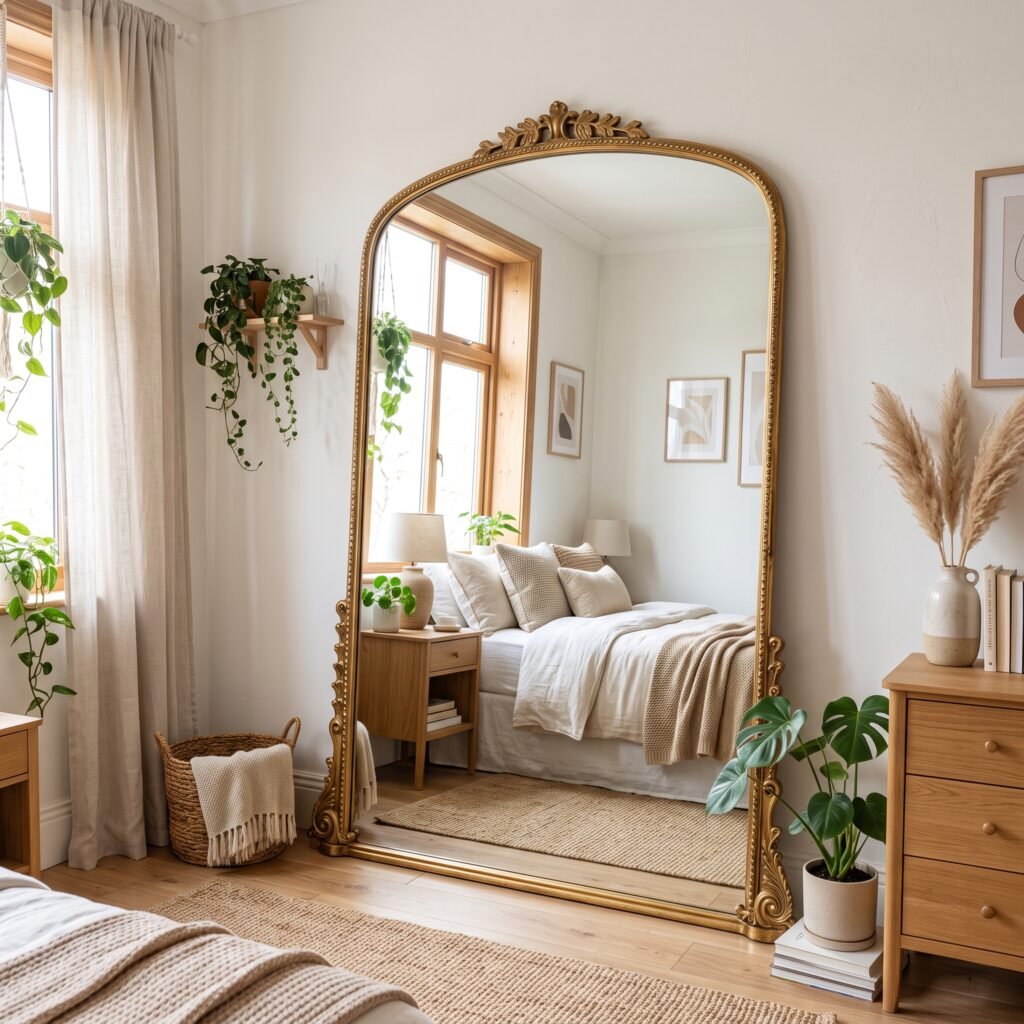
Mirrors are one of the oldest tricks in the interior design playbook — and they work. A large mirror on the wall of a small bedroom reflects both natural and artificial light, creating the impression of depth and making the room feel noticeably bigger than it actually is.
Beyond the space-expanding effect, a well-chosen mirror is genuinely a piece of decor. Arched mirrors with thin gold frames suit boho-minimal to contemporary bedroom styles, and a round mirror with a simple black or wooden frame is equally timeless. Either way, a bigger mirror means more presence on the wall.
Position it to reflect a window or a light source if possible — that’s where the biggest visual impact comes from. Even a mirror reflecting your fairy lights creates a magical, doubled warmth that makes the room feel much more intentional and inviting.
Hang a mirror so its centre is roughly at eye level — about 145–150 cm from the floor — and fix it with hardware rated for its weight, especially on plasterboard walls.
10. Choose a Storage Bed That Does the Work
In a small bedroom the bed itself should earn its floor space. A storage bed with deep drawers – four is a good number to look for – holds off-season bedding, spare pillows and anything else that would otherwise need a second piece of furniture. It keeps the room calmer because the clutter has somewhere to go, and it frees up wardrobe space for the things you actually wear.
11. Hang Curtains High and Let the Light In
Sheer curtains are a small-room favourite for a reason: they soften harsh daylight into a diffused glow and give you privacy without blocking the light altogether. Hang them properly and they do even more – mount the rod close to the ceiling and extend it 6 to 12 inches beyond each side of the window, with the fabric falling to the floor, so the window reads larger and the room feels taller.
12. Use the Headboard as the Anchor
A headboard anchors the whole room, which matters most when there is not much else in it. An upholstered headboard adds softness you can lean against, while a rattan one adds warmth and texture without visual weight. Whichever you choose, let it set the tone and keep the rest restrained: if something does not make you feel good or serve a function, it does not stay.
13. Create a Canopy Moment Without a Canopy Frame
You do not need a four-poster bed to get the soft, enclosed feeling of a canopy. A single ceiling hook and a length of sheer fabric in a pale, neutral tone, draped behind the headboard or across a corner, gives you the same dreamy effect with no floor space used at all. Keep the fabric light so it moves with the air rather than weighing the room down.
14. Add Height and Life With a Tiered Plant Stand
A tiered plant stand adds greenery at several heights without taking up a table, and with small grow lights fitted under the shelves it keeps plants happy even in a room with one small window. Dimensional wall decor – wooden floral pieces or other raised wall art – works the same way, adding depth to a plain wall without using any floor space. And if you want bedding that layers itself, a seersucker bed-in-a-bag in a soft neutral is an easy way to add texture to a small bed in one step.
Putting It All Together
None of the 14 ideas above requires a renovation or a contractor. Most need only a tape measure, a drill and an afternoon, and they can be added one at a time as budget allows.
If you’re not sure where to start, the lighting is almost always the highest-impact first move. Swap out harsh overhead light for fairy lights and a wall lamp, and you’ll immediately see the room’s potential. From there, add one storage solution that removes visible clutter, and one soft textile that brings warmth. Build from those three and the rest follows naturally.
These cozy bedroom ideas for small spaces work because small bedrooms can be some of the coziest rooms in a home — they just need a little more intention than a larger room does.
For further reading on creating calming bedroom environments, the Sleep Foundation’s guide to bedroom design covers how light, texture, and layout all affect sleep quality in ways that align perfectly with these cozy design principles.
And if you want to go deeper on color psychology in small spaces, Architectural Digest’s breakdown of warm versus cool palettes is worth a read before you commit to any major color decisions.
Start with one idea. See how it changes the feel of your space. Then add another. That’s genuinely how the best small bedrooms come together — one thoughtful layer at a time.
Mistakes to Avoid in a Small Bedroom
Buy the furniture before you measure the room and it will not fit: a bed that leaves no walkway, a bench wider than the bed, or shelves hung above a pillow where you bump your head. Choose a rug that is too small and the bed floats on bare floor, with the rug ending before it reaches the sides of the bed. Fill the room with dark, heavy furniture and a single overhead light and the room feels smaller instead of cosier. Add every idea on this page at once and the room becomes cluttered; add one idea, live with it for a week, and then decide what is still missing.
More Cozy Bedroom Ideas for Small Spaces
9 cozy bedroom ideas for better sleep
7 Tiny Bedroom Ideas That Maximize Space & Style
Frequently Asked Questions
How do I make a small bedroom feel cosy without cluttering it?
Start with storage that hides things away, such as a storage bench or under-bed bins, then add one layer of texture at a time — a throw, a cushion, soft lighting. Keep surfaces mostly clear and leave about a third of each shelf empty so the room feels calm rather than crowded.
What size rug should I use in a small bedroom?
Choose a rug that extends 45–60 cm beyond each side of the bed, so you step onto it when you get up. If the room is very small, a rug that fits under the lower two-thirds of the bed and extends past the foot works well, as long as it is wide enough to be seen on both sides.
What colour temperature is best for bedroom lighting?
Warm white light at 2700–3000K is the most common choice for bedrooms, because it feels soft and relaxing in the evening. Use it for bedside lamps and fairy lights, and save bright daylight bulbs for task areas such as a desk.
Can I use a storage bed in a very small bedroom?
Yes, if you measure first. Check that the drawers can open fully without hitting a door, radiator or bedside table, and that a lift-up base has room to open. In a very small room, drawers are usually easier to live with than a lift-up base.