
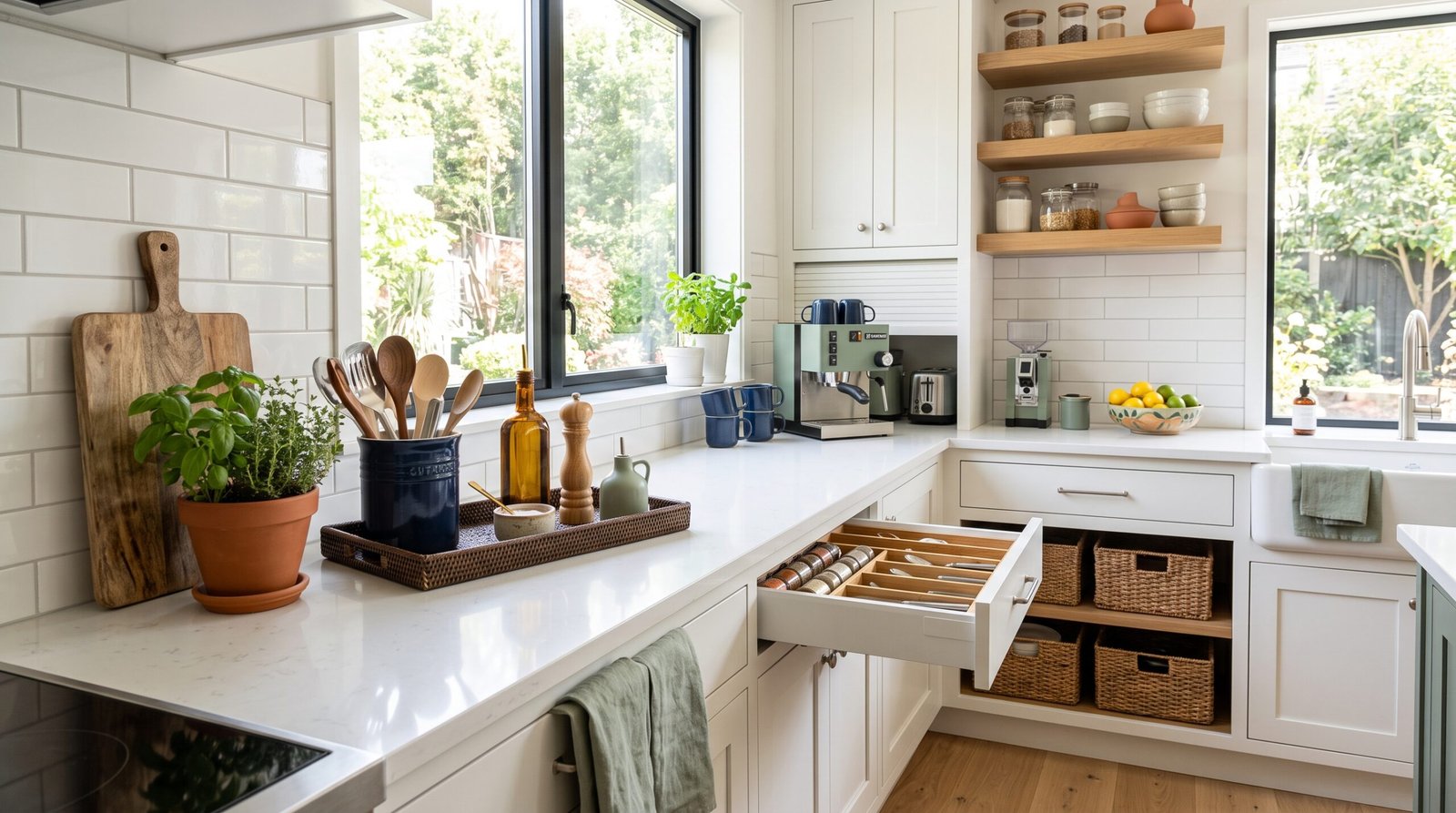
Your kitchen counter is probably working against you right now, and you don’t even know it.
Most people set up their counters once, shove things around until they “fit,” and then wonder why cooking feels like a chore. The clutter creeps in. The workflow breaks down. And suddenly the space that’s supposed to make life easier becomes the biggest source of daily friction in your home.
Here’s the thing: most of these problems aren’t about having too much stuff. They’re about making the same organizational mistakes that almost everyone makes. And once you see them, you can’t unsee them.
📋 Table of Contents
- Myth #1: More Counter Space Means Better Kitchen Counter Organization
- The Zones Mistake: Why Your Kitchen Counter Workflow Is Broken
- The Appliance Trap: What Actually Belongs on Your Kitchen Counter
- The Clutter Magnet Problem: Why Flat Surfaces Attract Chaos
- Expert Tips for Kitchen Counter Organization That Actually Sticks
- The Mindset Shift That Changes Everything
Myth #1: More Counter Space Means Better Kitchen Counter Organization
This is the one that trips up almost everyone who’s ever done a kitchen renovation.
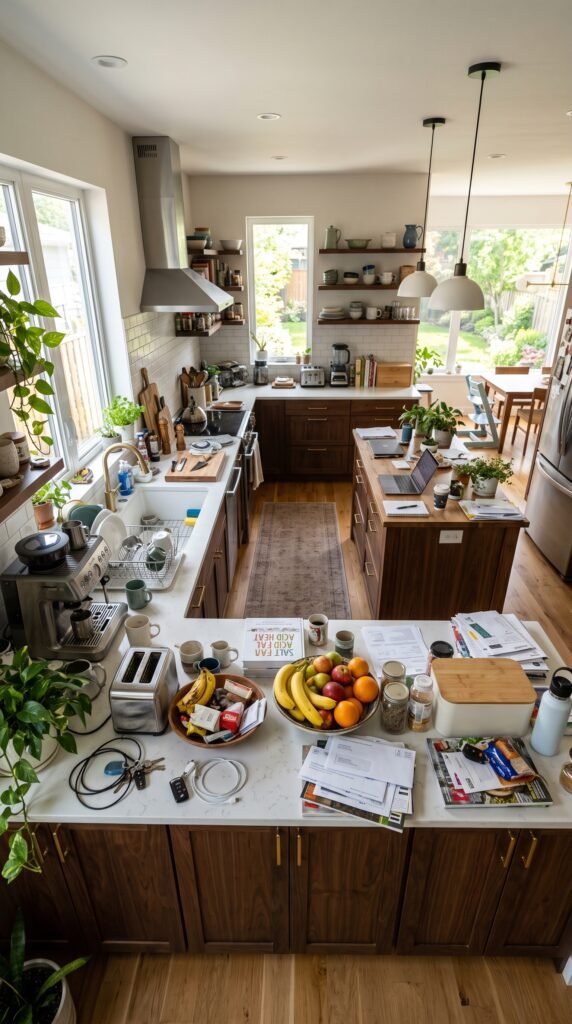
Picture this: someone tears out their old kitchen, installs a massive island, doubles their counter footage, and within six months it’s completely buried. Piles of mail. Random gadgets. A bread maker that’s been “about to be used” since last Thanksgiving.
More surface area doesn’t solve the problem. It just gives the problem more room to grow.
The truth is, counter space functions like a gas — it expands to fill whatever container you give it. The real issue isn’t the amount of space you have. It’s the absence of a system that defines what belongs there and what doesn’t.
Counters need rules, not square footage.
And honestly, some of the most functional kitchen setups are in small apartments with barely 8 feet of counter total. The constraint forces intentionality. Every inch is accounted for. Nothing lands there without a reason.
So before you start dreaming about a bigger kitchen, ask yourself: have you actually optimized what you already have?
The Zones Mistake: Why Your Kitchen Counter Workflow Is Broken
Here’s something kitchen designers know that most homeowners don’t: countertops are supposed to have zones, and those zones should follow the logic of how you actually cook.
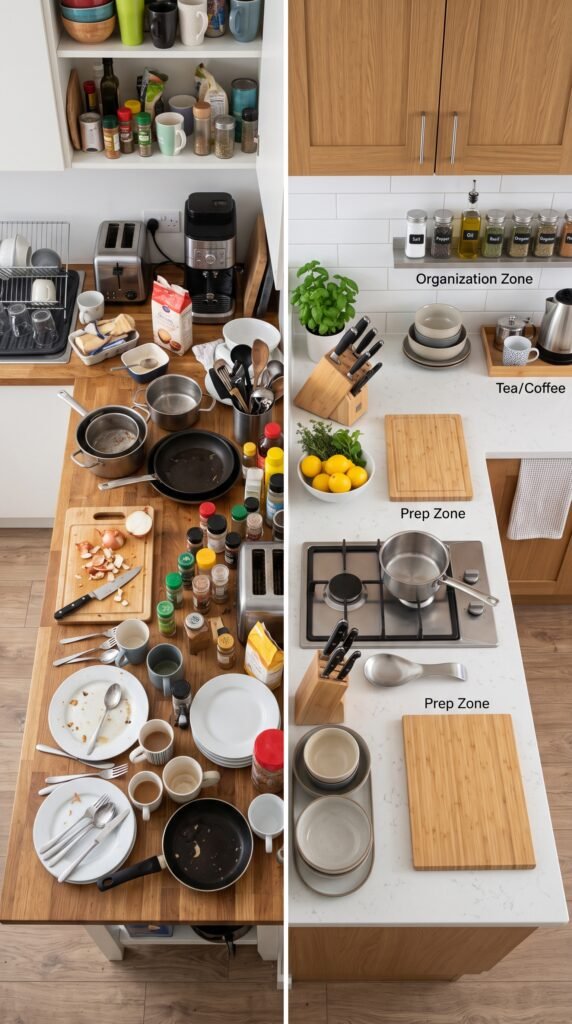
Most people treat their entire counter as one big flat surface. Everything goes everywhere. The coffee maker lives next to the cutting board, which is next to the toaster, which is somehow always in the way of the mixer you need twice a year.
That’s not a kitchen. That’s a storage unit with a sink.
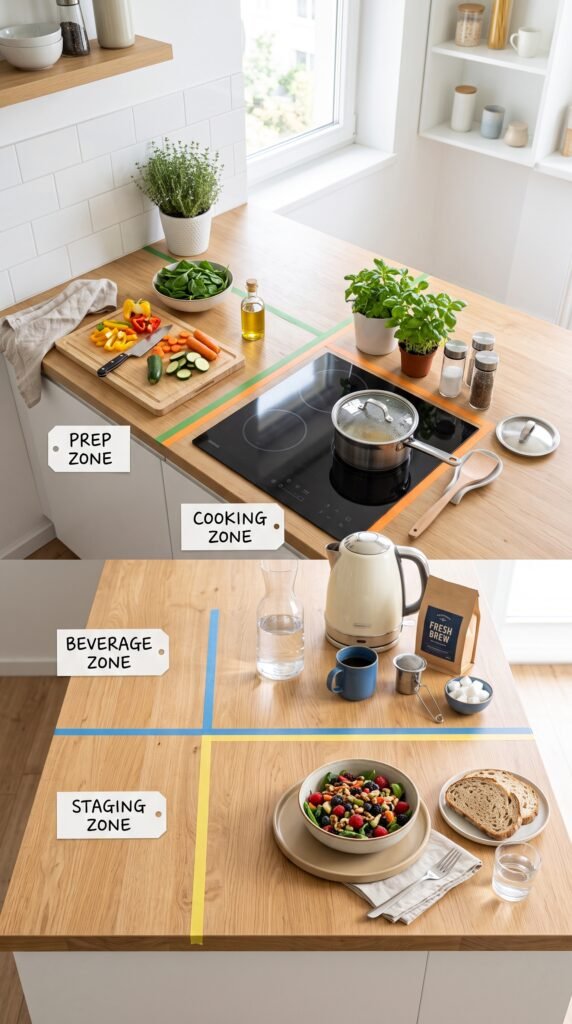
Real kitchen counter organization works in zones: a prep zone, a cooking zone, a coffee and beverage station, and a staging area for things going in or out of the house. Each zone has a defined purpose, and things that don’t serve that purpose don’t belong there.
The prep zone should be adjacent to your refrigerator, because that’s where ingredients enter the workflow. The cooking zone lives close to the stove. The beverage station can anchor a corner or an end of the run, kept separate so someone can make coffee without getting in the way of dinner prep.
Small Kitchen, Big Comfort: Cozy Ideas That Actually Work
When your zones make sense, cooking becomes almost automatic. Your hands know where to go. You stop shuffling things around mid-recipe. And cleanup takes half the time because everything has a home.
Fair warning: setting up zones takes about 30 minutes of moving things around and thinking honestly about how you use your kitchen. But that 30 minutes will save you countless micro-frustrations every single week.
The Appliance Trap: What Actually Belongs on Your Kitchen Counter
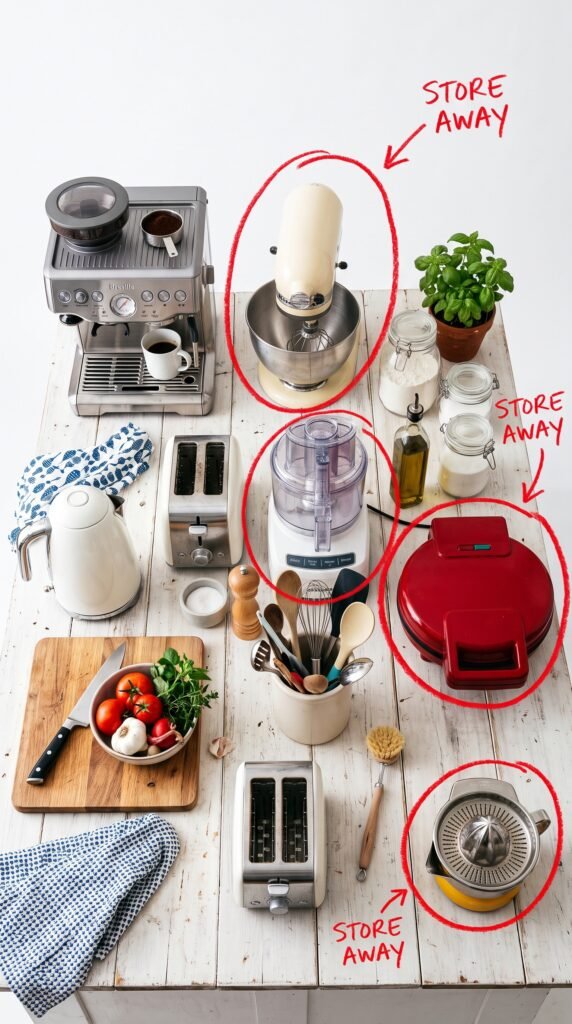
Let’s talk about the elephant in the room. Or rather, the stand mixer, the air fryer, the instant pot, the toaster oven, and the blender that are all taking up permanent residence on your kitchen counter right now.
Not all appliances deserve counter real estate.
This is where most people get it wrong. They assume that if something is used regularly, it belongs on the counter. But “regularly” is doing a lot of work in that sentence. If you use something three times a week, yes, the counter makes sense. If you use it three times a year, that thing needs to live in a cabinet.
The honest test is this: does it need to be plugged in constantly, or can it live 30 seconds away in a lower cabinet and still be totally accessible?
Most people who do this audit are surprised. The stand mixer stays. The toaster stays. The coffee maker obviously stays. But the blender that gets used for smoothies twice a month? The panini press that comes out for football Sundays? Those can go.
According to the National Kitchen and Bath Association, the average kitchen counter has less than 11 feet of usable workspace. When you factor in what’s permanently occupying that space, most people are working with 3 to 5 feet of actual prep area. That’s tight.
Best Outdoor Kitchen Designs for Every Budget & Backyard Size
Clearing even one or two appliances off the surface fundamentally changes how your kitchen feels. It’s not just visual. It changes how you move through the space.
The Clutter Magnet Problem: Why Flat Surfaces Attract Chaos
Here’s a behavioral fact that interior designers and professional organizers know well: any flat, accessible surface in your home will collect clutter within 48 to 72 hours of being cleared.
Your kitchen counter is ground zero for this phenomenon.
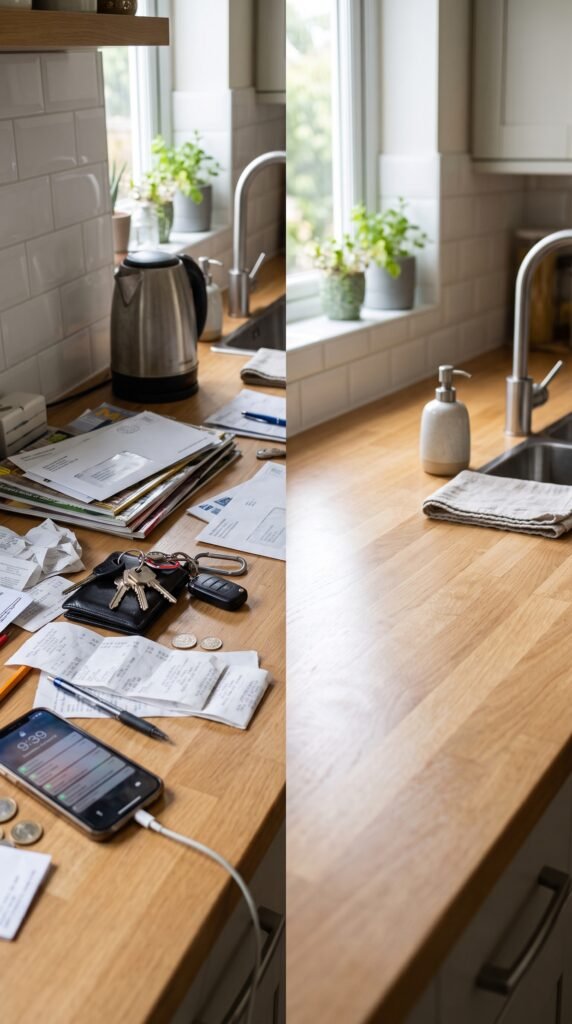
Mail, keys, receipts, random screws, lip balm, a phone charger, school permission slips — it all ends up there because it doesn’t have anywhere else to go. And once a few items land, more follow. It’s almost magnetic.
The solution isn’t to organize the clutter better. It’s to interrupt the pattern.
One method that actually works: place a small tray or basket near the entry point of your kitchen and designate it as the “landing zone” for non-kitchen items. Keys, mail, and everyday carry stuff goes there, not directly on the counter. Then, at a set time each day (morning coffee is a good anchor), you clear it out.
This gives the clutter a home without giving it your prep space.
It also helps to address the root causes. If the mail always piles up, you need a mail sorting system, not just a cleaner counter. If your kids drop backpacks and papers there every afternoon, they need a designated drop zone somewhere else in the house.
According to research published on Psychology Today, cluttered environments raise cortisol levels and interfere with focus and productivity. Your kitchen counter isn’t just affecting your cooking. It’s affecting your mood.
Expert Tips for Kitchen Counter Organization That Actually Sticks
Alright. You know the mistakes. Now here’s what actually works long-term.
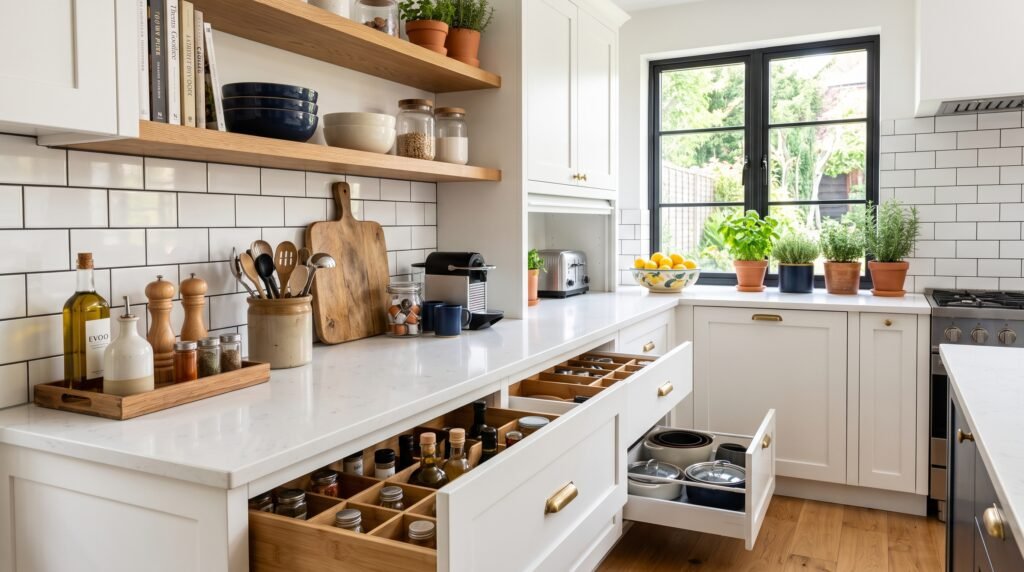
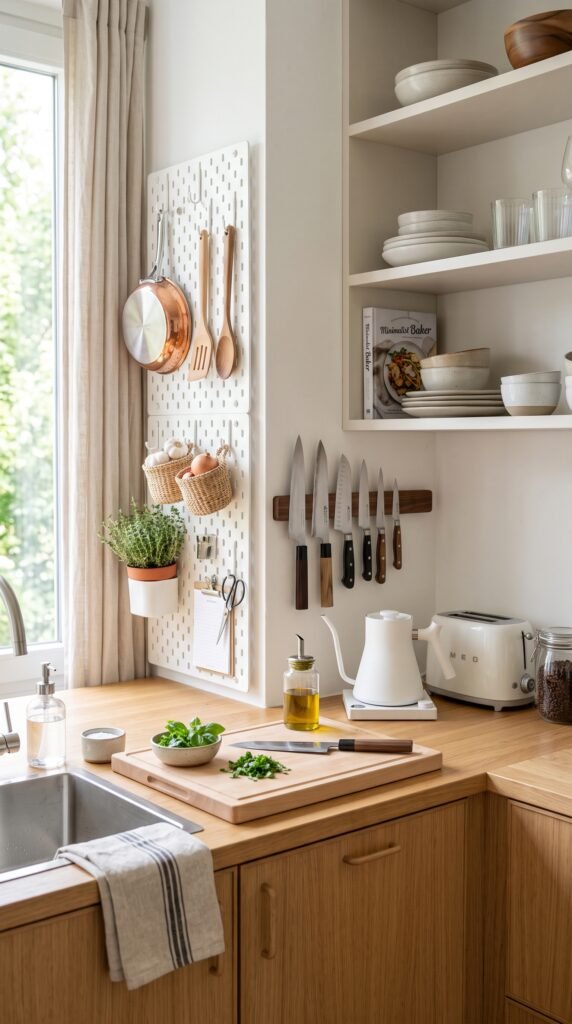
Use vertical space aggressively. Pegboards, magnetic knife strips, wall-mounted spice racks, and small floating shelves take storage off the counter and put it on the wall. This is a game changer in small kitchens. A magnetic knife strip alone can free up a full square foot of counter space.
Audit your counter every Sunday. Takes about five minutes. Walk through, remove anything that doesn’t belong, wipe it down. It resets the baseline and stops clutter from compounding.
Apply the “one in, one out” rule to appliances. Every time something new comes into the kitchen, something else has to leave. This keeps the slow creep from happening.
Store things at the point of use. Coffee stuff near the coffee maker. Cutting boards near the prep zone. Cooking oils near the stove. When things live where they’re used, you don’t have to think, and the counter stays clear between uses because nothing is “parked” in the wrong spot.
Make the inside of your cabinets work harder. Pull-out shelves, cabinet door organizers, and stackable risers can double your cabinet capacity, which directly reduces what needs to live on the counter. The Good Housekeeping Institute has covered this extensively, and the consensus is consistent: most people are using only about 60% of their cabinet space effectively.
Farmhouse Kitchen Remodel Ideas for a Warm and Cozy Look
Designate a “daily use only” rule for the counter. If it doesn’t get touched today, it doesn’t get counter space today. Some people put a small piece of tape on appliances when they use them. At the end of the week, anything without tape gets reassessed.
That last one sounds obsessive. But it’s also how people who always have clean counters operate. They just don’t admit it openly.
The Mindset Shift That Changes Everything
Organized kitchen counters aren’t the result of having a beautiful kitchen. They’re the result of making consistent small decisions about what deserves to be there.
Most kitchen counter problems aren’t organizational failures. They’re decision-making gaps. When something new enters your kitchen and there’s no system to handle it, it lands on the counter by default. And defaults compound fast.
The kitchens that stay clear share one thing: the people who use them have thought through their defaults. They’ve decided in advance where things go so they don’t have to make that call in the moment, when they’re tired and just want to set something down.
That pre-made decision is the whole game.
Because here’s the reality: a cluttered kitchen counter isn’t a personality flaw. It’s a systems problem. And systems can be fixed. The mistakes in this article are incredibly common because nobody teaches you this stuff. You inherit whatever habits the kitchen you grew up in modeled, and then you repeat them until something changes.
Consider this the something.
Start with one zone. Clear one appliance that doesn’t pull its weight. Put one landing basket near the entry point of your kitchen this week. Those three moves alone will shift how your kitchen counter functions, and you’ll feel it every single day.
Small changes. Big difference. That’s how this works.