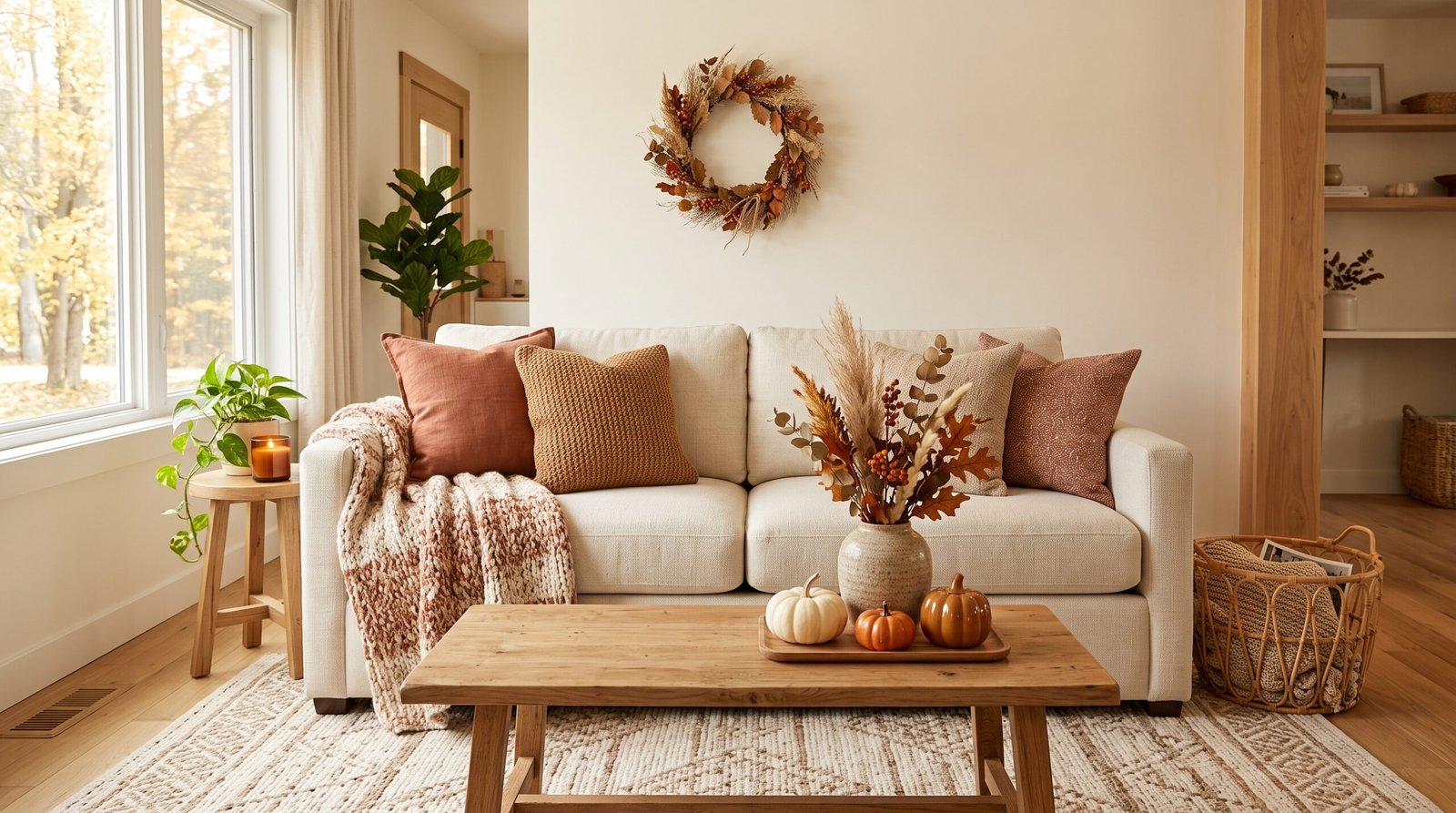
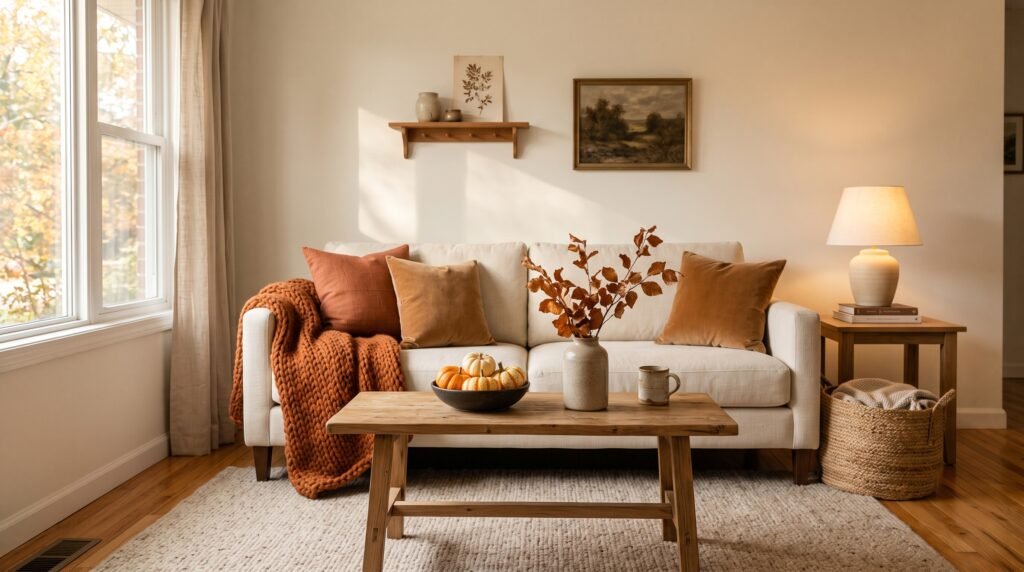
Fall living room decor does not need a design degree, a large budget or a whole new set of furniture. In most rooms, three changes make the difference: warmer texture on the sofa, one clear autumn color used in more than one place, and softer light in the evening. This guide works through those three in order, with the sizes, steps and checks a beginner actually needs — and with nothing to buy before you have used what you already own.
Start with the sofa, then the coffee table, then the walls. Allow about an hour, and stop after each step to stand at the doorway and look back. If a change does not make the room warmer or easier to use, undo it. You will find a beginner checklist at the end, plus answers to the questions beginners ask most often.
📋 Table of Contents
- The Biggest Myths About Fall Living Room Decor (That Are Holding You Back)
- The Real Facts Behind Seasonal Decorating That Experts Know
- Expert Tips for Fall Living Room Decor That Actually Work
- Start With Your Sofa, Not Your Coffee Table
- Use Natural Elements as a Foundation
- Work With What You Already Own
- The “One Swap” Method for Beginners
- How to Build a Fall Color Scheme Without Starting from Scratch
- Anchor Colors vs. Accent Colors
- Don’t Ignore Your Walls
- Common Beginner Mistakes to Avoid in Fall Living Room Decor
- A Beginner Checklist, Before You Start
- Frequently Asked Questions
The Biggest Myths About Fall Living Room Decor (That Are Holding You Back)
Before you buy or move anything, it helps to drop three ideas that lead beginners astray. Each one below is followed by what to do instead.
Myth 1: You need to buy new things every year.
You do not. Autumn colors repeat every year, and the pieces that make a room feel autumnal are mostly the pieces you already own in a warmer color: a throw, cushion covers, a basket, a wooden tray. The one exception is anything that has worn out — a sagging cushion or a stained throw will look worse in autumn light, not better. Replace worn items first; add new decoration only after that.
A practical test: put every autumn item you already own in one pile before you shop. If the pile already contains a warm throw, two or three cushion covers and something natural, such as a vase of dried stems, you probably need no new autumn decoration at all — you need to arrange what you have.
Myth 2: Fall colors mean orange. Always orange.
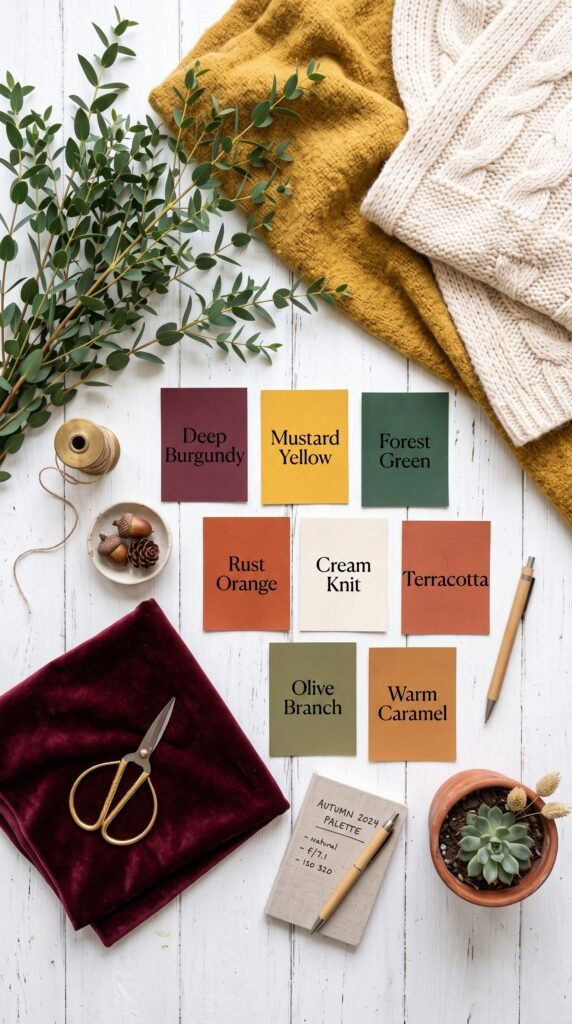
Orange is only one autumn color. The season also gives you rust, mustard, olive, deep green, warm brown, cream and burgundy. Pick one main color from that list and use it in at least three places — for example, a rust throw, a rust cushion and a rust candle — and the room will read as autumnal without a single pumpkin. If your sofa is gray or cream, almost any of these will work; if it is brown, choose rust or mustard rather than another brown, so the color still shows.
Myth 3: More is more.
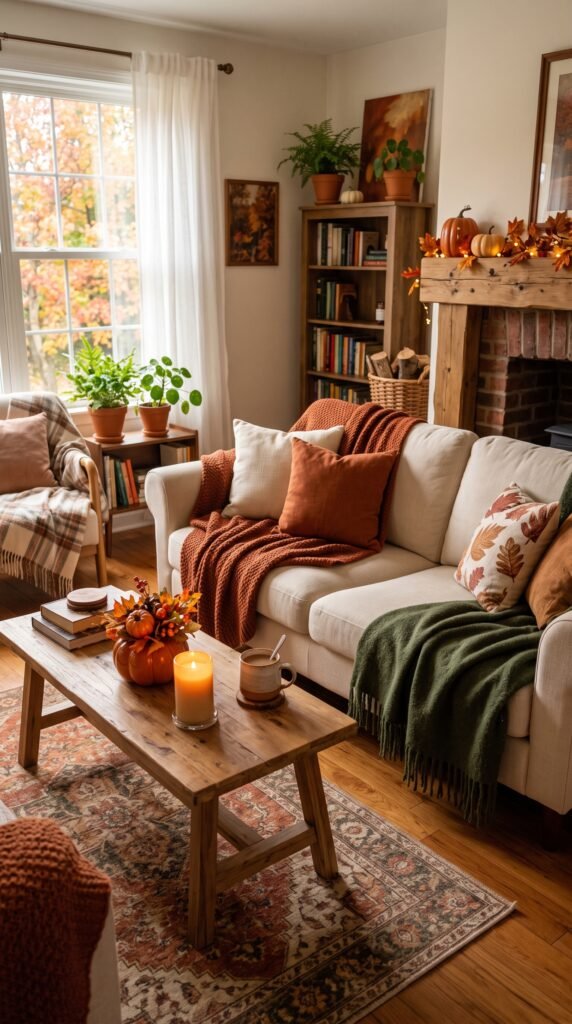
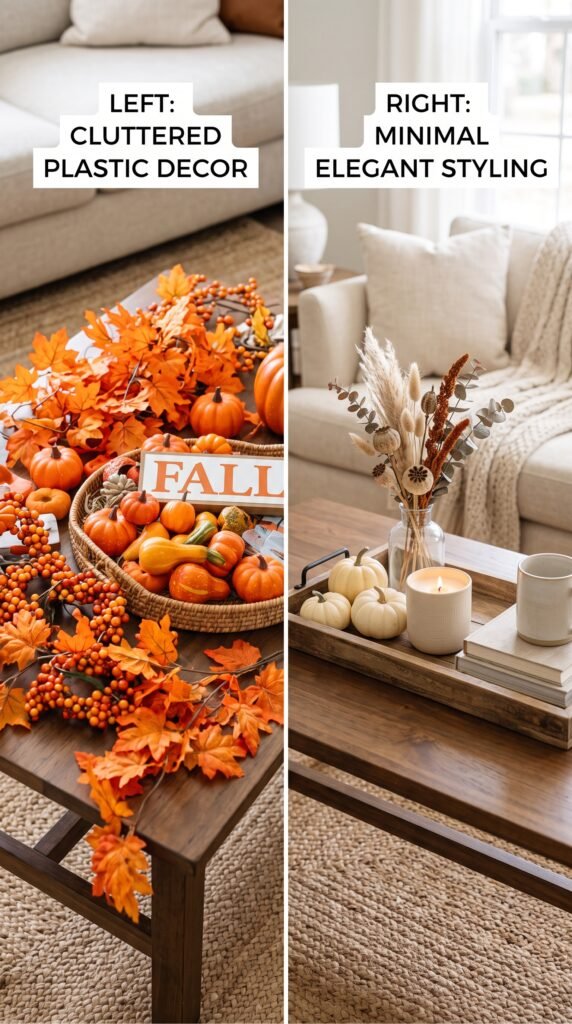
Overcrowding a room does not make it feel festive; it makes it harder to use. Count the autumn items on each surface. A coffee table needs three at most — a tray, a candle and one seasonal object, such as a small gourd. A mantel or shelf needs three things at different heights. If you cannot set a cup down on the coffee table, or you have to move decoration to sit down, take something away before you add anything else.
The Real Facts Behind Seasonal Decorating That Experts Know
So what actually makes fall living room decor work? Three things, in this order: texture, light and a restrained group of objects. Color alone will not do it.
Texture does more work than color
When a room feels autumnal, it is usually because the surfaces feel different from summer: a knitted or woven throw instead of a smooth one, a velvet or corduroy cushion cover, a wooden tray, a woven basket. Aim for at least three textures in the seating area — for example, knit, velvet and wood. If everything on the sofa is the same smooth cotton, adding a color will not make it feel like autumn; changing one cushion to a heavier texture will.
Start with the pieces you touch most: the throw you sit under and the cushion you lean on. Those two set the feel of the room. A candle, a pumpkin or a wreath is decoration on top of that; it cannot rescue a sofa that still feels like summer.
Lighting is the secret weapon nobody talks about.
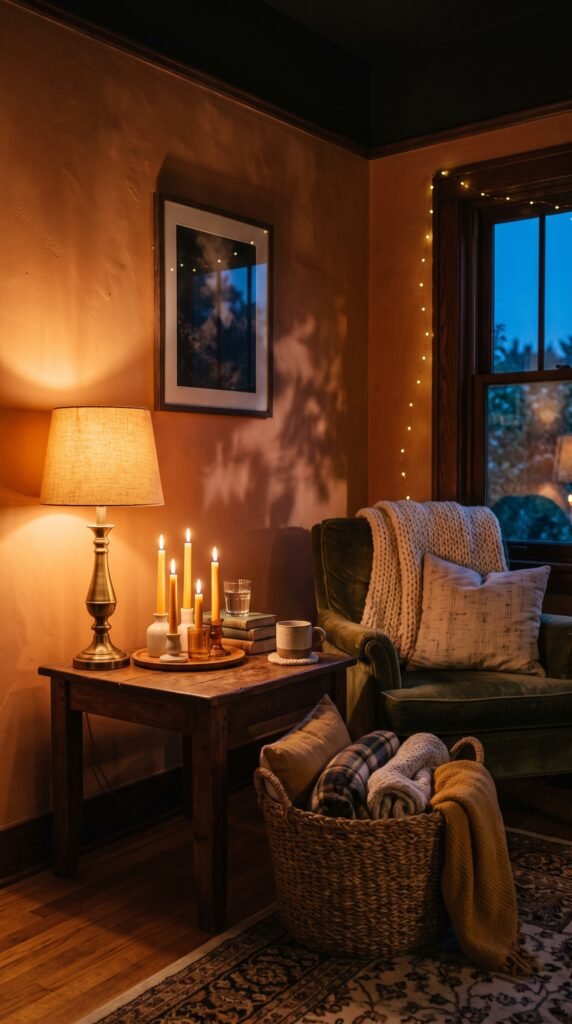
Fall living room decor lives and dies by light. Overhead lighting alone makes even a carefully styled room look flat, so switch to warm lamps at seating height in the evening. Look for warm-white bulbs marked 2700K on the box — that color temperature gives the soft, amber glow most people associate with autumn evenings, and it works in table lamps, floor lamps and wall lights alike. Use one to three light sources at different heights: a table lamp beside the sofa, a floor lamp in a dark corner, and a candle on the coffee table. Turn the ceiling light down or off and let those three do the work.
Layering follows a rule of three.
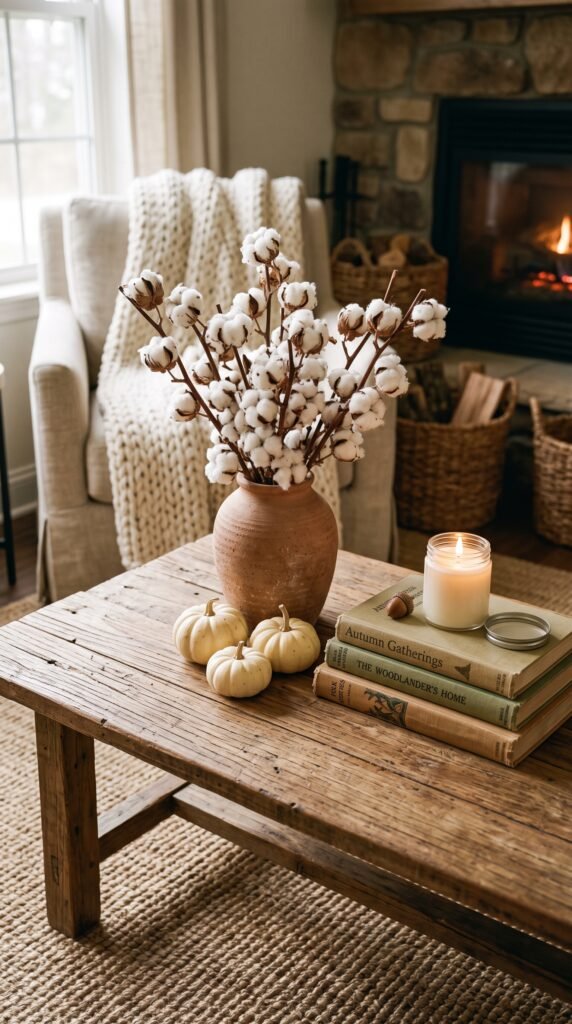
Every well-styled surface in a fall room follows some version of the rule of three: vary height, vary texture, vary shape, with three objects as the base — not one, not ten. On a coffee table, try a low wooden tray, a medium candle in a glass holder and a taller vase of dried stems. Leave at least a third of the table empty, so you can still set a cup down. If a surface looks crowded, remove the smallest object first; if it looks bare, add height, not another small object. If you need a few low-cost pieces to start with, the guide linked below lists affordable options.
10 Affordable Finds That Transform Cozy Living Room Decor
Expert Tips for Fall Living Room Decor That Actually Work
The method below is in the order to do it. Do step one properly before you move on — most beginners who are disappointed skipped the sofa and went straight to small decoration.
Start With Your Sofa, Not Your Coffee Table
Most beginners go straight for the coffee table, because it is in the middle of the room. Start with the sofa instead: it is the largest piece of furniture, so it sets the color and texture for everything else. Change the sofa first and the rest of the room follows; change only the coffee table and the sofa will still look like summer.
Put two or three cushions on a two-seater sofa, and three or four on a three-seater. Use 45 × 45 cm (18 in) covers for a standard sofa, and 50 × 50 cm (20 in) covers if the sofa is deep or the cushions are large — a cover that is too small will look lost, and one that is too large will sag. Mix one plain cover, one with texture (velvet, corduroy or knit) and, if you want a third, one with a simple pattern. Then add a throw: a standard throw is about 130 × 170 cm (50 × 60 in). Fold it in three lengthways, drape it over one arm or across the back, and let one end hang to seat level. Do not spread it flat over the whole sofa — a folded throw reads as intentional, a flat one reads as a cover-up.
Use Natural Elements as a Foundation
Dried pampas grass, eucalyptus stems, cotton stems, pinecones, acorns, small gourds and branches work well indoors because they are dry, light and long-lasting, and they do not need water. Put tall stems in a floor vase in an empty corner, and keep smaller items — pinecones, acorns, a small gourd — on a tray, where they can be lifted off in one move when you need the table. Check pinecones and branches for insects before you bring them in, and keep dried stems away from candles and lamps: they are flammable, so give them at least 30 cm (12 in) of clear space from any flame.
If you are using fresh leaves or cut branches, expect them to wilt within a few days indoors. Dried stems last the season, which is why they are a better starting point for a beginner. A single tall vase with three to five stems is enough for most living rooms; a second vase on the mantel is optional, not required.
Work With What You Already Own
Before buying a single thing, pull every blanket, cushion, candle, basket and vase out of your home and put them on the dining table. Sort them into three piles: autumn colors, neutral colors that work with autumn (cream, gray, brown, wood) and colors that clash with it (bright summer blues and pinks). Keep the first two piles; put the third pile away until spring. Most beginners find they already own at least half of what they need.
This step feels tedious, and people who skip it end up buying duplicates of things they already own in a drawer. Allow 15 minutes for it, and write down what is missing before you shop — a list with two or three items on it will stop impulse buying. If the missing item is a cushion cover, buy the cover, not a whole new cushion: covers cost less, store flat in summer and let you change color without changing the sofa.
The “One Swap” Method for Beginners
If a full restyle feels like too much, use the one-swap method: change one thing in each zone of the room, and stop there. The five swaps are: (1) one cushion cover on the sofa, in your autumn color; (2) a throw over the armchair or sofa arm; (3) a candle on the side table, in a glass holder so it is safe; (4) a natural element on the coffee table — a small gourd, a vase of dried stems or a bowl of pinecones; and (5) one piece of wall decoration, such as a wreath, a framed autumn print or a mirror with a warm-toned frame.
That is five swaps, in about 30 minutes, with no furniture moved and no painting. Do them in that order — sofa, chair, table, coffee table, wall — and step back after the third swap. If the room already feels warmer, you can stop; the last two swaps are finishing touches, not requirements. Buying a new cushion cover is the swap most beginners notice most, so start there if you buy only one thing.
How to Build a Fall Color Scheme Without Starting from Scratch
Color intimidates beginners because there are too many choices. Narrow it to one palette, below, and use the 60-30-10 guide as a check: about 60% of the room stays neutral (walls, sofa, rug), about 30% is your main autumn color (throw, cushions, curtains) and about 10% is an accent color (candles, a vase, a book). You do not need to measure this — if one color is everywhere and another appears only once, rebalance.
Anchor Colors vs. Accent Colors
Pick one anchor color for the large pieces — the throw and the cushion covers — and one accent color for small pieces. Three palettes that work in most living rooms are: (1) rust anchor with cream and warm wood; (2) olive anchor with cream and mustard accent; and (3) mustard anchor with deep green and cream. If your sofa is gray, rust or mustard will show best; if your sofa is cream, olive or burgundy will show best; if your sofa is brown, use a lighter anchor, such as mustard or cream, so the autumn pieces do not disappear into it.
That combination is warm, seasonal, sophisticated, and completely achievable without buying a single new piece of furniture — you are only changing covers, a throw and a few small objects, not the room itself. If you already own a throw in one of these colors, start from that throw and choose cushion covers to match it, rather than starting from a color chart.
Don’t Ignore Your Walls
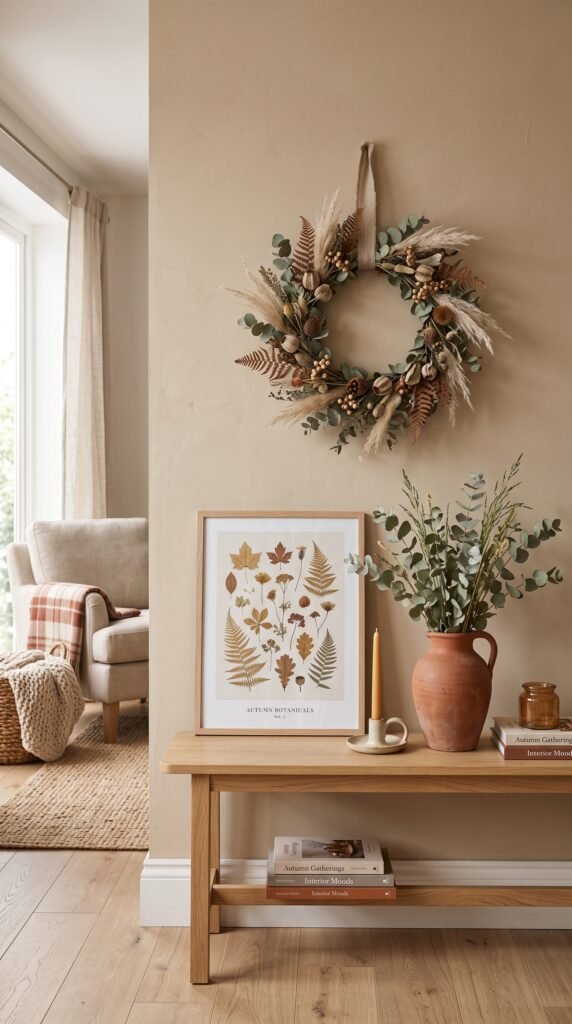
Most people decorate horizontally, across surfaces. But vertical space matters too. A simple wreath hangs above the sofa, a shelf holds a dried arrangement, or one framed autumn print replaces a bare wall. Choose one wall to work on — usually the wall above the sofa — and leave the others alone. A wreath about 60 cm (24 in) across suits most sofas; smaller wreaths look lost above a three-seater, and a wreath wider than two-thirds of the sofa looks out of proportion.
Hang a framed print or wreath so its center is about 145 cm (57 in) from the floor — roughly eye level for a standing adult — and leave 15–20 cm (6–8 in) between the bottom of the frame and the top of the sofa. That gap is the most common beginner error: hang it too high and it looks disconnected from the sofa; hang it too low and it crowds the cushions. Use a proper picture hook, check it with a level, and step back to the doorway before you fix it in place.
Common Beginner Mistakes to Avoid in Fall Living Room Decor
You are going to make at least one of these mistakes. That is fine — knowing about them ahead of time means you can fix them in minutes, rather than living with a room that feels wrong all season.
Buying everything in the same place. If all your fall decor comes from one store, it will look like a display set. Mix sources: a farmers’ market or garden center for natural elements, a charity shop for baskets and trays, and a homeware shop for one or two anchor pieces, such as a throw or cushion covers. Variety of origin creates variety of texture and character — and it usually costs less.
Using plastic or artificial items in prominent spots. Fake leaves on a coffee table, plastic pumpkins in the middle of the room, or artificial berry branches in a clear vase all read as cheap immediately, even when the rest of the room is thoughtfully styled. Push artificial elements to the background, or skip them in key spots. If you use them, choose matte finishes and put them where they are seen from a distance, not handled up close.
Forgetting scent. A room can look perfectly autumnal and still not feel it if it smells of nothing, or worse, of the cleaning product you used that morning. One candle in cinnamon, cedar, amber or apple does what visual styling alone cannot. Burn it for an hour before guests arrive, not all day, and never leave a lit candle unattended or near dried stems, curtains or a throw.
That scent rule is also a safety rule: trim the wick to about 6 mm (¼ in) before lighting, and place the candle in a glass holder on a tray, not directly on wood.
Keeping everything out too long. Fall decor that is still up in December looks like you forgot to take it down. A good rule is to put it up in the same week you first want a warm light in the evening, and take it down when you start thinking about winter or Christmas decoration — for most households, that is late November. Remove it in the same order you put it up, one zone at a time, and store cushion covers flat and dried stems upright so they are usable next year.
A Beginner Checklist, Before You Start
Here is the whole method in five lines. Work through it in order, and stop when the room feels warmer — you do not need to finish the list in one day.
1. Sort what you already own into autumn, neutral and put-away piles. 2. Change the sofa first: cushion covers in one autumn color, plus a folded throw. 3. Add one to three warm light sources at seating height, and turn the ceiling light down. 4. Style one surface — the coffee table — with three objects at different heights, leaving a third of it empty. 5. Hang one thing on the wall above the sofa, centered about 145 cm (57 in) from the floor.
That is fall living room decor for a beginner. It is not about having the right stuff, and it is not about getting every piece perfect on the first try. Start with your sofa, add texture, light a candle, bring in one natural element, and step back and see what changed. If a step did not help, undo it — a room that is easy to sit in beats a room that photographs well.
If your room is small, the same steps apply, with one change: use fewer objects, not smaller ones. One cushion, one throw and one light source will do more in a small room than five small decorations spread around it. Keep at least a third of every surface clear — in a small room, clear space is part of the decoration.
Frequently Asked Questions
How much should I spend on fall living room decor as a beginner?
Start with what you already own — most beginners need no new spending at all. If you buy one thing, make it cushion covers in your autumn color: covers cost less than new cushions, store flat, and change the look of the sofa more than any small decoration.
What fall colors work best in a living room?
Rust, mustard, olive, deep green, warm brown, cream and burgundy. Pick one as your main color and use it in at least three places, with a second color as a small accent. If your sofa is gray, rust or mustard shows best; if it is cream, olive or burgundy shows best.
When should I put fall decor up, and when should I take it down?
Put it up when you first want warm light in the evening, and take it down when you start thinking about winter decoration — for most households, that is late November. Dried stems and cushion covers can be stored and reused next year; fresh leaves and pumpkins cannot.
How do I decorate a small living room for fall without clutter?
Use fewer objects, not smaller ones: one cushion, one throw and one warm light source. Keep at least a third of every surface clear, and choose one wall only. In a small room, clear space is part of the decoration.