Small Closet Organization Hacks That Actually Work
If you’ve been searching for small closet organization hacks that deliver real results, you’re in the right place — because most of the advice floating around online is either too expensive, too complicated, or simply doesn’t survive contact with real life.
Table of Contents
The Myths About Small Closet Organization Hacks You Need to Stop Believing
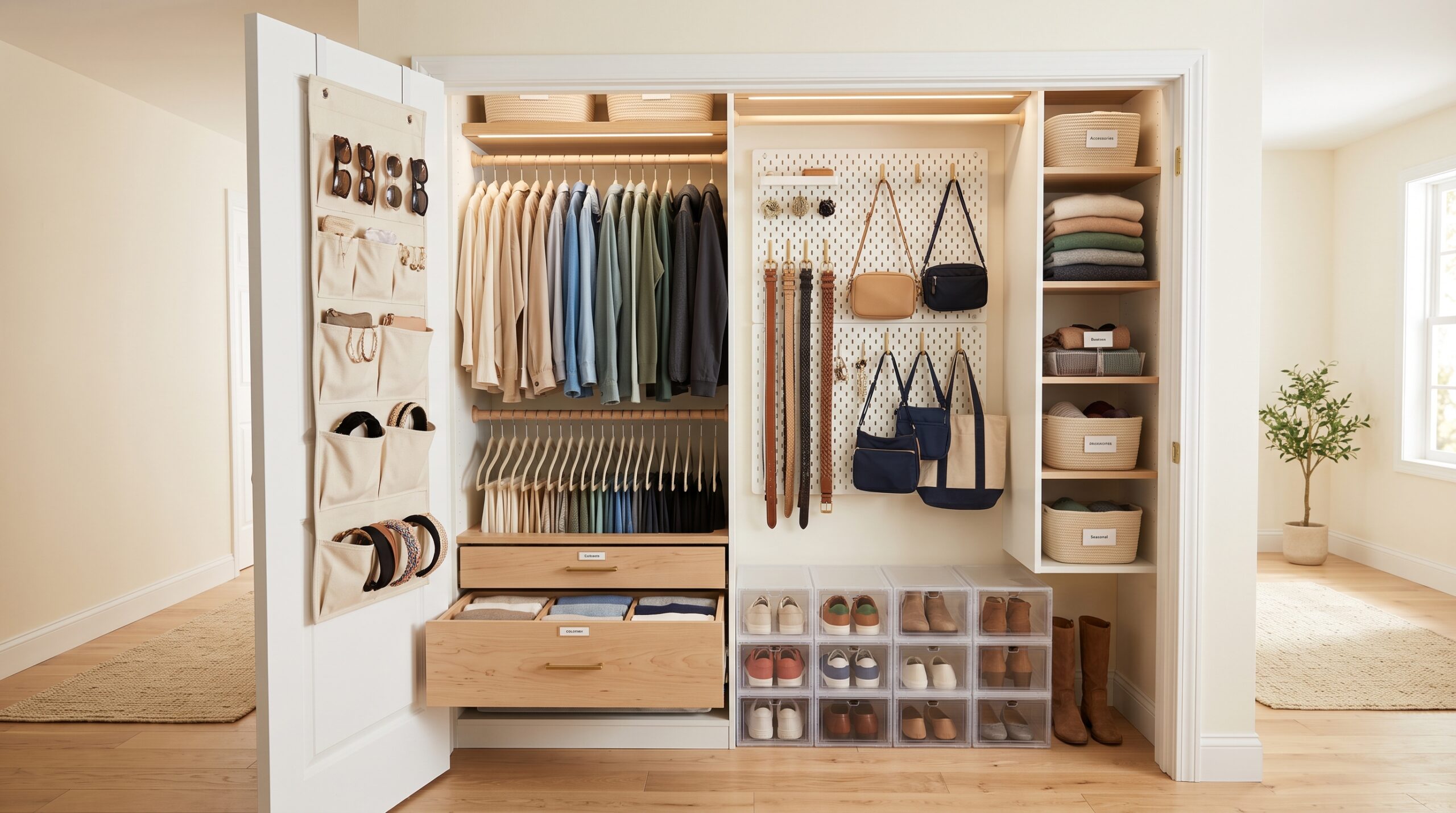
Here’s the uncomfortable truth: the closet organization industry is built on making you feel like your space is the problem. You’ve probably seen those spotless, magazine-worthy closets with custom built-ins, matching velvet hangers in every shade, and a dedicated drawer just for sunglasses. They look incredible. They also cost thousands of dollars and belong to people with professional stylists.
The first myth is that a small closet can only be functional if you invest in a custom shelving system. That’s simply not true. Plenty of well-organized small closets rely on nothing more than a $20 tension rod and some creativity. The second myth is that you need to purge everything down to a capsule wardrobe before organization can work. Editing your wardrobe helps, but it’s not a prerequisite — the right systems can handle a full closet without stripping your life down to ten neutral basics.
The third myth, and perhaps the most damaging, is that “small” is a permanent limitation. Small closet organization hacks work precisely because they treat vertical space, door backs, and floor corners as untapped real estate. Your closet isn’t too small — it’s just not yet optimized.
Why Most Small Closets Fail
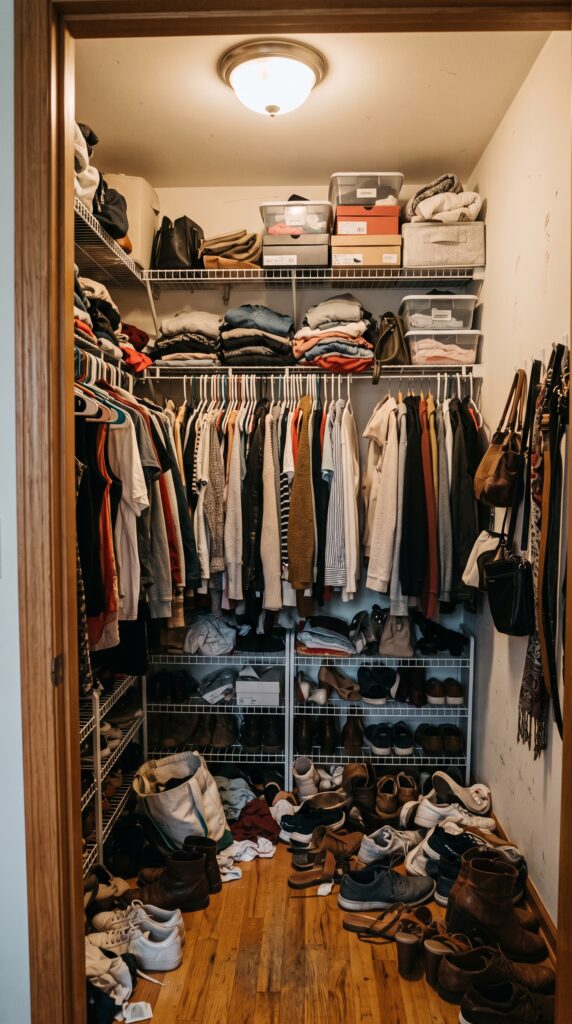
Before jumping into solutions, it helps to understand exactly what goes wrong. Most small closets fail for one of three structural reasons, and none of them are your fault.
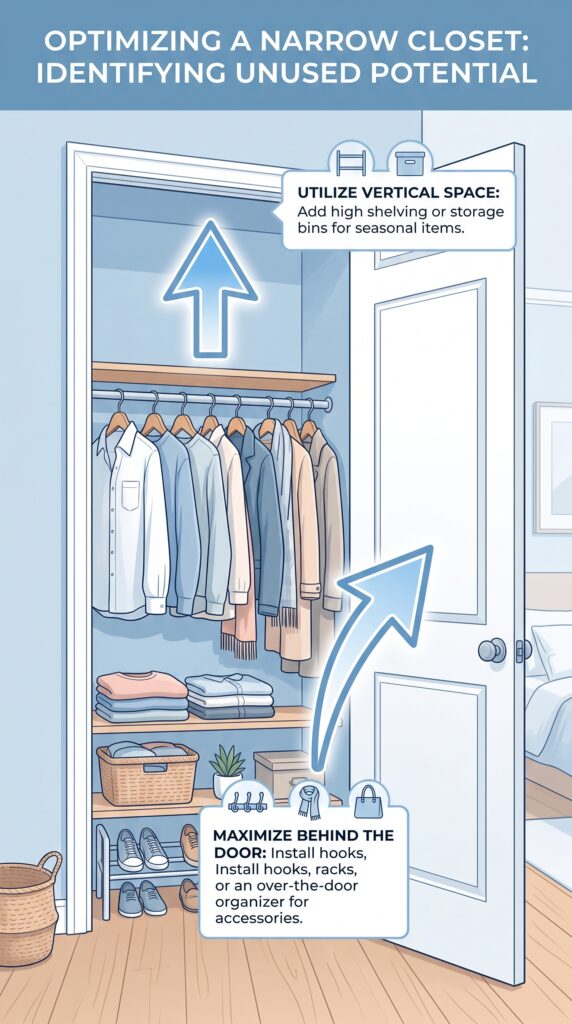
Dead vertical space. The average closet rod sits somewhere between five and six feet off the ground, leaving anywhere from one to two feet of empty space above it. Multiply that by the width of your closet and you’re looking at several cubic feet of storage you’re not using. That space above the rod is where a shelf, extra hooks or a second rod belong.
Single-tier hanging. Most standard closets come with one rod running the full length of the space. That single tier makes sense for long dresses and coats, but for shirts, jackets, and folded pants, it wastes the bottom half of the closet completely. Double-hanging rods can immediately double your hanging capacity without adding a single inch to your closet’s footprint.
Door blindness. The back of your closet door is one of the most consistently wasted surfaces in a home. A standard interior door has enough surface area to hold shoes, accessories, cleaning supplies, or folded items — all invisible when the door is open, all completely accessible the moment you reach for the handle.
If the bedroom around the closet is part of the problem, these tiny bedroom ideas that maximize space and style show how to make the whole room work harder.
Understanding these failure points is what separates surface-level tidying from small closet organization hacks that actually stick.
Expert Tips: Small Closet Organization Hacks That Actually Deliver
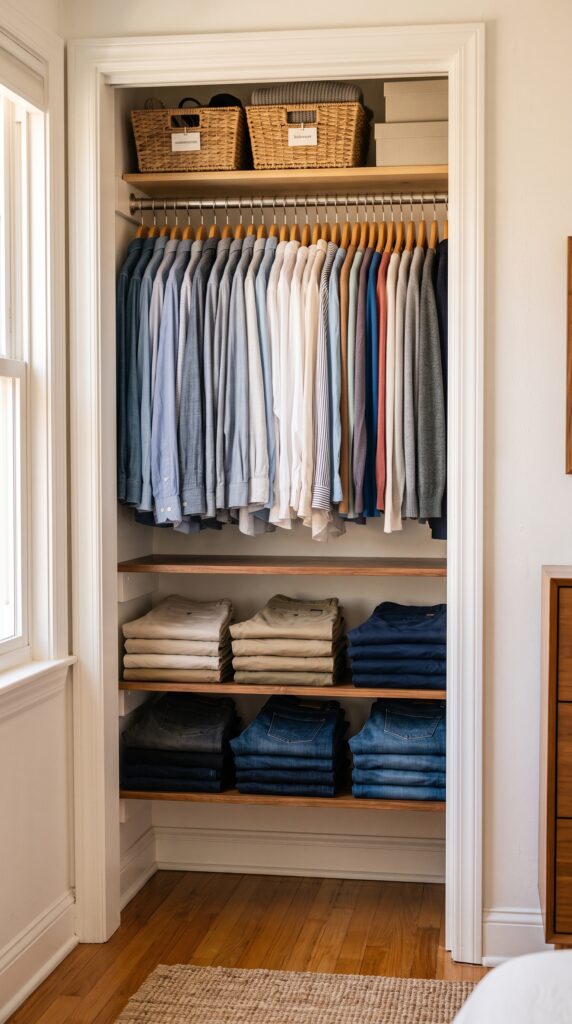
Now for the part you came here for. These are the fixes that make the biggest difference in a small closet. Each one is cheap, easy to undo if it doesn’t suit you, and aimed at making the closet work for you every day — not just look tidy for a photo.
1. Add a Second Rod to Double Your Hanging Space
The single most impactful thing you can do in any small closet is add a second hanging rod below your existing one. A simple expandable closet rod — the kind that hangs from your upper rod via two short chains — is inexpensive and installs in minutes with no tools. Use the top rod for tops, blouses, and jackets, and the lower rod for folded pants or shorter items. This one small closet organization hack alone can effectively double your usable hanging space.
If your closet has a section already dedicated to long items like dresses or coats, keep that section single-tier and double up everything else. The goal is to match your rod configuration to what you actually own.
2. Use the Back of the Door
An over-the-door organizer is one of those small closet organization hacks that sounds obvious but gets ignored far too often. A standard over-the-door shoe organizer doesn’t just hold shoes — it can store folded scarves, rolled belts, small bags, cleaning supplies, or even snacks if you’re working with a linen closet.
For a more polished look, over-the-door hooks are sleek and low-profile. Hang tomorrow’s outfit the night before, keep your most-used bags accessible, or use them for robes and frequently worn jackets. If you want more ideas for small spaces, The Spruce’s closet organization tips are a solid next read.
3. Add Shelf Risers and Stackable Bins
If your closet has a single fixed shelf above the rod, a shelf riser adds a second level, so the same shelf holds folded clothes in two layers instead of one. Place bulky items like sweaters or extra linens on the lower level and use the riser level for things you reach for less often — seasonal items, spare bedding, or rarely used accessories.
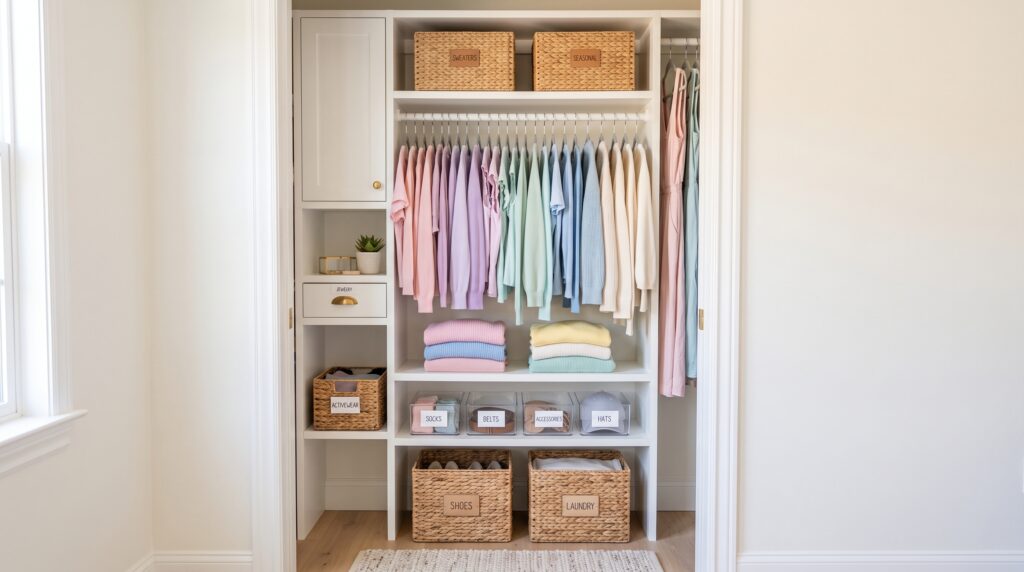
Stackable clear bins are another small closet organization hack that earns its keep. Clear bins let you see what’s inside without pulling everything out, which means you actually use the items you store rather than forgetting they exist. Label each bin and stack them along the floor, on shelves, or in corners to make use of every cubic inch.
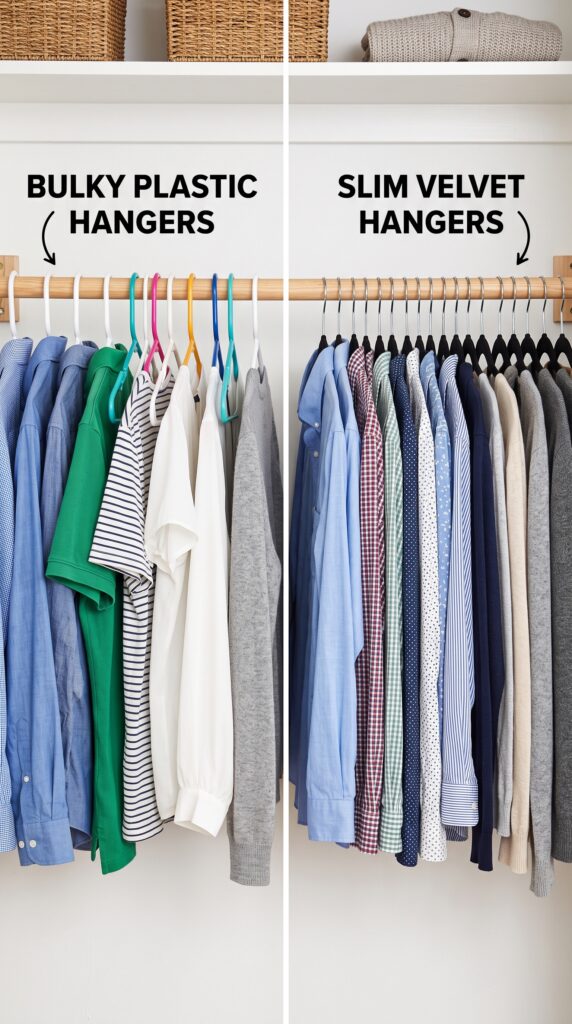
4. Switch to Slim Velvet Hangers
Standard plastic or wire hangers take up more rod space than slim velvet alternatives. Switching your entire closet to velvet hangers is one of those small closet organization hacks that feels almost too simple to mention, yet it visibly frees up rod space, because each hanger is so much thinner than a standard one. In a tight closet, that breathing room is the difference between cramming and being able to see what you own.
Velvet hangers also keep clothes from slipping, which means fewer items end up on the floor and more stay exactly where you put them.
5. Categorise Ruthlessly, Then Subcategorise
Categorization is the backbone of any lasting small closet organization system. Group all tops together, all bottoms together, all outerwear together. Within each category, organize by color or sleeve length — whichever makes sense for how your brain works.
The reason this matters is retrieval speed. When you can find what you need quickly, you’re less likely to pull everything out in a hurry and undo your organization. Small closet organization hacks only work long-term if the system is intuitive enough to maintain without thinking about it.
6. Use the Floor Space Intentionally
The floor of a small closet is not a dumping zone — or at least, it shouldn’t be. A low shoe rack along the floor keeps footwear organized and visible. A small stackable drawer unit fits neatly below hanging clothes and can hold accessories, gym wear, or anything that doesn’t hang well.
If your closet floor is completely occupied by a laundry hamper, consider moving it outside the closet entirely. Freeing up that floor space can dramatically change how the whole closet feels and functions.
The same thinking works beyond the closet — this small apartment bedroom transformation shows how one room went from cluttered to calm, step by step.
7. Work in the Right Order: Pull Out, Measure, Install, Return
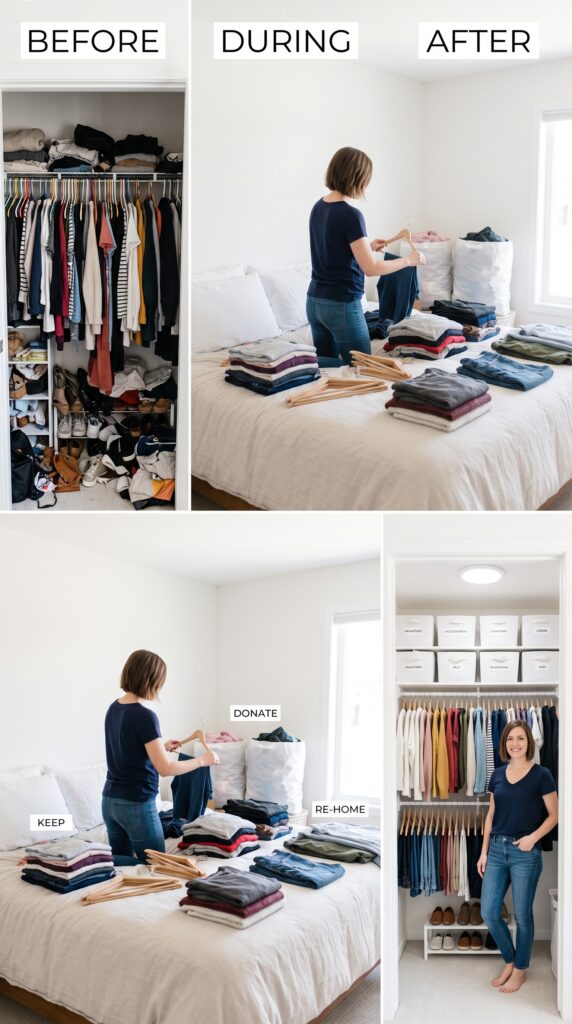
Knowing the hacks is one thing — knowing the order to implement them is another. Do them in the sequence below and you avoid the most common frustration: putting everything back, then realising you need to take it all out again to install a rod.
Start by pulling everything out. Yes, everything. You can’t see what you’re working with until the closet is empty. Sort items into keep, donate, and seasonal storage piles as you go.
Next, assess your space. Measure the height, width, and depth of your closet. Note where the rod sits, where fixed shelves are, and how much door clearance you have. This is when you decide which small closet organization hacks apply to your specific situation.
Then install your hardware. Add your double rod, your over-the-door organizer, your shelf risers. Do this before anything goes back in.
Finally, return items using your category system, switch to slim hangers as you go, and place bins and labels last. Labels matter because they make the system self-correcting — you (and anyone else who uses the closet) always know where things belong.
8. Use the Dead Space Above the Rod
That empty strip above the rod is the easiest extra storage in your closet — the space is already there, you just have to use it. A simple shelf above the rod holds out-of-season clothes or rarely used items, and a couple of hooks on the wall take bags and belts. Nothing else in the closet has to move to make room for it.
9. Keep Only What You Actually Wear
A small closet has no room for maybes. Take out anything you have not worn in the last year and anything that no longer fits, and move it on — donate it, store it elsewhere, or let it go. What stays should be clothes you actually reach for.
10. Do a Weekly Reset
Once a week, put back anything that has drifted out of place: re-hang the clothes on the floor, return the shoes to the rack and check the bins. A small reset stops the closet sliding back into chaos.
11. Fold Knits Instead of Hanging Them
Knitwear stretches on a hanger — shoulders go saggy and jumpers end up on the floor. Fold knits and stack them on a shelf or in a bin instead. Hangers are for shirts, blouses and trousers; the shelf is for anything soft and heavy.
12. Make the Upkeep Effortless
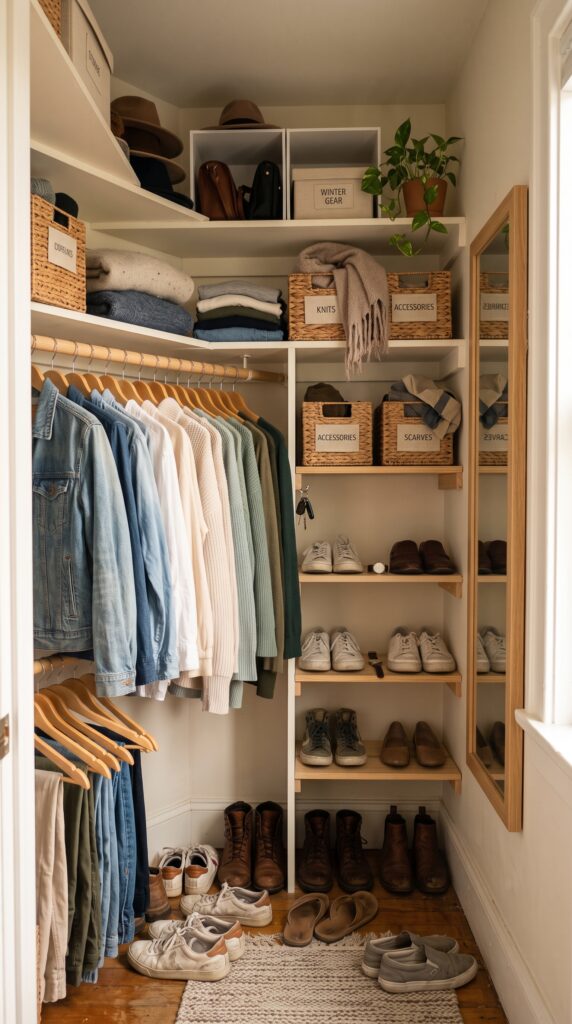
Many organization projects fade because they ask too much of you every day — too many steps, too many rules. The fixes in this guide work the other way around: each one makes the closet a little easier to use, so keeping it tidy takes less effort than letting it slide.
The other reason these hacks stick is that they work with human behavior rather than against it. You’re not being asked to fold everything into tiny origami squares or memorize a color-coded inventory system. You’re being given simple physical structures — a second rod, a door organizer, clear bins — that make the right choice the easy choice.
A small closet doesn’t have to mean a chaotic one. With the right approach, even the most cramped reach-in can become a genuinely functional space that makes getting dressed faster, easier, and a lot less frustrating.
Frequently Asked Questions
How do you organise a small closet on a budget?
Start with the cheapest fixes first: a second rod, slim velvet hangers and a shelf riser all cost less than a custom system and make the biggest difference. Pull everything out, group your clothes by category, then add one fix at a time.
How do you double hanging space in a small closet?
Add a second rod below the existing one for short items like shirts, blouses and folded trousers. Keep one section for long items like dresses and coats, and use the double rod for the rest.
Do slim velvet hangers really save space?
Yes — they are far thinner than standard plastic or wire hangers, so the same rod holds noticeably more. They also stop clothes slipping off onto the floor.
How do you keep a small closet tidy?
Build in a weekly reset: put back anything that has drifted out of place, re-hang fallen clothes and check the bins. And keep only what you actually wear — a closet full of maybes is hard to keep tidy.
What is the best way to use the space above the closet rod?
Add a shelf above the rod for out-of-season clothes or items you rarely use, and fix a couple of hooks on the wall for bags and belts. It is the easiest extra storage in the closet, because the space is already there.
