
Small Closet Organization Hacks That Actually Work
If you’ve been searching for small closet organization hacks that deliver real results, you’re in the right place — because most of the advice floating around online is either too expensive, too complicated, or simply doesn’t survive contact with real life.
The Myths About Small Closet Organization Hacks You Need to Stop Believing
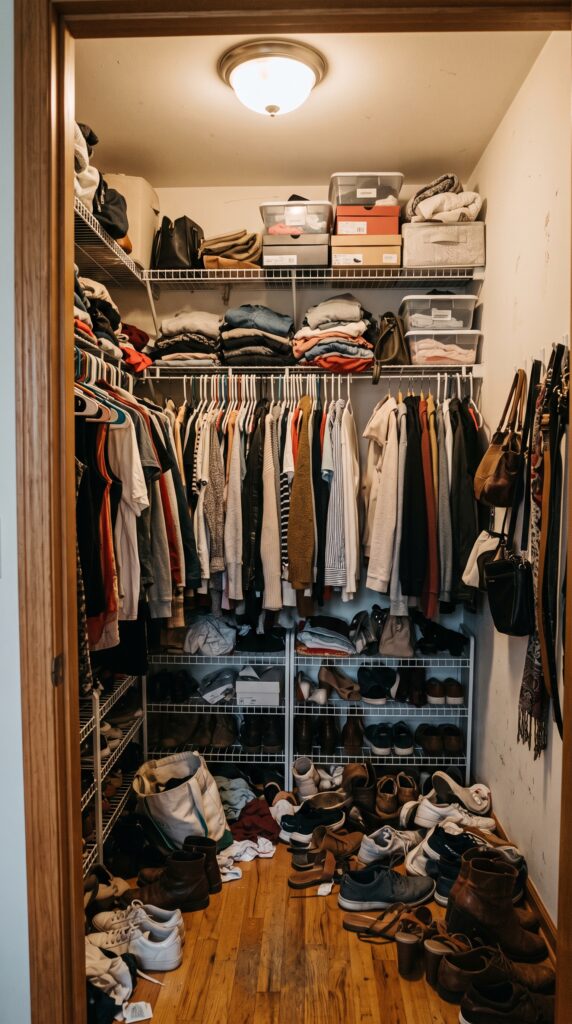
Here’s the uncomfortable truth: the closet organization industry is built on making you feel like your space is the problem. You’ve probably seen those spotless, magazine-worthy closets with custom built-ins, matching velvet hangers in every shade, and a dedicated drawer just for sunglasses. They look incredible. They also cost thousands of dollars and belong to people with professional stylists.
The first myth is that a small closet can only be functional if you invest in a custom shelving system. That’s simply not true. Plenty of well-organized small closets rely on nothing more than a $20 tension rod and some creativity. The second myth is that you need to purge everything down to a capsule wardrobe before organization can work. Editing your wardrobe helps, but it’s not a prerequisite — the right systems can handle a full closet without stripping your life down to ten neutral basics.
The third myth, and perhaps the most damaging, is that “small” is a permanent limitation. Small closet organization hacks work precisely because they treat vertical space, door backs, and floor corners as untapped real estate. Your closet isn’t too small — it’s just not yet optimized.
Real Facts About Why Most Small Closets Fail
Before jumping into solutions, it helps to understand exactly what goes wrong. Most small closets fail for one of three structural reasons, and none of them are your fault.
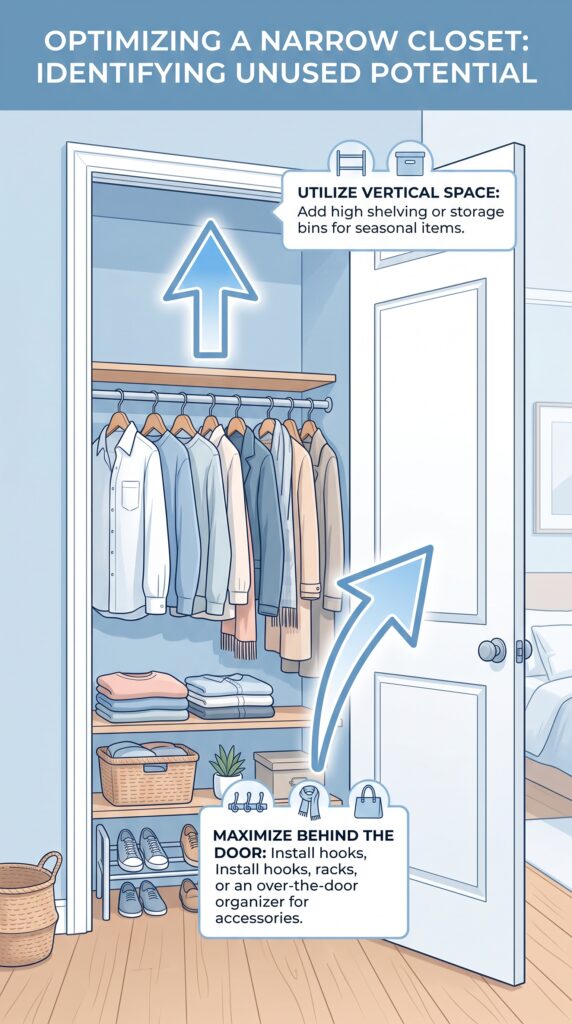
Dead vertical space. The average closet rod sits somewhere between five and six feet off the ground, leaving anywhere from one to two feet of empty space above it. Multiply that by the width of your closet and you’re looking at several cubic feet of storage you’re not using. According to the National Association of Professional Organizers, the number one organizing mistake homeowners make is ignoring vertical space entirely.
Single-tier hanging. Most standard closets come with one rod running the full length of the space. That single tier makes sense for long dresses and coats, but for shirts, jackets, and folded pants, it wastes the bottom half of the closet completely. Double-hanging rods can immediately double your hanging capacity without adding a single inch to your closet’s footprint.
Door blindness. The back of your closet door is one of the most consistently wasted surfaces in a home. A standard interior door has enough surface area to hold shoes, accessories, cleaning supplies, or folded items — all invisible when the door is open, all completely accessible the moment you reach for the handle.
how to maximize bedroom storage
Understanding these failure points is what separates surface-level tidying from small closet organization hacks that actually stick.
Expert Tips: Small Closet Organization Hacks That Actually Deliver
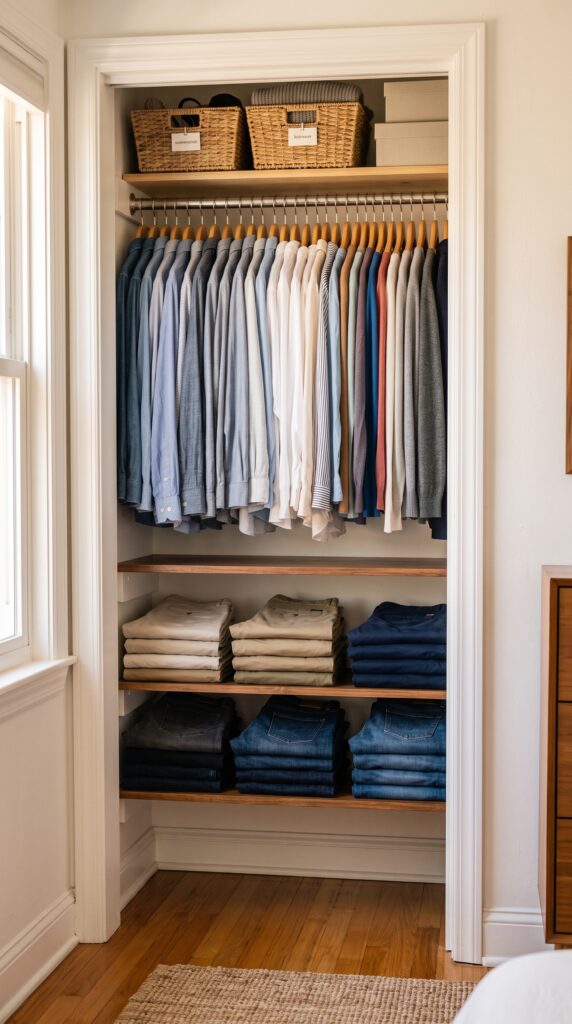
Now for the part you came here for. These tips are drawn from professional organizer methodology and the real-world experience of people living in compact homes, apartments, and older houses with undersized closets.
Double Your Hanging Space Without a Contractor
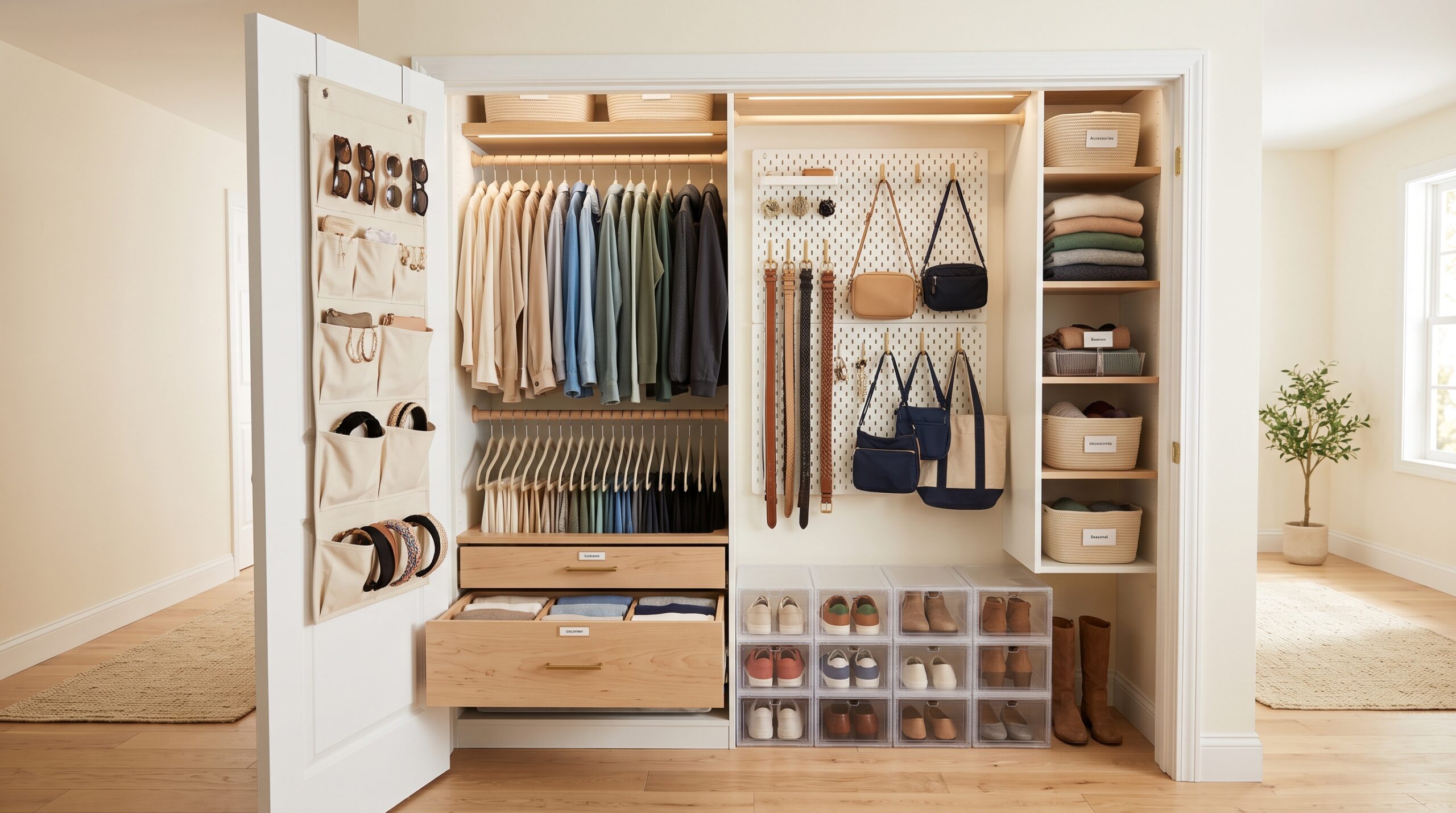
The single most impactful thing you can do in any small closet is add a second hanging rod below your existing one. A simple expandable closet rod — the kind that hangs from your upper rod via two short chains — costs very little and installs in under five minutes with zero tools. Use the top rod for tops, blouses, and jackets, and the lower rod for folded pants or shorter items. This one small closet organization hack alone can effectively double your usable hanging space.
If your closet has a section already dedicated to long items like dresses or coats, keep that section single-tier and double up everything else. The goal is to match your rod configuration to what you actually own.
Use the Back of the Door — Seriously
An over-the-door organizer is one of those small closet organization hacks that sounds obvious but gets ignored far too often. A standard over-the-door shoe organizer doesn’t just hold shoes — it can store folded scarves, rolled belts, small bags, cleaning supplies, or even snacks if you’re working with a linen closet.
For a more polished look, over-the-door hooks are sleek and low-profile. Hang tomorrow’s outfit the night before, keep your most-used bags accessible, or use them for robes and frequently worn jackets. According to The Spruce, utilizing door space is consistently ranked among the most effective closet hacks by professional organizers.
Shelf Risers and Stackable Bins: The Vertical Game
If your closet has a single fixed shelf above the rod, a shelf riser doubles your shelf space instantly. Place bulky items like sweaters or extra linens on the lower level and use the riser level for things you access less frequently — seasonal items, spare bedding, or rarely used accessories.
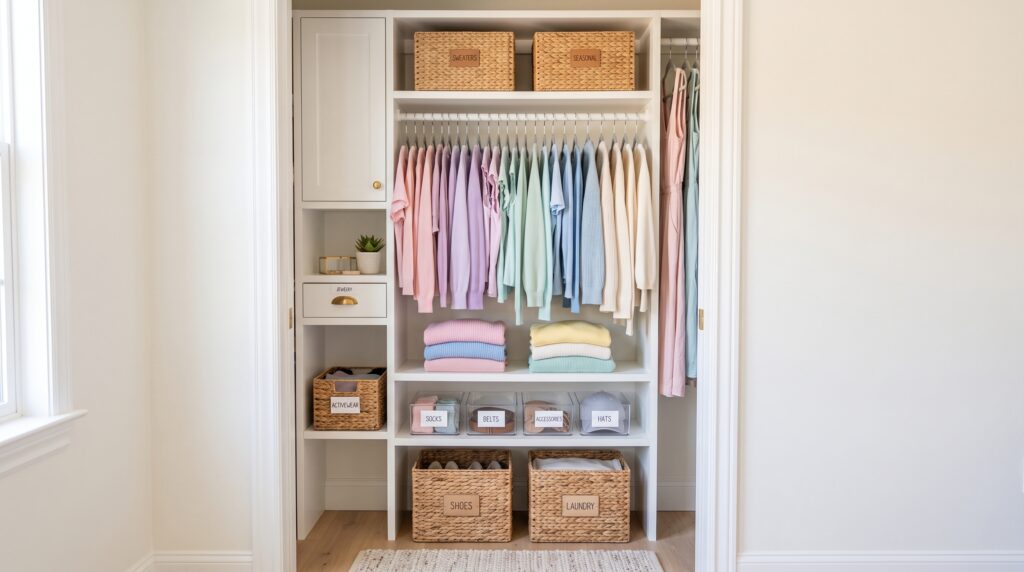
Stackable clear bins are another small closet organization hack that earns its keep. Clear bins let you see what’s inside without pulling everything out, which means you actually use the items you store rather than forgetting they exist. Label each bin and stack them along the floor, on shelves, or in corners to make use of every cubic inch.
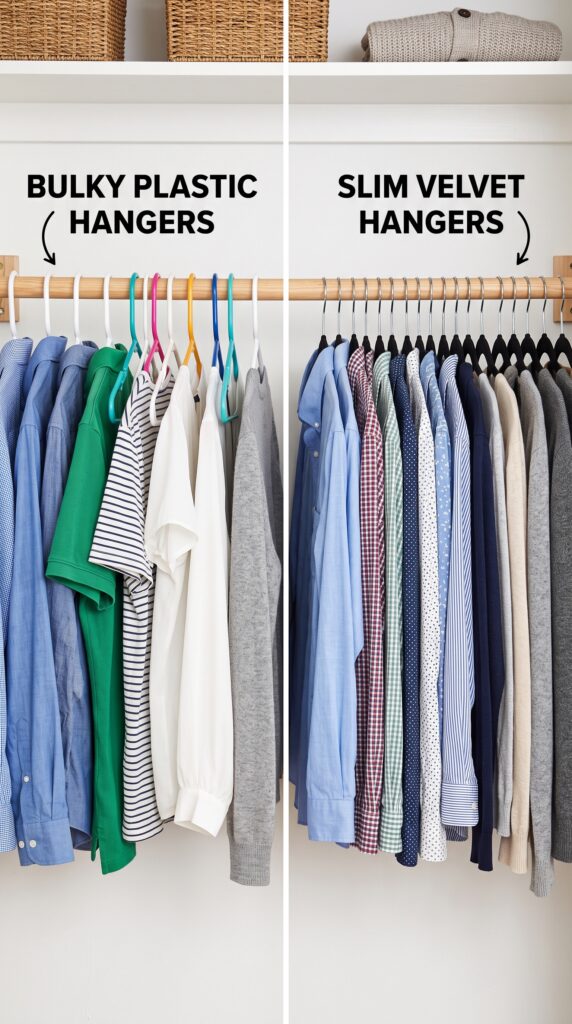
Slim Velvet Hangers Are Not Optional
Standard plastic or wire hangers take up dramatically more rod space than slim velvet alternatives. Switching your entire closet to velvet hangers is one of those small closet organization hacks that feels almost too simple to mention, yet it consistently frees up 20 to 30 percent more rod space. That’s not a small amount — in a tight closet, that’s the difference between cramming and breathing.
Velvet hangers also keep clothes from slipping, which means fewer items end up on the floor and more stay exactly where you put them.
Categorize Ruthlessly, Then Subcategorize
Categorization is the backbone of any lasting small closet organization system. Group all tops together, all bottoms together, all outerwear together. Within each category, organize by color or sleeve length — whichever makes sense for how your brain works.
The reason this matters is retrieval speed. When you can find what you need in under ten seconds, you’re less likely to pull everything out in a hurry and undo your organization. Small closet organization hacks only work long-term if the system is intuitive enough to maintain without thinking about it.
Use Floor Space Intentionally
The floor of a small closet is not a dumping zone — or at least, it shouldn’t be. A low shoe rack along the floor keeps footwear organized and visible. A small stackable drawer unit fits neatly below hanging clothes and can hold accessories, gym wear, or anything that doesn’t hang well.
If your closet floor is completely occupied by a laundry hamper, consider moving it outside the closet entirely. Freeing up that floor space can dramatically change how the whole closet feels and functions.
small space storage solutions for apartments
The Right Order of Operations for Tackling Your Closet
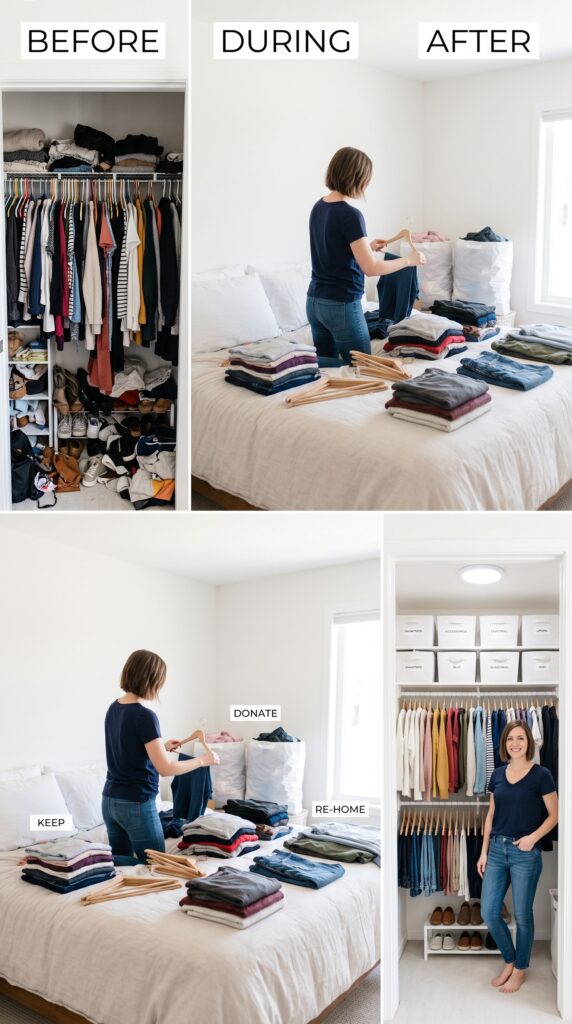
Knowing the hacks is one thing — knowing the order to implement them is another. Professional organizers consistently recommend the same sequence, and it works.
Start by pulling everything out. Yes, everything. You can’t see what you’re working with until the closet is empty. Sort items into keep, donate, and seasonal storage piles as you go.
Next, assess your space. Measure the height, width, and depth of your closet. Note where the rod sits, where fixed shelves are, and how much door clearance you have. This is when you decide which small closet organization hacks apply to your specific situation.
Then install your hardware. Add your double rod, your over-the-door organizer, your shelf risers. Do this before anything goes back in.
Finally, return items using your category system, switch to slim hangers as you go, and place bins and labels last. According to Real Simple, finishing with labels is important because it makes the system self-correcting — you (and anyone else who uses the closet) always know where things belong.
Why These Small Closet Organization Hacks Actually Stick
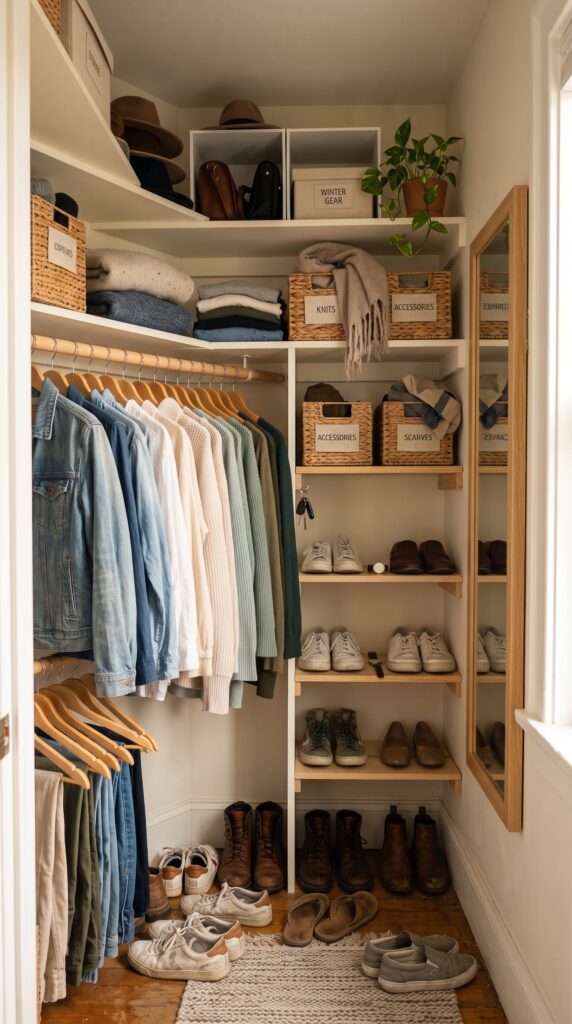
Most organization projects fail within three months because they require too much ongoing effort to maintain. The small closet organization hacks outlined here are designed to be self-sustaining. When everything has a designated home, returning items is as easy as taking them out.
The other reason these hacks stick is that they work with human behavior rather than against it. You’re not being asked to fold everything into tiny origami squares or memorize a color-coded inventory system. You’re being given simple physical structures — a second rod, a door organizer, clear bins — that make the right choice the easy choice.
A small closet doesn’t have to mean a chaotic one. With the right approach, even the most cramped reach-in can become a genuinely functional space that makes getting dressed faster, easier, and a lot less frustrating.