
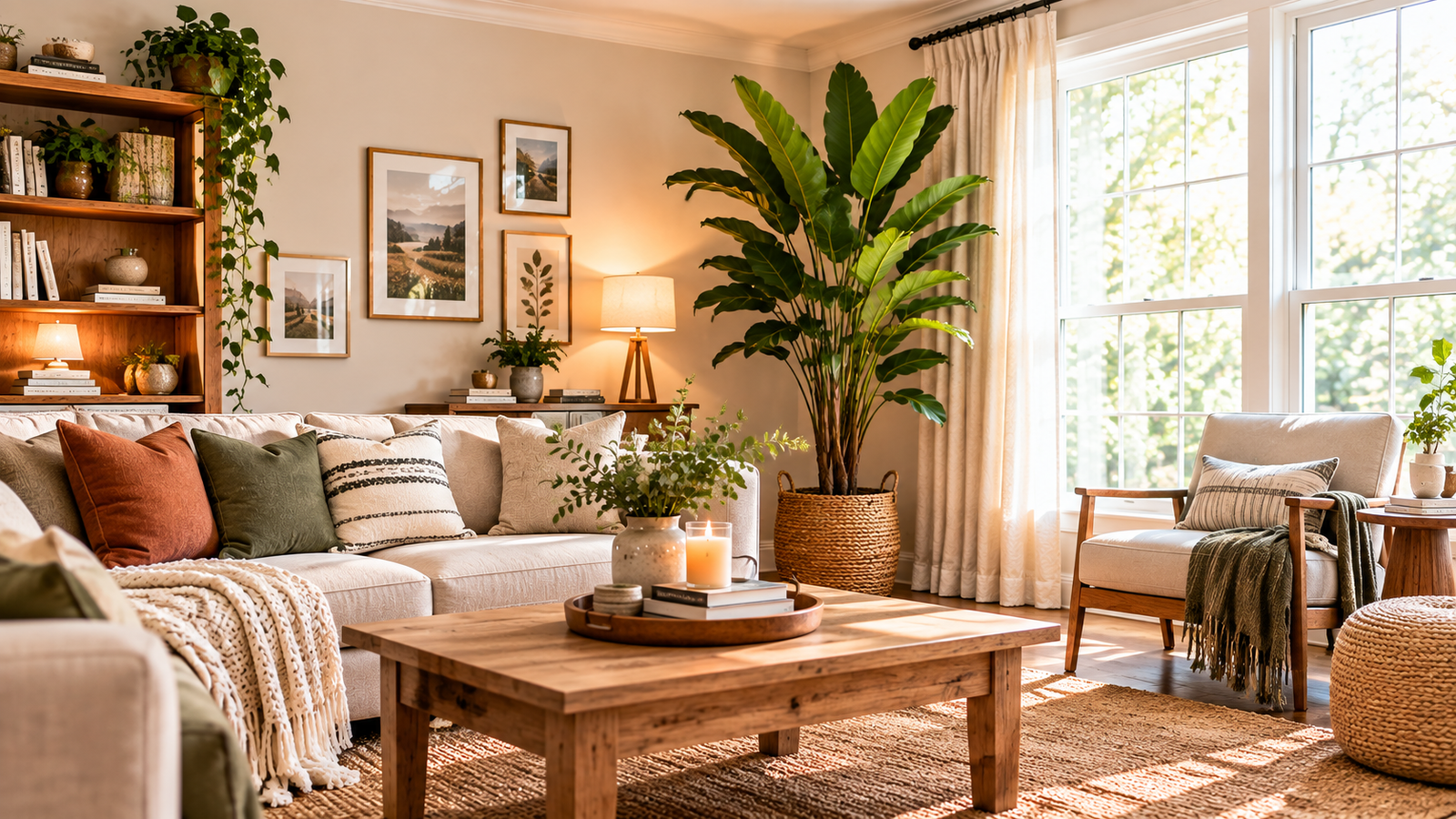
Every budget decorating list makes the same promise: a few smart, affordable changes and the room will suddenly click. Most of those lists lead with a new rug or a gallery wall. After redoing every room in my own house without a design background or a contractor, I’d put those near the bottom, not the top.
The change that actually mattered first, more than once, was height — and it took a few expensive mistakes to figure that out.
📋 Table of Contents
The Mistake: Buying Sideways Instead of Up
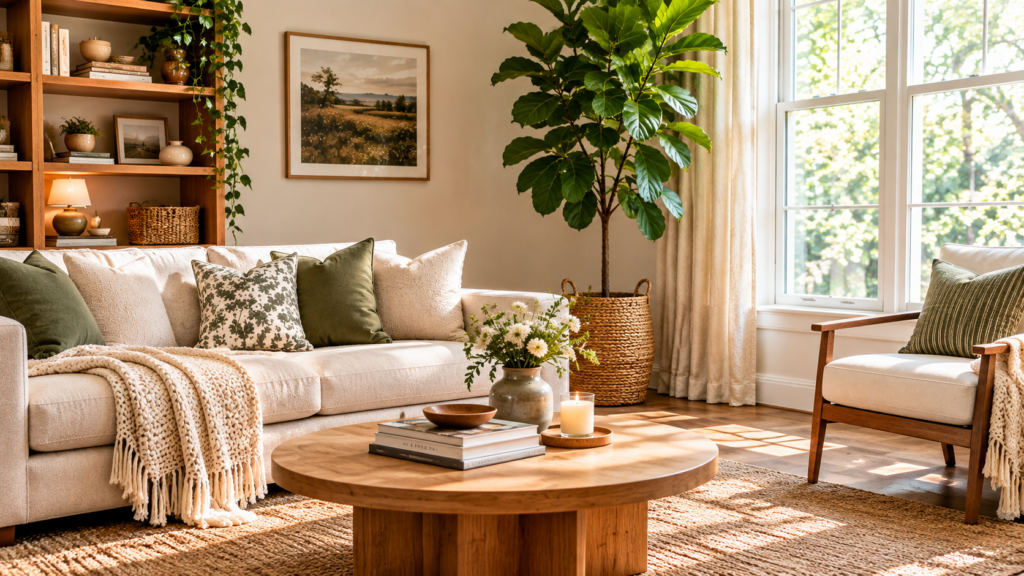
The easiest way to spend a decorating budget is on things that sit low: a new rug, a coffee table, a second armchair. They’re satisfying purchases because they’re tangible and immediately useful. The problem is that a room full of low, useful things can still feel flat, because nothing in it does anything for the vertical space.
I made this mistake in my own living room — a new rug, a different coffee table, a better arrangement of the seating — and the room still felt like something was missing. It took stepping back and actually looking at the room, rather than at any single piece in it, to see the problem: everything topped out at roughly the same height. The room had plenty of “stuff,” and no structure.
The Fix That Actually Worked
Once I noticed the problem, the fix was almost embarrassingly cheap compared to what I’d already spent. A single tall element in the room’s emptiest corner did more for how the room felt than the rug, the coffee table, and the seating rearrangement combined.
This isn’t a universal decorating law, but it held up in every room I tested it in after that: a room with height variation reads as designed. A room without it reads as furnished, which is a different and lesser thing.
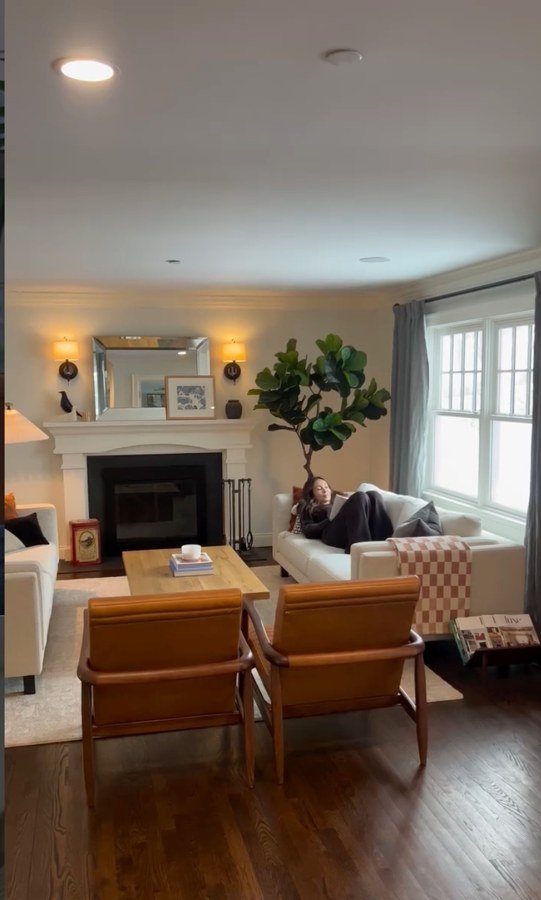
This is close to what convinced me. The room isn’t styled for a photo — someone’s actually curled up reading — but the tree by the window is doing real structural work, giving the space a vertical anchor that the furniture alone doesn’t provide.
Why a Plant Solved It Better Than Furniture Would Have
A tall piece of furniture — a bookshelf, an armoire — can do the same height job, but it usually costs more, needs a specific spot, and has to match everything else in the room. A tall plant sidesteps most of that. It doesn’t need to coordinate with your color palette, it fits almost any corner, and it’s the cheapest “tall” purchase available by a wide margin.
The catch, and the thing that cost me a second round of mistakes, is that the corners that most need height are often the corners with the worst light — which is exactly where a real plant struggles hardest. I killed two plants in the same corner before admitting that the spot simply wasn’t going to support anything living.
That’s when I actually looked into the newer faux options instead of dismissing them the way I had a few years earlier. The bark and leaf detail on the current generation — including trees from newer lines like Rootless — has genuinely changed since the last time I paid attention, to the point that the corner finally looks finished instead of like a plant graveyard.
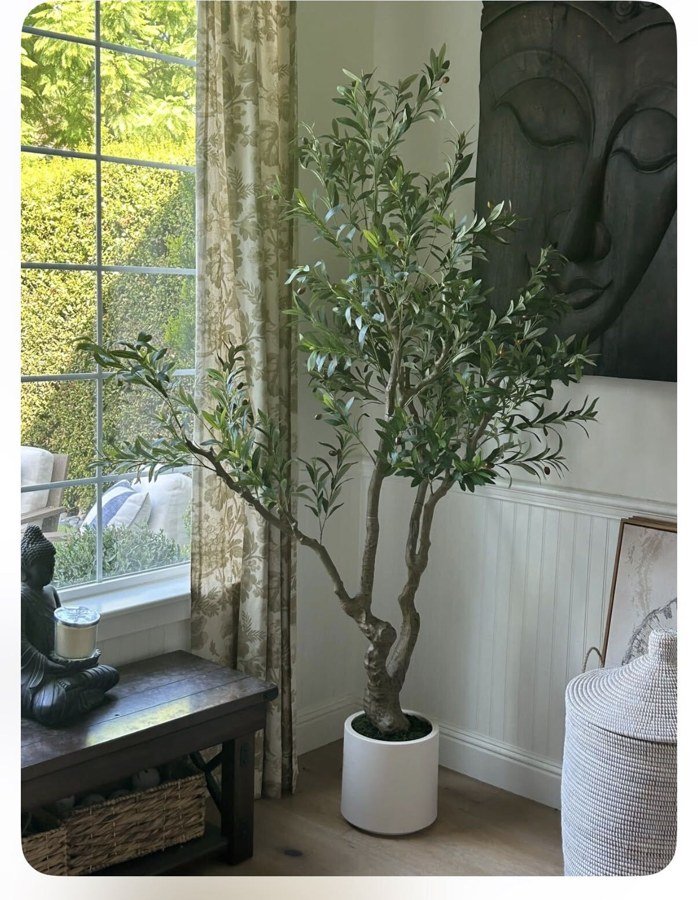
The detail that convinced me this wasn’t the same “obviously fake” plant category I remembered — bark texture close enough that it stops being the first thing you notice about the corner. If you’re comparing options, the trunk detail is worth checking before anything else — it’s the single biggest tell between a convincing tree and an obviously synthetic one.
Doing the Actual Math
Since this whole site is about budgets, it’s worth being honest about what the “expensive mistakes” actually cost, side by side. The new rug ran a little over $150. The replacement coffee table was another $200. Two dead plants, replaced twice each, came to close enough to $80 in soil, pots, and plant food that I stopped tracking it closely. None of that solved the actual problem, and all of it was money spent before I understood what was wrong.
The tall plant that finally fixed the corner cost less than the rug alone, and it solved a problem the rug was never going to touch. That’s the part that stings a little in hindsight — not that the fix was expensive, but that it was cheap, and I spent months and several hundred dollars avoiding it because it didn’t occur to me that “flat” was the actual diagnosis.
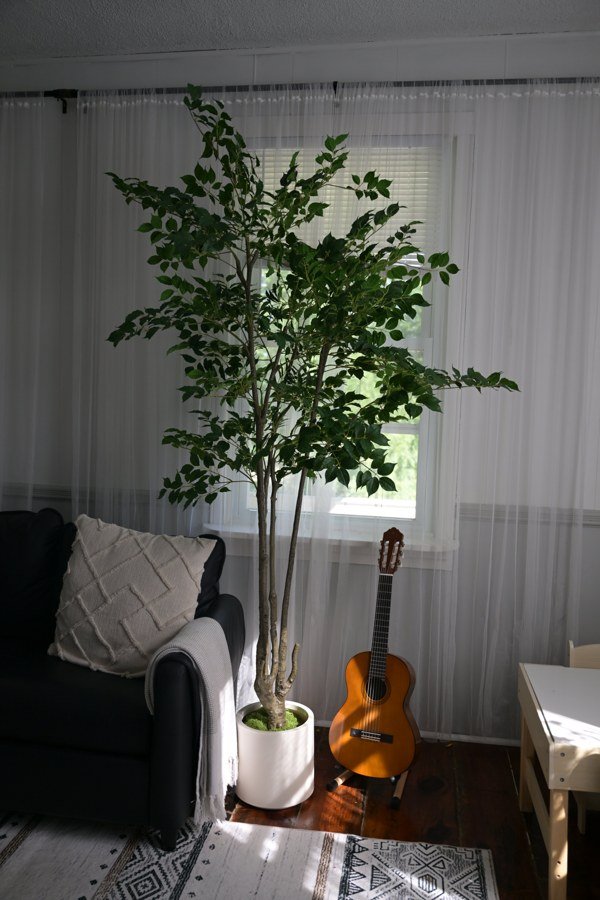
A tree doesn’t have to anchor a formal, styled room to do this job. This corner is about as unstaged as it gets — a guitar leaning against the wall, sheer curtains, a couch that’s clearly used daily — and the height fix works exactly the same way it would in a more polished room.
Where This Rule Doesn’t Apply
To be fair to rugs and gallery walls, height isn’t the fix for every flat-feeling room. A few situations call for something else first:
- If the room already has a tall bookshelf, armoire, or floor-to-ceiling curtains, height is probably already covered, and the flat feeling is coming from somewhere else — usually lighting or color, not scale.
- If the ceilings are unusually low, an overly tall piece can make the room feel cramped rather than finished. In that case, a mid-height plant paired with wall art higher up does more good than one dramatic six-foot tree.
- If the room is already visually busy, adding height on top of a lot of pattern and color can tip it into cluttered rather than layered. Height helps most in rooms that are currently sparse, not ones that are already full.
For everything else — the ordinary living room, bedroom, or dining nook that just feels a little flat without an obvious cause — checking for height variation first has been the single most reliable diagnostic I’ve found, budget or not.
The Actual Rule, Restated
If there’s one budget-decorating rule I’d hand to someone starting from scratch, it’s this: before spending on anything that sits at coffee-table height, check whether the room has any height variation at all. If it doesn’t, that’s very likely the actual problem, and it’s almost always the cheapest one on the list to fix.
Everything else — the rug, the gallery wall, the better lamp — matters, but it matters more once the room actually has some vertical structure to build around. Skipping straight to those without fixing height first is the mistake I made more than once, and it’s the one that wastes the most money for the least visible result. If you take nothing else from this, take the doorway test: it costs nothing, it takes ten seconds, and it would have saved me a few hundred dollars if I’d known to do it sooner.