
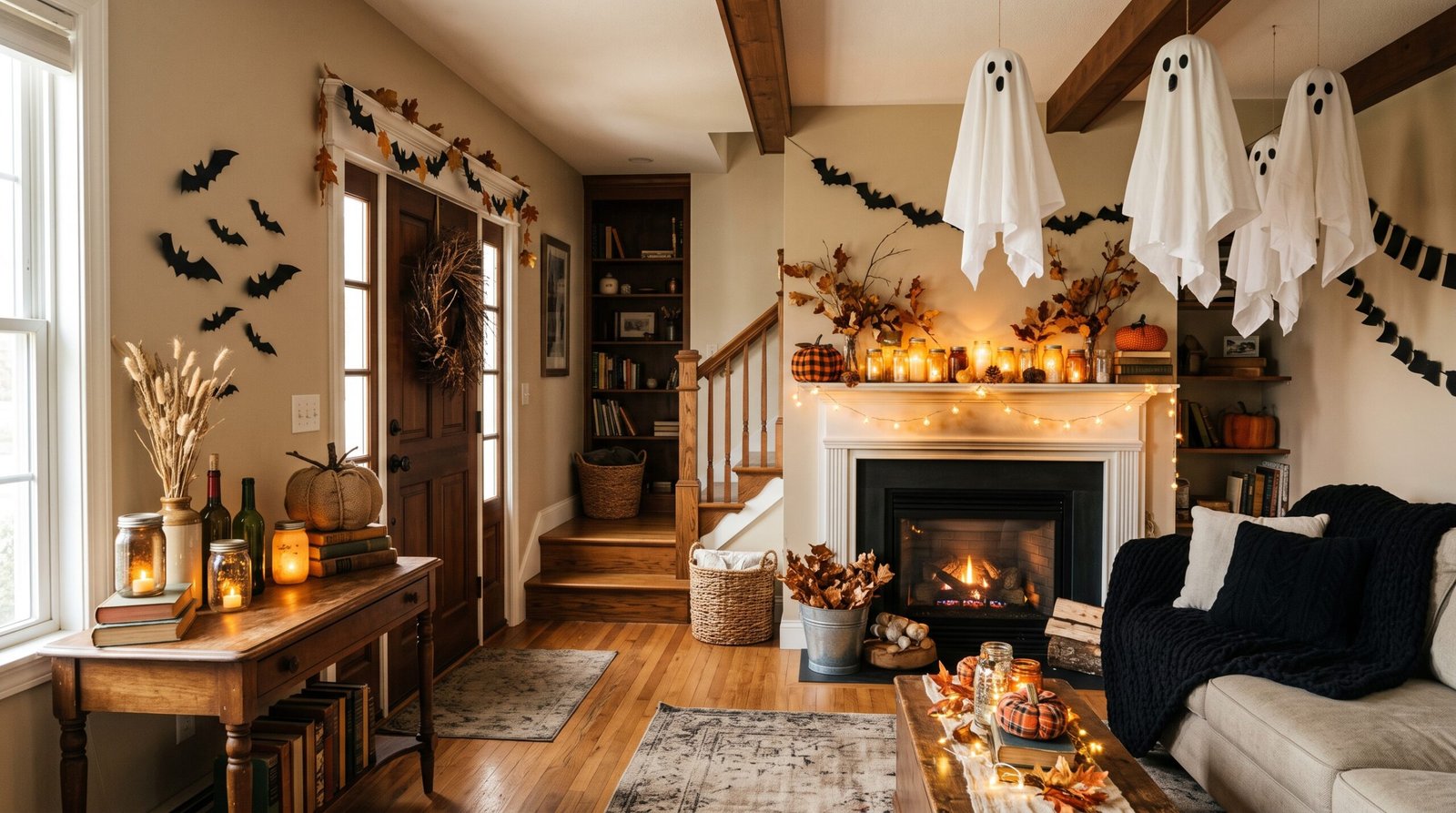
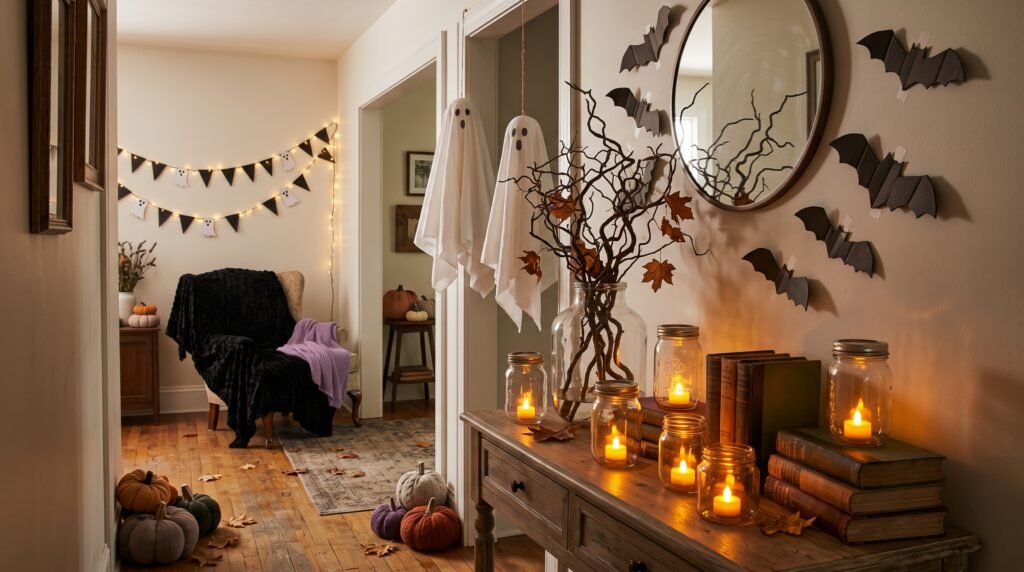
Getting your halloween decor right doesn’t require a single trip to the store, a single dollar spent, or a single hour doom-scrolling through Amazon wishlists. Everything you need is probably already in your house. And honestly, the stuff you make from what you already own tends to look better than the mass-produced plastic skeletons everyone else has on their porch.
📋 Table of Contents
The Myth That Good Halloween Decor Has to Cost Money
Here’s the thing — the seasonal decor industry is built on one idea: that you need new stuff every year. New inflatables. New string lights. New plastic spiders in orange packaging that you’ll throw away on November 1st.
That’s just not true.
Most people run into this exact problem when October rolls around: the stores are already half-sold-out, the budget is tight after summer spending, and somehow everyone else’s house looks like a haunted mansion. The panic sets in. The cart fills up. And two weeks later, you’ve got a pile of cheap decorations that look worse in real life than they did in the product photo.
But the families with the genuinely spooky, atmospheric homes? A lot of them aren’t buying anything new. They’re working with what they’ve got. And there are specific techniques that make this work.
Let’s break down the myths first, because a few assumptions are probably holding you back.
Myth #1: You need orange and black everything.
Not remotely true. Some of the most effective halloween decor uses no color at all. White, gray, and deep brown create an eerie, old-world look that feels genuinely unsettling in a way that neon orange plastic never does.
Myth #2: You need to go big.
A single well-placed element beats ten cluttered ones. A candle inside a dusty glass bottle on a windowsill does more atmospheric work than an entire bin of mixed decorations scattered across your living room.
Myth #3: You need specific “Halloween” items.
This one might be the most limiting belief of all. A dead plant is still a dead plant whether it’s October or March. A cracked mirror is eerie in any season. The spooky is in the styling, not the product category.
What You Already Own That Works as Halloween Decor
Take a slow walk through your home before you do anything else.
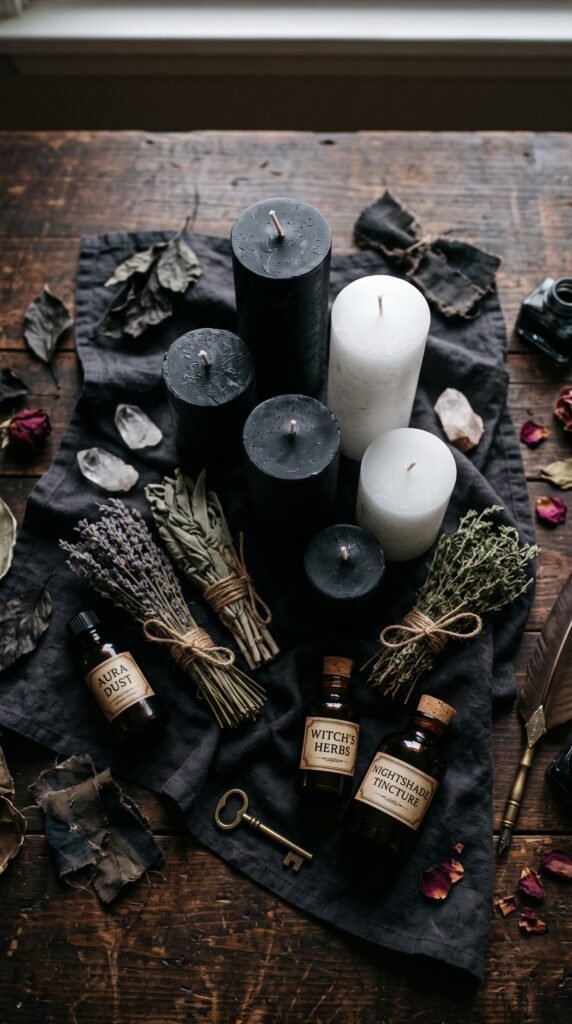
Look at what you have through a different lens. Not “does this look like Halloween” but “does this look unsettling, aged, witchy, or gothic?” Because those are the actual aesthetics underneath all the seasonal branding.
Here’s a quick category breakdown of things already in most homes that translate beautifully:
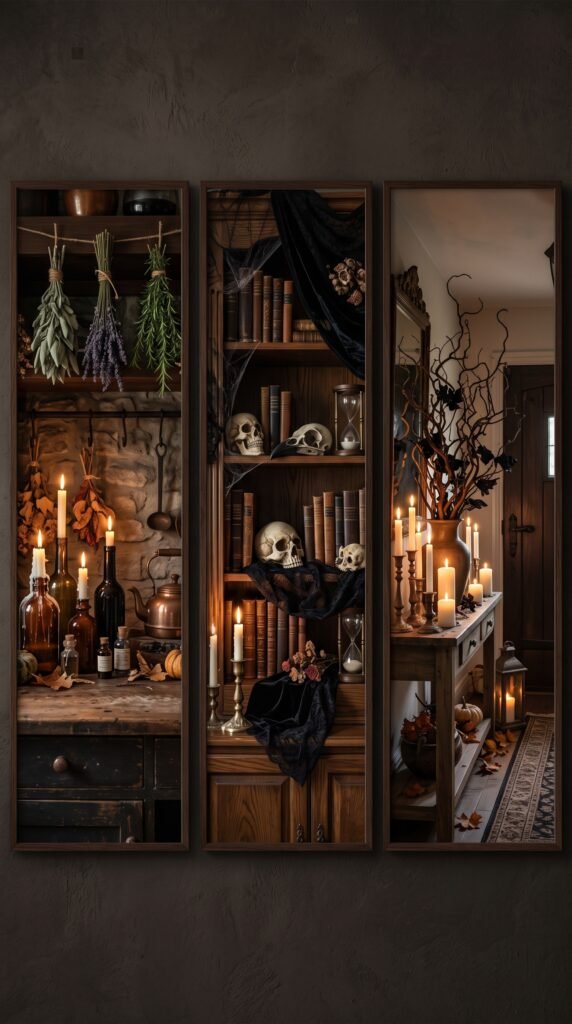
Glass jars and bottles. Any size. Cluster them on a windowsill, add a tea light, and you’ve got an instant apothecary display. Dust them a little if you want them to look old. Leave the labels on if they’re old or interesting. Remove them if they’re too modern.
Books. Old hardcovers, especially ones with worn spines or dark covers, stack into incredible halloween decor when arranged with some intentionality. Tilt a few. Stack some horizontally. Add a candle on top. Done.
Fabric and clothing. Dark curtains, black sweaters, lace tablecloths, even old bedsheets — all of these can be draped, bunched, layered, or hung to create texture and shadow. Cheesecloth pulled apart and stretched creates cobweb effects that look more realistic than the fake spiderweb bags sold at party stores.
Natural elements from outside. Fallen branches. Pinecones. Dead leaves. Spanish moss if you have it nearby. Rocks. These things are free, they’re everywhere in autumn, and they photograph beautifully.
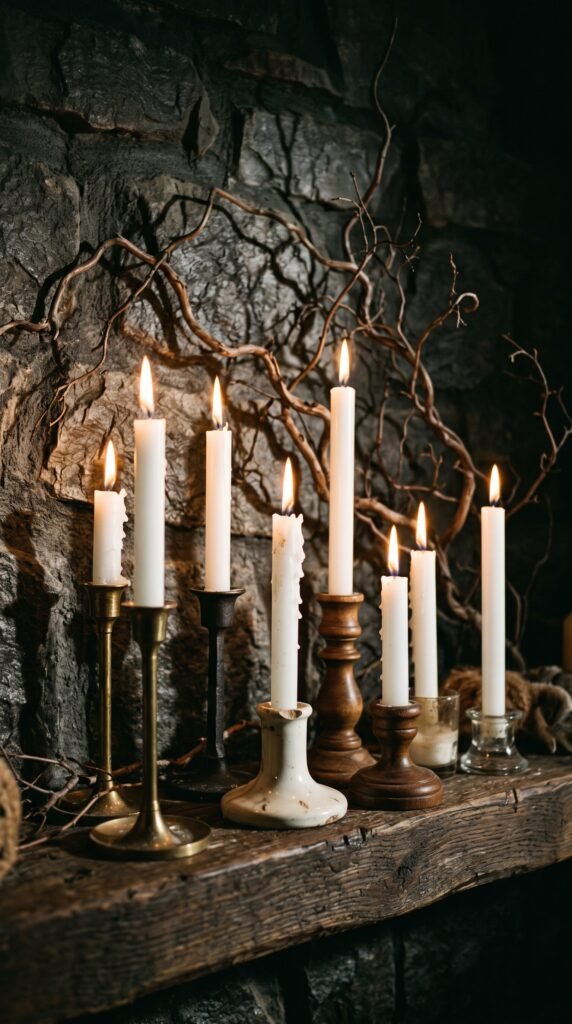
Candles you haven’t used. Most households have random candles tucked in drawers or cabinets — birthday candles, pillar candles, tea lights, taper candles. Gather them all. The combination of varied heights and wax colors looks more intentional than a matching set.
Halloween Lighting & Decor Ideas to Make Your Home Spookier This Year
Room-by-Room Guide to No-Buy Halloween Decor
Let’s get specific. Because “use what you have” is great advice until you’re standing in your kitchen wondering what that actually means for the space in front of you.
The Front Porch or Entryway
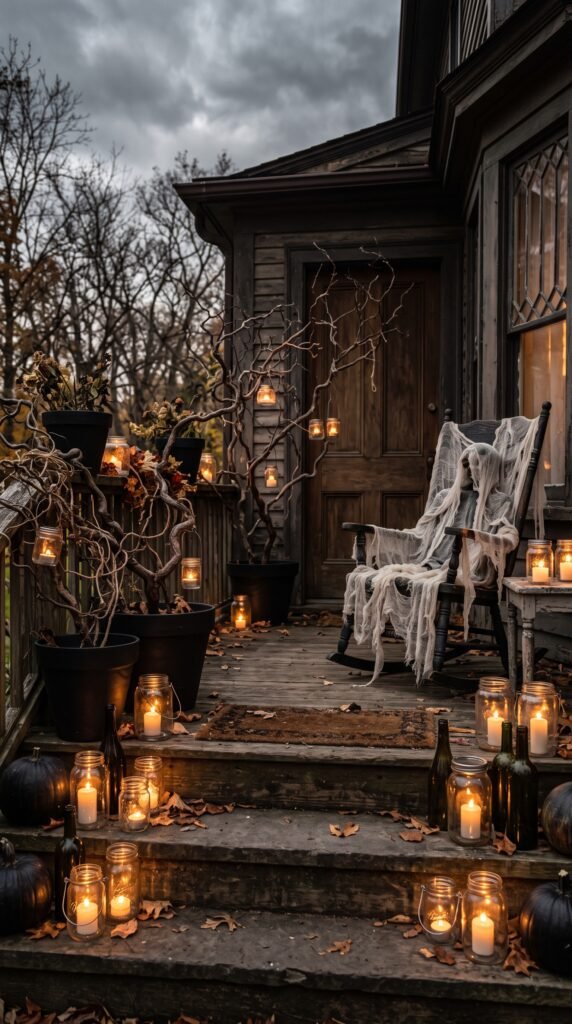
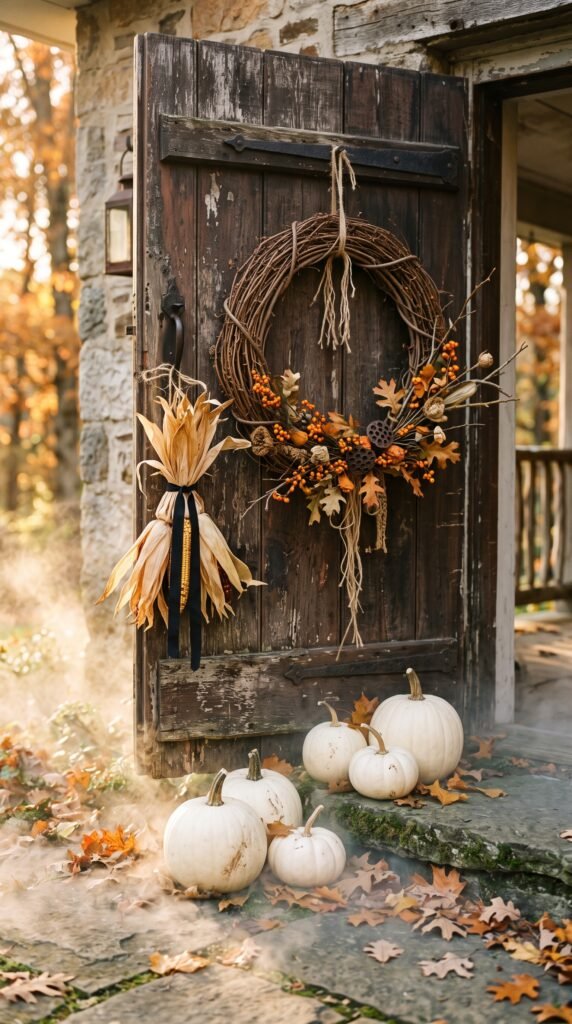
This is your most powerful canvas. Picture this: someone has two large planters on either side of their front door, both with long-dead summer flowers they haven’t pulled out yet. Most people see a gardening failure. What they actually have is a perfect Halloween prop. Dead plants in weathered containers are atmospheric. Add a cluster of gathered branches. Light a lantern if you have one. Lean some flat rocks against the base.
The goal is to make the entry feel like something is not quite right. Like the house has been empty for a season. You’re not going for cartoonish — you’re going for genuinely unsettling.
The Living Room
The fireplace mantle, if you have one, is your centerpiece. Layer objects at different heights: books stacked horizontally as a riser, a candle on top, a dark object beside it, a piece of fabric trailing down one side.
For the rest of the room, dim the lamps. Seriously. Remove a bulb if you have to. Dark rooms feel more atmospheric than fully lit ones, and that single change does more work than any decoration.
The Dining Table
A black or dark tablecloth (or an old dark bedsheet) draped over the table immediately transforms the space. Scatter candles down the center. Add pinecones, twisted branches, or a cluster of old bottles. This is actually the styling approach used in prop houses for film and TV — layered organic elements at varying heights along a central axis.
The Windows
Silhouettes are free to make and wildly effective. Cut basic shapes from black construction paper or cardboard (bats, cats, moons, gravestones) and tape them to windows from the inside. At night with interior lighting, they read as actual decorations to anyone outside. And during the day they look intentional from the inside.
11 Halloween Porch Ideas Renters Can Pull Off Without Nails
Styling Techniques That Make the Difference
This is where most people miss the mark. They have the right pieces but put them in the wrong configuration, under the wrong lighting, in too many places at once.
The Power of Grouping in Odd Numbers
Three candles. Five bottles. Seven books. Odd numbers look intentional and asymmetrical in a way the eye reads as artistic rather than accidental. This is a basic styling principle used in interior design and it applies directly to seasonal displays.
Shadow as a Decoration
Place a candle behind an interesting object — a plant with spiky leaves, a bottle, a figurine — and the shadow it casts on the wall behind it becomes part of the display. Larger than the object itself. Dramatic. Completely free.
The Rule of Varying Heights
Flat arrangements look like clutter. Raised arrangements look like displays. Use books, upturned bowls, or stacked boxes under fabric to create levels within a grouping. This single change makes any collection of objects look styled.
Texture Over Color
Instead of adding more orange, add more texture. Rough linen next to smooth glass. Dry bark next to a wax candle. Soft moss next to stone. The contrast is what creates visual interest, and it reads as sophisticated even in a seasonal context.
According to Martha Stewart’s Halloween decorating archives, natural materials and candlelight consistently outperform synthetic decorations in terms of atmosphere — a fact that holds up across decades of seasonal content.
And Better Homes & Gardens regularly features zero-cost or low-cost halloween decor ideas in their seasonal roundups, noting that the most-shared reader submissions are almost always handmade or foraged rather than store-bought.
Why DIY Halloween Decor Actually Works Better
There’s a real reason for this, beyond personal taste.
Store-bought decorations are designed to look good in a product photo under optimized lighting. Your home is not a product photo. The lighting is different. The scale is different. The context is different.
Things you make or repurpose are already scaled and contextually appropriate for your space. A branch you brought in from your own yard fits the aesthetic of your porch because it came from there. A plastic skeleton ordered from a warehouse in New Jersey does not have that advantage.
Beyond the visual logic, there’s an psychological element that’s easy to overlook. Spaces that feel personal feel more unsettling in the right way. When visitors can see that effort and intention went into a display, it registers differently than prefabricated spookiness. The uncanny valley of halloween decor is real: things that are almost-but-not-quite right are scarier than things that are obviously fake.
Stuck With Boring Decor? 15 Fresh Halloween Ideas to the Rescue
So when you use a cracked vase you’ve had for years, a book that belonged to someone else, a piece of cloth that has actual history in your home, those objects carry a quality that no new purchase can replicate.
Putting It All Together: A No-Buy Halloween Decor Plan
Here’s the practical sequence.
Start with an audit. Walk your home with a basket and collect: every candle you own, every dark or textured fabric item, every glass bottle or jar, every natural object (pinecones, stones, dried flowers, branches), and any objects with interesting shapes or shadows.
Then choose your three main zones. Not your whole house. Three places that get the most traffic or visibility: front door, living room mantle or central surface, and one window visible from the street.
Style each zone with the grouping principle — odd numbers, varying heights, textured contrast. Add candlelight where possible. Remove bright decorations that compete with the atmosphere you’re building.
Then do the lighting edit. In each room you’re decorating, lower the ambient light. Remove a bulb. Switch to a lamp. Close a blind. Atmosphere is 70% lighting, 30% objects.
According to Apartment Therapy’s seasonal decorating guides, low lighting combined with natural materials and candlelight is the single most effective combination for creating genuine atmosphere in a home of any size.
The halloween decor that stops people in their tracks isn’t always the most expensive or the most elaborate. Most of the time, it’s the most considered. The display where someone clearly thought about what they were doing, made choices with intention, and created something that couldn’t have come from a store.
That’s entirely possible without spending a single thing.
And the fact that it’s also free? That’s just a bonus.