
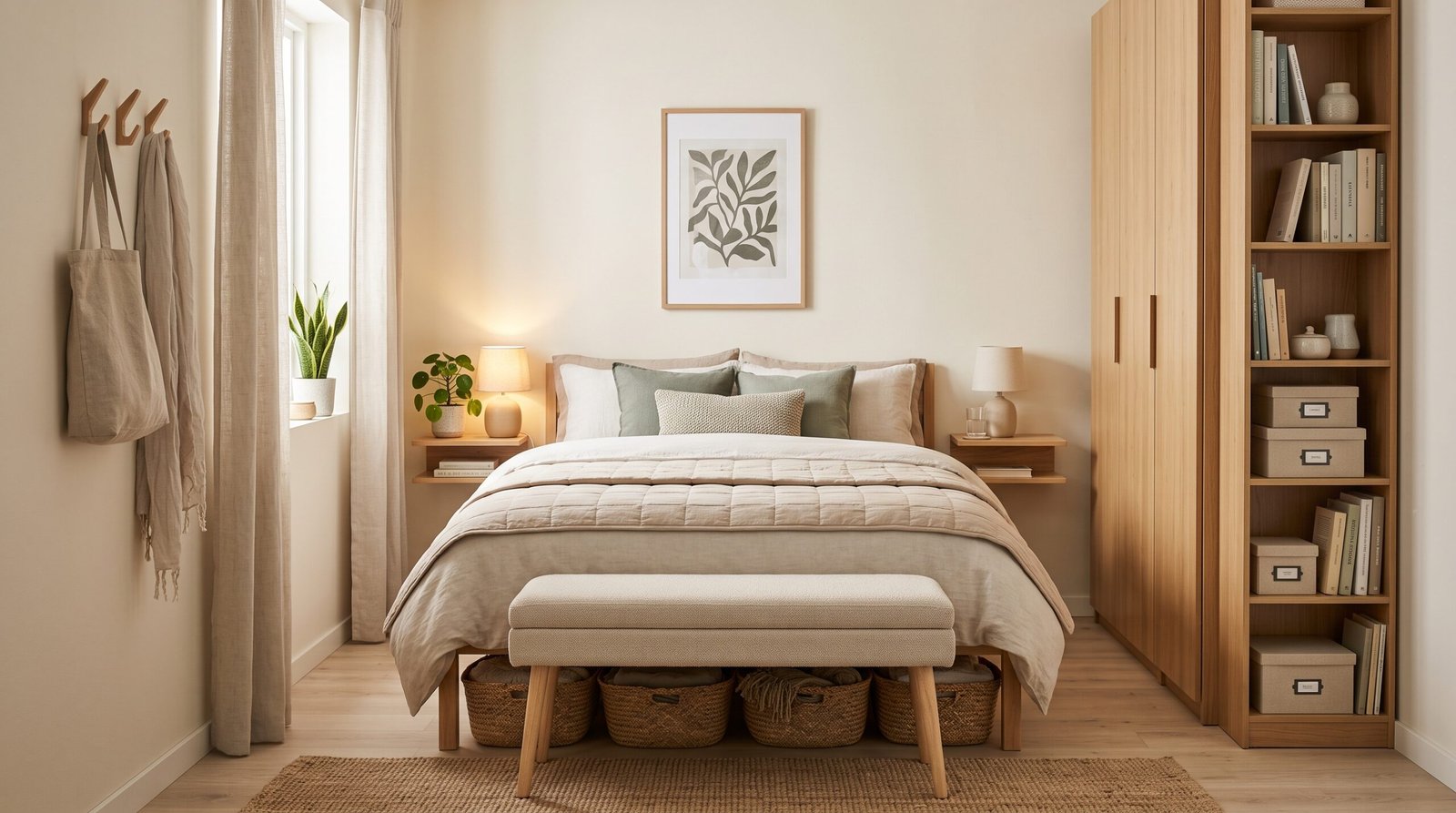
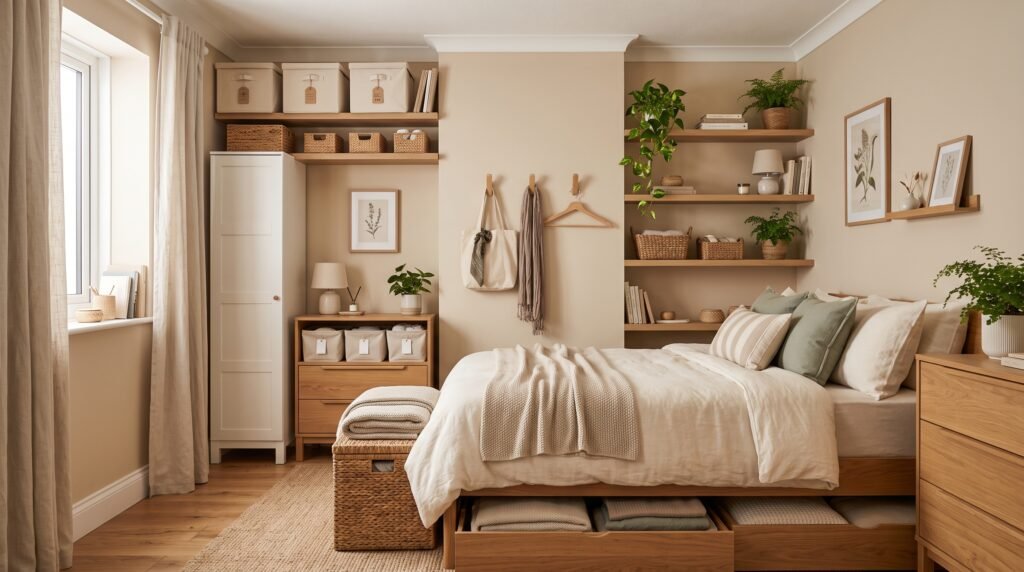
If you’ve been searching for small bedroom storage ideas that don’t require a contractor, a full weekend, or a budget that makes you wince, you’re in exactly the right place. Most people think the only way to fix a cramped bedroom is a total overhaul. Rip everything out. Start fresh. Spend thousands.
That’s just not true.
📋 Table of Contents
- Why Small Bedrooms Feel More Chaotic Than They Actually Are
- The Zones You’re Probably Wasting
- Small Bedroom Storage Ideas That Work Without Major Renovations
- Go Under the Bed First
- Add Shelves to Dead Wall Space
- Rethink Your Closet Ceiling
- Use the Back of Every Door
- The Furniture Choices That Double Your Storage Capacity
- Nightstands With Drawers or Shelves
- Ottomans That Open
- Tall Dressers Over Wide Ones
- Small Bedroom Storage Ideas for Renters Who Can’t Touch the Walls
- The One Organizing Habit That Keeps Small Bedroom Storage Working
Why Small Bedrooms Feel More Chaotic Than They Actually Are
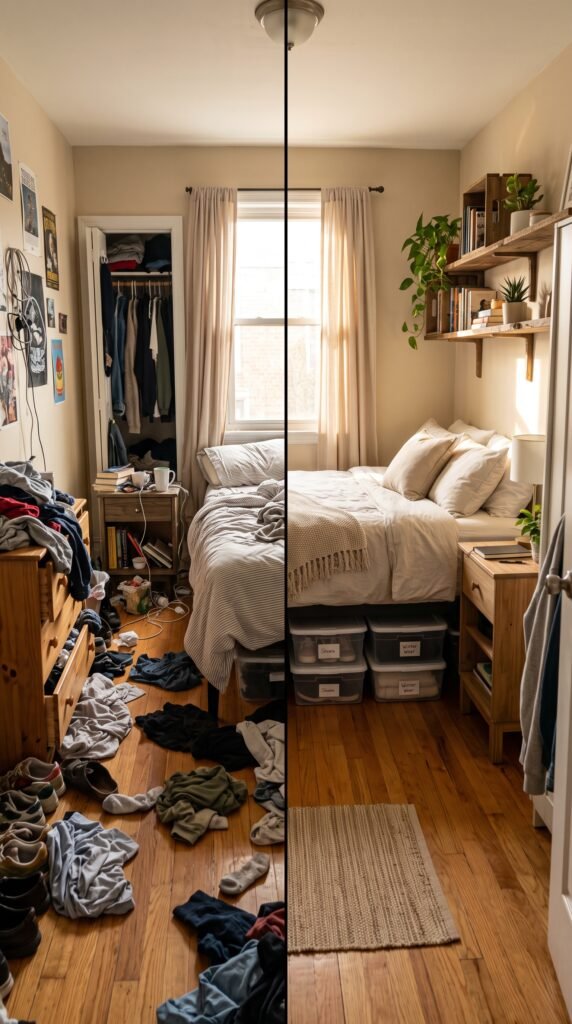
Here’s the thing about a small bedroom: the problem usually isn’t space. It’s the kind of space you’re using (or rather, not using).
Picture this. You walk into a room where the floor is mostly clear, but the closet is jammed, the top of the dresser is a graveyard for random items, and there are three different chairs doing the job of one. The room feels suffocating. But measure it out and you’d find there’s actually decent square footage sitting completely idle — vertical wall space above eye level, the hollow zone under the bed, the backs of doors.
Most people store things where they can see them. That habit is the real culprit.
When storage is reactive — you just put things where there’s room — it creates visual noise in every direction. Your brain reads that noise as disorder. And disorder in a sleep space is a quiet kind of stress you carry all day without realizing it.
The fix isn’t more furniture. It’s smarter placement of the storage you already have (or could easily add).
The Zones You’re Probably Wasting
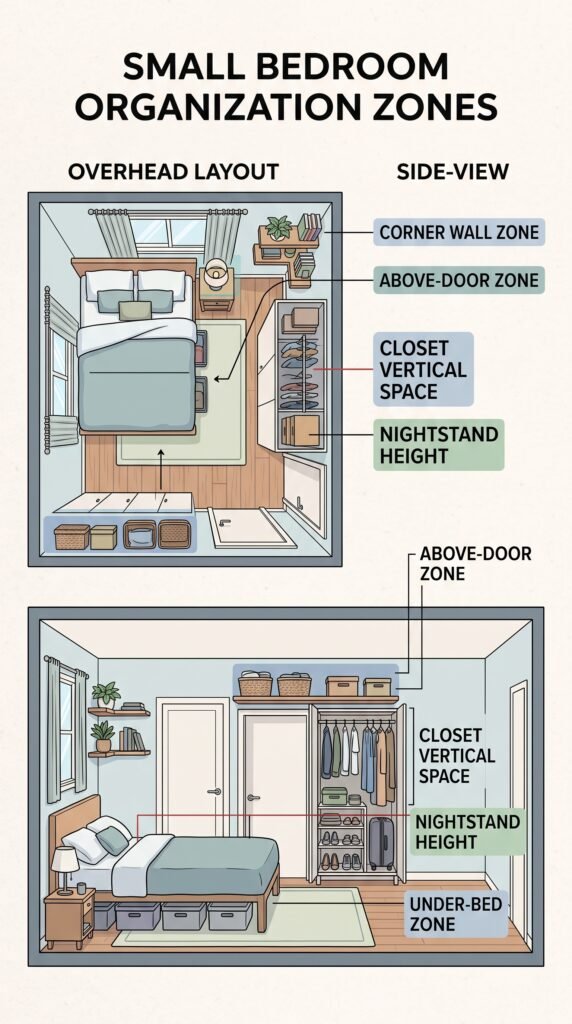
Before buying a single bin or shelf bracket, do a zone audit of your room. Walk in and mentally divide the space into three horizontal layers.
The floor layer. Everything from the ground up to about knee height. Most people treat this as prime real estate, but it’s actually the worst place to store anything you want to find fast, and it’s the zone most responsible for making a room look small.
The mid layer. Roughly waist to shoulder height. This is where your brain naturally looks for things, so it should hold your most-used items. But it shouldn’t be overloaded.
The upper layer. Shoulder height and above, all the way to the ceiling. This zone is almost universally ignored in bedrooms. And it’s often the biggest untapped storage opportunity you have.
Most rooms have 2-3 feet of usable vertical space above the tallest furniture that never gets touched. Add floating shelves up there and you’ve created storage without touching a single inch of floor space.
How to Transform Small Bedroom Ideas Into Real Results
That said, vertical storage only works if what’s up there is organized. A row of mismatched boxes stacked randomly just trades floor clutter for ceiling clutter. Use matching bins with labels, or keep it to items that look intentional — books, baskets, a small collection of something.
Small Bedroom Storage Ideas That Work Without Major Renovations
This is where it gets practical.
Go Under the Bed First
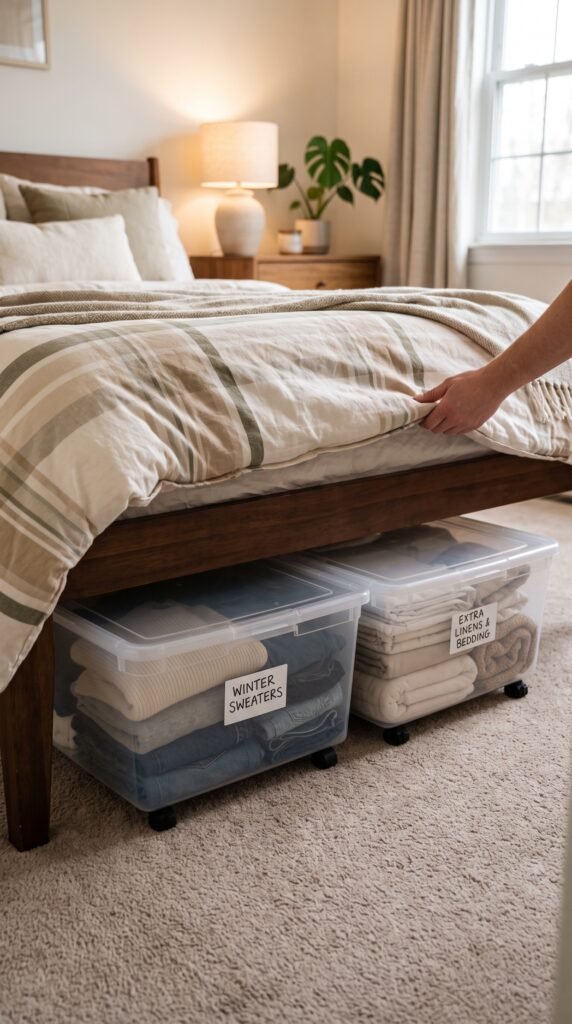
Under-bed storage is the most underused square footage in the average bedroom. A standard queen bed has roughly 20-25 square feet of usable space beneath it — more than most people realize.
The catch is height. Most under-bed bins need about 6-7 inches of clearance. If your frame sits low, a simple bed riser set (usually just a few dollars) can lift the frame 3-5 inches and unlock that whole zone.
What goes under there? Seasonal clothes work perfectly. Extra bedding. Shoes you rotate out. Things you need a few times a year but not weekly. The key is to use flat bins with lids that actually close, and to keep a mental (or literal) list of what’s where. Out of sight shouldn’t mean out of mind.
According to The Spruce’s bedroom organization guide, under-bed storage is one of the top five strategies designers use in small spaces specifically because it has zero visual impact on the room.
Add Shelves to Dead Wall Space
Look at the wall above your bed. Now look at the space above your closet door. Now the wall beside your dresser. There’s a good chance at least one of those spots has 12-18 inches of open vertical space that’s doing absolutely nothing.
Floating shelves cost between $15 and $60 depending on size and material. Installation takes 30-45 minutes if you own a drill. And the storage payoff is significant.
The rule for shelves in a small bedroom: keep them intentional. Two or three items per shelf, maximum. A basket, a small plant, a book stack. If the shelf looks curated, it reads as decor. If it’s jammed, it reads as overflow.
Hidden Tricks Behind the Most Irresistible Cozy Bedroom Ideas
Rethink Your Closet Ceiling
Most closets have one rod and one shelf. That shelf usually sits 6-8 inches below the ceiling with dead space above it.
Add a second shelf above the existing one and you’ve just added meaningful storage without touching the floor, the walls outside the closet, or your furniture layout. Folded sweaters, spare pillows, holiday items — that’s where they go.
Why Your Bedroom Ideas Aren’t Working (And the Simple Fix)
Use the Back of Every Door
The back of a bedroom door and a closet door are two surfaces that most people leave completely blank. Both can hold over-door organizers, hooks, or slim pocket systems.
For a bedroom door: shoe organizers work for more than shoes. Accessories, small bags, phone chargers, journals, medications. The pockets hold surprisingly varied things.
For a closet door: this is where a full-length organizer with clear pockets becomes a game changer. Scarves, belts, socks, small tools, whatever you find yourself digging around for.
Fair warning: over-door organizers only work if the door can still close fully. Check your clearance before you buy anything.
The Furniture Choices That Double Your Storage Capacity
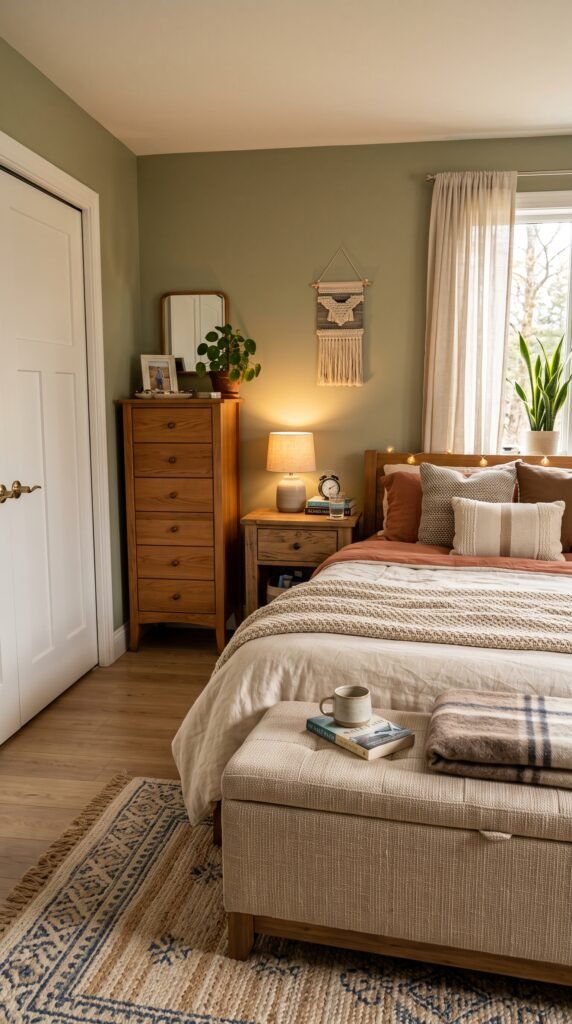
Furniture in a small bedroom needs to earn its place twice. Once for its primary function and once for storage.
Nightstands With Drawers or Shelves
A nightstand with one open shelf and one drawer holds significantly more than a tiny round side table or a stool. And in a small room, every surface counts twice.
Look for nightstands that go floor to shelf in one continuous piece. The open shelf below the drawer is useful for books, a water bottle, a small speaker. The drawer handles everything you want nearby but out of sight.
Ottomans That Open
The ottoman at the foot of a bed is one of the most justifiable purchases in a small bedroom because it functions as seating, a surface, and hidden storage all at once. Most storage ottomans hold the equivalent of one large bin worth of items. Extra blankets, pillows, out-of-season accessories.
If you already have a bench or ottoman at the foot of your bed that doesn’t open, consider whether it’s actually earning its footprint in the room. If not, swap it.
Tall Dressers Over Wide Ones
Wide, low dressers maximize horizontal footprint and sacrifice vertical space. Tall, narrow dressers do the opposite. In most small bedrooms, a 5 or 6 drawer tall dresser holds more than a 4-drawer wide one while taking up less floor space.
According to Apartment Therapy’s small space furniture guide, switching from a low wide dresser to a tall narrow one is one of the highest-impact single furniture changes for gaining usable floor space in a small room.
Small Bedroom Storage Ideas for Renters Who Can’t Touch the Walls
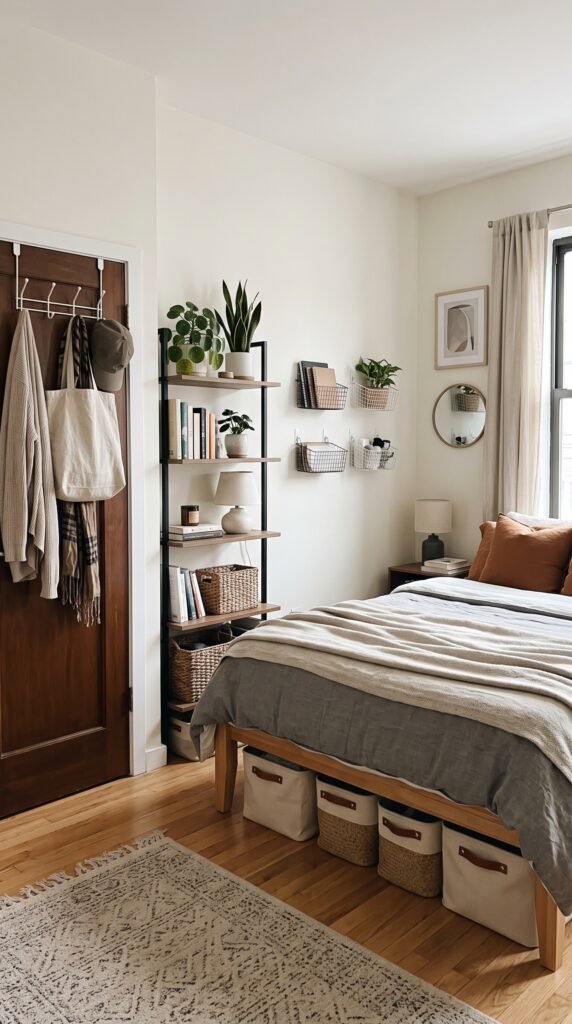
Renting changes the equation. You can’t always drill into walls or install permanent shelving. But the renter-friendly storage world has expanded a lot in the last five years.
Adhesive strips have gotten strong enough to hold real weight. Command-style strips now come in versions rated for 7.5 to 16 pounds per hook. That’s enough for a basket, a small organizer, or a row of hooks for bags and jackets along a wall.
Freestanding shelving units are another option entirely. A narrow freestanding shelf (often called a ladder shelf or a leaning shelf) sits against the wall without any mounting and holds a meaningful amount. The trade-off is stability — you want a unit with a low center of gravity or one that can lean flat against the wall to prevent tipping.
Over-door systems, as mentioned above, need zero installation. Same with bed risers, under-bed bins, and storage ottomans.
The mindset shift for renters: instead of asking “where can I install storage,” ask “what vertical surface am I not using yet.”
Most of the time, the answer is right in front of you.
The One Organizing Habit That Keeps Small Bedroom Storage Working
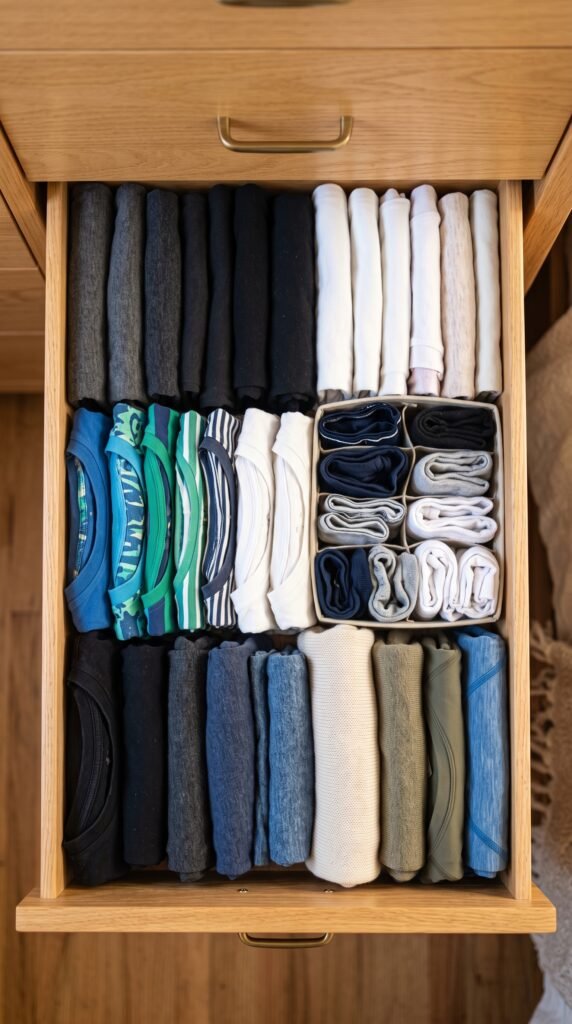
Systems are only as good as the habits that maintain them.
The most common reason small bedroom storage ideas stop working after a few months is that new things come in without old things going out. A new sweater arrives. It gets squeezed into an already full drawer. The drawer stops closing. Everything shifts.
The fix is simple. One in, one out. Every time something new comes into your bedroom — a piece of clothing, a book, a gadget — something else leaves. Not eventually. That same day.
It sounds rigid. But it’s actually what prevents the slow creep that turns an organized room back into a chaotic one within three to six months.
The Container Store’s organization research consistently shows that the most organized people aren’t those with the most storage solutions — they’re the ones with the least number of items overall.
More storage doesn’t create organization. Fewer things do.
That’s the lesson that most bedroom overhaul content skips entirely. You can add every shelf, bin, and hook in this article and still have a chaotic room if you’re not editing the volume of stuff that lives in it.
So start there. Before any purchase, do one editing pass through your bedroom. Be a little merciless. What hasn’t been touched in six months? What’s being stored “just in case”? What’s there out of guilt or habit rather than actual use?
Clear that out first. Then the small bedroom storage ideas in this article will actually stick.