
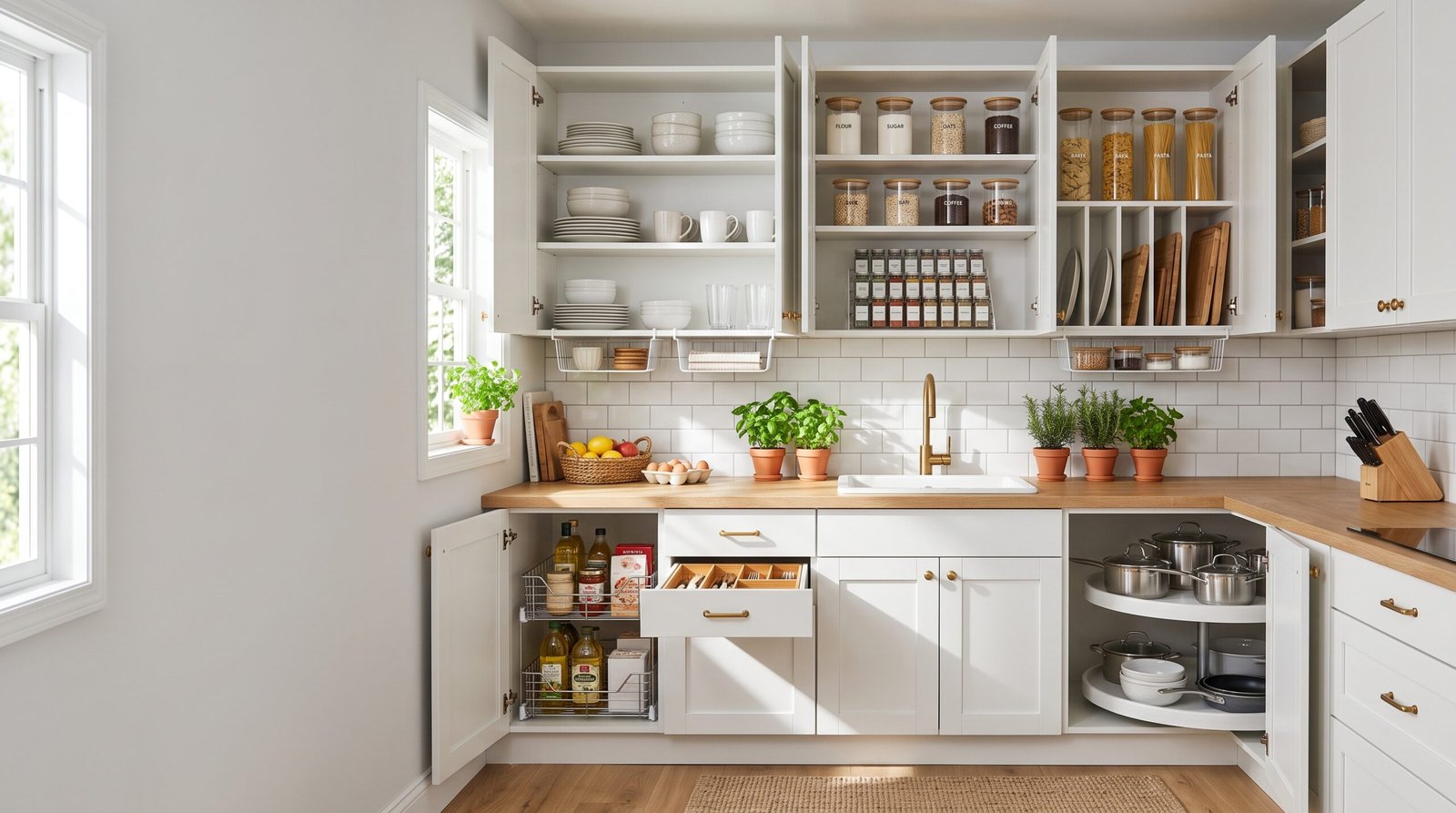
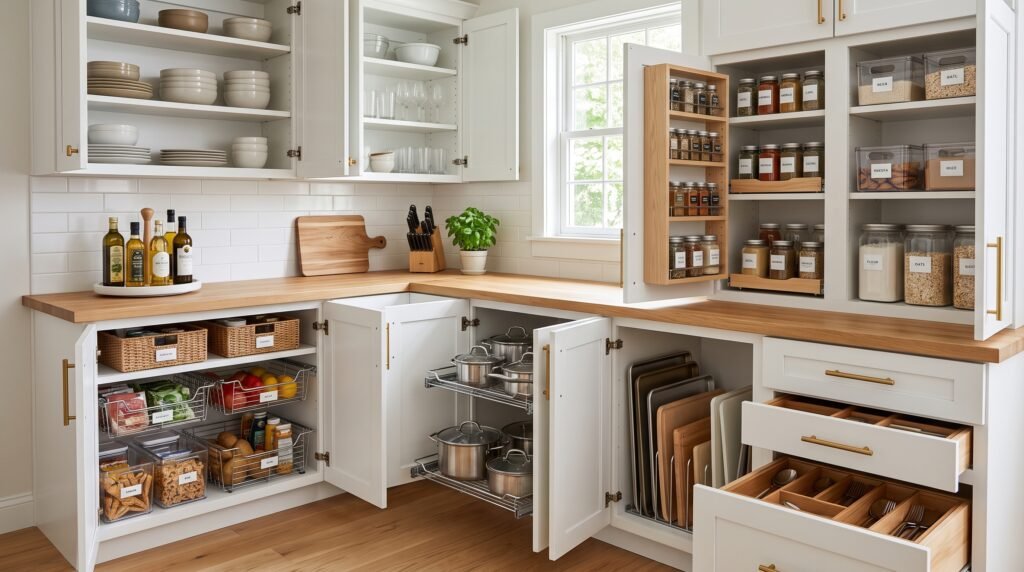
If you’ve ever opened a cabinet door only to have a cutting board avalanche onto your foot, you already know how desperately you need small kitchen cabinet organization ideas that actually work. Most people assume a cramped kitchen is a life sentence of clutter, but professional organizers see it differently — a small kitchen isn’t a problem to solve around, it’s a space to optimize with intention.
The Biggest Myths About Small Kitchen Cabinet Organization Ideas
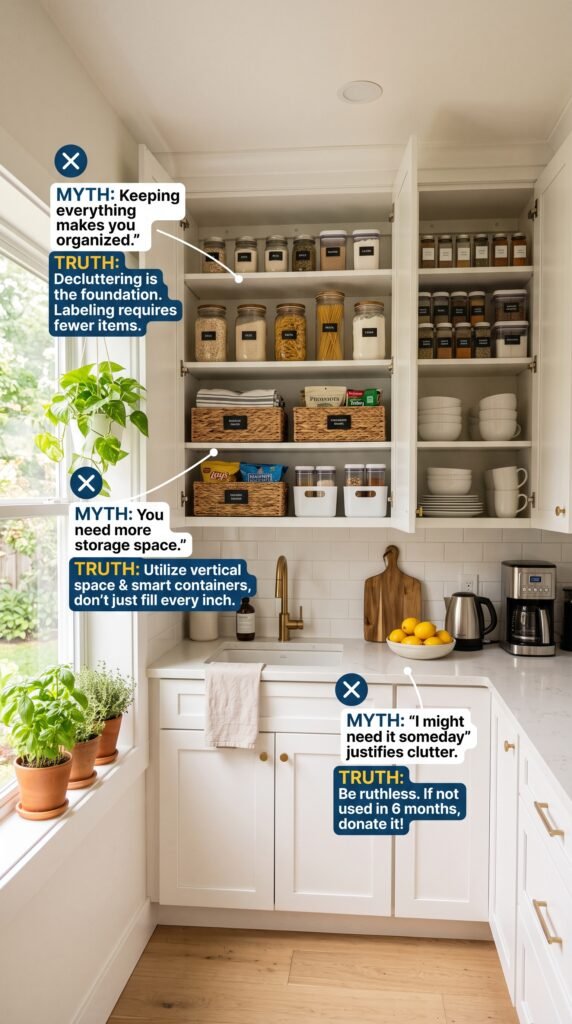
The first myth to dismantle is that you simply need more space. Professional organizers hear this constantly, and it’s almost never true. What most small kitchens need isn’t square footage — they need a system.
Myth #1: You need to buy more storage products first.
The reality is that buying bins and baskets before editing your belongings is one of the most common (and expensive) mistakes people make. Before a single organizer goes on a shelf, you need to know exactly what you’re keeping. Purchasing storage solutions without first purging means you’re organizing clutter, not eliminating it.
Myth #2: Deep cabinets are better than shallow ones.
Deep cabinets sound like a luxury, but they’re actually one of the most problematic features in a small kitchen. Items get pushed to the back and forgotten, expiration dates pass unnoticed, and retrieving anything requires excavating through layers of pots and pans. Shallow shelving with clear visibility often outperforms deep cabinets in functional terms.
Myth #3: Matching sets make a kitchen more organized.
Matching containers look satisfying in photos, but uniformity for its own sake can work against you. A mismatched collection of containers that fit your actual shelf dimensions and hold your actual food quantities will always outperform a beautiful set that wastes vertical space or leaves awkward gaps.
Myth #4: Small kitchens can’t store large items.
Oversized pots, stand mixers, and sheet pans intimidate people with small cabinets, but placement strategy changes everything. Vertical dividers for sheet pans, pull-out cabinet drawers for heavy appliances, and corner carousel systems for pots can accommodate large items in surprisingly tight spaces.
The Real Facts Behind Effective Small Kitchen Cabinet Organization Ideas
Let’s replace those myths with what professional organizers actually know to be true. These facts are backed by both ergonomic research and the practical experience of certified professional organizers who work in small kitchens every week.
Fact #1: The “Golden Zone” determines everything.
Ergonomics researchers and kitchen designers refer to the space between your hips and your shoulders as the Golden Zone. Items you use daily should live in this range — not on the lowest shelf, not on the highest one. When you map your cabinet contents around this principle, your kitchen becomes dramatically more functional without adding a single inch of storage.
Fact #2: Vertical space is almost always wasted.
The average kitchen cabinet has 12 to 16 inches of vertical space per shelf, but most items only occupy 4 to 8 inches of height. That gap above your cereal boxes or stacked plates is dead air. Stackable shelves, risers, and under-shelf baskets reclaim that vertical real estate and can effectively double your usable storage without any renovation.
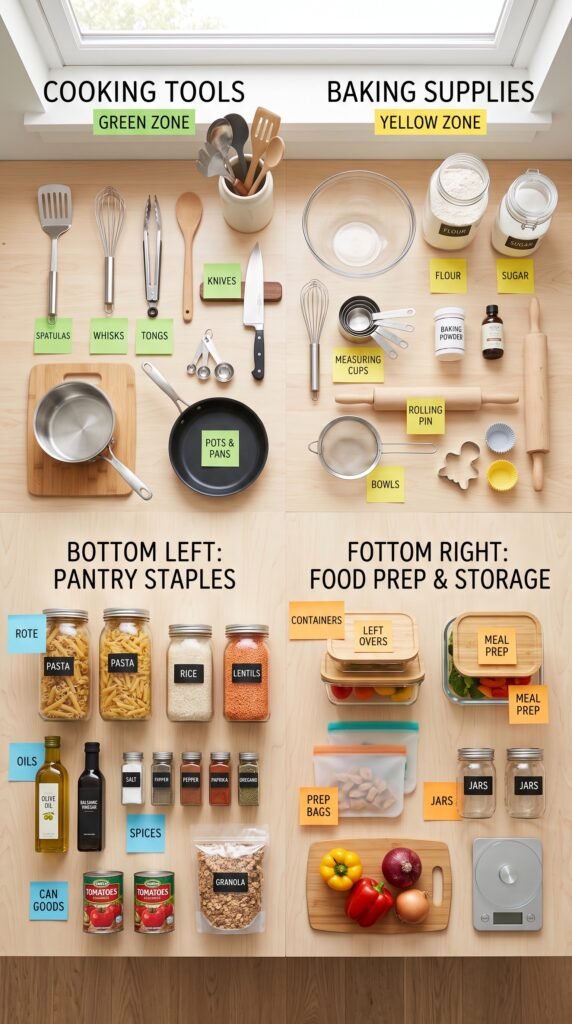
Fact #3: Zone-based organization reduces decision fatigue.
According to research on cognitive load and decision-making, the more decisions your brain has to make during routine tasks, the faster it fatigues. A zone-based kitchen — where baking supplies live in one cabinet, breakfast items in another, and cooking oils near the stove — means your brain operates on autopilot during meal prep. Professional organizers use this principle on every kitchen project they take on.
You can learn more about the psychology behind organizing systems at the National Association of Productivity and Organizing Professionals, which publishes research and resources on evidence-based organization strategies.
Fact #4: Turntables (lazy Susans) have a measurable ROI.
A corner cabinet without a turntable wastes an estimated 30 to 50 percent of its available space, according to kitchen design studies. Corner spaces are notoriously difficult to reach, but a two-tier lazy Susan transforms an inaccessible black hole into one of the most functional spots in the kitchen. The same principle applies to deep pantry-style cabinets — a turntable on any shelf makes everything visible and reachable.
Fact #5: Labels aren’t just aesthetic — they’re functional.
Labeling is often dismissed as a personality quirk of the hyper-organized, but it serves a critical maintenance function. When every family member or housemate can see where something belongs, items get returned to their correct location. Without labels, even a beautifully organized kitchen drifts back into chaos within weeks.
Expert Tips for Small Kitchen Cabinet Organization Ideas That Actually Last
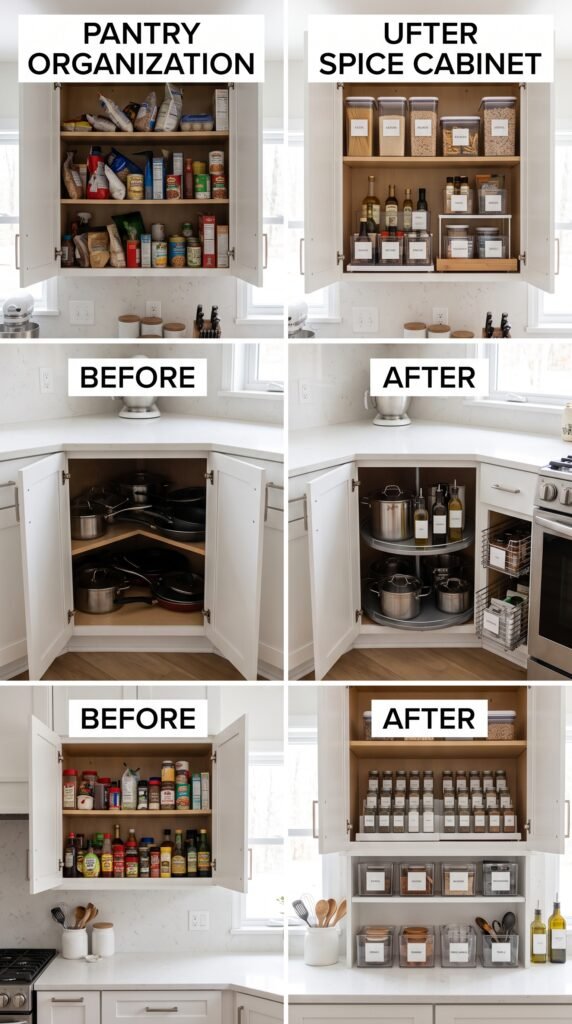
These are the strategies professional organizers return to on every small kitchen project. They’re not trendy hacks — they’re durable systems built on real organizational principles.
Audit Before You Organize
Before touching a single cabinet, empty everything out. Every item goes on the kitchen table or countertop, grouped by category. This audit step is non-negotiable for professional organizers because it reveals exactly how much you have, what you’ve forgotten about, and what genuinely has no place in your kitchen anymore.
Most people discover during this phase that they own three vegetable peelers, a collection of takeout chopsticks that spans the last decade, and at least one appliance they haven’t touched since moving in. None of those items deserve cabinet space.
Assign Every Item a “First Home”
This concept, popularized by professional organizing expert Marie Kondo and reinforced by most certified organizers, is deceptively simple: every item has one designated location, and it always returns there. When an item doesn’t have a first home, it drifts to the nearest flat surface and contributes to clutter.
Assigning a first home also forces you to make a real decision about whether an item belongs in the kitchen at all. The holiday serving platter you use twice a year doesn’t need prime Golden Zone real estate. It belongs in a high cabinet, a dining room buffet, or a labeled box in storage.
Use Door Space Aggressively
The inside of a cabinet door is one of the most underused surfaces in any kitchen. Over-the-door organizers, adhesive-mounted spice racks, and small hooks can hold an impressive volume of items — measuring cups, pot lids, aluminum foil boxes, cleaning supplies — without competing for shelf space. best cabinet door organizers for small kitchens | over the door kitchen storage
Most cabinet doors can support a surprisingly heavy load if the organizer is properly mounted. Look for products rated for at least 10 to 15 pounds if you plan to store more than lightweight spices.
Decant Pantry Items Into Uniform Containers
This is the single tip that generates the most visual transformation per dollar spent. Transferring pasta, rice, flour, sugar, and cereals from their original bulky packaging into uniform airtight containers does several things at once: it dramatically reduces the volume of packaging waste taking up shelf space, it makes quantities immediately visible at a glance, and it keeps food fresher longer.
The FDA’s food storage guidelines recommend airtight containers for pantry staples specifically because they reduce exposure to moisture, pests, and temperature fluctuations — so there’s a practical food safety argument for decanting, not just an aesthetic one.
Prioritize Pull-Out Drawers for Lower Cabinets
Lower cabinets are the most ergonomically challenging storage area in any kitchen. Bending down, reaching to the back, and stacking items deep into a cabinet floor makes contents nearly invisible and difficult to retrieve. Pull-out drawer inserts — which can be installed in existing lower cabinets without major renovation — convert static floor-level storage into accessible, highly visible drawers.
This is one of the highest-impact changes you can make for a small kitchen, particularly for pots, pans, and small appliances that tend to become buried. Several manufacturers offer slide-out cabinet organizers specifically designed to fit standard cabinet widths without requiring custom installation.
Stack Smartly, Not Just Vertically
Stacking is not the same as organizing. A tower of plates five high takes up no more floor space than a tower of plates three high, but it’s harder to access and more fragile. Professional organizers recommend using stackable shelf risers that create distinct visual levels within a cabinet, so every item sits on its own “shelf” without being buried beneath another.
This approach works exceptionally well for mugs, glasses, canned goods, and small containers. Pair it with a pull-forward habit — always pull the front item to the back and bring the back item to the front — to prevent anything from being forgotten.
Zone-by-Zone Breakdown of Small Kitchen Cabinet Organization Ideas
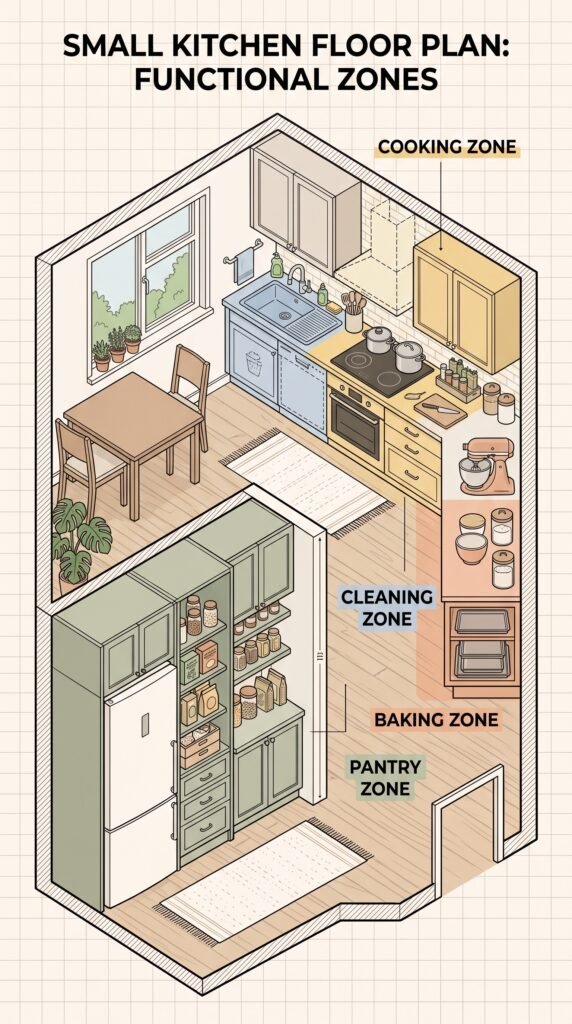
Applying zone logic to your specific cabinet layout is where the general principles above become a personalized system. Here’s how professional organizers typically assign zones in a small kitchen.
The Cooking Zone lives immediately around the stove and includes oils, spices, frequently used utensils, and the pots and pans you reach for most often. The cabinet directly above the stove (if accessible) is ideal for items used during active cooking.
The Prep Zone is typically near the main countertop workspace and holds cutting boards, mixing bowls, measuring cups and spoons, and tools like vegetable peelers and graters. This zone should be within arm’s reach of where you do most of your food prep work.
The Pantry Zone encompasses dry goods, canned items, oils and vinegars, and snacks. If you don’t have a dedicated pantry, one or two upper cabinets can be designated pantry-only. Uniformity matters here — consistent container heights allow for stacking and make label-reading at a glance much easier.
The Appliance Zone is often the most problematic area in a small kitchen because appliances are large, heavy, and used with varying frequency. The rule of thumb: appliances used daily stay on the countertop or in a highly accessible lower cabinet. Appliances used monthly or less get moved to the highest shelf or out of the kitchen entirely.
The Psychology and Science Behind Sustainable Small Kitchen Cabinet Organization Ideas
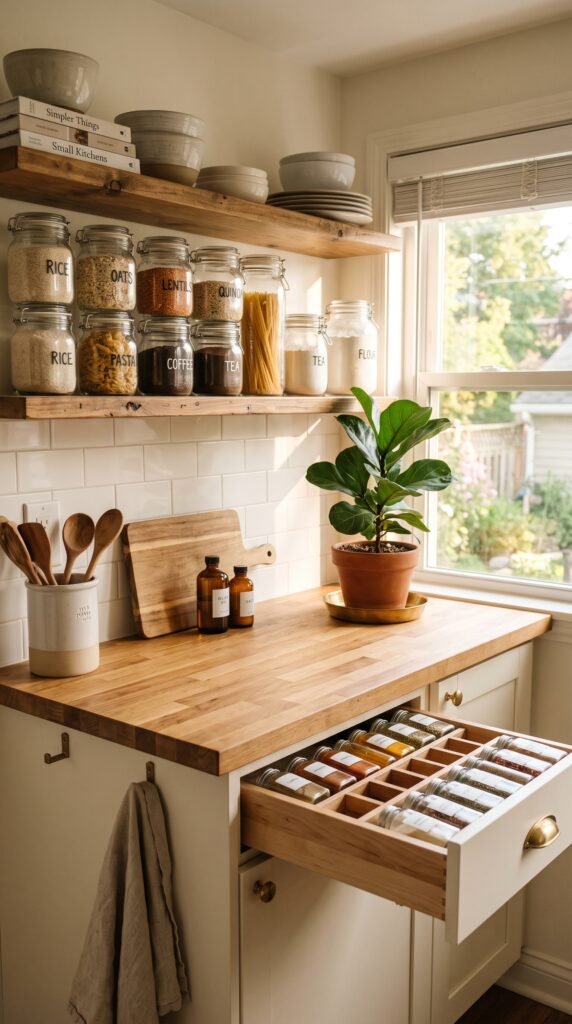
The reason most kitchen organization efforts fail isn’t a product problem — it’s a maintenance problem. Professional organizers are emphatic on this point: the most beautiful organizing system in the world fails if it isn’t designed to be maintained by the real humans who use it.
Sustainable organization has three properties: it’s easy to put things away, it’s easy to find things, and it’s immediately obvious when something is out of place. When a system requires effort to maintain, it will eventually be abandoned. When it’s easier to put something in its right place than to leave it out, the system maintains itself.
Research published by the American Psychological Association has found that cluttered home environments, including kitchens, are associated with elevated cortisol levels — the primary stress hormone. This means your kitchen organization isn’t just about convenience. It has a measurable impact on your daily stress levels.
Designing your small kitchen cabinet organization around this insight means every decision should reduce friction, not add to it. Lids should be stored immediately beside their containers. Frequently used spices should be visible without moving anything. Snacks should be at eye level, not buried behind pantry cans.
A Note on Maintenance Routines
The most successful small kitchen organization systems are supported by a brief weekly reset. Professional organizers typically recommend a 10-minute Sunday routine: wipe down shelves, pull items forward, return any strays to their first homes, and check pantry containers for items running low. This micro-maintenance prevents the gradual drift that turns a clean system into chaos over time.
Choosing Products That Support These Small Kitchen Cabinet Organization Ideas
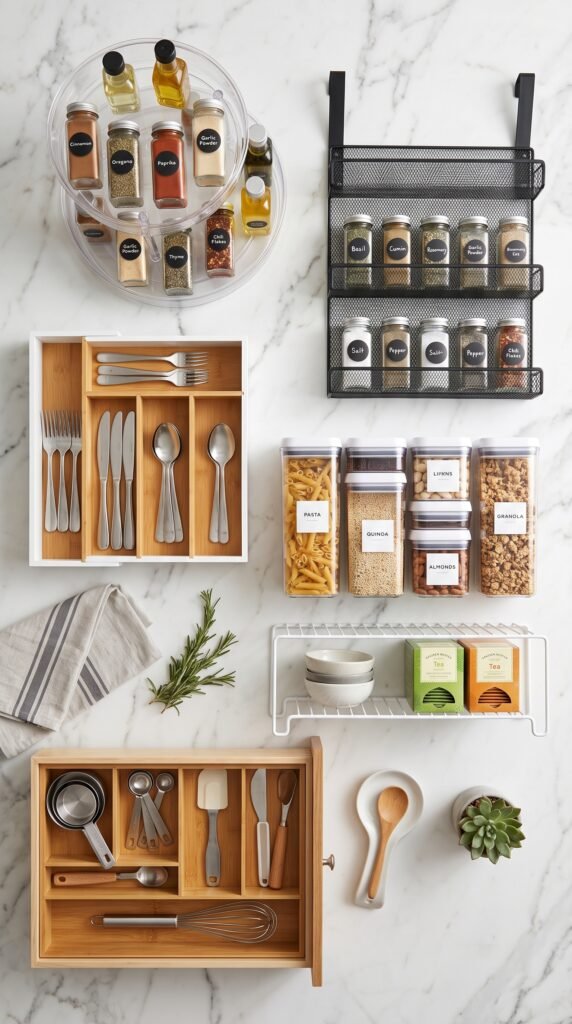
Not all organizing products are created equal, and the market is flooded with items designed more for the “after” photo than for real daily use. Here’s how professional organizers think about product selection for small kitchen cabinets.
Durability over aesthetics. A beautiful woven basket that warps when it gets wet or can’t be wiped clean is a poor investment for a kitchen. Prioritize washable, moisture-resistant materials — acrylic, BPA-free plastic, stainless steel, or coated wire.
Fit before function. Always measure your cabinets before purchasing any organizer. This seems obvious, but it’s the single most common mistake. A turntable that’s two inches too wide for a corner cabinet, a shelf riser that’s too tall for your middle shelf clearance, or a drawer insert that’s half an inch short of the cabinet depth — these fit issues make products useless and end up in the back of a closet.
Adjustability extends product life. Organizers with adjustable dividers, modular designs, or extendable widths adapt as your kitchen needs change. Fixed designs that only work for one exact use case require replacement every time your storage needs shift.
Transparency beats opacity. Clear containers and organizers consistently outperform opaque ones in kitchen settings because visibility reduces the “out of sight, out of mind” problem that leads to wasted food and forgotten items. When you can see exactly what you have, you use it.
Every small kitchen cabinet organization idea ultimately comes down to one core principle: design for the life you actually live, not the kitchen you wish you had. The cabinets you have right now, with the right system applied thoughtfully, are capable of holding everything you genuinely need — and releasing everything you don’t.